Author: scstechindia

  • 5 Common Pitfalls That Delay IT Project Delivery and How to Avoid Them

    5 Common Pitfalls That Delay IT Project Delivery and How to Avoid Them

    Ever wondered why so many IT projects run over time or exceed budgets? Even with talented teams and modern tools, delays are surprisingly common and the consequences can be costly. Late delivery can mean lost revenue, missed market opportunities, and frustrated stakeholders.

    The truth is, most IT project delays are predictable. For IT companies in Mumbai, understanding the common pitfalls and taking proactive steps can help keep projects on track, deliver value faster, and reduce stress for teams.

    Why IT Projects Get Delayed: An Overview

    Research shows that a significant share of IT and technology projects struggle with time and budget. In one analysis of 1,355 public-sector IT projects, the average project ran 24% longer than planned.

    According to a global BCG survey, nearly 50% of respondents reported that more than 30% of their organization’s tech projects are delayed or go over budget.

    For large-scale initiatives, even moderate overruns can result in millions in lost productivity or missed opportunities.

    Some key factors behind these delays include:

    • Unrealistic timelines – Setting targets without accounting for dependencies and complexity leads to bottlenecks.
    • Undefined roles and responsibilities – Teams spend time clarifying tasks instead of executing them.
    • Hidden risks – Technical debt, legacy systems, or vendor dependencies can slow progress if not anticipated.
    • Changing priorities – Shifting business needs or market pressures often force teams to rework completed tasks.

    By quantifying the impact of these issues, it becomes clear why proactive strategies are essential. Understanding these root causes is the first step to avoiding delays before they spiral out of control.
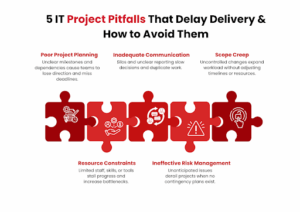
    Poor Project Planning

    Poor planning is one of the biggest reasons IT projects fall behind schedule. Without a clear roadmap, it’s easy for teams to lose direction, waste effort, and miss deadlines.

    Consider this: projects that lack structured planning and clear requirements are significantly more prone to time and cost overruns—for instance, 47% of failed projects cite inaccurate requirements as a root cause. Poor planning often shows up as:

    • Undefined milestones – Teams aren’t sure what to deliver and when.
    • No priority framework – Critical tasks get delayed because everything feels equally urgent.
    • Overlooked dependencies – A module that relies on another system may be delayed if the dependency isn’t accounted for.

    To avoid this pitfall, start by:

    1. Breaking the project into measurable phases – Assign clear objectives and deadlines for each phase.
    2. Identifying dependencies upfront – Map out internal and external connections that could affect delivery.
    3. Building buffer time – Account for testing, reviews, and potential issues instead of aiming for a “perfect” schedule.

    A solid plan doesn’t just keep you on schedule; it also reduces stress and improves team confidence, helping everyone focus on value rather than firefighting delays.

    Inadequate Communication

    Even the best-planned IT project can derail if communication breaks down. Teams may duplicate work, miss critical updates, or misinterpret requirements, all of which add delays and costs.

    Studies show that projects with poor communication are 50% more likely to miss deadlines. Common issues include:

    • Unclear reporting channels – Team members aren’t sure whom to update or where to find critical information.
    • Limited stakeholder engagement – Decisions are delayed because key stakeholders aren’t involved in discussions early enough.
    • Information silos – Different departments work in isolation, causing integration issues and rework.

    To keep communication effective:

    1. Set regular check-ins and updates – Weekly or bi-weekly status meetings ensure everyone is aligned.
    2. Define clear reporting channels – Specify how progress, issues, and decisions should be communicated.
    3. Leverage collaborative tools – Project management platforms, shared dashboards, and document repositories reduce confusion and ensure transparency.

    Strong communication doesn’t just prevent delays, it empowers your team to act quickly, make informed decisions, and maintain momentum throughout the project lifecycle.

    Scope Creep

    Scope creep occurs when project requirements expand beyond the original plan, often without adjusting timelines or resources. Even small changes can compound, causing significant delays and budget overruns.

    Studies of project management across industries show that scope creep significantly reduces the chances of project success, especially in more complex endeavors. 

    In practice, even modest unchecked additions to scope can add several weeks or months to a project timeline if not managed properly. Common triggers include:

    • Unclear requirements at the start – Teams may interpret objectives differently, leading to unplanned additions.
    • Stakeholder changes mid-project – New features or priorities are added without assessing the impact on delivery.
    • Poor change control – Requests for adjustments are implemented immediately rather than evaluated against the schedule and budget.

    To prevent scope creep:

    1. Define requirements clearly upfront – Document business needs, technical specs, and acceptance criteria before work begins.
    2. Establish a change management process – Evaluate every request for its impact on timelines, costs, and resources.
    3. Communicate trade-offs – Make stakeholders aware of the consequences of adding new features mid-project.

    By controlling scope, you keep the project focused, predictable, and easier to deliver on time, while still accommodating necessary improvements in a structured way.

    Resource Constraints

    Even a well-planned IT project can stall if your team lacks the right resources. Resource constraints aren’t just about staffing, they also include technology, budget, and skills.

    In a broad survey of global projects, 50% fail to deliver on time or budget, often because of resource constraints.

    For IT specifically, resource limitations (lack of staff, skill gaps, missing tools) frequently slow down delivery. Typical challenges include:

    • Understaffed teams – Critical tasks are delayed because there aren’t enough hands to handle the workload.
    • Skill gaps – Team members may lack expertise in specific technologies, requiring additional training or external support.
    • Limited budget or tools – Delays occur when essential software, hardware, or testing environments aren’t available on time.

    To address resource constraints:

    1. Assess resource needs early – Map out staffing, skills, and tools required for each project phase.
    2. Plan for contingencies – Have backup personnel or external partners ready to step in if needed.
    3. Prioritize budget allocations – Ensure critical areas, such as testing or infrastructure, aren’t underfunded.

    By proactively managing resources, you keep the project moving smoothly, prevent bottlenecks, and improve overall delivery confidence.

    Ineffective Risk Management

    Failing to identify and manage risks is a silent killer of IT project timelines. Unexpected technical issues, vendor delays, or regulatory changes can derail progress if they aren’t anticipated and mitigated.

    Statistics show that projects with poor risk management are 40% more likely to miss deadlines. Common risk-related issues include:

    • Unidentified dependencies – Critical systems or third-party services fail to deliver on time.
    • Lack of contingency planning – Teams scramble when unexpected problems arise, causing delays.
    • Reactive approach – Risks are addressed only after they occur, rather than being proactively mitigated.

    To avoid these pitfalls:

    1. Conduct a thorough risk assessment – Identify potential technical, operational, and external risks before the project starts.
    2. Prioritize risks by impact – Focus on high-probability and high-impact risks first.
    3. Develop mitigation strategies – Have backup plans, resource allocations, and escalation procedures in place.

    Effective risk management ensures that surprises don’t derail your timeline, allowing your team to stay on track even when challenges arise.

    Actionable Takeaways

    Delays in IT projects don’t have to be inevitable. For IT companies in Mumbai, addressing the five common pitfalls: poor planning, inadequate communication, scope creep, resource constraints, and ineffective risk management can keep projects on schedule, reduce costs, and deliver measurable business value.

    To recap actionable steps:

    1. Plan meticulously – Break projects into clear phases, account for dependencies, and build buffer time.
    2. Communicate effectively – Set reporting channels, hold regular updates, and use collaborative tools.
    3. Control scope – Define requirements clearly and manage changes with a structured process.
    4. Manage resources smartly – Assess staffing, skill sets, and tools upfront, and plan contingencies.
    5. Mitigate risks proactively – Identify, prioritize, and plan for potential challenges before they become roadblocks.

    At SCSTech, we specialize in guiding organizations through complex IT projects with precision and expertise. Our team helps you plan strategically, streamline execution, and anticipate challenges so that your projects are delivered on time and within budget.

    Contact SCSTech today to partner with experts who can turn your IT initiatives into predictable, successful outcomes.

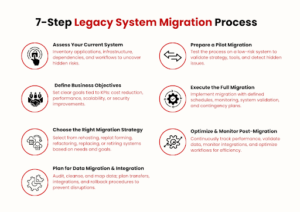
  • The 7-Step Process to Migrate Legacy Systems Without Disrupting Operations

    The 7-Step Process to Migrate Legacy Systems Without Disrupting Operations

    Are your legacy systems holding your business back? Outdated applications, slow performance, cybersecurity vulnerabilities, and complex integrations can silently drain productivity and increase operational risks. In fact, only 46 % of data migration projects finish on schedule—and just 36 % remain within budget, highlighting how easily such transitions derail.

    Migrating to modern platforms promises efficiency, scalability, and security, but the process can feel daunting.

    The good news is, with a structured approach, you don’t have to gamble with downtime or data loss. In this guide, we’ll walk you through a 7-step process to migrate your legacy systems safely and effectively, helping you maintain business continuity while upgrading your IT environment.

    Step 1 – Assess Your Current System

    Before you even think about migration, you need a complete understanding of your current IT environment. This means going beyond a surface check. Start by identifying:

    • Applications in use – Which ones are business-critical, and which can be retired or replaced?
    • Infrastructure setup – Servers, databases, integrations, and how they connect.
    • Dependencies and workflows – How different systems rely on each other, including third-party tools.

    A clear system assessment helps you uncover hidden risks. For example, you may find that an old payroll module depends on a database that isn’t compatible with modern cloud platforms. If you skip this stage, such issues can cause downtime later.

    To keep this manageable, create an inventory report that maps out all systems, users, and dependencies. This document becomes your baseline reference for planning the rest of the migration.

    Step 2 – Define Business Objectives for Migration

    Once you know what you’re working with, the next step is to define why you’re migrating in the first place. Without clear objectives, even the best technical plan can go off-track.

    Start by asking:

    1. What outcomes do we want? – Is the goal to cut infrastructure costs, improve system performance, enable scalability, or strengthen security?
    2. Which processes need improvement? – For example, faster reporting for finance, better uptime for customer-facing apps, or smoother integrations for supply chain systems.
    3. What risks must we minimize? – Think compliance, downtime, and data loss.

    Document these goals and tie them directly to business KPIs. For instance, if your objective is to reduce operational costs, you might target a 25% drop in IT spend over the next two years. If it’s about performance, you may aim for response times under one second for customer transactions. For example, organizations pursuing modernization commonly realize cost savings of 13 % to 18 % as inefficiencies, architectural debt, and maintenance overhead are reduced.

    This clarity ensures that every decision, from choosing the migration strategy to monitoring post-migration performance, is aligned with measurable business value.

    Step 3 – Choose the Right Migration Strategy

    With your current system assessed and objectives defined, it’s time to select the migration strategy that best fits your business. There’s no one-size-fits-all approach, the right choice depends on your legacy setup, budget, and long-term goals.

    The most common strategies include:

    1. Rehosting (“Lift and Shift”) – Move applications as they are, with minimal changes. This is often the fastest route but may not unlock the full benefits of modernization.
    2. Replatforming – Make limited adjustments (like moving databases to managed services) without a full rewrite. This balances speed and optimization.
    3. Refactoring/Re-architecting – Redesign applications to fully leverage cloud-native capabilities. This option is resource-heavy but future-proofs your system.
    4. Replacing – Retire outdated applications and replace them with new SaaS or off-the-shelf solutions.
    5. Retiring – Eliminate redundant systems that no longer add value.

    To decide, weigh factors such as:

    • Compatibility with existing workflows
    • Projected costs vs. long-term savings
    • Security and compliance needs
    • User adoption and training requirements

    By matching the strategy to your business objectives, you avoid unnecessary complexity and ensure the migration delivers real value, not just a technical upgrade.

    Step 4 – Plan for Data Migration and Integration

    Data is at the core of any legacy system, and moving it safely is often the most challenging part of migration. If you don’t plan this step carefully, you risk losing critical information or facing inconsistencies that disrupt business operations.

    Start with a data audit. Identify what data is relevant, what can be archived, and what needs cleansing before migration. Outdated, duplicated, or corrupted records only add complexity; cleaning them now prevents issues later.

    Next, map out data dependencies. For example, if your HR system pulls employee data from a central database that also serves payroll, both need to move in sync. Skipping this detail can break processes that employees rely on daily.

    For integration, establish how your new environment will interact with:

    • Existing applications that won’t migrate immediately
    • Third-party tools used by different teams
    • APIs and middleware that handle real-time transactions

    Finally, decide on a migration method:

    • Big Bang – Move all data in one go, usually over a planned downtime window.
    • Phased – Transfer data in stages to minimize disruption.

    Whichever you choose, always back it up with a rollback plan. If something goes wrong, you need a reliable way to restore systems without losing business continuity.

    Step 5 – Prepare a Pilot Migration

    Jumping straight into a full migration is risky. A pilot migration helps you test your approach in a controlled environment before scaling it across the entire organization.

    Here’s how to structure it:

    1. Select a low-risk system or module – Choose something non-critical but still representative of your larger environment. For example, a reporting tool or internal dashboard.
    2. Replicate the migration process – Apply the same steps you plan for the full migration, including data transfer, integration, and security checks.
    3. Measure outcomes against your objectives – Look at performance benchmarks, system compatibility, user experience, and downtime. Did the pilot meet the KPIs you defined in Step 2?
    4. Identify issues early – This stage is where hidden dependencies, data integrity gaps, or integration failures usually show up. Catching them now avoids major disruptions later.

    A pilot isn’t just a “test run”, it’s a validation exercise. It gives your team the confidence that the chosen strategy, tools, and processes will scale effectively when it’s time for the real migration.

    Step 6 – Execute the Full Migration

    With lessons learned from the pilot, you’re ready to carry out the full migration. This step requires tight coordination between IT teams, business units, and external partners to ensure minimal disruption.

    A strong execution plan should cover:

    1. Timeline and scheduling – Define clear migration windows, ideally during off-peak hours, to reduce impact on daily operations.
    2. Communication plan – Keep stakeholders and end-users informed about expected downtime, system changes, and fallback options.
    3. Data transfer process – Use the validated method (big bang or phased) from Step 4, ensuring continuous monitoring for errors or mismatches.
    4. System validation – Run functional and performance tests immediately after each migration batch. Confirm that applications, integrations, and security policies work as expected.
    5. Contingency measures – Have a rollback procedure and dedicated support team on standby in case critical issues arise.

    Remember, success here isn’t just about “moving everything over.” It’s about doing it with zero data loss, minimal downtime, and full business continuity. If executed properly, users should notice improvements rather than disruptions.

    Step 7 – Optimize and Monitor Post-Migration

    The migration itself is only half the journey. Once your systems live in the new environment, continuous monitoring and optimization are crucial to realize the full benefits.

    Start by:

    1. Tracking performance metrics – Measure application response times, system uptime, transaction success rates, and other KPIs defined in Step 2.
    2. Validating data integrity – Ensure all records migrated correctly, with no missing or corrupted entries.
    3. Monitoring integrations – Confirm that workflows across connected systems operate seamlessly.
    4. Collecting user feedback – Users often spot issues that automated monitoring misses. Document their experience to identify friction points.

    After initial validation, focus on optimization:

    • Fine-tune configurations to improve performance.
    • Automate routine tasks where possible.
    • Plan periodic audits to maintain compliance and security.

    Continuous monitoring helps you proactively address issues before they escalate, ensuring your migrated systems are not just functional, but efficient, reliable, and scalable for future business needs.

    Conclusion

    As companies increasingly modernize, 76 % of organizations are now actively engaged in legacy system modernization initiatives, underlining how mainstream this challenge has become.

    With the right digital transformation solutions, from assessing your current environment to optimizing post-migration performance, each stage ensures your systems stay reliable while unlocking efficiency, scalability, and security.

    At SCSTech, we specialize in guiding businesses through complex migrations with minimal risk. Our experts can help you choose the right strategy, manage data integrity, and monitor performance so you get measurable results. Contact our team today to discuss a migration plan tailored to your business objectives.

  • Cybersecurity Measures for Smart Grid Infrastructure with Custom Cybersecurity Solutions

    Cybersecurity Measures for Smart Grid Infrastructure with Custom Cybersecurity Solutions

    Smart grids are no longer future tech. They’re already running in many cities, silently balancing demand, managing renewable inputs, and automating fault recovery. But as this infrastructure gets smarter, it also becomes more exposed. Custom cybersecurity solutions are now essential to defend these networks. Cyber attackers are targeting data centers, probing energy infrastructure for weak entry points. A misconfigured substation, an unpatched smart meter, or a compromised third-party module can shut off power.

    In this article, you’ll find a clear breakdown of the real risks today’s grids face, and the specific cybersecurity layers that need to be in place before digital operations go live.

    Why Smart Grids Are Becoming a Target for Cyber Threats

    The move to smart grids brings real-time energy control, dynamic load balancing, and cost savings. But it also exposes utilities to threats they weren’t built to defend against. Here’s why smart grids are now a prime target:


    • The attack surface has multiplied. Each smart meter, sensor, and control point is a potential entry. Smart grids can involve millions of endpoints, and attackers only need one weak link.
    • Legacy systems are still in play. Many control centers still run SCADA systems using outdated protocols like Modbus or DNP3, often without encryption or proper authentication layers. These weren’t designed with cybersecurity in mind, just reliability.
    • Energy infrastructure is an impact target of high value. Compromises to energy grids have more than just outages; they can shut down hospitals, water treatment, and emergency services. That makes them a go-to for politically driven or state-sponsored attackers.
    • Malware is becoming more intelligent. Incidents such as Industroyer and TRITON have demonstrated how intelligent malware can be used to hack controls of breakers or shut down safety systems, without evading traditional perimeter security.

    Top Cybersecurity Risks Facing Smart Grid Infrastructure

    Even well-funded utilities are struggling to stay ahead of cyber threats. Below are the primary risk categories that demand immediate attention in any smart grid environment:

    • Unauthorized access to control systems: Weak credentials or remote access tools expose SCADA and substation systems to intruders.
    • Data tampering or theft: Latent attacks on sensor or control signal data can mislead operators and disrupt grid stability.
    • Malware for SCADA and ICS: Malicious code such as Industroyer can result in operational outages or unrecoverable equipment damage.
    • Denial of Service (DoS) attacks: DoS attacks of high volume or of a protocol nature can impede critical communications in grid monitoring or control systems
    • Supply chain vulnerabilities in grid components: Malware-infected or hardware-compromised firmware from suppliers may breach trust prior to systems being made live

    Key Cybersecurity Measures to Secure Smart Grids

    Smart grid cybersecurity is an architecture of policy, protocols, and technology layers across the entire system. The following are the most important actions utilities and municipal planners must take into account when upgrading grid infrastructure:

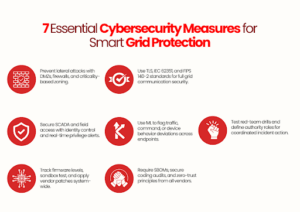
    1. Network Segmentation

    IT (corporate) and OT (operational) systems must be fully segregated. If one segment gets hacked, others remain functional.

    • Control centers must not have open network paths in common with smart meters or field sensors.
    • Implement DMZs (Demilitarized Zones) and internal firewalls to block lateral movement.
    • Zone according to system criticality, not ease of access.

    2. Encryption Protocols

    Grid data needs encryption both in transit and at rest.

    • For legacy protocols (like Modbus/DNP3), wrap them with TLS tunnels or replace them with secure variants (e.g., IEC 62351).
    • Secure all remote telemetry, command, and firmware update channels.
    • Apply FIPS 140-2 validated algorithms for compliance and reliability.

    3. Multi-Factor Authentication & Identity Control

    Weak or default credentials are still a leading breach point.

    • Apply role-based access control (RBAC) for all users.
    • Enforce MFA for operators, field technicians, and vendors accessing SCADA or substation devices.
    • Monitor for unauthorized privilege escalations in real time.

    This is especially vital when remote maintenance or diagnostics is allowed through public networks.

    4. AI-Based Intrusion Detection

    Static rule-based firewalls are no longer enough.

    Deploy machine learning models trained to detect anomalies in:

    • Grid traffic patterns
    • Operator command sequences
    • Device behavior baselines

    AI can identify subtle irregularities that humans and static logs may miss, especially across distributed networks with thousands of endpoints.

    5. Regular Patching and Firmware Updates

    Firmware without patches in smart meters, routers, or remote terminal units (RTUs) can become silent attack points.

    Continue patching on a strict timeline:

    • Take inventory of all field and control equipment, including firmware levels.
    • Test patches in sandboxed testing before grid-wide deployment.
    • Establish automated patch policies where feasible, particularly for third-party IoT subcomponents.

    6. Third-Party Risk Management

    Your network is only as strong as its weakest vendor.

    • Audit the secure coding and code-signing practices of supplier development.
    • Enforce SBOMs (Software Bills of Materials) to monitor embedded dependencies.
    • Confirm vendors implement zero-trust principles into device and firmware design.

    7. Incident Response Planning

    Detection alone won’t protect you without a tested response plan.

    At a minimum:

    • Define escalation protocols for cyber events that affect load, control, or customer systems.
    • Run red-team or tabletop exercises quarterly.
    • Appoint a cross-functional team (cybersecurity, ops, legal, comms) with clear authority to act during live incidents.

    These measures only work when applied consistently across hardware, software, and people. For cities and utilities moving toward digitalized infrastructure, building security in from the beginning is no longer a choice; it’s a requirement.

    What Urban Energy Planners Should Consider Before Grid Digitization

    Smart grid digitization is a strategic transformation that alters the way energy is provided, monitored, and protected. Urban planners, utility boards, and policymakers need to think beyond infrastructure and pose this question: Is the system prepared to mitigate new digital threats from day one?

    This is what needs to be on the table prior to mass rollout:

    • Risk Assessment First: Perform a complete inventory of current OT and IT systems. Determine what legacy components are unable to support contemporary encryption, remote access control, or patch automation.
    • Vendor Accountability: Make each vendor or integrator involved in grid modernization possess demonstrated security protocols, patch policies, and zero-trust infrastructure by design.
    • Interoperability Standards: Don’t digitize in isolation. Make sure new digital components (like smart meters or grid-edge devices) can securely communicate with central SCADA systems using standardized protocols.
    • Legal and Regulatory Alignment: Local, state, or national compliance frameworks (like NCIIPC, CERT-In, or IEC 62443) must be factored into system design from day one.

    Conclusion

    Cyberattacks on smart grids are already testing vulnerabilities in aging infrastructure in cities. And protecting these grids isn’t a matter of plugging things in. It takes highly integrated systems and custom cybersecurity solutions that can grow with the threat environment. That’s where SCS Tech comes in. We assist energy vendors, system integrators, and city tech groups with AI-infused development services tailored to critical infrastructure. If you’re building the next phase of digital grid operations, start with security.

    That’s where SCS Tech comes in.

    We assist energy vendors, system integrators, and city tech groups with AI-infused development services tailored to critical infrastructure.

    If you’re building the next phase of digital grid operations, start with security.

    FAQs 

    1. How do I assess if my current grid infrastructure is ready for smart cybersecurity upgrades?

    Begin with a gap analysis through your OT (Operational Technology) and IT layers. See what legacy elements are missing encryption, patching, and segmentation. From there, walk through your third-party dependencies and access points; those tend to be the weakest links.

    2. We already have firewalls and VPNs. Why isn’t that enough for securing a smart grid?

    Firewalls and VPNs are fundamental perimeter protections. Smart grids require stronger controls, such as segmentation in real time, anomaly detection, authentication at the device level, secure firmware pipelines that are secure, and so on. Most grid attacks originate within the network or from trusted vendors.

    3. How can we test if our grid’s cybersecurity plan will actually work during an attack?

    Conduct red-team or tabletop training simulations with technical and non-technical teams participating. These simulations reveal escalation, detection, or decision-making breakdowns far better found in practice runs than in actual incidents.

  • AI-Powered Public Health Surveillance Systems with AI/ML Service

    AI-Powered Public Health Surveillance Systems with AI/ML Service

    Public health surveillance has always depended on delayed reporting, fragmented systems, and reactive measures. AI/ML service changes that structure entirely. Today, machine learning models can detect abnormal patterns in clinical data, media signals, and mobility trends, often before traditional systems register a threat. But building such systems means understanding how AI handles fragmented inputs, scales across regions, and turns signals into decisions.

    This article maps out what that architecture looks like and how it’s already being used in real-world health systems.

    What Is an AI-Powered Public Health Surveillance System?

    An AI-powered public health surveillance system continuously monitors, detects, and analyzes signals of disease-related events in real-time, before these events contaminate the overall population.

    It does this by combining large amounts of data from multiple sources, including hospital records, laboratory results, emergency department visits, prescription trends, media articles, travel logs, and even social media content. AI/ML service models trained to identify patterns and anomalies scan these inputs constantly to flag signs of unusual health activity.

    How AI Tracks Public Health Risks Before They Escalate

    AI surveillance doesn’t just collect data; it actively interprets, compares, and predicts. Here’s how these systems identify early health threats before they’re officially recognized.

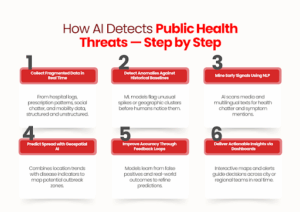
    1. It starts with signals from fragmented data

    AI surveillance pulls in structured and unstructured inputs from numerous real-time sources: 

    • Syndromic surveillance reports (i.e., fever, cough, and respiratory symptoms)
    • Hospitalizations, electronic health records, and lab test trends
    • News articles, press wires, and social media mentions
    • Prescription spikes for specific medications
    • Mobility data (to track potential spread patterns)

    These are often weak signals, but AI picks up subtle shifts that human analysts might miss.

    2. Pattern recognition models flag anomalies early

    AI systems compare incoming data to historical baselines.

    Once the system detects unusual increases or deviations (e.g., a sudden surge in flu-like symptoms in a given location), it creates an internal alert for the performance monitoring system.

    For example, BlueDot flagged the COVID-19 cluster in Wuhan by observing abnormal cases of pneumonia in local news articles before any warnings emerged from other global sources.

    3. Natural Language Processing (NLP) mines early outbreak chatter

    AI reads through open-source texts in multiple languages to identify keywords, symptom mentions, and health incidents, even in informal or localized formats.

    4. Geospatial AI models predict where a disease may move next

    By combining infection trends with travel data and population movement, AI can forecast which regions are at risk days before cases appear.

    How it helps: Public health teams can pre-position resources and activate responses in advance.

    5. Machine learning models improve with feedback

    Each time an outbreak is confirmed or ruled out, the system learns.

    • False positives are reduced
    • High-risk variables are weighted better
    • Local context gets added into future predictions

    This self-learning loop keeps the system sharp, even in rapidly changing conditions.

    6. Dashboards convert data into early warning signals

    The end result is a structured insight for decision-makers.

    Dashboards visualize risk zones, suggest intervention priorities, and allow for live monitoring across regions.

    Key Components Behind a Public Health AI System

    AI-powered surveillance relies on a coordinated system of tools and frameworks, not just one algorithm or platform. Every element has a distinct function in converting unprocessed data into early detection.

    1. Machine Learning + Anomaly Detection

    Tracks abnormal trends across millions of real-time data points (clinical, demographic, syndromic).

    • Used in: India’s National Public Health Monitoring System
    • Speed: Flagged unusual patterns 54× faster than traditional frameworks

    2. Hybrid AI Interfaces

    Designed for lab and frontline health workers to enhance data quality and reduce diagnostic errors.

    • Example: Antibiogo, an AI tool that helps technicians interpret antibiotic resistance results
    • Connected to: Global platforms like WHONET

    3. Epidemiological Modeling

    Estimates the spread, intensity, or incidence of diseases over time using historical data.

    • Use case: France used ML to estimate annual diabetes rates from administrative health records
    • Value: Allows for non-communicable disease surveillance, not only outbreak detection

    Together, these elements create a surveillance system able to record, interpret, and respond to real-time health threats, quickly and more correctly than ever before by manual means.

    How Cities and Health Bodies Are Using AI Surveillance in the Real World

    AI-powered public health surveillance is already being applied in focused contexts, by cities, health departments, and evidence-based programs to identify threats sooner and respond with exactness.

    The following are three real-world examples that illustrate how AI isn’t simply reviewing data; it’s optimizing frontline response.

    1. Identifying TB Earlier in Disadvantaged Populations

    In Nagpur, where TB is still a high-burden disease, mobile vans with AI-powered chest X-ray diagnostics are being deployed in slum communities and high-risk populations.

    These devices screen automatically, identifying probable TB cases for speedy follow-up, even where on-site radiologists are unavailable.

    Why it matters: Rather than waiting for patients to show up, AI is assisting cities in taking the problem to them and detecting it earlier.

    2. Screening for Heart Disease at Scale

    The state’s RHD “Roko” campaign uses AI-assisted digital stethoscopes and mobile echo devices to screen schoolchildren for early signs of rheumatic heart disease. This data is centrally collected and analyzed, helping detect asymptomatic cases that would otherwise go unnoticed.

    Why it matters: This isn’t just a diagnosis; it’s preventive surveillance at the population level, made possible by AI’s speed and consistency.

    3. Predicting COVID Hotspots with Mobility Data

    During the COVID-19 outbreak, Valencia’s regional government used anonymized mobile phone data, layered with AI models, to track likely hotspots and forecast infection surges.

    Why it matters: This lets public health teams move ahead of the curve, allocating resources and shaping containment policies based on forecasts, not lagging case numbers.

    Each example shows slightly different application diagnostics, early screening, and outbreak modeling, but all point to one outcome: AI gives health systems the speed and visibility they need to act before things spiral.

    Conclusion

    AI/ML service systems are already proving their role in early disease detection and real-time public health monitoring. But making them work at scale, across fragmented data streams, legacy infrastructure, and local constraints requires more than just models.

    It takes development teams who understand how to translate epidemiological goals into robust, adaptable AI platforms.

    That’s where SCS Tech fits in. We work with organizations building next-gen surveillance systems, supporting them with AI architecture, data engineering, and deployment-ready development. If you’re building in this space, we help you make it operational. Let’s talk!

    FAQs

    1. Can AI systems work reliably with incomplete or inconsistent health data?

    Yes, as long as your architecture accounts for it. Most AI surveillance platforms today are designed with missing-data tolerance and can flag uncertainty levels in predictions. But to make them actionable, you’ll need a robust pre-processing pipeline and integration logic built around your local data reality.

    2. How do you handle privacy when pulling data from public and health systems?

    You don’t need to compromise on privacy to gain insight. AI platforms can operate on anonymized, aggregated datasets. With proper data governance and edge processing where needed, you can maintain compliance while still generating high-value surveillance outputs.

    3. What’s the minimum infrastructure needed to start building an AI public health system?

    You don’t need a national network to begin. A regional deployment with access to structured clinical data and basic NLP pipelines is enough to pilot. Once your model starts showing signal reliability, you can scale modularly, both horizontally and vertically.

  • IoT-Based Environmental Monitoring for Urban Planning and Oil and Gas Industry Consulting

    IoT-Based Environmental Monitoring for Urban Planning and Oil and Gas Industry Consulting

    Cities don’t need more data. They need the appropriate data, at the appropriate time, in the appropriate place. Enter IoT-based environmental monitoring. From tracking air quality at street level to predicting floods before they hit, cities are using sensor networks to make urban planning more precise, more responsive, and evidence based. This approach is also applied in oil and gas industry consulting to optimize operations and mitigate risks.

    In this section, we talk about how to design this situation, where it already is, and how planning teams and solution providers can begin designing a smarter system from the ground up.

    IoT-Based Environmental Monitoring: What Is It?

    IoT-based environmental monitoring, utilizing networked sensors, is utilized to measure environmental phenomena in real time. While originally scoped to focus on larger urban systems such as urban economic development, construction, noise, or traffic, it can also document the condition of the urban environment (e.g., tracking temperature, noise, water, and air quality) simultaneously across a city. Similar sensor-driven approaches are increasingly valuable in oil and gas industry consulting to enhance safety, efficiency, and predictive maintenance.

    These sensors can be attached to steeples or buildings, visibility from vehicles, or new towers built specifically for dispersion of data collection, and their data continues to be collected continuously through the wireless networks to monitor real-time changes, such as pollution increases, temperature spikes, moisture increases, etc. They populate database(s) amassed in collected patterns, cleaned, processed, and available via dashboards from either a cloud service or edge processing resource.

    Key IoT Technologies Behind Smart Environmental Monitoring


    Smart environmental monitoring is predicated on a highly integrated stack of hardware, connectivity, and processing technologies that have all been optimized to read and act on environmental data in real-time.

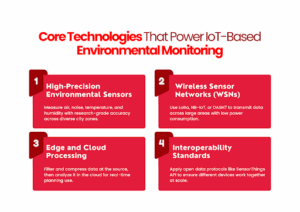
    1. High-Precision Environmental Sensors

    Sensors calibrated for urban deployments measure variables like PM2.5, NO₂, CO₂, temperature, humidity, and noise levels. Many are low-cost yet capable of research-grade accuracy when deployed and maintained correctly. They are compact, power-efficient, and suitable for long-term operation in varied weather conditions.

    2. Wireless Sensor Networks (WSNs)

    Data from these sensors travels via low-power, wide-area networks such as LoRa, DASH7, or NB-IoT. These protocols enable dense, city-wide coverage with minimal energy use, even in areas with weak connectivity infrastructure.

    3. Edge and Cloud Processing

    Edge devices conduct initial filtering and compression of data close to the point of origin to minimize loads for transmission. Data is processed and forwarded to cloud platforms for more thorough analysis, storage, and incorporation into planning teams’ or emergency response units’ dashboards.

    4. Interoperability Standards

    To manage data from multi-vendor sensors, standards such as OGC SensorThings API make various sensor types communicate in a common language. This enables scalable integration into larger urban data environments.

    These core technologies work together to deliver continuous, reliable environmental insights, making them foundational tools for modern urban planning.

    Real-World Use Cases: How Cities Are Using IoT to Monitor Environments

    Cities from around India and indeed the world are already employing IoT-based solutions to address actual planning issues. What’s remarkable, however, is not the technology in itself, it’s how cities are leveraging it to measure better, react more quickly, and plan more cleverly.

    The following are three areas where the effect is already evident:

    1. Air Quality Mapping at Street Level

    In Hyderabad, low-cost air quality sensors were installed in a network of 49 stations to continuously monitor PM2.5 and PM10 for months, including during seasonal peaks and festival seasons.

    What made this deployment successful wasn’t so much the size, but the capacity to see hyperlocal pollution data that the traditional stations fail to capture. This enabled urban planning teams to detect street-level hotspots, inform zoning decisions, and tell public health messaging with facts, not guesses.

    2. Flood Response Through Real-Time Water Monitoring

    Gorakhpur installed more than 100 automated water-level sensors linked to an emergency control center. The IoT sensors assist urban teams in monitoring the levels of drainage, initiating pump operations, and acting on flood dangers within hours rather than days.

    The payoff? 60% less pump downtime and a quantifiable reduction in water wastage response time. This data-driven infrastructure is now incorporated into the city’s larger flood preparedness plan, providing this time planners with real-time insight into areas of risk.

    3. Urban Heat and Climate Insights for Planning 

    In Lucknow, IIIT has broadened its sensor-based observatory to cover environmental data other than temperature, including humidity, air pollution, and wind behavior. The objective is to construct early warning models, heat mapping, and sustainable land-use planning decisions.

    For urban planning authorities, this type of layered environmental intelligence feeds into everything from tree-planting areas to heat-resilient infrastructure planning, particularly urgent as Indian cities continue to urbanize and heat up.

    These examples demonstrate that IoT-based monitoring is not only generating raw data but also actionable knowledge. And, incorporating that knowledge into the planning process changes reactive management of our cities to proactive, evidence-based actions.

    Benefits of IoT Environmental Monitoring for City Planning Teams

    Environmental information only looks good on paper. For urban planning departments and the service providers who assist them, IoT-based monitoring systems provide more than sensor readings; they unlock clarity, efficiency, and control.

    This is what that means in everyday decision-making:

    • Catch problems early – Receive real-time notifications on pollution surges, water-level fluctuations, or noise areas, and teams can respond, not merely react.
    • Plan with hyperlocal accuracy – Utilize hyperlocal data to plan infrastructure where it really matters, such as green buffers, noise barriers, or drainage improvement.
    • Evidence-based, not assumption-based zoning and policy – Use measurable trends in the environment to support land-use decisions, not assumptions. 
    • Strengthen disaster preparedness – Feed real private sector and municipal data in real time to heat wave, flood, and air-quality alert systems to allow for early action. 
    • Improve collaboration between departments – Build a shared dashboard or live map for multiple civic teams, including garbage, roads, and transportation departments.

    Getting Started with IoT in Urban Environmental Monitoring

    Getting started does not mean executing an entire city system on day one. It is about having clarity about what and where to measure, and how to make that information useful quickly. Here is how to start from concept to reality.

    1. Start with a clear problem

    Before choosing sensors or platforms, identify what your city or client needs to monitor first:

    • Is it the air quality near traffic hubs?
    • Waterlogging in low-lying zones?
    • Noise levels near commercial areas?

    The more specific the problem, the sharper the system design.

    2. Use low-cost, research-grade sensors for pilot zones

    Don’t wait for a budget that covers 300 locations. Start with 10. Deploy compact, solar-powered, or low-energy sensors in targeted spots where monitoring gaps exist. Prioritize places with:

    • Frequent citizen complaints
    • Poor historical data
    • Known high-risk zones

    This gives you proof-of-use before scaling.

    3. Connect through reliable, low-power networks

    LoRa, NB-IoT, or DASH7 — choose the protocol based on:

    • Signal coverage
    • Data volume
    • Energy constraints

    What matters is stable, uninterrupted data flow, not theoretical bandwidth.

    4. Don’t ignore the dashboard

    A real-time sensor is only useful if someone can see what it’s telling them.
    Build or adopt a dashboard that:

    • Flags threshold breaches automatically
    • Let’s teams filter by location, variable, or trend
    • Can be shared across departments without tech training

    If it needs a manual report to explain, it’s not useful enough.

    5. Work toward standards from the beginning

    You might start small, but plan for scale. Use data formats (like SensorThings API) that will integrate easily into larger city platforms later, without rewriting everything from scratch.

    6. Involve planners

    A planning team should know how to use the data before the system goes live. Hold working sessions between tech vendors and municipal engineers. Discuss what insights matter most and build your system around them, not the other way around.

    Conclusion

    Environmental challenges in cities aren’t getting simpler, but how we respond to them is. With IoT-based monitoring, urban planners and solution providers can shift from reactive cleanups to proactive decisions backed by real-time data. But technology alone doesn’t drive that shift. It takes tailored systems that fit local conditions, integrate with existing platforms, and evolve with the city’s needs. The role of artificial intelligence in agriculture shows a similar pattern, where data-driven insights and adaptive systems help address complex environmental and operational challenges.

    SCS Tech partners with companies building these solutions, offering development support for smart monitoring platforms that are scalable, adaptive, and built for real-world environments.

    If you’re exploring IoT for environmental planning, our team can help you get it right from day one.