Author: SCS Tech India

  • How RPA is Redefining Customer Service Operations in 2025

    How RPA is Redefining Customer Service Operations in 2025

    Customer service isn’t broken, but it’s slow.

    Tickets stack up. Agents switch between tools. Small issues turn into delays—not because people aren’t working, but because processes aren’t designed to handle volume.

    By 2025, this is less about headcount and more about removing steps that don’t need humans.

    That’s where the robotic process automation service (RPA) fits. It handles the repeatable parts—status updates, data entry, and routing—so your team can focus on exceptions.

    Deloitte reports that 73% of companies using RPA in service functions saw faster response times and reduced costs for routine tasks by up to 60%.

    Let’s look at how RPA is redefining what great customer service actually looks like—and where smart companies are already ahead of the curve.

    What’s Really Slowing Your Team Down (Even If They’re Performing Well)

    If your team is resolving tickets on time but still falling behind, the issue isn’t talent or effort—it’s workflow design.

    In most mid-sized service operations, over 60% of an agent’s day is spent not resolving customer queries, but navigating disconnected systems, repeating manual inputs, or chasing internal handoffs. That’s not inefficiency—it’s architectural debt.

    Here’s what that looks like in practice:

    • Agents switch between 3–5 tools to close a single case
    • CRM fields require double entry into downstream systems for compliance or reporting
    • Ticket updates rely on batch processing, which delays real-time tracking
    • Status emails, internal escalations, and customer callbacks all follow separate workflows

    Each step seems minor on its own. But at scale, they add up to hours of non-value work—per rep, per day.

    Customer Agent Journey

    A Forrester study commissioned by BMC found a major disconnect between what business teams experience and what IT assumes. The result? Productivity losses and a customer experience that slips, even when your people are doing everything right.

    RPA addresses this head-on—not by redesigning your entire tech stack, but by automating the repeatable steps that shouldn’t need a human in the loop in the first place.

    When deployed correctly, RPA becomes the connective layer between systems, making routine actions invisible to the agent. What they experience instead: is more time on actual support and less time on redundant workflows.

    So, What Is RPA Actually Doing in Customer Service?

    In 2025, RPA in customer service is no longer a proof-of-concept or pilot experiment—it’s a critical operations layer.

    Unlike chatbots or AI agents that face the customer, RPA works behind the scenes, orchestrating tasks that used to require constant agent attention but added no real value.

    And it’s doing this at scale.

    What RPA Is Really Automating

    A recent Everest Group CXM study revealed that nearly 70% of enterprises using RPA in customer experience management (CXM) have moved beyond experimentation and embedded bots as a permanent fixture in their service delivery architecture.

    So, what exactly is RPA doing today in customer service operations?

    Here are the three highest-impact RPA use cases in customer service today, based on current enterprise deployments:

    1. End-to-End Data Coordination Across Systems

    In most service centers—especially those using legacy CRMs, ERPs, and compliance platforms—agents have to manually toggle between tools to view, verify, or update information.

    This is where RPA shines.

    RPA bots integrate with legacy and modern platforms alike, performing tasks like:

    • Pulling customer purchase or support history from ERP systems
    • Verifying eligibility or warranty status across databases
    • Copying ticket information into downstream reporting systems
    • Syncing status changes across CRM and dispatch tools

    In a documented deployment by Infosys, BPM, a Fortune 500 telecom company, faced a high average handle time (AHT) due to system fragmentation. By introducing RPA bots that handled backend lookups and updates across CRM, billing, and field-service systems, the company reduced AHT by 32% and improved first-contact resolution by 22%—all without altering the front-end agent experience.

    2. Automated Case Closure and Wrap-Up Actions

    The hidden drain on service productivity isn’t always the customer interaction—it’s what happens after. Agents are often required to:

    • Update multiple CRM fields
    • Trigger confirmation emails
    • Document case resolutions
    • Notify internal stakeholders
    • Apply classification tags

    These are low-value but necessary. And they add up—2–4 minutes per ticket.

    What RPA does: As soon as a case is resolved, a bot can:

    • Automatically update CRM fields
    • Send templated but personalized confirmation emails
    • Trigger workflows (like refunds or part replacements)
    • Close out tickets and prepare them for analytics
    • Route summaries to quality assurance teams

    In a UiPath case study, a European airline implemented RPA bots across post-interaction workflows. The bots performed tasks like seat change confirmation, fare refund logging, and CRM note entry. Over one quarter, the bots saved over 15,000 agent hours and contributed to a 14% increase in CSAT, due to faster resolution closure and improved response tracking.

    3. Real-Time Ticket Categorization and Routing

    Not all tickets are created equal. A delay in routing a complaint to Tier 2 support or failing to flag a potential SLA breach can cost more than just time—it damages trust.

    Before RPA, ticket routing depended on either agent discretion or hard-coded rules, which often led to misclassification, escalation delays, or manual queues.

    RPA bots now triage tickets in real-time, using conditional logic, keywords, customer history, and even metadata from email or chat submissions.

    This enables:

    • Immediate routing to the correct queue
    • Auto-prioritization based on SLA or customer tier
    • Early alerts for complaints, cancellations, or churn indicators
    • Assignment to the most suitable rep or team

    Deloitte’s 2023 Global Contact Center Survey notes that over 47% of RPA-enabled contact centers use robotic process automation to handle ticket classification, contributing to first-response time improvements between 35–55%, depending on volume and complexity.

    4. Proactive Workflow Monitoring and Error Reduction

    RPA in 2025 goes beyond just triggering actions. With built-in logic and integrations into workflow monitoring tools, bots can now detect anomalies and automatically:

    • Alert supervisors of stalled tickets
    • Escalate SLA risks
    • Retry failed data transfers
    • Initiate fallback workflows

    This transforms RPA from a “task doer” to a workflow sentinel, proactively removing bottlenecks before they affect CX.

    Why Smart Teams Still Delay RPA—Until the Cost Becomes Visible

    Let’s be honest—RPA isn’t new. But the readiness of the ecosystem is.

    Five years ago, automating customer service workflows meant expensive integrations, complex IT lift, and months of change management. Today, vendors offer pre-built bots, cloud deployment, and low-code interfaces that let you go from idea to implementation in weeks.

    So why are so many teams still holding back?

    Because the tipping point isn’t technical. It’s psychological.

    There’s a belief that improving CX means expensive software, new teams, or a full system overhaul. But in reality, some of the biggest gains come from simply taking the repeatable tasks off your team’s plate—and giving them to software that won’t forget, fatigue, or fumble under pressure.

    The longer you wait, the wider the performance gap grows—not just between you and your competitors, but between what your team could be doing and what they’re still stuck with.

    Before You Automate: Do This First

    You don’t need a six-month consulting engagement to begin. Start here:

    • List your 10 most repetitive customer service tasks
      (e.g., ticket tagging, CRM updates, refund processing)
    • Estimate how much time each task eats up daily
      (per agent or team-wide)
    • Ask: What value would it unlock if a bot handled this?
      (Faster SLAs? More capacity for complex issues? Happier agents?)

    This is your first-pass robotic process automation roadmap—not an overhaul, just a smarter delegation plan. And this is where consultative automation makes all the difference.

    Don’t Deploy Bots. Rethink Workflows First.

    You don’t need to automate everything.

    You need to automate the right things—the tasks that:

    • Slow your team down
    • Introduce risk through human error
    • Offer zero value to the customer
    • Scale poorly with volume

    When you get those out of the way, everything else accelerates—without changing your tech stack or budget structure.

    RPA isn’t replacing your service team. It’s protecting them from work that was never meant for humans in the first place.

    Automate the Work That Slows You Down Most

    If you’re even thinking about robotic process automation services in India, you’re already behind companies that are saving hours per day through precise robotic process automation.

    At SCS Tech India, we don’t just deploy bots—we help you:

    • Identify the 3–5 highest-impact workflows to automate
    • Integrate seamlessly with your existing systems
    • Launch fast, scale safely, and see results in weeks

    Whether you need help mapping your workflows or you’re ready to deploy, let’s have a conversation that moves you forward.

    FAQs

    What kinds of customer service tasks are actually worth automating first?

    Start with tasks that are rule-based, repetitive, and time-consuming—but don’t require judgment or empathy. For example:

    • Pulling and syncing customer data across tools
    • Categorizing and routing tickets
    • Sending follow-up messages or escalations
    • Updating CRM fields after resolution

    If your agents say “I do this 20 times a day and it never changes,” that’s a green light for robotic process automation.

    Will my team need to learn how to code or maintain these bots?

    No. Most modern RPA solutions come with low-code or no-code interfaces. Once the initial setup is done by your robotic process automation partner, ongoing management is simple—often handled by your internal ops or IT team with minimal training.

    And if you work with a vendor like SCS Tech, ongoing support is part of the package, so you’re not left troubleshooting on your own.

    What happens if our processes change? Will we need to rebuild everything?

    Good question—and no, not usually. One of the advantages of mature RPA platforms is that they’re modular and adaptable. If a field moves in your CRM or a step changes in your workflow, the bot logic can be updated without rebuilding from scratch.

    That’s why starting with a well-structured automation roadmap matters—it sets you up to scale and adapt with ease.

  • The Role of Predictive Analytics in Driving Business Growth in 2025

    The Role of Predictive Analytics in Driving Business Growth in 2025

    Consumer behaviour is shifting faster than ever. Algorithms are making decisions before you do. And your gut instinct? It’s getting outpaced by businesses that see tomorrow coming before it arrives.

    According to a 2024 Gartner survey, 79% of corporate strategists say analytics, AI, and automation are critical to their success over the next two years. Many are turning to specialised AI/ML services to operationalise these priorities at scale.

    Markets are moving too fast for backward-looking plans. Today’s winning companies aren’t just reacting to change — they’re anticipating it. Predictive analytics gives you the edge by turning historical data into future-ready decisions faster than your competition can blink.

    If you’ve ever timed a campaign based on last year’s buying cycle, you’ve already used predictive instinct. But in 2025, instinct isn’t enough. You need a system that scales it.

    Where It Actually Moves the Needle — And Where It Doesn’t

    Let’s get real—predictive analytics isn’t a plug-and-play miracle. It’s a tool. Its value comes from where and how you apply it. Some companies see 10x ROI. Others walk away unimpressed. The difference? Focus.

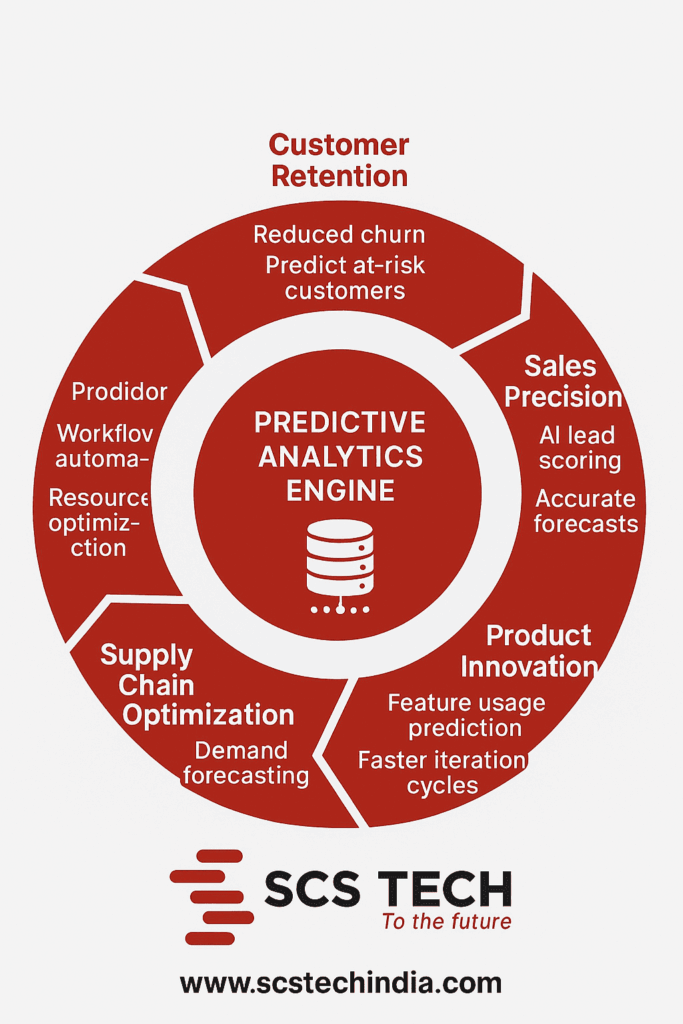
    Predictive Analytics Engine

    A McKinsey report noted that companies using predictive analytics in key operational areas see up to 6% improvement in profit margins and 10% higher customer satisfaction scores. However, these results only show up when the use case is aligned with actual friction points. Especially when backed by an integrated AI/ML service that aligns models with on-the-ground decision triggers.

    Here’s where prediction delivers outsized returns:

    1. Demand Forecasting (Relevant for: Manufacturing, retail, and healthcare): These industries lose revenue when supply doesn’t match demand, either through excess inventory that expires or stockouts that miss sales. It helps businesses align production with real demand patterns, often region-specific or seasonal.
    2. Customer Churn Prediction (Relevant for: Telecom and BFSI): When customers leave quietly, the business loses long-term value without warning. What prediction does: It flags small changes in user behavior that often go unnoticed, like a drop in usage or payment delays, so retention teams can intervene early.
    3. Predictive Maintenance (Relevant for: Heavy machinery, logistics, and energy sectors): Unplanned downtime halts operations and damages client trust. It uses machine data—often analysed through an AI/ML service—to identify early signs of failure, so teams can act before breakdowns happen.
    4. Fraud Detection (Relevant for: Banking and insurance): As digital transactions scale, fraud becomes harder to detect through manual checks alone. Algorithms analyse transaction patterns and flag anomalies in real time—often faster and more accurately than audits.

    But not every use case delivers.

    Where It Fails—or Flatlines

    • When data is sparse or irregular. Prediction thrives on patterns. No patterns? No value.
    • When you’re trying to forecast rare, one-off events—like a regulatory upheaval or leadership shift.
    • When departments work in silos, hoarding insights instead of feeding them back into models.
    • When you deploy tools before identifying problems, a common mistake with off-the-shelf dashboards.

    Key Applications of Predictive Analytics for Business Growth

    Predictive analytics becomes valuable only when it integrates with core decision systems—those that determine how, when, and where a business allocates its capital, people, and priorities. Used correctly, it transforms lagging indicators into real-time levers for operational clarity. Below are not categories—but impact zones—where the application of predictive intelligence changes how growth is executed, not just reported.

    1. Customer acquisition and retention

    Retention is not a loyalty problem. It’s an attention problem. Businesses lose customers not when value disappears—but when relevance lapses. Predictive analytics identifies these lapses early.

    • By leveraging behavioural clustering and time-series models, high-performing businesses can detect churn signals long before customers take action.
    • According to a Forrester study, companies that operationalized churn prediction frameworks reported up to 15–20% improvement in customer lifetime value (CLV) by deploying targeted interventions when disengagement patterns first emerge.

    This is not segmentation. It’s micro-forecasting—where response likelihood is recalculated in real time across interaction channels.

    In B2C models, these drives offer timing and personalization. In B2B SaaS, it influences renewal forecasts and account management priorities. Either way, the growth engine no longer runs on intuition. It runs on modeled intent.

    2. Marketing and revenue operations

    Campaigns fail not because of creative gaps—but because they’re misaligned with demand timing. Predictive analytics changes that by eliminating the lag between audience insight and go-to-market execution.

    • By integrating external signals—like macroeconomic indicators, sector-specific sentiment, and real-time intent data—into media planning systems, marketing teams shift from reactive attribution to predictive conversion modeling. Such insights often come faster when powered by a reliable AI/ML service capable of digesting external and internal data streams.
    • This reduces CAC volatility and improves budget elasticity.

    In sales, predictive scoring systems ingest CRM data, email trails, past deal cycles, and intent signals to identify not just who is likely to close, but when and at what cost to serve.

    A McKinsey study noted that sales teams with mature predictive analytics frameworks closed deals 12–15% faster and achieved 10–20% higher conversion rates than those using standard lead scoring.

    3. Product strategy and innovation

    The traditional model of product development—build, launch, measure—is fundamentally reactive. Predictive analytics shifts this flow by identifying undercurrents in customer need before they surface as requests or complaints.

    • NLP models—typically deployed through an AI/ML service—run across support tickets, online reviews, and feedback forms, and extract friction themes at scale.
    • Layered with usage telemetry, companies can model not just what customers want next, but what will reduce churn and increase NPS with the lowest development cost.

    In hardware and manufacturing, predictive analytics ties into field service data and defect logs to anticipate which design improvements will yield the greatest operational return—turning product development into a value optimization function, not a roadmap gamble.

    4. Supply chain and operations

    Supply chains break not because of a lack of planning, but because of dependence on static planning. Predictive models inject fluidity—adapting forecasts based on upstream and downstream fluctuations in near real-time.

    • One electronics OEM layered weather data, regional demand shifts, and supplier capacity metrics into its forecasting models—cutting inventory holding costs by 22% and avoiding stockouts in two consecutive holiday seasons.
    • Beyond demand, predictive analytics enables logistics risk profiling, flagging geographies, vendors, or nodes that show early signals of disruption.

    It also supports capacity-aware scheduling—adjusting throughput based on absenteeism, machine wear signals, or raw material inconsistencies. This doesn’t require full automation. It requires precision frameworks that make manual interventions smarter, faster, and more aligned with system constraints.

    5. Finance and risk management

    Financial models typically operate on the assumption of linearity. Predictive analytics exposes the reality—that financial health is event-driven and behavior-dependent.

    • Revenue forecasting systems embedding signals like interest rate changes, currency volatility, and regional policy shifts improved forecast accuracy by up to 25%, according to PwC.
    • In credit and fraud, supervised models don’t just look for rule violations—but for breaks in pattern coherence, even when individual inputs appear safe.

    This is why predictive risk systems are no longer limited to banks. Mid-sized enterprises exposed to global vendors, multi-currency transactions, or digital assets are embedding fraud detection into operational controls—not waiting for post-event audits.

    Challenges in Implementing Predictive Analytics

    The failure rate of predictive analytics initiatives remains high, not because the technology is insufficient, but because most organizations misdiagnose what prediction actually requires. It is not a data visualization problem. It’s an integration problem. Below are the real constraints that separate signal from noise.

    1. Data infrastructure

    Predictive accuracy depends on historical depth, temporal granularity, and data context. Most organizations underestimate how fragmented or unstructured their data is, until the model flags inconsistent inputs.

    • According to IDC, only 32% of organizations have enterprise-wide data governance sufficient to support cross-functional predictive models.
    • Without normalized pipelines, real-time ingestion, and tagging standards, even advanced models collapse under ambiguity.

    2. Model reliability and explainability

    In regulated industries—finance, healthcare, insurance—accuracy alone isn’t enough. Explainability becomes critical.

    • Stakeholders need to understand why a model flagged a transaction, rejected a claim, or reprioritized a lead.
    • Black-box models like deep learning demand interpretability frameworks (e.g., LIME or SHAP) or hybrid models that balance clarity with accuracy.

    Without this transparency, trust erodes—and regulatory non-compliance becomes a serious risk.

    3. Siloed ownership

    Prediction has no value if insight stays in a dashboard. Yet many organizations keep data science isolated from sales, ops, or finance.

    • This leads to what Gartner calls the “insight-to-action gap.”
    • Models generate accurate outputs, but no one acts on them—either due to unclear ownership or because workflows aren’t built to accept predictive triggers.

    To close this, predictions must be embedded into decision architecture—CRM systems, scheduling tools, pricing engines—not just reporting layers.

    4. Talent scarcity

    Most businesses conflate data analytics with predictive modeling. But statistical reports aren’t predictive systems.

    • You don’t need someone to report what happened—you need people who build systems that act on what will happen.
    • That means hiring data engineers, ML ops architects, and domain-informed modelers—not spreadsheet analysts.

    This mismatch leads to failed pilots and dashboards that look impressive but fail to drive business impact.

    5. Change management

    The biggest friction point isn’t technical—it’s cultural.

    • Predictive systems challenge intuition. They force leaders to trust data over experience.
    • This only works when there’s executive alignment—when leadership is willing to move from authority-based decisions to model-informed strategy.

    Adoption requires not just access to tools, but governance models, feedback loops, and measurable accountability.

    What Business Growth Looks Like with Prediction Built-In

    When predictive analytics is done right, growth doesn’t look like fireworks. It looks like precision.

    • You don’t over-hire.
    • You don’t overstock.
    • You don’t launch in the wrong quarter.
    • You don’t spend weeks figuring out why shipments are delayed—because you already fixed it two cycles ago.

    The power of prediction is in consistency.

    And in mid-sized businesses, consistency is the difference between making payroll comfortably and cutting corners to survive Q4.

    In public health systems, predictive models helped reduce patient wait times by anticipating post-holiday surges in outpatient visits. The result? Less crowding. Faster care. Better resource planning.

    No billion-dollar transformation. Just friction, removed.

    This is where SCS Tech earns its edge.

    They don’t sell dashboards—they offer a tailored AI/ML service that solves recurring friction points using AI/ML architectures tailored to your reality.

    • If your shipment delays always happen in the same two regions,
    • If your production overruns always start with the same raw material,
    • If your customer complaints always spike on certain weekdays—

    That’s where they begin. They don’t drop a model and leave. They build prediction into your process to the point where it stops you from losing money.

    What to Look for If You Want to Explore Further

    Before bringing in predictive analytics, ask yourself:

    • Where are we routinely late in making calls?
    • Which part of the business costs more than it should—because we’re always reacting?
    • Do we have enough historical data tied to that problem?

    If the answer is yes, you’re not early. You’re already behind.

    That’s the entry point for SCS Tech. They don’t lead with tools. They start by identifying high-friction, recurring events that can be modelled—and then make that logic part of your system.

    Their strength isn’t variety. It’s pattern recognition across sectors where delay costs money: logistics bottlenecks, vendor overruns, and churn without warning. SCS Tech knows how to operationalise prediction—not as a shiny overlay but as a layer that runs quietly behind the scenes.

    Final Thoughts

    Most business problems aren’t surprising—they just keep resurfacing because we’re too late to catch them. Prediction changes that. It gives you leverage, not hindsight.

    This isn’t about being futuristic. It’s about preventing wasted spend, lost hours, and missed quarters.

    If you’re running a mid-sized business and are tired of reacting late, talk to SCS Tech India. Start with one recurring issue. If it’s predictable, we’ll help you systemize the fix—and prove the return in weeks, not quarters.

    FAQs

    We already use dashboards and reports—how is this different?

    Dashboards tell you what has already happened. Predictive analytics tells you what’s likely to happen next. It moves you from reactive decision-making to proactive planning. Instead of seeing a sales dip after it occurs, prediction can flag the drop before it shows up on reports, giving you time to correct the course.

    Do we need a massive data science team to get started?

    No. You don’t need an in-house AI lab. Most companies start with external partners or off-the-shelf platforms tailored to their domain. The critical part isn’t the tool—it’s the clarity of the problem you’re solving. You’ll need clean data, domain insight, and a team that can translate the output into action. That’s more important than building everything from scratch.

    Can we apply predictive analytics to small or one-time projects?

    You can try—but it won’t deliver much value. Prediction is best suited for ongoing, high-volume decisions. Think of recurring purchases, ongoing maintenance, repeat fraud attempts, etc. If you’re testing a new product or entering a new market with no history to learn from, traditional analysis or experimentation will serve you better.


  • How Digital Twins Transform Asset & Infrastructure Management in Oil and Gas Technology Solutions

    How Digital Twins Transform Asset & Infrastructure Management in Oil and Gas Technology Solutions

    What if breakdowns could be predicted before they become expensive shutdowns? In an age where reliability is everything, avoiding failures before they occur can prevent millions of dollars in losses. With real-time visibility, digital twin technology can make it happen to guarantee seamless operations even in the most demanding environments.

    Based on industry reports, organizations that utilize digital twins have seen their equipment downtime decrease by as much as 20% and overall equipment effectiveness increase by as much as 15%. In cost terms, that translates to more than millions annually. These kinds of figures are what make the application of digital twins today a strategic imperative.

    In this blog, let us understand how digital twins redefine bare operational spaces in oil and gas technology solutions: predictive maintenance, asset performance, and sustainability.

    How Digital Twins Improve Asset and Infrastructure Management in Oil and Gas Technology Solutions?

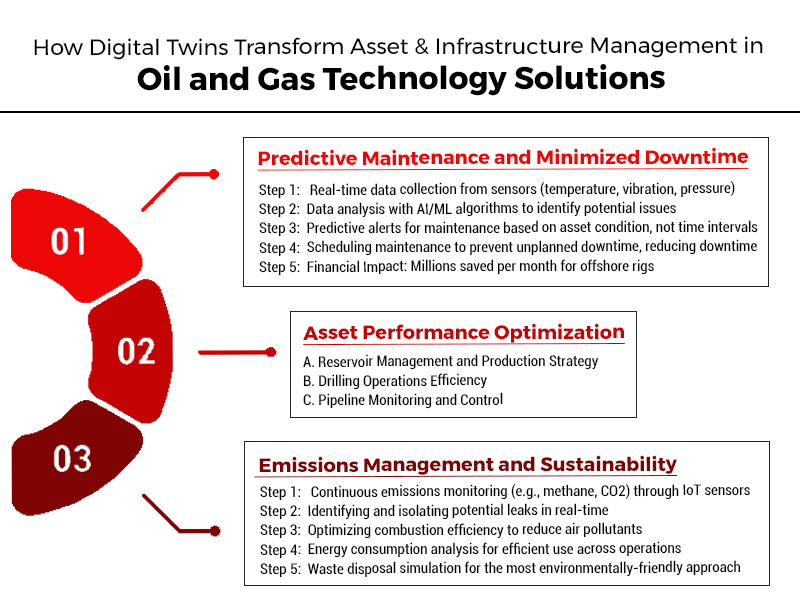
    1. Predictive Maintenance and Minimized Downtime

    Digital twins ensure intelligent maintenance by transitioning from time-based to condition-based maintenance, using real-time analysis to foretell equipment issues before they are severe.

    • Real-Time Health Monitoring: Digital twins also gather real-time data from sensors installed on pumps, compressors, turbines, and drilling equipment. Among the parameters constantly monitored are the vibration rates, pressure waves, and thermal trends, which may be used in monitoring for indicators of wear and impending failure.
    • Predictive Failure Detection: With machine learning and past failure patterns, digital twins can identify slight deviations that can lead to component failures. This enables teams to correct the problem before the problem leads to system-scale disruption.
    • Optimized Maintenance Scheduling: Rather than depending on strict maintenance schedules, digital twins suggest maintenance based on the actual condition of the assets. This avoids unnecessary work, minimizes labour costs, and maintains only when necessary, saving maintenance expenses.
    • Financial Impact: The cost savings in operations are directly obtained from the decrease in unplanned downtime. Predictive maintenance with digital twins can save millions per month for a single offshore rig alone.

    how Digital Twins enable Predictive Maintenance

    2. Asset Performance Optimization

    Asset performance optimization is not so much about getting the assets up and running as it is about getting every possible value from each asset at each stage in its operational lifecycle. Digital twins are key to this:

    A. Reservoir Management and Production Strategy

    Digital twins simulate oil reservoir behaviour by integrating geologic models with real-time operating data. This enables engineers to simulate different extraction methods—like water flooding or injecting gas—and select the one that will maximize recovery rates with the minimum amount of environmental damage.

    Operators receive insight into reservoir pressure, fluid contents, and temperature behaviour. Such data-driven insight assists in determining where and when to drill, optimize field development strategy, and maximize long-term asset use.

    B. Drilling Operations Efficiency

    Digital twin real-time modelling helps adapt quickly to altering conditions underground during drilling. Integrating drilling rig information, seismic information, and historical performance metrics, operators can select optimal drilling paths, skip danger areas, and ensure wellbore stability.

    Workflow simulations also minimize uncertainty and inefficiencies during planning, minimising well construction time. This enhances safety, minimizes non-productive time (NPT), and minimizes total drilling cost.

    C. Pipeline Monitoring and Control

    Digital twins are also applied in midstream operations, such as pipelines. They track internal pressure, flow rate, and corrosion data. By tracking anomalies such as imputed leaks or pipeline fatigue in real time, operators can perform preventive measures to ensure system integrity.

    Predictive pressure control and flow optimization also enhance energy efficiency by lowering the load on pump equipment, which results in operational efficiencies and environmental performance.

    3. Emissions Management and Sustainability

    Sustainability and environmental compliance are central to the technology solutions for oil and gas today. Digital twins offer the data infrastructure for tracking, managing, and optimizing environmental performance throughout operations.

    • Continuous Emission Monitoring: Digital twins are connected to IoT sensors deployed across production units and refineries to track emissions continuously. The systems monitor methane levels, flaring efficiency, and air quality in general. Preleak detection ensures immediate action to contain noxious emissions. On-site real-time combustion analysis can also help ensure maximum efficiency for processes by keeping pollutant production during flaring or burning down to the least.
    • Energy Use Insights: Plant operators use digital twins to point out inefficiency in energy usage in specific areas. With instantaneous comparisons between the input energy and the output from processes, operators recognize energy loss patterns and propose changes for lesser usage—greener and more efficient operation.
    • Simulation for Waste Handling: Digital twins model and analyze a variety of waste disposal plans in a bid to ascertain the most cost-effective and environmentally friendly approach. Whether dealing with drilling waste or refinery residues, operators are made transparent to minimize, reuse, or dispose of waste as per legislation.
    • Carbon Capture Optimization: As carbon capture and storage (CCS) emerges as a hot topic in the energy industry, digital twins help maximize these systems to their best. They mimic the behaviour of injected CO₂ in subsurface reservoirs, detect leakage risks, and maximize injection strategy for enhanced storage reliability. This helps companies achieve corporate sustainability objectives and aids global decarbonization goals.

    What is the Strategic Role of Digital Twins in Oil and Gas Technology Solutions?

    Digital twins are no longer pilot technologies—they are starting to become the basis for the digital transformation of oil and gas production. From upstream to downstream, they deliver unique visibility, responsiveness, and management of physical assets.

    Their capacity to integrate real-time operational data with sophisticated analytics enables companies to:

    • Improve equipment reliability and lower failures
    • Enhance decision-making on complicated operations
    • Reduce operating expenses with predictive models
    • Comply with environmental regulations and sustainability goals

    With oil and gas operators under mounting pressure to extract margins, keep humans safe, and show environmental responsibility, digital twins provide a measurable and scalable solution.

    Conclusion

    Digital twins are transforming asset and infrastructure management throughout the oil and gas value chain. They influence predictive maintenance, asset optimization, and sustainability—the three pillars of operational excellence in today’s energy sector.

    By enabling data-informed decision-making, reducing risk, and maximizing asset value, digital twins are a stunning leap in oil and gas technology solutions. Companies implementing this technology with support from SCS Tech will be better poised to run efficiently, meet regulatory demands, and dominate a globally competitive market.

  • Why Custom Cybersecurity Solutions and Zero Trust Architecture Are the Best Defense Against Ransomware?

    Why Custom Cybersecurity Solutions and Zero Trust Architecture Are the Best Defense Against Ransomware?

    Are you aware that ransomware attacks worldwide increased by 87% in February 2025? The sharp peak highlights the need for organizations to review their cybersecurity strategies. Standard solutions, as often one-size-fits-all, cannot specifically address the vulnerabilities of individual organizations and cannot match evolving cybercriminal methods.

    In contrast, custom cybersecurity solutions are designed to address an organization’s requirements, yielding flexible defences bespoke to its infrastructure. When integrated with Zero Trust Architecture—built around ongoing verification and strict access control—such solutions create a comprehensive defence against increasingly advanced ransomware attacks.

    This blog will examine how custom cybersecurity solutions and Zero Trust Architecture come together to create a strong, dynamic defence against the increasing ransomware threat.

    Custom Cybersecurity Solutions – Targeted Defense Against Ransomware

    Unlike one-size-fits-all generic security tools, customized solutions target unique vulnerabilities and provide adaptive defences suited to the organization’s threat environment. This particularity is crucial in ransomware combat since ransomware frequently attacks specific system weaknesses.

     how custom cybersecurity solutions help prevent and mitigate ransomware attacks?

    Key Features of Custom Cybersecurity Solutions That Fight Ransomware

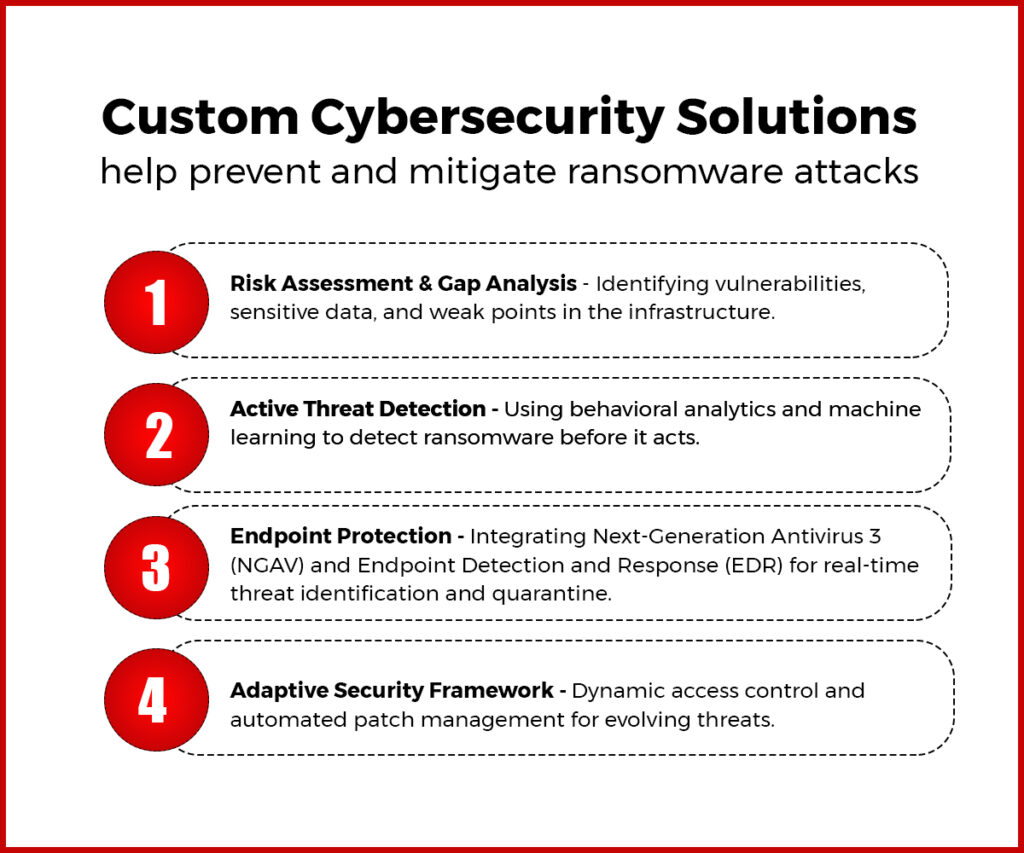
    1. Risk Assessment and Gap Analysis

    Custom cybersecurity solutions start with thoroughly analysing an organization’s security position. This entails:

    • Asset Identification: Organizations must identify key data and systems that need increased security. These are sensitive customer data, intellectual property, and business data that, if breached, would have devastating effects.
    • Vulnerability Analysis: By doing this analysis, organizations determine vulnerabilities like old software, misconfiguration, or exposed endpoints that ransomware can target. This ensures that security solutions are designed to counter specific risks instead of general protection.

    The result of such intensive evaluation guides the creation of focused security measures that are more efficacious for countering ransomware attacks.

    2. Active Threat Detection

    Custom-made security solutions incorporate the best detection features designed to detect ransomware behaviour before its ability to act. The integral parts are:

    • Behavioral Analytics: These platforms track user and system activity for signs of anomalies suggesting ransomware attempts. For instance, unexpected peaks in file encryption activity or unusual access patterns may indicate a threat.
    • Machine Learning Models: Using machine learning algorithms, organizations can forecast patterns of attacks using historical data and developing trends. These models learn continuously from fresh data, and their capacity to identify threats improves with time.

    This proactive strategy allows organizations to recognize and break up ransomware attacks at the initial phases of the attack cycle, significantly reducing the likelihood of data loss or business disruption.

    3. Endpoint Protection

    Endpoints—laptops, desktops, and servers—are common entry points for ransomware attacks. Customized solutions utilize aggressive endpoint protection that involves:

    • Next-Generation Antivirus (NGAV): Compared to traditional signature-based detection-based antivirus solutions, NGAV applies behaviour-based detection mechanisms for identifying known and unknown threats. This is necessary to identify new ransomware strains that have not received signatures.
    • Endpoint Detection and Response (EDR): EDR solutions scan endpoints in real-time for any suspicious activity and can quarantine a compromised endpoint automatically from the network. Containing this way prevents ransomware from spreading throughout the networks of an organization.

    By putting endpoint security first, bespoke cybersecurity solutions protect against ransomware attacks by making possible entry points secure.

    4. Adaptive Security Framework

    Custom solutions are created to adapt to developing threats to maintain ongoing protection through:

    • Dynamic Access Controls: These controls modify users’ permissions according to up-to-the-minute risk evaluations. For instance, if a user is exhibiting unusual behaviour—such as looking at sensitive files outside regular working hours—the system can restrict their access temporarily until further verification is done.
    • Automated Patch Management: One must stay current with updates to address vulnerabilities that ransomware can exploit. Automated patch management maintains all systems up to the latest security patches without manual intervention.

    This dynamic system enables companies to defend themselves against changing ransomware strategies.

    Zero Trust Architecture (ZTA) – A Key Strategy Against Ransomware

    The Zero Trust Architecture cybersecurity functions on the “never trust, always verify” paradigm. It removes implicit network trust by insisting on ongoing authentication and rigorous access controls on all users, devices, and applications. This makes it highly effective against ransomware because of its focus on reducing trust and verifying all requests to access.

    Key Features of ZTA That Counteract Ransomware

    1. Least Privilege Access

    Ransomware usually takes advantage of over permissions to propagate within networks. ZTA implements least privilege policies through:

    • Limiting User Access: Users are given access only to resources required for their functions. This reduces the impact if an account is compromised.
    • Dynamic Permission Adjustments: Permissions are adjustable by contextual properties like location or device health. For instance, if a user is trying to view sensitive information from an unknown device or location, their access can be denied until additional verification is done.

    This tenet significantly lessens the chances of ransomware spreading within networks.

    2. Micro-Segmentation

    ZTA segments networks into smaller zones or segments; each segment must be authenticated separately. Micro-segmentation restricts the spread of ransomware attacks by:

    • Isolating Infected Systems: When a system is infected with ransomware, micro-segmentation isolates the system from other areas of the network, eliminating lateral movement and further infection.
    • Controlled Segmentation Between Segments: Each segment may have its access controls and monitoring mechanisms installed, enabling more detailed security controls specific to types of data or operations.

    By using micro-segmentation, organizations can considerably lower the risk of ransomware attacks.

    3. Continuous Verification

    In contrast to legacy models that authenticate users one time upon login, ZTA demands continuous verification throughout a session.

    • Real-Time Authentication Verifications: Ongoing checks ensure that stolen credentials cannot be utilized in the long term. If suspicious activity is noted within a user session—e.g., access to unexpected resources—the system may request re-authentication or even deny access.
    • Immediate Access Denial: If a device or user acts suspiciously with signs of a possible ransomware attack (e.g., unexpected file changes), ZTA policies can deny real-time access to stop the damage.

    This ongoing validation process strengthens security by ensuring only valid users retain access during their interactions with the network.

    4. Granular Visibility

    ZTA delivers fine-grained visibility into network activity via ongoing monitoring:

    • Early Ransomware Attack Detection: Through monitoring for off-the-book data transfers or unusual file access behaviour, organizations can recognize early indications of ransomware attacks before they become full-fledged incidents.
    • Real-Time Alerts: The design sends real-time alerts for anomalous activity so that security teams can react promptly to suspected threats and contain threats before they cause critical harm.

    This level of visibility is essential to ensuring an effective defence against advanced ransomware techniques.

    Why Custom Cybersecurity Solutions and Zero Trust Architecture Are Best Against Ransomware?

    1. Holistic Security Coverage

    Custom cybersecurity solutions target organization-specific threats by applying defences to individual vulnerabilities. Zero Trust Architecture delivers generic security guidelines for all users, devices, and applications. They offer complete protection against targeted attacks and more general ransomware campaigns.

    2. Proactive Threat Mitigation

    Custom solutions identify threats early via sophisticated analytics and machine learning algorithms. ZTA blocks unauthorized access completely via least privilege policies and ongoing verification. This two-layered method reduces opportunities for ransomware to enter networks or run successfully.

    3. Minimized Attack Surface

    Micro-segmentation in ZTA eliminates lateral movement opportunities across networks, and endpoint protection in bespoke solutions secures shared entry points against exploitation. Together, they cut the general attack surface for ransomware perpetrators drastically.

    4. Scalability and Flexibility

    Both models fit in perfectly with organizational expansion and evolving threat horizons:

    • Bespoke solutions change through dynamic security controls such as adaptive access controls.
    • ZTA scales comfortably across new users/devices while it enforces rigid verification processes.

    In tandem, they deliver strong defences regardless of organizational size or sophistication.

    Conclusion

    Ransomware threats are a serious concern as they target weaknesses in security systems to demand ransom for data recovery. To defend against these threats, organizations need a strategy that combines specific protection with overall security measures. Custom cybersecurity solutions from SCS Tech provide customised defenses that address these unique risks, using proactive detection and flexible security structures.

    At the same time, zero trust architecture improves security by requiring strict verification at every step. This reduces trust within the network and limits the areas that can be attacked through micro-segmentation and continuous authentication. When used together, these strategies offer a powerful defense against ransomware, helping protect organizations from threats and unauthorized access.

  • How AI/ML Services and AIOps Are Making IT Operations Smarter and Faster?

    How AI/ML Services and AIOps Are Making IT Operations Smarter and Faster?

    Are you seeking to speed up and make IT operations smarter? With infrastructure becoming increasingly complex and workloads dynamic, traditional approaches are insufficient. IT operations are vital to business continuity, and to address today’s requirements, organizations are adopting AI/ML services and AIOps (Artificial Intelligence for IT Operations).

    These technologies make work autonomous and efficient, changing how systems are monitored and controlled. Gartner says 20% of companies will leverage AI to automate operations—removing more than half of middle management positions by 2026.

    In this blog, let’s see how AI/ML services and AIOps are making organizations really work smarter, faster, and proactively.

    How Are AI/ML Services and AIOps Making IT Operations Faster?

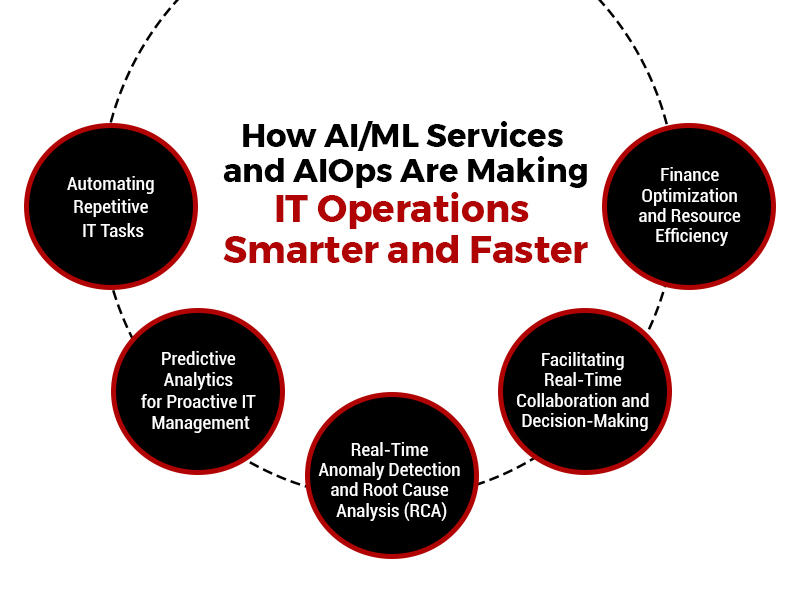
    1. Automating Repetitive IT Tasks

    AI/ML services apply models to transform operations into intelligent and quicker ones by identifying patterns and taking actions automatically—without human intervention. This eliminates IT teams’ need to manually read logs, answer alerts, or perform repetitive diagnostics.

    Through this, log parsing, alert verification, and restart of services that previously used hours can be achieved in an instant using AIOps platforms, vastly enhancing response time and efficiency. The key areas of automation include the following:

    A. Log Analysis

    Each layer of IT infrastructure, from hardware to applications, generates high-volume, high-velocity log data with performance metrics, error messages, system events, and usage trends.

    AI-driven log analysis engines use machine learning algorithms to consume this real-time data stream and analyze it against pre-trained models. These models can detect known patterns and abnormalities, do semantic clustering, and correlate behaviour deviations with historical baselines. The platform then exposes operational insights or passes incidents when deviations hit risk thresholds. This eliminates the need for human-driven parsing and cuts the diagnostic cycle time to a great extent.

    B. Alert Correlation

    Distributed environments have multiple systems that generate isolated alerts based on local thresholds or fault detection mechanisms. Without correlation, these alerts look unrelated and cannot be understood in their overall impact.

    AIOps solutions apply unsupervised learning methods and time-series correlation algorithms to group these alerts into coherent incident chains. The platform links lower-level events to high-level failures through temporal alignment, causal relationships, and dependency models, achieving an aggregated view of the incident. This makes the alerts much more relevant and speeds up incident triage.

    C. Self-Healing Capabilities

    After anomalies are identified or correlations are made, AIOps platforms can initiate pre-defined remediation workflows through orchestration engines. These self-healing processes are set up to run based on conditional logic and impact assessment.

    The system initially confirms whether the problem satisfies resolution conditions (e.g., severity level, impacted nodes, length) and subsequently engages in recovery procedures like service restarting, resource redimensioning, cache clearing, or reverting to baseline configuration. Everything gets logged, audited, and reported, so automated flows are being tweaked.

    2. Predictive Analytics for Proactive IT Management

    AI/ML services optimize operations to make them faster and smarter by employing historical data to develop predictive models that anticipate problems such as system downtime or resource deficiency well ahead of time. This enables IT teams to act early, minimizing downtime, enhancing uptime SLAs, and preventing delays usually experienced during live troubleshooting. These predictive functionalities include the following:

    A. Early Failure Detection

    Predictive models in AIOps platforms employ supervised learning algorithms trained on past incident history, performance logs, telemetry, and infrastructure behaviour. Predictive models analyze real-time telemetry streams against past trends to identify early-warning signals like performance degradation, unusual resource utilization, or infrastructure stress indicators.

    Critical indicators—like increasing response times, growing CPU/memory consumption, or varying network throughput—are possible leading failure indicators. The system then ranks these threats and can suggest interventions or schedule automatic preventive maintenance.

    B. Capacity Forecasting

    AI/ML services examine long-term usage trends, load variations, and business seasonality to create predictive models for infrastructure demand. With regression analysis and reinforcement learning, AIOps can simulate resource consumption across different situations, such as scheduled deployments, business incidents, or external dependencies.

    This enables the system to predict when compute, storage, or bandwidth demands exceed capacity. Such predictions feed into automated scaling policies, procurement planning, and workload balancing strategies to ensure infrastructure is cost-effective and performance-ready.

    3. Real-Time Anomaly Detection and Root Cause Analysis (RCA)

    AI/ML services render operations more intelligent by learning to recognize normal system behaviour over time and detect anomalies that could point to problems, even if they do not exceed fixed limits. They also render operations quicker by connecting data from metrics, logs, and traces immediately to identify the root cause of problems, lessening the requirement for time-consuming manual investigations.


     real-time anomaly detection and root cause analysis (RCA) using AI/ML

    The functional layers include the following:

    A. Anomaly Detection

    Machine learning models—particularly those based on unsupervised learning and clustering—are employed to identify deviations from established system baselines. These baselines are dynamic, continuously updated by the AI engine, and account for time-of-day behaviour, seasonal usage, workload patterns, and system context.

    The detection mechanism isolates anomalies based on deviation scores and statistical significance instead of fixed rule sets. This allows the system to detect insidious, non-apparent anomalies that can go unnoticed under threshold-based monitoring systems. The platform also prioritizes anomalies regarding severity, system impact, and relevance to historical incidents.

    B. Root Cause Analysis (RCA)

    RCA engines in AIOps platforms integrate logs, system traces, configuration states, and real-time metrics into a single data model. With the help of dependency graphs and causal inference algorithms, the platform determines the propagation path of the problem, tracing upstream and downstream effects across system components.

    Temporal analysis methods follow the incident back to its initial cause point. The system delivers an evidence-based causal chain with confidence levels, allowing IT teams to confirm the root cause with minimal investigation.

    4. Facilitating Real-Time Collaboration and Decision-Making

    AI/ML services and AIOps platforms enhance decision-making by providing a standard view of system data through shared dashboards, with insights specific to each team’s role. This gives every stakeholder timely access to pertinent information, resulting in faster coordination, better communication, and more effective incident resolution. These collaboration frameworks include the following:

    A. Unified Dashboards

    AIOps platforms consolidate IT-domain metrics, alerts, logs, and operation statuses into centralized dashboards. These dashboards are constructed with modular widgets that provide real-time data feeds, historical trend overlays, and visual correlation layers.

    The standard perspective removes data silos, enables quicker situational awareness, and allows for synchronized response by developers, system admins, and business users. Dashboards are interactive and allow deep drill-downs and scenario simulation while managing incidents.

    B. Contextual Role-Based Intelligence

    Role-based views are created by dividing operational data along with teams’ responsibilities. Runtime execution data, code-level exception reporting, and trace spans are provided to developers.

    Infrastructure engineers view real-time system performance statistics, capacity notifications, and network flow information. Business units can receive high-level SLA visibility or service availability statistics. This level of granularity is achieved to allow for quicker decisions by those most capable of taking the necessary action based on the information at hand.

    5. Finance Optimization and Resource Efficiency

    With AI/ML services, they conduct real-time and historical usage analyses of the infrastructure to suggest cost-saving resource deployment methods. With automation, scaling, budgeting, and resource tuning activities are carried out instantly, eliminating manual calculations or pending approvals and achieving smoother and more efficient operations.

    The optimization techniques include the following:

    A. Cloud Cost Governance

    AIOps platforms track usage metrics from cloud providers, comparing real-time and forecasted usage. Such information is cross-mapped to contractual cost models, billing thresholds, and service-level agreements.

    The system uses predictive modeling to decide when to scale up or down according to expected demand and flags underutilized resources for decommissioning. It also supports non-production scheduling and cost anomaly alerts—allowing the finance and DevOps teams to agree on operational budgets and savings goals.

    B. Labor Efficiency Gains

    By automating issue identification, triage, and remediation, AIOps dramatically lessen the number of manual processes that skilled IT professionals would otherwise handle. This speeds up time to resolution and frees up human capital for higher-level projects such as architecture design, performance engineering, or cybersecurity augmentation.

    Conclusion

    Adopting AI/ML services and AIOps is a significant leap toward enhancing IT operations. These technologies enable companies to transition from reactive, manual work to faster, more innovative, and real-time adaptive systems.

    This transition is no longer a choice—it’s required for improved performance and sustainable growth. SCS Tech facilitates this transition by providing custom AI/ML services and AIOps solutions that optimize IT operations to be more efficient, predictable, and anticipatory. Getting the right tools today can equip organizations to be ready, decrease downtime, and operate their systems with increased confidence and mastery.

  • How GIS Companies in India Use Satellites and Drones to Improve Land Records & Property Management?

    How GIS Companies in India Use Satellites and Drones to Improve Land Records & Property Management?

    India, occupying just 2.4% of the world’s entire land area, accommodates 18% of the world’s population, resulting in congested land resources, high-speed urbanization, and loss of productive land. For sustainable land management, reliable land records, effective land use planning, and better property management are essential.

    To meet the demand, Geographic Information System (GIS) companies use satellite technology and drones to establish precise, transparent, and current land records while facilitating effective property management. The latest technologies are revolutionizing land surveying, cadastral mapping, property valuation, and land administration, enhancing decision-making immensely.

    This in-depth blog discussion addresses all steps involved in how GIS companies in India utilize satellites and drones to improve land records and property management.

    How Satellite Technology is Used in Land Records & Property Management

    Satellite imagery is the foundation of contemporary land management, as it allows for exact documentation, analysis, and tracking of land lots over massive regions. In contrast to error-prone, time-consuming ground surveys, satellite-based land mapping provides high-scale, real-time, and highly accurate knowledge.

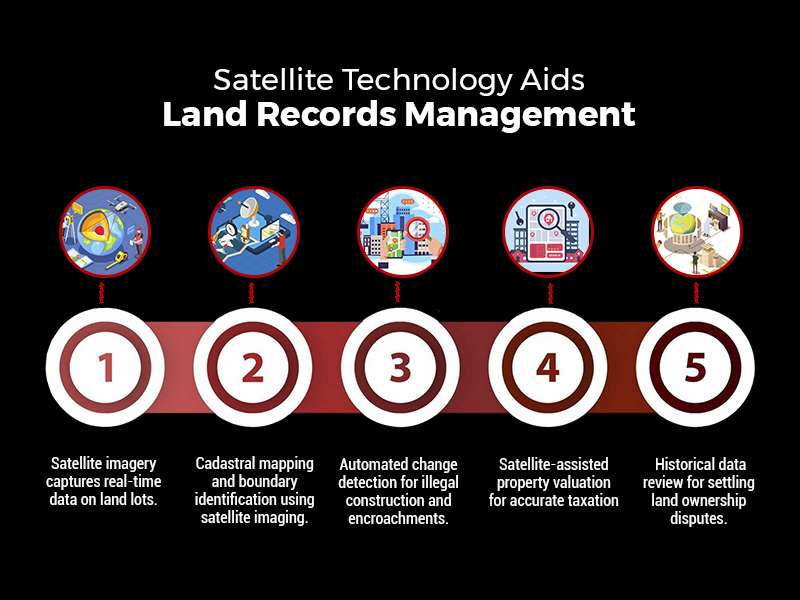
    how satellite technology aids land records management

    The principal benefits of employing satellites in land records management are:

    • Extensive Coverage: Satellites can simultaneously cover entire states or the whole nation, enabling mass-scale mapping.
    • Availability of Historical Data: Satellite images taken decades ago enable monitoring of land-use patterns over decades, facilitating settlement of disputes relating to ownership.
    • Accessibility from Remote Locations: No requirement for physical field visits; the authorities can evaluate land even from remote areas.

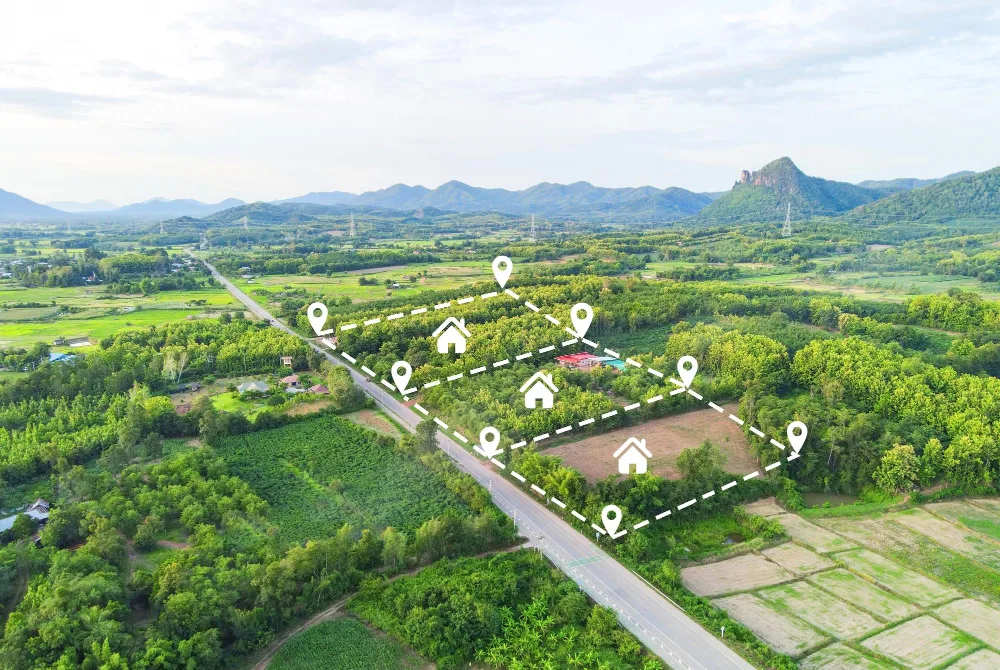
    1. Cadastral Mapping – Determining Accurate Property Boundaries

    Cadastral maps are the legal basis for property ownership. Traditionally, they were manually drafted, with the result that they contained errors, boundary overlap, and owner disputes. Employing satellite imaging, GIS companies in India can now:

    • Map land parcels digitally, depicting boundaries accurately.
    • Cross-check land titles by layering historical data over satellite-derived cadastral data.
    • Identify encroachments by matching old records against new high-resolution imagery.

    For example, a landowner asserting additional land outside their legal boundary can be easily located using satellite-based cadastral mapping, assisting local authorities in correcting such instances.

    2. Land Use and Land Cover Classification (LULC)

    Land use classification is essential for urban, conservation, and infrastructure planning. GIS companies in India examine satellite images to classify land, including:

    • Agricultural land
    • Forests and protected areas
    • Residential, commercial, and industrial areas
    • Water bodies and wetlands
    • Barren land

    Such a classification aids the government in regulating zoning laws, tracking illegal land conversions, and enforcing environmental rules.

    For instance, the illegal conversion of agricultural land into residential areas can be easily identified using satellite imagery, allowing regulatory agencies to act against unlawful real estate development simultaneously.

    3. Automated Change Detection – Tracking Illegal Construction & Encroachments

    One of the biggest challenges in land administration is the proliferation of illegal constructions and unauthorized encroachments. Satellite-based GIS systems offer automated change detection, wherein:

    • Regular satellite scans detect new structures that do not match approved plans.
    • Illegal mining, deforestation, or land encroachments are flagged in real-time.
    • Land conversion violations (e.g., illegally converting wetlands into commercial zones) are automatically reported to authorities.

    For example, a satellite monitoring system identified the unauthorized expansion of a residential colony into government land in Rajasthan, which prompted timely action and legal proceedings.

    4. Satellite-Based Property Taxation & Valuation

    Correct property valuation is critical for equitable taxation and the generation of revenues. Property valuation traditionally depended on physical surveys, but satellites have made it a streamlined process:

    • Location-based appraisal: Distance to highways, commercial centers, and infrastructure developments is included in the tax calculation.
    • Footprint building analysis: Machine learning-based satellite imaging calculates covered areas, avoiding tax evasion.
    • Market trend comparison: Satellite photos and property sale data enable the government to levy property taxes equitably.

    For example, the municipal government in Bangalore utilized satellite images to spot almost 30,000 properties that had not been appropriately reported in tax returns, and the property tax revenue went up.

    How Drone Technology is Applied to Land Surveys & Property Management

    While satellites give macro-level information, drones collect high-accuracy, real-time, and localized data. Drones are indispensable in regions where extreme precision is required, such as:

    • Urban land surveys with millimeter-level accuracy.
    • Land disputes demanding legally admissible cadastral records.
    • Surveying terrain in hilly, forested, or inaccessible areas.
    • Rural land mapping under government schemes such as SVAMITVA.

    1. Drone-Based Cadastral Mapping & Land Surveys

    Drones with LiDAR sensors, high-resolution cameras, and GPS technology undertake automated cadastral surveys, allowing:

    • Accurate land boundary mapping, dispelling disputes.
    • Faster surveying (weeks rather than months), cutting down administrative delays.
    • Low-cost operations compared to conventional surveying.

    For example, drones are being employed to map rural land digitally under the SVAMITVA Scheme, issuing official property titles to millions of landholders.

    2. 3D Modeling for Urban & Infrastructure Planning

    Drones produce precise 3D maps that offer:

    • Correct visualization of cityscapes for planning infrastructure projects.
    • Topography models that facilitate flood control and disaster management.
    • Better land valuation insights based on elevation, terrain, and proximity to amenities.

    For example, Mumbai’s urban planning department used drone-based 3D mapping to assess redevelopment projects, ensuring efficient use of land resources.

    3. AI-Powered Analysis of Drone Data

    Modern GIS software integrates Artificial Intelligence (AI) and Machine Learning (ML) to:

    • Detect unauthorized construction automatically.
    • Analyze terrain data for thoughtful city planning.
    • Classify land parcels for taxation and valuation purposes.

    For instance, a Hyderabad-based drone-based AI system identified illegal constructions and ensured compliance with urban planning regulations.

    Integration of GIS, Satellites & Drones into Land Information Systems

    Satellite and drone data are integrated into Intelligent Land Information Systems (ILIS) by GIS companies in India that encompass:

    A. System of Record (Digital Land Registry)

    • Geospatial database correlating land ownership, taxation, and legal titles.
    • Blockchain-based digital land records resistant to tampering.
    • Uninterrupted connectivity with legal and financial organizations.

    B. System of Insight (Automated Land Valuation & Analytics)

    • Artificial intelligence-based property valuation models based on geography, land topology, and urbanization.
    • Automated taxation ensures equitable revenue collection.

    C. System of Engagement (Public Access & Governance)

    • Internet-based GIS portals enable citizens to confirm property ownership electronically.
    • Live dashboards monitor land transactions, conflicts, and valuation patterns.

    Conclusion

    GIS, satellite imagery, and drones have transformed India’s land records and property management by making accurate mapping, real-time tracking, and valuation efficient. Satellites give high-level insights, while drones provide high-precision surveys, lowering conflicts and enhancing taxation.

    GIS companies in India like SCS Tech, with their high-end GIS strength, facilitate such data-based land administration, propelling India towards a transparent, efficient, and digitally integrated system of governance, guaranteeing equitable property rights, sustainable planning, and economic development.

  • What IT Infrastructure Solutions Do Businesses Need to Support Edge Computing Expansion?

    What IT Infrastructure Solutions Do Businesses Need to Support Edge Computing Expansion?

    Did you know that by 2025, global data volumes are expected to reach an astonishing 175 zettabytes? This will create huge challenges for businesses trying to manage the growing amount of data. So how do businesses manage such vast amounts of data instantly without relying entirely on cloud servers?

    What happens when your data grows faster than your IT infrastructure can handle? As businesses generate more data than ever before, the pressure to process, analyze, and act on that data in real time continues to rise. Traditional cloud setups can’t always keep pace, especially when speed, low latency, and instant insights are critical to business success.

    That’s where edge computing addresses such limitations. By bringing computation closer to where data is generated, it eliminates delays, reduces bandwidth use, and enhances security.

    Therefore, with local processing, and reducing reliance on cloud infrastructure, organizations are allowed to make faster decisions, improve efficiency, and stay competitive in an increasingly data-driven world.

    Read further to understand why edge computing matters and how IT infrastructure solutions help support the same.

    Why do Business Organizations need Edge Computing?

    Regarding business benefits, edge computing is a strategic benefit, not merely a technical upgrade. While edge computing allows organizations to attain better operational efficiencies through reduced latency and improve real-time decision-making to deliver continuous, seamless experiences for customers, mission-critical applications involve processing data on time to enhance reliability and safety – financial services, smart cities.

    As the Internet of Things expands its reach, scaling and decentralized infrastructure solutions become necessary for competing in an aggressively data-driven and rapidly evolving new world. Edge computing has many savings, enabling any company to stretch resources to great lengths and scale costs across operations and edge computing services into a new reality.

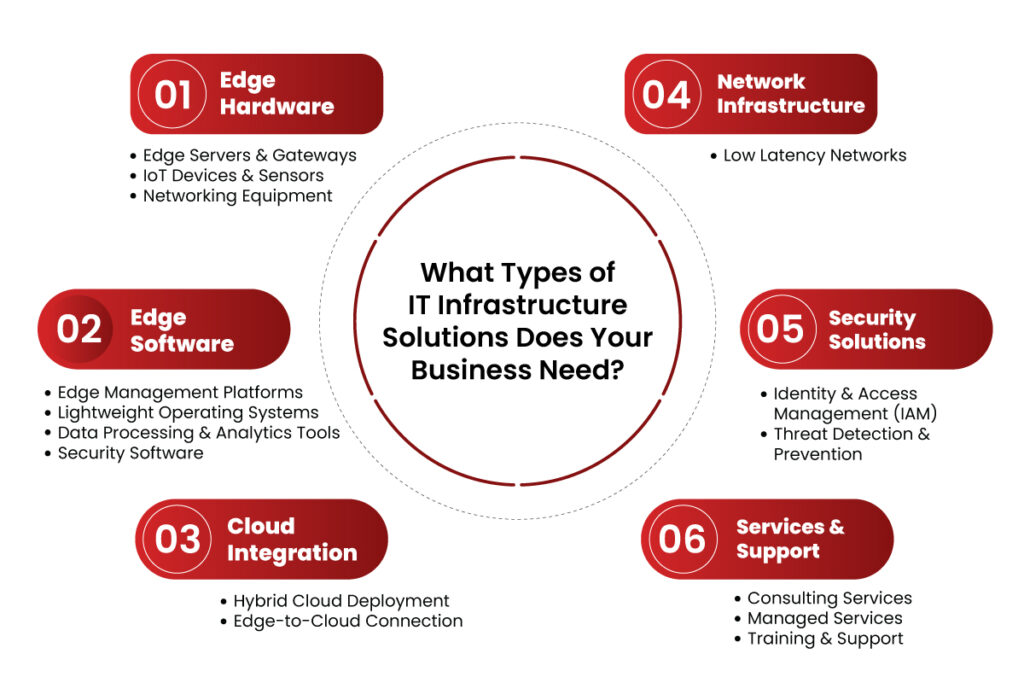
    What Types of IT Infrastructure Solutions Does Your Business Need?

    1. Edge Hardware

    Hardware is the core of any IT infrastructure solutions. For a business to benefit from the advantages of edge computing, the following are needed:

    Edge Servers & Gateways

    Edge servers compute the data at the location, thus avoiding communication back and forth between the centralized data centers. Gateways act as an interface middle layer aggregating and filtering IoT device data before forwarding it to the cloud or edge servers.

    IoT Devices & Sensors

    These are the primary data collectors in an edge computing architecture. Cameras, motion sensors, and environmental monitors collect and process data at the edge to support real-time analytics and instant response.

    Networking Equipment

    A network infrastructure is very important for a seamless communication system. High-speed routers and switches enable fast data transfer between the edge devices and cloud or on-premise servers.

    2. Edge Software

    The core requirement to make data processing effective is that a business must install edge computing feature-supporting software.

    Edge Management Platforms

    Controlling various edge nodes spread over different locations becomes quite complex. Platforms such as Digi Remote Manager enable the remote configuration, deployment, and monitoring of edge devices.

    Lightweight Operating Systems

    Standard OSs consume many resources. Businesses must install OS solutions designed especially for edge devices to utilize available resources effectively.

    Data Processing & Analytics Tools

    Real-time decision-making is imperative at the edge. AI-driven tools allow immediate analysis of data coming in and reduce reliance on cloud processing to enhance operational efficiency.

    Security Software

    Data on the edge is highly susceptible to cyber threats. Security measures like firewalls, encryption, and intrusion detection keep the edge computing environment safe.

    3. Cloud Integration

    While edge computing advises processing near data sources, it does not do away with cloud dependency for extensive storage and analytical functions.

    Hybrid Cloud Deployment

    Business enterprises must accept hybrid clouds, combining seamless integration with the edge and the cloud platform. Services in AWS, Azure, and Google Cloud enable proper data synchronization that an option for a central control panel can replicate.

    Edge-to-Cloud Connection

    Reliable and safe communication between edge devices and cloud data centres is fundamental. 5G, fiber-optic networking, and software-defined networking offer low-latency networking.

    4. Network Infrastructure

    Edge computing involves a robust network delivering low-latency, high-speed data transfer.

    Low Latency Networks

    The technologies, including 5G, provide for lower latency real-time communication. Those organizations that depend on edge computing will require high-speed networking solutions optimized for all their operations. SD-WAN stands for Software-Defined Wide Area Network.

    SD-WAN optimizes the network performance while ensuring data routes remain efficient and secure, even in highly distributed edge environments.

    5. Security Solutions

    Security is one of the biggest concerns with edge computing, as distributed data processing introduces more potential attack points.

    Identity & Access Management (IAM)

    The IAM solutions ensure that only authorized personnel access sensitive edge data. MFA and role-based access controls can be used to reduce security risks.

    Threat Detection & Prevention

    Businesses must deploy real-time intrusion detection and endpoint security at the edge. Cisco Edge Computing Solutions advocates trust-based security models to prevent cyberattacks and unauthorized access.

    6. Services & Support

    Deploying and managing edge infrastructure requires ongoing support and expertise.

    Consulting Services

    Businesses should seek guidance from edge computing experts to design customized solutions that align with industry needs.

    Managed Services

    Managed services for businesses lacking in-house expertise provide end-to-end support for edge computing deployments.

    Training & Support

    Ensuring IT teams understand edge management, security protocols, and troubleshooting is crucial for operational success.

    What Types of IT Infrastructure Solutions Does Your Business Need?

    Conclusion

    As businesses embrace edge computing, they must invest in scalable, secure, and efficient IT infrastructure solutions. The right combination of hardware, software, cloud integration, and security solutions ensures organizations can leverage edge computing benefits for operational efficiency and business growth.

    With infrastructure investment aligned to meet business needs, companies will come out with the best of opportunities in a very competitive, evolving digital landscape. That’s where SCS Tech comes in as an IT infrastructure solution provider, helping businesses with cutting-edge solutions that seamlessly integrate edge computing into their operations. This ensures they stay ahead in the future of computing—right at the edge.

  • How Robotic Process Automation Services Achieve Hyperautomation?

    How Robotic Process Automation Services Achieve Hyperautomation?

    Do you know that the global hyper-automation market is growing at a 12.5% CAGR? The change is fast and represents a transformational period wherein enterprises can no longer settle for automating single tasks. They need to optimize entire workflows for superior efficiency.

    But how does a company move from task automation to full-scale hyperautomation? It all starts with Robotic Process Automation services in india (RPA), the foundational technology that allows organizations to scale beyond the automation of simple tasks and into intelligent, end-to-end workflow optimization.

    Continue reading to see how robotic process automation services in india services powers hyperautomation for businesses, automating workflows to improve speed, accuracy, and digital transformation.

    What is Hyperautomation?

    Hyperautomation, more than just the automation of repetitive tasks, is reaching for an interconnected automation ecosystem that makes processes, data, and decisions flow smoothly. It’s the strategic approach for enterprises to quickly identify, vet, and automate as many business and IT processes as possible and to extend traditional automation to create an impact across the entire organization. RPA, at its core, represents this revolution, which can automate structured rule-based tasks at speed, consistency, and precision.

    However, pure hyper-automation extends beyond RPA and integrates with more technologies like AI, ML, process mining, and intelligent document processing that incorporate to get the entire workflow automated. These technologies enhance decision-making ability, eliminate inefficiencies, and optimize workflows across the enterprise.

    What is the Role of RPA in Hyperautomation?

    1. RPA as the “Hands” of Hyperautomation

    RPA shines with the automation of structured and rule-based work as the execution engine of hyper-automation. RPA bots can execute pre-defined workflows and interact with different systems to perform repetitive duties. For example, during invoice processing, RPA bots can extract data from PDFs and automatically update accounting software, which can be efficient and accurate.

    1. RPA as a Bridge for Legacy Systems

    Many organizations have problems integrating with old infrastructure. RPA solves the problem by simulating human interaction with legacy systems that do not have APIs. This way, automation can work with these systems by simulating user actions. For instance, a bank may use RPA bots to move data from a mainframe to a new reporting tool without needing expensive and complicated API integrations.

    1. RPA for Data Aggregation and Consolidation

    RPA helps automatically collect and aggregate business data. With the support of RPA, businesses can gain a better single view through a consolidated fragmented source of data. For instance, RPA-based sales data collected from different e-commerce channels can provide a performance overview.

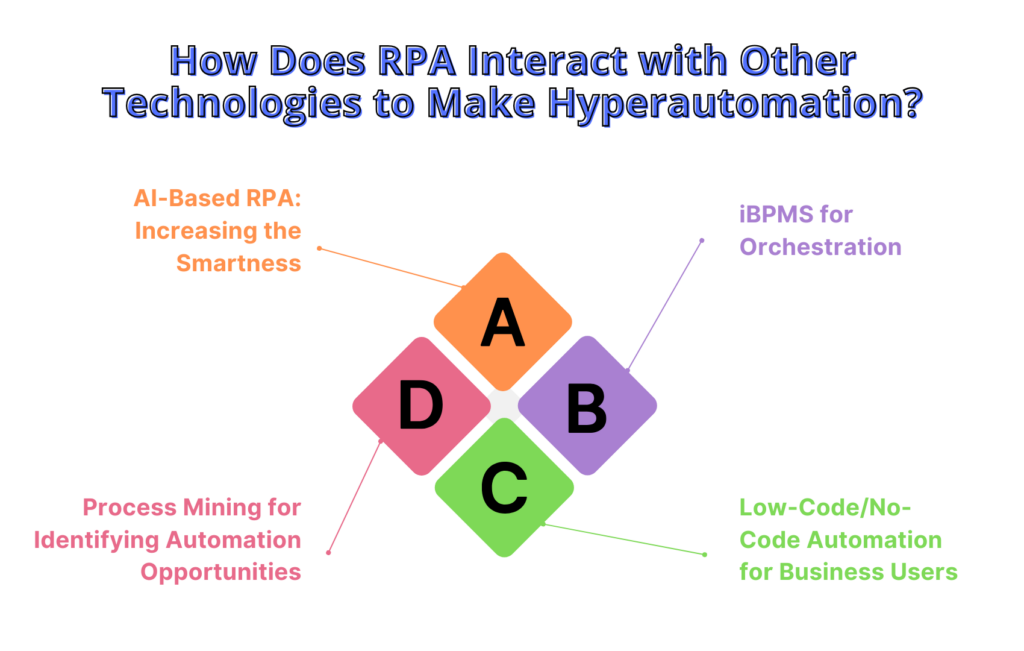
    How Does RPA Interact with Other Technologies to Make Hyperautomation?

    1. AI-Based RPA: Increasing the Smartness

    RPA becomes intelligent by associating with other AI-based technologies.

    • Natural Language Processing (NLP): This facilitates using unstructured emails and chat logs to enable the intelligent routing of communications
    • Machine Learning (ML): These bots increase their performance over time because of the data they draw from the previous records. Hence, it maximizes accuracy and efficiency.
    • Computer Vision: This is an advancement of RPA since it enables one to interface with applications that may or may not contain structured interfaces with no screen present.

    For instance, AI-based RPA can be used in intelligent claims processing in insurance, where it can automatically extract, validate, and route data.

    1. Process Mining for Identifying Automation Opportunities

    Process mining tools assess the workflow and then identify the points of inefficiency by pointing to where automating is likely. The bottleneck found can be automated using RPA, streamlining the processes involved. An example would be if a hospital optimized admission using process mining to automate entry and verification through RPA.

    1. iBPMS for Orchestration

    iBPMS provides governance and real-time automation monitoring; therefore, it executes processes efficiently and effectively. RPA automates some tasks within an extensive process framework managed by iBPMS. For example, order fulfillment in e-commerce involves using RPA to update inventory and ship orders.

    1. Low-Code/No-Code Automation for Business Users

    Low-code/no-code platforms enable nontechnical employees to develop RPA workflows, thus democratizing automation and speeding up hyper-automation adoption. For example, a marketing team can use a low-code tool to automate lead management, freeing time for more strategic activities while improving efficiency.

    RPA's Interaction with Other Technologies to Make Hyperautomation

    What is the Impact Of RPA on Hyperautomation in Terms of Business?

    1. Unleash Full Potential

    Hyperautomation unlocks the true potential of RPA, which is rich in AI, process mining, and intelligent decision-making. The RPA performs mundane tasks, while AI-driven tools optimize workflows and improve decision-making and accuracy.

    For example, RPA bots can process invoice data extraction. AI enhances document classification and validation to ensure everything is automated.

    1. Flexibility and Agility in Operations

    RPA enables businesses to integrate multiple automation tools under one umbrella while still being able to change immediately according to fluctuating market and business situations. This cannot be achieved through static automation, but it provides more scalable and flexible ways of automating workflows with real-time optimization using RPA-based hyperautomation.

    1. Increasing Workforce Productivity

    With the automation of mundane, time-consuming tasks, RPA allows others to apply more of their expertise in strategic thinking, innovation, and customer interaction, thereby improving workforce productivity and further driving the business.

    1. Seamless Interoperability Of Systems

    RPA makes the data exchange and execution of workflows between business units, digital workers or bots, and IT systems invisible. This gives organizations the benefit of faster decisions and effective operations.

    Hyperautomation using RPA provides for efficiency, reduced operational cost, and ROI. Therefore, business benefits range from real-time data processing to automatic compliance checks with easy scalability to stay sustainable and profitable over long periods.

    Conclusion

    Hyperautomation is more than just RPA services—it’s about integrating technologies like AI, process mining, and low-code platforms to drive real transformation.

    Hyperautomation is not just about adding technology to your processes — it’s about rethinking how work flows across your organization. By combining technology intelligently, businesses can automate smarter, work faster, and make decisions with greater accuracy.]

    This powerful digital strategy, driven by RPA services, can not only boost efficiency but also help your organization become more agile, resilient, and future-ready.

    As a leader in the automation solutions firm, SCS Tech supports initiating this digital strategy in organizations to help them move beyond tactical automation to a strategic enabler of that same transformation.

  • What Role Does Blockchain Play in Streamlining Identity Verification for eGovernance Solutions?

    What Role Does Blockchain Play in Streamlining Identity Verification for eGovernance Solutions?

    What if identity verification didn’t mean endless waits, repeated paperwork, and constant data theft risks? These problems are the setbacks of outdated systems, slowing down public services and putting sensitive information at risk. Blockchain solves these issues by streamlining identity verification in eGovernance solutions. It reduces paperwork, speeds up validation, and ensures transparency and security in the process used by governments to verify citizens.

    Blockchain provides a real-time auditable record because of its unique, decentralized, and tamperproof architecture. By this, blockchains ensure clarity between citizens as well as governmental institutions.

    But how exactly does blockchain revolutionize identity verification in eGovernance? In this blog we will first look into its impact before taking a more detailed look at the key flaws of traditional identity systems and why an upgrade is long overdue.

    The Problems of Traditional Identity Verification in eGovernance

    1. Centralized Databases Are Easy Prey for Cyberattacks

    Most government identity verification systems rely on central databases, representing an attractive target for attackers. The recent OPM hack in the U.S. demonstrated this risk. Once hacked, sensitive citizen data is instantly available on the dark web.

    1. Data Silos and Repetitive Verification Processes

    Government agencies are not interlinked; each agency maintains a separate database of identities. This has created the need for citizens to continuously furnish the same information for services like health, social security, and driving licenses.

    1. Lack of Transparency and Trust

    Citizens do not know where and how their identity data is stored and accessed. An auditable system cannot be available; identity misuse and unauthorized access become widespread. The lack of public trust in the eGovernance solution prevails.

    1. High Costs and Inefficiencies

    Complex identity verification systems, fraud fighting and manual checking of documents impose a burden on government resources. Inefficiencies in service delivery and increased operational costs result.

    What Role Does Blockchain Play in Streamlining Identity Verification for eGovernance Solutions?

    Blockchain redefines the entire landscape of verification through identities. Let’s break it down as to how it solves the above issues:

    • Decentralized Identifiers (DIDs): Empowering Citizens

    DIDs allow people to be in control of their digital identity. Instead of government-issued IDs stored in centralized databases, users store their credentials on a blockchain. Citizens selectively disclose only the necessary information, which enhances privacy.

    • Verifiable Credentials (VCs): Instant and Secure Authentication

    VCs are cryptographically signed digital documents demonstrating identity attributes like age, citizenship, or educational qualifications. Governments can issue VCs to citizens and use them to access public services without excessive disclosure of personal data.

    • Zero-Knowledge Proofs (ZKPs): Privacy-Preserving Verification

    With ZKPs, a person may prove identity and conceal all details. For instance, one citizen can prove they are above 18 years old without revealing their birth date. This minimizes the data exposure and theft of one’s identity.

    • Smart Contracts: Automating Verification Processes

    Smart contracts enforce pre-defined verification rules without any human intervention. For example, a smart contract can immediately approve or reject citizen’s applications for government benefits based on the eligibility criteria by checking the VC.

    Role of Blockchain in Streamlining Identity Verification for eGovernance Solutions

    Real-Time eGovernance Blockchain Solutions

    1. Safe Digital Voting

    Blockchain ensures secure voting and increases the integrity of elections. Citizens get registered with a DID, receive a VC from an electoral commission, and vote anonymously on a tamper-proof ledger. ZKPs verify whether a voter is eligible to vote without disclosing their identity.

    1. Digital Identity Wallet for Social Welfare Programs

    Governments can provide VCs that prove their entitlement to welfare schemes. These are kept in digital purses, and the citizen will withdraw his benefit without requiring documents each time.

    1. Cross-Border Identity Verification

    The immigrants possess blockchain-verified credentials for identity, educational qualifications, and work experience. Immigration departments use smart contracts that authenticate credentials to help avoid tedious delays and paperwork over the authenticity of the same.

    Solution of Blockchain’s Issues in eGovernance

    Even though blockchain comes with many advantages, its significant concerns that need to be addressed are scalability, interoperability, and governance. Here’s how they are being addressed:

    1. Scalability Solutions

    Rollups and sidechains are some of the layer-2 scaling solutions that make it possible to achieve high transaction throughput and reduce congestion on the blockchain to increase efficiency.

    1. Interoperability Across Platforms

    Cross-chain bridges and atomic swaps protocols facilitate identity verification across multiple blockchain networks and jurisdictions to be integrated with existing eGovernance frameworks seamlessly.

    1. Privacy and Compliance

    Homomorphic encryption and secure multi-party computation further enhance data privacy while maintaining compliance with GDPR. The governance framework should be well-defined by governments to govern blockchain-based identity systems.

    1. Quantum-Resistant Cryptography

    With the evolution of quantum computing, blockchain networks have been moving towards quantum-resistant cryptographic algorithms for long-term security.

    Future of Blockchain Identity in eGovernance

    The adoption of blockchain for identity verification is just beginning. Future advancements will include:

    • Self-Sovereign Identity (SSI): Citizens will fully own and control their digital identities without intermediaries.
    • AI-Powered Identity Verification: AI will detect fraud, improve security, and enhance user experience.
    • Decentralized Autonomous Organizations (DAOs): It is the management of digital identities in a transparent, autonomous manner and decentralized one.
    • Metaverse Identities: Blockchain can facilitate secure identities maintained virtually in virtual worlds and digital transactions.

    Conclusion

    Blockchain for identity verification is revolutionizing eGovernance solutions. It eliminates centralized vulnerabilities, reduces verification costs, and enhances trust in blockchain-based identity solutions, opening avenues for efficient, transparent, and secure public services.

    The future digital identity will be decentralized, user-centric, and fraud-resistant for governments and institutions embracing this technology.

    SCS Tech is committed to create this future to help businesses and governments navigate this ever-changing digital landscape. Blockchain identity solutions aren’t just the future—they are the present.

  • How Can Digital Oilfields Reduce Downtime with Oil and Gas Technology Solutions?

    How Can Digital Oilfields Reduce Downtime with Oil and Gas Technology Solutions?

    Unplanned downtime costs the oil and gas industry billions each year. In fact, research shows that companies with a reactive maintenance approach spend 36% more time in downtime than those using data-driven, predictive maintenance strategies. The difference?

    A potential $34 million in annual savings. With such high stakes, it’s no longer a question of whether the oil and gas industry should adopt digital transformation in oil and gas — it’s about how to implement these innovations to maximize efficiency and reduce costly downtime.

    The answer lies in Digital Oilfields (DOFs), which seamlessly integrate advanced technologies to optimize operations, improve asset reliability, and cut costs.

    In this blog, let’s explore how Digital Oilfields revolutionize operations and reshape the future of the oil and gas industry.

    How Does Digital Oilfields Seamless Integration Revolutionize Operations?

    Digital Oilfields solutions implement Industrial IoT (IIoT) for Oil & Gas, real-time analysis, and automation to streamline operations, predict likely breakdowns, and drive peak asset efficiency. Predictive maintenance for Oil & Gas enables firms to visualize equipment in real-time, predict breakdowns in advance, and do everything possible to avoid downtime.

    Digital Oilfield transformation replaced traditional operations with man-critical and reactive modes to data-centered, AI-led decision-making. This improves the oil and gas industry’s safety, sustainability, and profitability. However, the need to understand the key causes of downtime is crucial in addressing these challenges and minimizing operational disruptions.

    The Key Drivers of Downtime in Oil & Gas Technology Solutions

    1. Equipment Failures: The Number-One Contributor

    Equipment breakdown is one of the significant sources of unplanned downtime. Several reasons are involved, including:

    • Corrosion: Sour crude (high sulfur) pipelines deteriorate over time by electrochemical action, especially at welds, bends, and dead legs.
    • Erosion: Sand-and-similar-abrasive-content high-speed fluids in fracking erosion erode pump impellers, chokes, and pipes.
    • Fatigue: Alternating pressure changes and vibration fatigue cause pipes to be damaged, usually at stress concentrators and threaded joints.
    • Scaling & Fouling: Mineral (such as calcium carbonate) and organic depositing in heat exchangers and pipes diminishes flow efficiency and causes shutdowns.
    • Cavitation & Seal Failures: Shock waves from collapsing vapor bubbles form when sudden pressure drops create vapor bubbles, which wear out the seals and pump impellers.

    2. Human Errors: Beyond Simple Mistakes

    Human error accounts for most of the oil and gas downtime due to the following:

    • Complacency: Routine work causes operators to overlook warning signs.
    • Communication Breakdowns: Communication breakdowns between operations, maintenance, and engineering personnel can delay problem-solving.
    • Poor Procedures & Information Overload: Inadequate procedures and excessive information overload can lead to misestimation.
    • Normalization of Deviance: Repeatedly exceeding operating limits by a small margin can lead to failures of catastrophic magnitude.

    3. Poor Planning & Scheduling

    Maintenance schedules and turnarounds, if not planned well, can cause downtime due to:

    • Scope Creep: Unplanned expansion of maintenance work that causes delay.
    • Poor Inventory Management: No spares available, resulting in prolonged downtime.
    • Lack of Redundancy & Single Supplier Over-Reliance: Supply chain interruption can bring operations to a standstill.

    With these major challenges in mind, the next logical step is understanding how Digital Oilfields tackle them.

     Key Drivers of Downtime in Oil & Gas Technology Solutions

    How Digital Oilfields Minimize Downtime?

    1. Real-Time Monitoring with Industrial IoT in Oil & Gas

    The newest IoT sensors bring critical information about equipment conditions so that proactive maintenance practices can be exercised. Some of those are:

    • Vibration Sensors: Picks up pump and compressor misalignments and bearing wear.
    • Acoustic Sensors: Picks up pipeline and pressure system leaks by detecting ultrasonic noises.
    • Corrosion Probes: Quantifies corrosion type, rate, and causative factors for effective mitigation.
    • Multiphase Flow Meters: Offers precise measurement of oil, gas, and water flow rates to prevent slugging and optimize production.

    2. Predictive Maintenance in Oil & Gas: AI-Driven Insights

    Artificial Intelligence (AI) and as well as Machine Learning (ML) based predictive analytics allow companies to predict failures before their occurrence. Some of the key applications are:

    • Failure Prediction Models: AI models consider historical failure records to predict the future failure of equipment.
    • Remaining Useful Life (RUL) Estimation: Machine learning estimates the time before a component fails, allowing for proper maintenance planning.
    • Anomaly Detection: Detects deviations in normal operating conditions, indicating future problems.
    • Prescriptive Analytics: Provides accurate recommendations for proactive actions to optimize equipment life.

    3. Automation & Remote Operations: Reduction of Human Error

    • Automated Control Systems: Allows operating conditions (e.g., temperature, flow rates, pressures) to be managed with real-time feedback.
    • Robotic Inspections: Robotic scanning of pipes and offshore rigs reduces human exposure to hazardous conditions.
    • Remote Monitoring & Control Centers: Operators remotely manage Assets from centralized facilities for enhanced productivity and savings.

    4. Digital Twins: Virtual Copies to Optimize

    Digital Twins are virtual copies of physical assets using AI to imitate real-time operations which include:

    • Real-Time Data Sync: Synchronizes with real-time sensor inputs in real-time.
    • Scenario Planning & Training: Mimics several operating scenarios to predict simulation and train operators.

    5. Advanced Digital Oilfield Technologies

    • Tank & LPG Level Monitors: Detect leaks and temperature stratification and predict evaporation/condensation rates.
    • Smart Flow Meters: Recognize multiphase flows and detect anomalies.
    • Thief Hatch Sensors: Recognize intrusions and monitor gas emissions.

    Conclusion

    The oil and gas industry is an area of convergence where industrial IoT, predictive maintenance, and automation are no longer a necessity. As digital oilfields offer more than digitization, they represent a shifting paradigm that decreases downtime, enhances safety, and delivers improved profitability.

    Therefore, businesses with digital oilfields can leverage the real potential of oil and gas technology solutions by using analytics, real-time monitoring, and AI-driven automation.

    With this technology, businesses can hence achieve operational excellence and success in the long run. SCS Tech supports oil and gas companies with cutting-edge digital solutions to re-imagine their businesses to be efficient, resilient, and industry-fit for the future.