

Most upstream oil and gas teams already use some form of digital tools, whether it’s SCADA systems, production monitoring software, or sensor data from the field. These are all examples of oil and gas technology that play a critical role in modernizing upstream workflows.
But in many cases, these tools don’t work well together. The result? Missed opportunities, duplicated effort, and slow decisions.
A digital roadmap helps fix that. It gives you a clear plan to use technology in ways that actually improve drilling, production, and asset reliability, not by adding more tools, but by using the right ones in the right places.
This article outlines the important elements for developing a viable, execution-ready plan specific to upstream operations.
What a Digital Roadmap Looks Like in Upstream Oil and Gas
In upstream oil and gas, a digital roadmap isn’t a general IT plan; it’s an execution-driven guide tailored for field operations across drilling, production, and asset reliability. These roadmaps prioritize production efficiency, not buzzword technology.
A practical digital transformation in oil and gas depends on grounding innovation in field-level reality, not just boardroom strategy.
Most upstream firms are using technologies like SCADA or reservoir software, but these often remain siloed. A smart roadmap connects the dots, taking fragmented tools and turning them into a system that generates measurable value in the field.
Here’s what to include:
- Use Case Alignment – Focus on high-impact upstream areas: drilling automation, asset integrity, reservoir management, and predictive maintenance. McKinsey estimates digital tech can reduce upstream operating costs by 3–5 % and capex by up to 20 %.
- Targeted Technology Mapping – Defining where AI/IOT or advanced analytics fit into daily operations is invaluable. This is where next-gen oil and gas technology, such as edge computing and real-time analytics, can proactively prevent failure and improve uptime.
- Data Infrastructure Planning – Address how real-time well data, sensor streams, and historical logs are collected and unified. McKinsey highlights that 70 % of oil firms stall in pilot phases due to fragmented data systems and a lack of integrated OT/IT infrastructure.
- Phased Rollout Strategy – Begin with focused pilots, like real-time drilling performance tracking, then expand to multiple fields. Shell and Chevron have successfully used this playbook: validating gains at a small scale before scaling asset-wide
Rather than a one-size-fits-all framework, a strong upstream digital roadmap is asset-specific, measurable, and built for execution, not just strategy decks. It helps upstream companies avoid digitizing for the sake of it, and instead focus on what actually moves the needle in the field.
Building a Digital Roadmap for Upstream Oil and Gas Operations
A digital roadmap helps upstream oil and gas teams plan how and where to use technology across their operations. It’s not just about picking new tools, it’s about making sure those tools actually improve drilling, production, and day-to-day fieldwork.
The following are the critical steps to creating a roadmap that supports real goals, not just upgrades to digital.
Step 1: Define Business Priorities and Operational Pain Points
Before looking at any technology, you need to clearly understand what problem you’re trying to solve – that’s step one to building a digital roadmap that works, not just for corporate, but also for the people who are running wells, rigs, and operations every day.
This starts by answering one question: What are the business outcomes your upstream team needs to improve in the next 12–24 months?
It could be:
- Reducing non-productive time (NPT) in drilling operations
- Improving the uptime of compressors, pumps, or separators
- Lowering the cost per barrel in mature fields
- Meeting environmental compliance more efficiently
- Speeding up production reporting across locations
These are not just IT problems; they’re business priorities that must shape your digital plan.
For each priority, define the metric that tells you whether you’re moving in the right direction.
| Business priority | Metric to track |
| Reduce NPT in drilling | Avg. non-productive hours per rig/month |
| Improve asset reliability | Unplanned downtime hours pre-asset |
| Lower operational costs | Costs per barrel (OPEX) |
| Meet ESG reporting requirements | Time to compile and validate compliance data |
It is simple to understand which digital use cases merit efforts once you have assigned numbers to the goals you established. This is where strategic oil and gas industry consulting adds value by turning operational pain points into measurable digital opportunities.
Step 2: Audit Your Existing Digital Capabilities and Gaps
Now that you have the agreed consideration for what priorities you want to strengthen in your upstream activities, the second step is to identify your existing data capabilities, tools, and systems, and assess how well they support what you want to achieve.
It is not an inventory of software. You’re reviewing:
- What you have
- What you’re underutilizing
- What’s old or difficult to scale
- And what you’re completely lacking
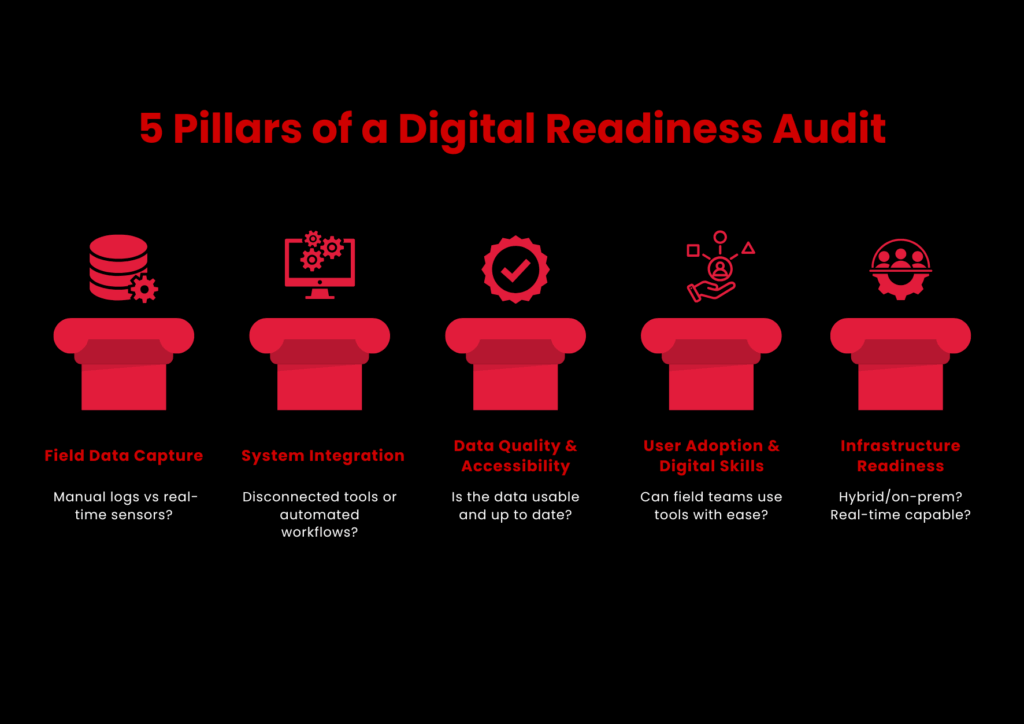
A successful digital transformation in oil and gas starts with a clear-eyed view of your current tools, gaps, and data flows.
Focus Areas for a Practical Digital Audit
Your audit should consider five priority areas:
- Field Data Capture
- Do you still use manual logs or spreadsheets for day-to-day production, asset status, or safety reports?
- Do you have sensors or edge devices? Are they available and connected?
- Is field data captured in real-time or batched uploads?
- System Integration
- Are SCADA, ERP, maintenance software, and reporting tools communicating?
- Are workflows between systems automated or manually exported/imported?
- Data Quality and Accessibility
- How up-to-date, complete, and clean is your operational data?
- Do engineers and analysts access insights easily, or do they depend on IT every time?
- User Adoption and Digital Skill Levels
- Are digital tools easy to use by field teams?
- Is there ongoing training for digital tools besides initial rollouts?
- Infrastructure Readiness
- Are you running on cloud, on-premises, or a hybrid setup?
- Do remote sites have enough connectivity to support real-time monitoring or analytics?
Step 3: Prioritize High-Impact Use Cases for Digitization
A digital roadmap fails when it attempts to do too much or gets the wrong priorities. That’s why this step is about selecting the correct digital use cases to begin with.
You don’t require a long list. You require the correct 3–5 use cases that align with your field requirements, provide early traction, and enable you to gain momentum.
How to Select and Prioritize the Right Use Cases
Use three filters:
-
Business Impact
Does it materially contribute to your objectives from Step 1? Can it decrease downtime, save money, enhance safety, or accelerate reporting?
-
Feasibility
Do you have sufficient data and infrastructure to enable it? Can you deploy it with your existing team or partners?
-
Scalability
If it works in one site, can you expand it across other wells, rigs, or regions?
Plot your candidates on a simple Impact vs. Effort matrix and focus first on the high-impact, low-effort quadrant.
These examples have been validated industry-wide in both onshore and offshore environments:
| Use cases | What it solves | Why it works |
| Predictive maintenance for rotating equipment | Unexpected failures, costly unplanned downtime | Can reduce maintenance costs by up to 25% and unplanned outages by 70% (GE Digital) |
| Automated drilling performance tracking | Slow manual analysis of rig KPIs | Speeds up decision-making during drilling and improves safety |
| Remote monitoring of good conditions | Infrequent site visits, delayed issue detection | Supports real-time response and better resource allocation |
| AI-driven production forecasting | Inaccurate short-term forecasts, missed targets | Helps optimize lift strategies and resource planning |
| Digital permit to work systems | Paper-based HSE workflows | Improves compliance tracking and field audit readiness |
Don’t select use cases solely on tech appeal. Even AI won’t work if there’s dirty data or your field staff can’t use it confidently.
Step 4: Build a Phased Roadmap with Realistic Timelines
Many digital transformation efforts in upstream oil and gas lose momentum because they try to do too much, too fast. Teams get overwhelmed, budgets stretch thin, and progress stalls. The solution? Break your roadmap into manageable phases, tied to clear business outcomes and operational maturity.
Many upstream leaders leverage oil and gas industry consulting to design phased rollouts that reduce complexity and accelerate implementation.
Here’s how to do it in practice.
Consider your shortlist in Step 3. Don’t try to do it all immediately. Rather, classify each use case into one of three buckets:
- Quick wins (low complexity and ready for piloting)
- Mid-range initiatives (need integrations or cross-site collaboration)
- Long-term bets (advanced analytics, AI, or full-scale automation)
Suppose you begin with production reporting and asset monitoring:
| Phase | What happens | When |
| Test | Pilot asset condition monitoring on 3 pumps | Month 1-3 |
| Expand | Roll out monitoring to 20+ pumps across fields | Month 4-12 |
| Integrate | Link monitoring with maintenance dispatch + alert automation | Month 13-24 |
This strategy prevents your teams from getting tech-fatigued. Every victory wins over trust. And above all, it makes leadership visible, measurable value, nota digital aspiration.
Step 5: Monitor, Iterate, and Scale Across Assets
Once your roadmap is in motion, don’t stop at rollout. You need to keep track of what’s working, fix what isn’t, and expand only what brings real results. This step is about building consistency, not complexity.
- Regularly review KPIs to determine if targets are being achieved
- Gather field feedback to identify adoption problems or technical holes
- Enhance and evolve based on actual usage, not projections
- Scale established solutions to comparable assets with aligned needs and infrastructure
This keeps your roadmap current and expanding, rather than wasting time on tools that do not yield results.
Conclusion
Creating a digital roadmap for upstream oil and gas operations isn’t a matter of pursuing fads or purchasing more software. Effective use of oil and gas technology is less about adopting every new tool and more about applying the right tech in the right phase of field operations.
It’s setting your sights on the right objectives, leveraging what you already have better, and deploying technology in a manner that your teams can realistically use and expand upon.
This guide took you through every step:
- How to set actual operational priorities
- How to conduct an audit of your existing capability
- How to select and deploy high-impact use cases
- How to get it all done on the ground, over time
But even the most excellent roadmap requires experience behind it, particularly when field realities, integration nuances, and production pressures are at play.
That’s where SCSTech is.
We’ve helped upstream teams design and implement digital strategies that don’t just look good on paper but deliver measurable value across assets, people, and workflows. From early audits to scaled deployments, our oil and gas industry consulting team knows how to align tech decisions with business outcomes.
If you’re planning to move forward with a digital roadmap, talk to us at SCSTech. We can help you turn the right ideas into real, field-ready results.