Category: CyberSecurity

  • How to Design a Network Operations Center in a Winning Way

    How to Design a Network Operations Center in a Winning Way

    A network operations center is an IT infrastructure management unit that has become a necessity for many companies, especially those who have to see to multiple networks on a regular basis. A NOC gives an opportunity of 24/7/365 IT infrastructure monitoring, troubleshooting and foreseeing network failures to ensure high network uptime and stable functioning of applications and databases. However, establishing an orderly NOC is quite challenging. The first step you should take is to choose the NOC’s structure that will determine your resource needs. Below, I explain how adopting a multi-tier model used in most of today’s large NOCs will help you build a structured and smoothly functioning NOC in your company.
    NOC design in tiers

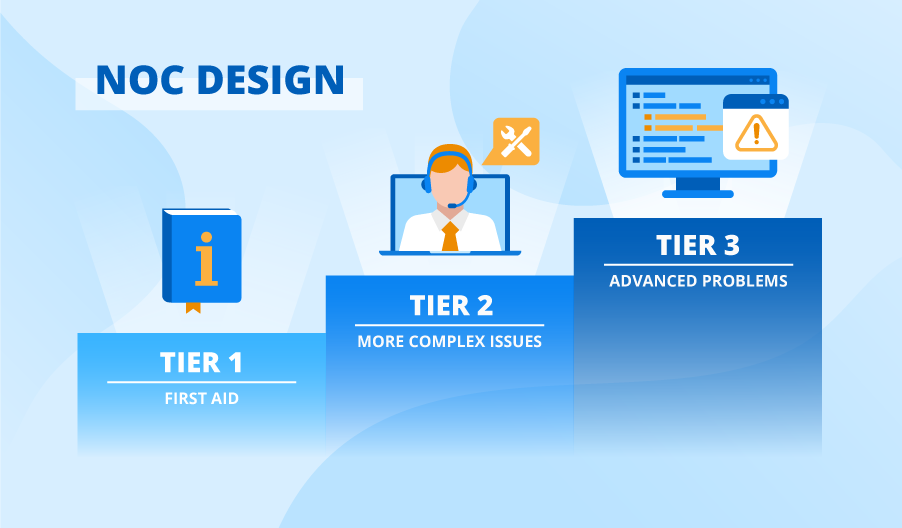
    A multi-tier model to network operations center design helps effectively distribute responsibilities among different NOC levels, according to the skills and experience of NOC engineers and the complexity of issues they deal with.

    NOC Tier 1 – First aid

    At this level, NOC staff receives infrastructure-related requests and deals with simple network issues, such as login problems, checking proper network configurations. NOC Tier 1 specialists can use problem-solving scripts containing step-by-step instructions on how to tackle issues quickly. Problems that require a higher level of technical expertise are escalated to NOC Tier 2 specialists.

    NOC Tier 2 – More complex issues

    This level is represented by more tech-savvy specialists who deal with thornier network issues, which often requires a deeper understanding of the supported IT infrastructure. Some common tasks at NOC Tier 2 include resolving configuration issues, account administration, services restart, etc. If an issue involves more detailed research on the code level, it is escalated to NOC Tier 3.

    NOC Tier 3 – Advanced problems

    Tier 3 serves as the top escalation point for NOC Tier 1 and Tier 2 specialists. Tier 3 engineers are responsible for handling issues on the code or database level and provide hot fixes. Resolving issues at NOC Tier 3 requires development skills, so you can either keep it in-house or outsource to a vendor who is ready to work at the backend level.

    Build an orderly NOC

    A properly chosen structure is the key to a smoothly functioning network operations center. By choosing a multi-tier model with proper escalation procedures for your NOC, you can resolve IT infrastructure issues of different complexity promptly and make your IT infrastructure truly reliable. If you’d like to entrust the design and management of your network operations center to a reliable service provider, feel free to contact us.


     

  • What Is Cyber Risk Management?

    What Is Cyber Risk Management?

    Cyber risk management is the process by which you determine potential cyber threats, and then put measures into place to keep those threats at acceptable levels. Your cyber risk management efforts should be formalized into a plan, which should then be updated often to stay current with evolving cybersecurity threats.

    Considering just how dangerous cyber-criminals can be to your organization, a current cybersecurity framework is no longer just a good idea; it’s required. Cybersecurity risk management is so important that multiple organizations offer guidance and standards to mitigate cyber threats. The National Institute of Standards and Technology (NIST) is one; the International Organization for Standardization (ISO) is another.

    Cybersecurity risk is the likelihood your company might suffer damages because of a successful cyber-attack. This risk includes data breaches, loss of critical information, regulatory enforcement (including monetary penalties) due to a breach, or damage to your reputation after a cybersecurity event. Risk is different from uncertainty in that risk can be measured, and protected against. For example, you can block phishing attempts or build strong firewalls (a risk) but you cannot stop a hurricane from downing your WI-Fi networks for a whole day (uncertainty).

    This means you should evaluate your business several times a year to understand how your company adheres to current information security protocols, and what new threats may have developed since your last analysis. This evaluation is known as a cybersecurity risk assessment. Regular risk assessments will help in implementing a scalable cybersecurity framework for your business.

    What Are the Different Types of Cybersecurity Risk?

    Cybersecurity risks come in many forms, and CISOs should be aware of all them when developing your risk management process. To start, the four most common cyber-attacks are:

    Malware: Malicious software that installs itself that causes abnormal behavior within your information system;
    Phishing: Emails or messages that trick users into revealing personal or sensitive data;
    Man-in-the-Middle attack (MitM): Cyber-criminals eavesdrop on private conversations to steal sensitive information; and
    SQL injection: A string of code is inserted in the server, prompting it to leak private data.

    When building your risk management strategy, prioritize which common cyber incidents you want to prepare for. Strategizing for those most likely to occur within your business, or for those events where regulatory compliance obligates you to address them. Then you can move forward with creating an effective risk management program.

    Why Is Cyber Risk Management Important?

    Your business should always be learning how to adapt to changing cybersecurity standards while also monitoring potential threats.

    A cybersecurity event like an internal data breach or a successful cyber-attack can cause significant financial losses. It can also create disruptions in the day-to-day operations of your business, as you inform employees and customers of the breach and the steps you’ll take in response.

    By maintaining regular cyber risk management you can keep the chances of a cybersecurity event low, protecting your business for the long term.

    What Is the Cybersecurity Risk Management Process?

    Cybersecurity risk management is an ongoing process that involves regular monitoring and frequent analysis of existing security protocols. Generally, a cyber risk manager will work with key stakeholders and decision-makers across the business to draft a cybersecurity risk statement, where potential risks are identified as well as the company’s tolerance for each risk. Then, safety measures and training are matched with each cybersecurity risk.

    The organization then follows policies and procedures in its daily operations to keep cybersecurity threats at a minimum, and the cybersecurity risk manager monitors the overall security posture. From time to time the risk manager should also report on how well security protocols are helping to mitigate cyber risks and potential threats, and make recommendations as necessary to improve security for the evolving threat landscape.

    A follow-up risk assessment may be required to update the risk management strategy currently in place.

    SCS Tech offers cybersecurity services for Large Enterprises and SME’s. Our experts help you navigate your cybersecurity needs as your business scales, whether continuing your current cybersecurity program or building all-new network security.

    To know more about our cybersecurity service visit www.scstechindia.com/

  • Top 5 Reasons Why Cybersecurity is Important

    Top 5 Reasons Why Cybersecurity is Important

    Cyber attacks are widespread, which can harm millions of people. Organizations can be shut down. Services can’t be provided to citizens. Widespread cyber attacks configuration of cloud services with increasing cybercriminal attacks risk the organization and its process.

    The days are gone for simple firewalls antivirus software which helped us to secure our data and identity.

    Cyber threats can arrive from any level of association. Cybersecurity is no longer something any company can ignore. Security regularly affects businesses of all sizes and makes them causing reversible reputational damage to the companies involved.

    Why is cybersecurity critical?

    Cybersecurity is the event or process of recovering and protecting computer systems, devices, networks, and programs from any cyber attack.

    Cyber attacks are increasingly causing danger to your sensitive data, as attackers employ new methods of artificial intelligence and social engineering to your traditional security controls.

    The world is frequently reliant on technology. This dependence will continue as we introduce the next generation of smart internet-enabled devices that have access to our networks via Wi-Fi and Bluetooth.

    Let’s explore its importance:

    1. Cyber-attacks affect all

    Cyber attacks can cause electrical power outages, the disappointment of military equipment, and breaches of national security privileged insights. They can bring about the theft of important, sensitive information like clinical records. They can upset telephone and PC organizations or paralyze frameworks, making information inaccessible.

    Cyber attacks can occur on a worldwide scale, also with programmers breaking government organizations. It is such a danger that atomic plants can be assaulted, causing a nuclear calamity with a considerable number of lives lost. These digital worms made centrifuges heat up and may have caused a blast costing human lives.

    1. Rapid technological change will benefit

    With the launch of the 5G network, a significant expansion of multidimensional cyber attack vulnerability increased. The new system requires a similar redefined cyber strategy. By further stating the increase in cyber attacks of the software, it will be challenging to retool how organizations would save the virtual network of the 21st century. Modern technologies like IoT are increasing the number of devices connected, and there will be approximately 400 billion connected devices by the end of 2022.

    1. Damage to organization and loss of jobs

    There has been a lot of breaches of companies in recent years. Organizations should conduct phishing simulation tests to test the awareness of employees. It should be done initially before and after training to measure the improvement areas of your employees. Creating an incident response strategy will allow organizations to stay ahead of the attack. It will ensure your quick response on the offense to keep the attackers from getting a hold of sensitive data.

    1. Cybersecurity threats faced by individuals

    Not just do countries and organizations face dangers from the actions and intentions of hackers, yet people face numerous risks too. Identity theft is a colossal issue, where hackers steal a person’s very own data and sell it for benefit.

    This likewise puts the individual security of an individual and their family in danger. This happened in various events, and a million of Rs was lost to the detriment of the person in question. In different cases, the programmers use coercion and blackmail in the wake of taking their identity and requesting recover cash to make no further move. This is particularly valid for high-profile identity theft cases of superstars or individuals with high net worth.

    1. Cyber concerns may result in increased regulation and legislation

    With cybersecurity threats increasing, new laws and regulations can be placed to protect the consumer from attacks. It means that increased legislation and regulations may soon become a reality. Citizens need to be made aware of laws that are passed and make sure that their organizations comply with the laws. The laws specified for cybersecurity will result in better functionality and process of the organization resulting in more safe and secure data-driven solutions for clients.

    SCS Tech specializes in designing, building, and running optimized security solutions which help the organization and individuals defend against all cybersecurity attacks. Write to us to learn more about how we can help: info@scstechindia.com