
Category: data secuirty

  • How Custom Cybersecurity Solutions Protect Cloud, Mobile, and On-Site Systems?

    How Custom Cybersecurity Solutions Protect Cloud, Mobile, and On-Site Systems?

    Just 39 seconds—that’s all it takes for a cyberattack to strike, faster than you can reply to your emails.

    This alarming frequency indicates the urgent need for cybersecurity solutions. With every company relying on cloud computing, mobile devices, and on-site infrastructure, the demand for robust protection has never been greater. While each environment has its own unique vulnerabilities, cyber security consulting services help organizations identify and address these gaps effectively. General security measures may cover major threats, but expert consulting ensures even the less obvious vulnerabilities are not overlooked.

    That is where custom cybersecurity solutions come in for each system, which are different, specified according to their needs, and used to counter specific threats.

    Let’s discuss, in detail, each of the challenges presented by cloud, mobile, and on-site systems. Understand how custom cybersecurity solutions overcome those challenges, and improve security in each.

    Security of Cloud Systems: Overcoming Unique Security Challenges

    With the advent of cloud computing, tremendous flexibility and scalability emerged for businesses, but they differ through unique risks. With various users sharing cloud environments and being managed by third parties, they pose unique security issues that vary from traditional systems.

    What Are the Challenges in Cloud Security?

    • Data Breach: When sensitive information is stored in the cloud, it is most vulnerable to unauthorized access, especially if it has weak credentials or is not configured correctly.
    • Account Hijacking: Compromise from phishing leads to allowing attackers access to valuable information.
    • Insecure API: An insecure API control can be equated to an open door for an attacker with services in the cloud.
    • Compliance Complexities: These are the complexities of the compliance cloud configurations that must be put into strict regulatory standards like GDPR or HIPAA. This is challenging to implement effectively.

    How Do Custom Cybersecurity Solutions Enhance Cloud Security?
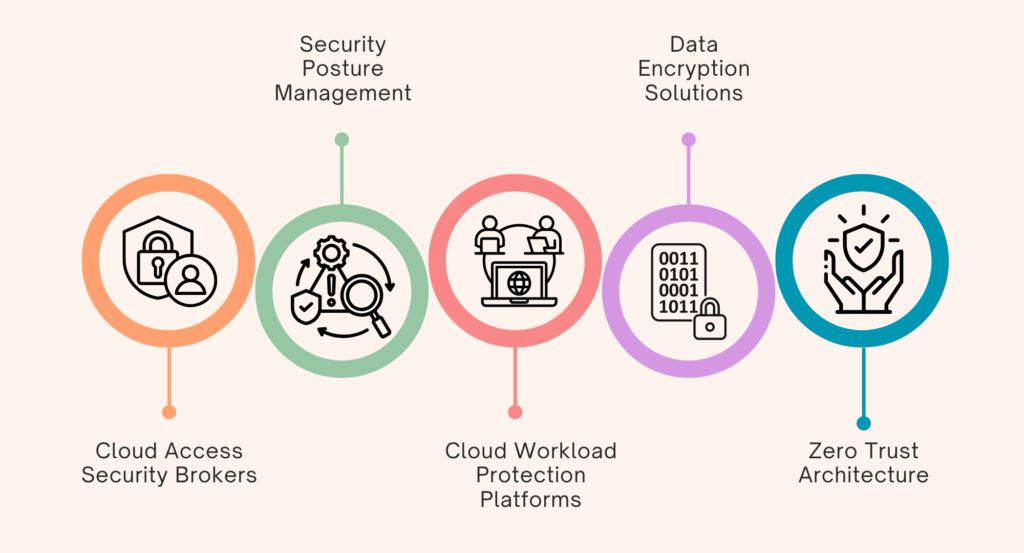
    Discover how custom cybersecurity solutions provide tailored protection for secure cloud environments

    1. Cloud Access Security Brokers (CASBs): CASBs serve as security layers between the cloud provider and the user base. It provides
      1. Data Protection: CASBs enforce data-loss-prevention policies through enforcing DLP policies by monitoring how data is transferred and blocking unauthorized access to sensitive information.
      2. Threat Detection: They use behavioral analytics to detect anomalies in user behavior that might suggest a breach.
      3. Compliance Management: CASBs help keep organizations compliant with all the appropriate industry regulations based on audit trails and reporting.
    2. Security Posture Management (SPM): SPM tools continuously watch for identifying vulnerabilities and misconfigurations in the cloud environments. This is done through:
      1. Vulnerability Scanning: Scanner tools that scan for all misconfigurations and known vulnerabilities in cloud resources.
      2. Compliance Audits: Periodic audits that the configurations adhere to best security practices and the appropriate regulations from the mandate.
    3. Cloud Workload Protection Platforms (CWPP): They protect the applications running in the cloud by analyzing activity in real-time and blocking unauthorized access attempts.
      1. Runtime Protection: The CWPP can detect real-time threats by protecting applications against malicious activity.
      2. Intrusion Prevention: The CWPP prevents any unauthorized access attempt and reduces the attack’s impact on workloads.
    4. Data Encryption Solutions: Encryption at rest, associated with the storage of data, and in motion, associated with the transfer of data utilise strong algorithms such as Advanced Encryption Standard (AES) coupled with Rivest-Shamir-Adleman (RSA) ensuring the integrity of data as it flows through all its stages of the life cycle.
      1. Encryption at Rest: With strong encryption algorithms such as AES-256, data is encrypted to secure those at rest in the cloud.
      2. Encryption in Transit: Encryption protocols, such as TLS/SSL, consist of specific ones that encrypt data between users and cloud services.
    5. Zero Trust Architecture: Zero Trust continuously verifies users and devices, limits network access, and controls lateral movement. This architectural model is designed so that not a single user or device should be trusted by default, regardless of whether they are inside or outside the network perimeter.
      1. Identity Verification: MFA ensures only the proper users can access cloud resources.
      2. Micro-Segmentation: This involves limiting lateral movement as the workload is segmented so multiple attack vectors remain inaccessible to the hackers if one resource is compromised.

    Mobile Systems: Unique Risks and Custom Solutions for Security

    The increasing use of mobile devices in the workplace has become a meaningful way to access company information. Still, they also pose vulnerabilities due to their portability and high connectivity. Among mobile security threats are malware attacks, phishing scams, and accidental data leaks in cases where information is mishandled.

    What Are the Issues in Mobile Security?

    • Threats of Malware: The mobile phone is highly vulnerable to malware that can steal away information or compromise system operations.
    • Phishing Attacks: Mobile phishing attacks target mobile users with fake messages that compel the victims to unveil sensitive information.
    • Leakage of Data: The leakage of data is facilitated by mishandling and storing some applications without appropriate security, thereby making them vulnerable.

    How Do Custom Cybersecurity Solutions Improve Mobile Security?
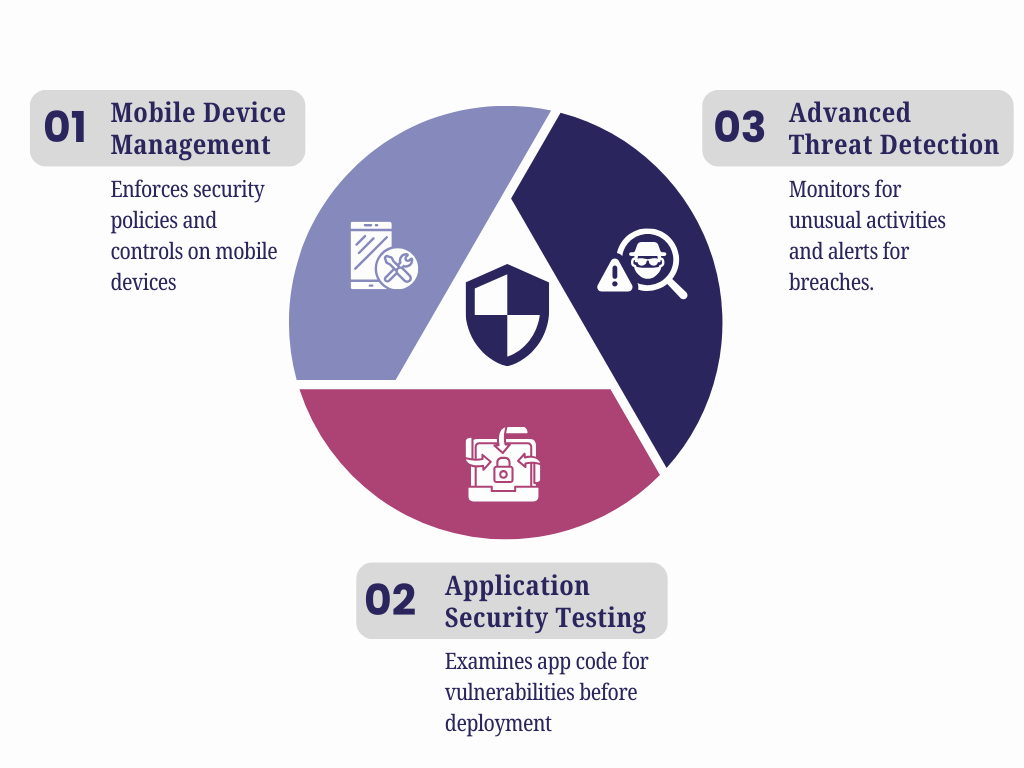
    How to Improve Mobile Security with Custom Cybersecurity Solutions

    1. Mobile Device Management (MDM): MDM will help enforce security policies across mobile devices and controls preventing the installation of unauthorized applications. This is done by:
      1. Wipe Remotely Ability: IT administrators can remotely wipe the data off lost or stolen devices so sensitive information cannot be accessed.
      2. Application Control: MDM enables organizations to mark applications as white lists or black lists depending on security policies to prevent malicious applications from being installed.
    2. Application Security Testing: This examines the code of a mobile application for potential vulnerabilities while simulating attacks to determine hidden weaknesses before deploying the app.
      1. Static Application Security Testing (SAST): It scans for possible weaknesses in the source code that may occur when executed.
      2. Dynamic Application Security Testing (DAST): Running applications are tested for vulnerability through simulated attacks that could reveal the exploits.
    3. Advanced Threat Detection: Behavioral analytics monitor mobile devices for unusual activities and enable an immediate response to potential breaches.
      1. Behavioral Analytics: These systems monitor patterns in the user behavior that signify a potential compromise.
      2. Real-Time Alerts: Instant alerting of suspicious events to allow for prompt investigation and action.

    On-Site Systems: Controlling Internal and Physical Threats through Custom Cybersecurity Solutions

    As businesses continue their digital transformation, on-site systems form the backbone of most organizations, since they provide a direct source of access to data coupled with control.

    They are always vulnerable to internal threats and intrusion by physical persons. Insiders and unauthorized physical intrusion are the main risks to on-site systems.

    What Are the Security Problems in On-Site Systems?

    • Insider Threat: The insiders compromised the security since those authorized to privilege access may misuse their rights.
    • Physical Violations: Unauthorized physical entities entering critical areas directly result in hardware or data exposure.

    How Do Custom Cybersecurity Solutions Improve On-Site Security?
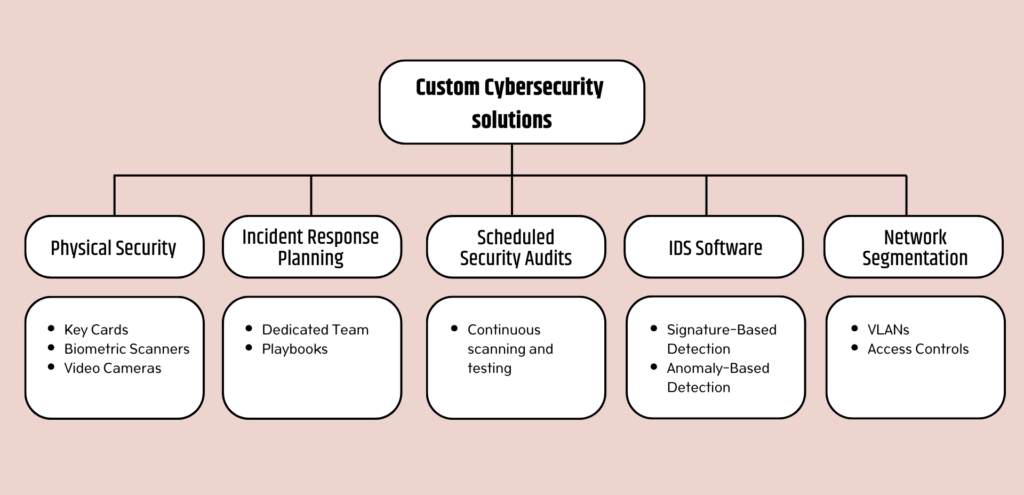
    Learn how custom cybersecurity solutions enhance on-site security by addressing unique vulnerabilities.

    1. Network Segmentation: Division of the network into sub-divisions. Segmentation limits the movement of attackers and restricts access to sensitive data. This format helps isolate breaches, thus protecting the rest of the network.
      1. Virtual Local Area Networks (VLANs): Separation of the different network-level departments reduces the likelihood of lateral movement by an attacker.
      2. Access Controls Between Segments: Strict access controls make sure that only authorized persons gain access to the sensitive segments.
    2. IDS Software: Intrusion Detection Systems (IDS) software keeps track of network traffic by detecting signatures and anomalies, which will notify of a threat in real-time.
      1. Signature-Based Detection: Predefined signatures of known threats are recognized and provide immediate responses to familiar attacks.
      2. Anomaly-Based Detection: This form of detection involves scanning for patterns that don’t fall under the usual traffic profile within the network. The method finds new threats that do not match existing signatures.
    3. Scheduled Security Audit: Periodic scanning for weaknesses and penetration testing will discover and remove all the possible vulnerabilities within the system before hackers take advantage of them.
    4. Incident Response Planning: A dedicated incident response team and a few playbooks for common scenarios ensure that breaches are fast and efficient and the eventual damage is reduced.
    5. Physical Security: Restrict access to building parts using key cards, biometric scanners, and video cameras.

    Conclusion

    Present-day generic solutions fail when unique challenges exist in cloud, mobile, and on-site systems. SCS Tech, a trusted name among the cybersecurity solutions group, provides targeted protection needed to keep data and operations safe.

    Whether planning a new security strategy or seeking to build upon and enhance the existing one, investing in custom cybersecurity solutions is paramount in these times of constant global changes and cyber threats.

     

  • How AI Technology Companies Power Security Operation Centers (SOC) to Enhance Threat Detection?

    How AI Technology Companies Power Security Operation Centers (SOC) to Enhance Threat Detection?

    What if the security system could foresee threats even before they arise?

    That is the power artificial intelligence brings to Security Operation Centers. The role of AI in SOCs is transforming how businesses start to detect and respond to cybersecurity.

    The statistical growth of AI adoption in significant sectors of India has already touched 48% in FY24, a clear pointer to AI’s role in today’s security landscape. This transformation is a trend and redefines cybersecurity for industries with better cyber threat countermeasures.

    This blog will explain to you how AI technology companies enable SOCs to improve in threat detection. We will also demystify some of the significant AI/ML service and trends that are helping improve efficiency in a SOC.

    How do AI Technology Companies help Improve Security Operation Centers Improve Threat Detection?

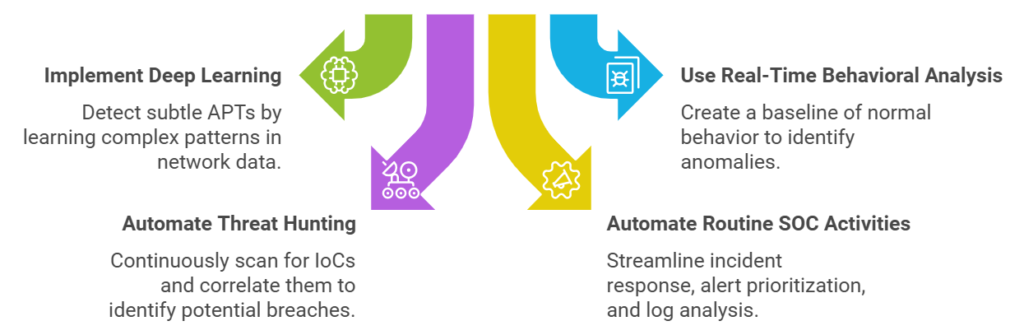
    Ways AI Technology Companies Improve Security Operation Centers Improve Threat Detection

    Deep Learning for Anomaly Detection

    AI technologies and intense learning are game changers in the identification of cyber threats. Traditional techniques do not typically detect the subtlest advanced persistent threats (APTs) because they mimic regular network traffic.

    Deep learning, particularly neural networks, can catch the latent patterns. For instance, CNNs represent one specific type of deep learning that processes network data as an image, thereby learning complex patterns associated with cyber attacks.

    This technology detects unusual network behavior that would otherwise escape the standard observation methods. Preventive detection made possible by AI technology companies will reveal exfiltration of data or lateral movements within the network, this is crucial in preventing breaches.

    Real-Time Behavioral Analysis

    Another powerful feature offered by AI & ML services for SOCs is real-time behavioral analysis. This technique creates a “normal” baseline of users and devices operating on the network so that AI can identify anomalies that could indicate a potential threat.

    These features help SOCs efficiently discover compromised accounts as well as insider threats. This is done through anomaly detection algorithms, User and Entity Behavior Analytics (UEBA), and Security Information and Event Management (SIEM) systems.

    Automating Threat Hunting

    Threat hunting by AI technology companies scans continuously for IoCs, which may indicate a compromise of unusual IP addresses or malware signatures from a feed from the threat intelligence.

    AI may be able to correlate IoCs across internal logs, identify potential breaches before they escalate, and then automatically create an alert for the SOCs.

    As a result, SOCs can proactively identify threats, reducing response time and improving the organization’s overall cybersecurity posture.

    Automation of Routine SOC Activities

    AI is crucial to automating routine SOC activities while allowing SOC analysts to focus on the most critical threats.

    Key areas in which IT infrastructure solution providers excel at automation include:

    • Automated Incident Response: AI can initiate incident response activities automatically. In case of malware detection on an endpoint, AI may lock the compromised device, notify the concerned people, and initiate forensic logging without a human’s intervention.
    • Intelligent Alert Prioritization: AI algorithms categorize alerts based on the threats’ potential impact and context. In this respect, SOC analysts face high-risk threats before discussing lesser-priority issues.
    • Log Correlation and Analysis: AI can correlate logs from multiple sources- say firewalls and intrusion detection systems in real time and discover patterns that unveil complex attacks. AI technology companies can correlate failed login attempts with successful ones from other locations to detect credential-stuffing attacks.

    These automation techniques make SOCs operate much more efficiently and keep on top of what matters in security without tedious work.

    Predictive Analytics for Threat Anticipation

    AI enables SOCs to predict threats even before they take place with predictive analytics.

    Based on the analysis of historical data and recent trends of threats, AI predicts possible attacks and takes proactive defenses.

    • Machine Learning for Predictive Threat Prediction: Machine learning models rely on past data to recognize earlier trends in the events in the system. These then predict vulnerabilities later in the organization’s infrastructure.
    • Risk Scoring Models: The AI generates risk scores for the assets, allotting relevant exposure and vulnerability levels. The higher the scores, the more attention is required from SOCs.
    • Threat Landscape Monitoring: AI monitors reports from external sources, such as news and social media, on emerging threats. If discussion over a new cyber exploit gains popularity over the Internet, AI has been poised to alert SOC teams to take precautionary measures long in advance.

    Predictive analytics enable SOCs always to be ahead of attackers, which drives overall cybersecurity resilience.

    Enabling AI Technology that Transforms the Capability of a SOC

    Some of the advanced AI & ML services, such as reinforcement learning, graph analytics, and federated learning, have far more capabilities for a SOC.

    • Reinforcement Learning: In reinforcement learning, AI discovers the best responses by simulating cyberattack scenarios. SOCs can leverage it to try out strategies for incident response and develop quicker response times.
    • Graph Analytics: Graph analytics helps visualize complicated relationships in a network by showing the connections between users, devices, and accounts. Thus, this can help SOCs identify previously latent threats that the traditional monitoring fails to perceive.
    • Federated Learning: Federated learning allows organizations to collaborate over training machine learning models without exposing sensitive data. This will enable SOCs to enhance their precision of the threats through gathered knowledge in a manner that ensures data privacy.

    These technologies equip SOCs with all the capabilities required to rapidly, accurately, and effectively react to emerging threats.

    Strategies for Effective Implementation of AI in a SOC

    While AI technology companies offer several benefits, the implementation of a SOC requires careful planning.

    Organizations will consider the following strategies:

    • Develop Data Strategy: An appropriate data collection, normalization, and storage strategy should be done. SOCs would necessitate a centralized logging solution for the AI model to appropriately parse data from disparate sources.
    • Testing and Verification of Model Before Deployment: The accuracy of the AI models must be tested before they are deployed. Repeated feedback from SOC analysts about their relative performance must be integrated into those models.
    • Cross-Functional Collaboration: Cross-functional collaboration between cybersecurity teams and data scientists is the best way to implement AI. Cross-functional teams ensure that AI models are developed with both technical expertise and security objectives in mind.

    Key Challenge Consideration for AI Adoption

    While the benefits are many, integrating AI in SOCs introduces several other challenges, like quality issues, ethical concerns, and compatibility issues related to already established infrastructures.

    • Data Quality: AI models require accurate data; hence, poor data quality may degrade the ability of the model to make precise or correct detections. Organizations should validate and ensure log completeness across all systems.
    • Ethical Considerations: AI systems must respect privacy rights and avoid bias. Regular audits can ensure that AI-driven decisions are fair and aligned with organizational values.
    • Complexity of Integration of AI: The integration of AI in existing SOCs is not that simple. In many cases, a phased rollout would be more effective as this does not disturb the workplace and allows compatibility problems to be efficiently resolved.

    Future of AI in SOCs

    AI at work in SOCs holds great promise, with the trend indicating:

    • Autonomous Security Operations: SOCs may get better at automation, handling specific incidents by themselves, human intervention being needed only according to requirement, and speeding up response times.
    • Integrate with Zero Trust Architectures: Ensuring continuous and ever-changing verification of the identity of users at access points, which thus reduces the possibility of unauthorized access.
    • Advanced sharing of Threat Intelligence: AI-powered applications may enable organizations to securely share any findings related to developed threats. These applications enhance collective defense beyond the boundaries of industries.

    Conclusion

    AI technology companies empower SOCs. SOCs can now do better, detect, and respond to advanced cyber threats through real-time analysis, automation, deep learning, and predictive analytics.

    With the constant evolution of AI, SOCs will get even better. This means businesses will feel more confident in securing their data and operations in a world of digitization.

    SCS Tech stands at the cutting edge in providing organizations with AI-driven solutions and improving their cybersecurity capabilities.