Category: Digital Transformation

  • LiDAR vs Photogrammetry: Which One Is Right for Your GIS Deployment?

    LiDAR vs Photogrammetry: Which One Is Right for Your GIS Deployment?

    Both LiDAR and photogrammetry offer the accuracy of spatial data, yet that doesn’t simplify the choice. They fulfill the same function in GIS implementations but do so with drastically different technologies, expenses, and conditions in the field. LiDAR provides laser accuracy, as well as canopy penetration; photogrammetry provides high-resolution visuals, as well as velocity. However, selecting one without knowing where it will succeed or fail means the investment is wasted or the data is compromised.

    Choosing the right technology also directly impacts the success of your GIS services, especially when projects are sensitive to terrain, cost, or delivery timelines.

    This article compares them head-to-head across real-world factors: mapping accuracy, terrain adaptability, processing time, deployment requirements, and cost. You’ll see where one outperforms the other and where a hybrid approach might be smarter.

    LiDAR vs Photogrammetry: Key Differences

    LiDAR and photogrammetry are two of GIS’s most popular techniques for gathering spatial data. Both are intended to record real-world environments but do so in dramatically different manners.

    LiDAR (Light Detection and Ranging) employs laser pulses to estimate distances between a sensor and targets on the terrain. These pulses bounce back towards the sensor to form accurate 3D point clouds. It is functional in many light environments and can even scan through vegetation to map the ground.

    Photogrammetry, however, utilizes overlapping photographs taken from cameras, usually placed on drones or airplanes. These photos are then computer-processed to construct the shape and location of objects in 3D space. It is greatly dependent on favorable lighting and open visibility to produce good results.

    Both methods are supportive of GIS mapping, although one might be more beneficial than the other based on project needs. Here’s where they vary in terms of principal differences:

    • Accuracy in GIS Mapping
    • Terrain Suitability & Environmental Conditions
    • Data Processing & Workflow Integration
    • Hardware & Field Deployment
    • Cost Implications

    Accuracy in GIS Mapping

    When your GIS implementation is contingent upon accurate elevation and surface information, applications such as flood modeling, slope analysis, or infrastructure planning, the quality of your data collection means the project makes it or breaks it.

    LiDAR delivers strong vertical accuracy thanks to laser pulse measurements. Typical airborne LiDAR surveys achieve vertical RMSE (Root Mean Square Error) between 5–15 cm, and in many cases under 10 cm, across various terrain types. Urban or infrastructure-focused LiDAR (like mobile mapping) can even get vertical RMSE down to around 1.5 cm.

    Photogrammetry, on the other hand, provides less accurate vertical accuracy. Generally, most good-quality drone photogrammetry is able to produce around 10–50 cm RMSE in height, although horizontal accuracy is usually 1–3 cm. Tighter vertical accuracy is more difficult to achieve and requires more ground control points, improved image overlap, and good lighting, all require more money and time.

    For instance, an infrastructure corridor that must be accurately elevated to plan drainage may be compromised by photogrammetry alone. A LiDAR survey would be sure to collect the small gradients required for good water flow or grading design, however.

    • Use LiDAR when vertical accuracy is critical, for elevation modeling, flood risk areas, or engineering requirements.
    • Use photogrammetry for horizontal mapping or visual base layers where small elevation errors are acceptable and the cost is a constraint.

    These distinctions are particularly relevant when planning GIS in India, where both urban infrastructure and rural landscapes present diverse elevation and surface data challenges.

    Terrain Suitability & Environmental Conditions

    Choosing between LiDAR and photogrammetry often comes down to the terrain and environmental conditions where you’re collecting data. Each method responds differently based on vegetation, land type, and lighting.

    LiDAR performs well in vegetated and complex situations. Its laser pulses penetrate the thick canopy and produce reliable ground models even with heavy cover. For instance, LiDAR has been found to be trustworthy where there are forest canopies of 30 meters, and it keeps its vertical accuracy within 10–15 cm as opposed to photogrammetry, which usually cannot trace the ground surface under heavy vegetation.

    Photogrammetry excels in flat, open, and well-illuminated conditions. It relies on unobstructed lines of sight and substantial lighting. In open spaces such as fields or urban areas devoid of tree cover, it produces high-resolution images and good horizontal positioning, usually 1–3 cm horizontal accuracy, although vertical accuracy deteriorates to 10–20 cm in uneven terrain or light. 

    Environmental resilience also varies:

    • Lighting and weather: LiDAR is largely unaffected by lighting conditions and can operate at night or under overcast skies. In contrast, photogrammetry requires daylight and consistent lighting to avoid shadows and glare affecting model quality.
    • Terrain complexity: Rugged terrain featuring slopes, cliffs, or mixed surfaces can unduly impact photogrammetry, which relies on visual triangulation. LiDAR’s active sensing covers complex landforms more reliably.

    “LiDAR is particularly strong in dense forest or hilly terrain, like cliffs or steep slopes”.

    Choosing Based on Terrain

    • Heavy vegetation/forests – LiDAR is the obvious choice for accurate ground modeling.
    • Flat, open land with excellent lighting – Photogrammetry is cheap and reliable.
    • Mixed terrain (e.g., farmland with woodland margins) – A hybrid strategy or LiDAR is the safer option.
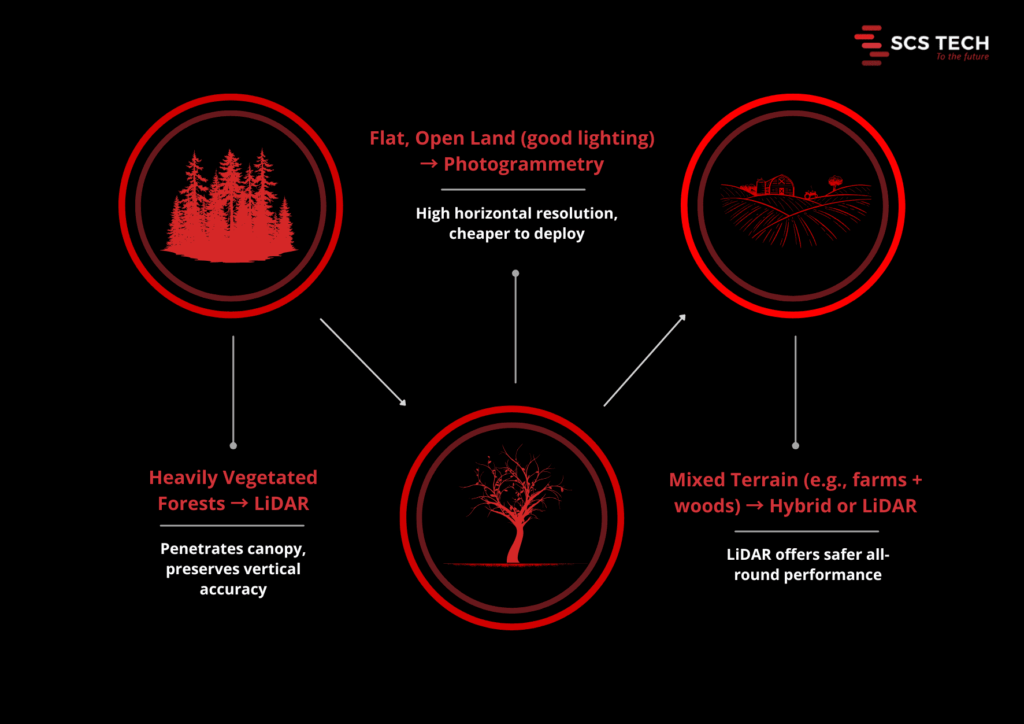
    In regions like the Western Ghats or Himalayan foothills, GIS services frequently rely on LiDAR to penetrate thick forest cover and ensure accurate ground elevation data.

    Data Processing & Workflow Integration

    LiDAR creates point clouds that require heavy processing. Raw LiDAR data can be hundreds of millions of points per flight. Processing includes noise filtering out, classifying ground vs non-ground returns, and developing surface models such as DEMs and DSMs.

    This usually needs to be done using dedicated software such as LAStools or TerraScan and trained operators. High-volume projects may take weeks to days to process completely, particularly if classification is done manually. With current LiDAR processors that have AI-based classification, processing time can be minimized by up to 50% without a reduction in quality.

    Photogrammetry pipelines revolve around merging overlapping images into 3D models. Tools such as Pix4D or Agisoft Metashape automatically align hundreds of images to create dense point clouds and meshes. Automation is an attractive benefit for companies offering GIS services, allowing them to scale operations without compromising data quality.

    The processing stream is heavy, but very automated. However, image quality is a function of image resolution and overlap. A medium-sized survey might be processed within a few hours on an advanced workstation, compared to a few days with LiDAR. Yet for large sites, photogrammetry can involve more manual cleanup, particularly around shaded or homogeneous surfaces.

    • Choose LiDAR when your team can handle heavy processing demands and needs fully classified ground surfaces for advanced GIS analysis.
    • Choose photogrammetry if you value faster setup, quicker processing, and your project can tolerate some manual data cleanup or has strong GCP support.

    Hardware & Field Deployment

    Field deployment brings different demands. The right hardware ensures smooth and reliable data capture. Here’s how LiDAR and photogrammetry compare on that front.

    LiDAR Deployment

    LiDAR requires both high-capacity drones and specialized sensors. For example, the DJI Zenmuse L2, used with the Matrice 300 RTK or 350 RTK drones, weighs about 1.2 kg and delivers ±4 cm vertical accuracy, scanning up to 240k points per second and penetrating dense canopy effectively. Other sensors, like the Teledyne EchoOne, offer 1.5 cm vertical accuracy from around 120 m altitude on mid-size UAVs.

    These LiDAR-capable drones often weigh over 6 kg without payloads (e.g., Matrice 350 RTK) and can fly for 30–55 minutes, depending on payload weight.

    So, LiDAR deployment requires investment in heavier UAVs, larger batteries, and payload-ready platforms. Setup demands trained crews to calibrate IMUs, GNSS/RTK systems, and sensor mounts. Teams offering GIS consulting often help clients assess which hardware platform suits their project goals, especially when balancing drone specs with terrain complexity.

    Photogrammetry Deployment

    Photogrammetry favors lighter drones and high-resolution cameras. Systems like the DJI Matrice 300 equipped with a 45 MP Zenmuse P1 can achieve 3 cm horizontal and 5 cm vertical accuracy, and map 3 km² in one flight (~55 minutes).

    Success with camera-based systems relies on:

    • Mechanical shutters to avoid image distortion
    • Proper overlaps (80–90%) and stable flight paths 
    • Ground control points (1 per 5–10 acres) using RTK GNSS for centimeter-level geo accuracy

    Most medium-sized surveys run on 32–64 GB RAM workstations with qualified GPUs.

    Deployment Comparison at a Glance


    Aspect  LiDAR Photogrammetry 
    Drone requirements ≥6 kg payload, long battery life 3–6 kg, standard mapping drones
    Sensor setup Laser scanner, IMU/GNSS, calibration needed High-resolution camera, mechanical shutter, GCPs/RTK
    Flight time impact Payload reduces endurance ~20–30% Similar reduction; camera weight less critical
    Crew expertise required High—sensor alignment, real-time monitoring Moderate — flight planning, image quality checks
    Processing infrastructure High-end PC, parallel LiDAR tools 32–128 GB RAM, GPU-enabled for photogrammetry


    LiDAR demands stronger UAV platforms, complex sensor calibration, and heavier payloads, but delivers highly accurate ground models even under foliage.

    Photogrammetry is more accessible, using standard mapping drones and high-resolution cameras. However, it requires careful flight planning, GCP setup, and capable processing hardware.

    Cost Implications

    LiDAR requires a greater initial investment. A full LiDAR system, which comprises a laser scanner, an IMU, a GNSS, and a compatible UAV aircraft, can range from $90,000 to $350,000. Advanced models such as the DJI Zenmuse L2, combined with a Matrice 300 or 350 RTK aircraft, are common in survey-grade undertakings.

    If you’re not buying in bulk, LiDAR data collection services typically begin at about $300 an hour and go higher than $1,000 based on the type of terrain and resolution needed.

    Photogrammetry tools are considerably more affordable. An example is a $2,000 to $20,000 high-resolution drone with a mechanical shutter camera. In most business applications, photogrammetry services are charged at $150-$500 per hour, which makes it a viable alternative for repeat or cost-conscious mapping projects.

    In short, LiDAR costs more to deploy but may save time and manual effort downstream. Photogrammetry is cheaper upfront but demands more fieldwork and careful processing. Your choice depends on the long-term cost of error versus the up-front budget you’re working with.

    A well-executed GIS consulting engagement often clarifies these trade-offs early, helping stakeholders avoid costly over-investment or underperformance.

    Final Take: LiDAR vs Photogrammetry for GIS

    A decision between LiDAR and photogrammetry isn’t so much about specs. It’s about understanding which one fits with your site conditions, data requirements, and the results your project relies on.

    Both are strong suits. LiDAR provides you with improved results on uneven ground, heavy vegetation, and high-precision operations. Photogrammetry provides lean operation when you require rapid, broad sweeps in open spaces. But the true potential lies in combining them, with one complementing the other where it is needed.

    If you’re unsure which direction to take, a focused GIS consulting session with SCSTech can save weeks of rework and ensure your spatial data acquisition is aligned with project outcomes. Whether you’re working on smart city development or agricultural mapping, selecting the right remote sensing method is crucial for scalable GIS projects in India.

    We don’t just provide LiDAR or photogrammetry; our GIS services are tailored to deliver the right solution for your project’s scale and complexity.

    Consult with SCSTech to get a clear, technical answer on what fits your project, before you invest more time or budget in the wrong direction.

  • How to Build a Digital Roadmap for Upstream Oil and Gas Operations

    How to Build a Digital Roadmap for Upstream Oil and Gas Operations

    Most upstream oil and gas teams already use some form of digital tools, whether it’s SCADA systems, production monitoring software, or sensor data from the field. These are all examples of oil and gas technology that play a critical role in modernizing upstream workflows.

    But in many cases, these tools don’t work well together. The result? Missed opportunities, duplicated effort, and slow decisions.

    A digital roadmap helps fix that. It gives you a clear plan to use technology in ways that actually improve drilling, production, and asset reliability, not by adding more tools, but by using the right ones in the right places.

    This article outlines the important elements for developing a viable, execution-ready plan specific to upstream operations.

    What a Digital Roadmap Looks Like in Upstream Oil and Gas

    In upstream oil and gas, a digital roadmap isn’t a general IT plan; it’s an execution-driven guide tailored for field operations across drilling, production, and asset reliability. These roadmaps prioritize production efficiency, not buzzword technology.

    A practical digital transformation in oil and gas depends on grounding innovation in field-level reality, not just boardroom strategy.

    Most upstream firms are using technologies like SCADA or reservoir software, but these often remain siloed.  A smart roadmap connects the dots, taking fragmented tools and turning them into a system that generates measurable value in the field.

    Here’s what to include:

    • Use Case Alignment – Focus on high-impact upstream areas: drilling automation, asset integrity, reservoir management, and predictive maintenance. McKinsey estimates digital tech can reduce upstream operating costs by 3–5 % and capex by up to 20 %.
    • Targeted Technology Mapping – Defining where AI/IOT or advanced analytics fit into daily operations is invaluable.  This is where next-gen oil and gas technology, such as edge computing and real-time analytics, can proactively prevent failure and improve uptime.
    • Data Infrastructure Planning – Address how real-time well data, sensor streams, and historical logs are collected and unified. McKinsey highlights that 70 % of oil firms stall in pilot phases due to fragmented data systems and a lack of integrated OT/IT infrastructure.
    • Phased Rollout Strategy – Begin with focused pilots, like real-time drilling performance tracking, then expand to multiple fields. Shell and Chevron have successfully used this playbook: validating gains at a small scale before scaling asset-wide


    Rather than a one-size-fits-all framework, a strong upstream digital roadmap is asset-specific, measurable, and built for execution, not just strategy decks. It helps upstream companies avoid digitizing for the sake of it, and instead focus on what actually moves the needle in the field.

    Building a Digital Roadmap for Upstream Oil and Gas Operations

    A digital roadmap helps upstream oil and gas teams plan how and where to use technology across their operations. It’s not just about picking new tools, it’s about making sure those tools actually improve drilling, production, and day-to-day fieldwork. 

    The following are the critical steps to creating a roadmap that supports real goals, not just upgrades to digital.

    Step 1: Define Business Priorities and Operational Pain Points

    Before looking at any technology, you need to clearly understand what problem you’re trying to solve – that’s step one to building a digital roadmap that works, not just for corporate, but also for the people who are running wells, rigs, and operations every day.

    This starts by answering one question: What are the business outcomes your upstream team needs to improve in the next 12–24 months?

    It could be:

    • Reducing non-productive time (NPT) in drilling operations
    • Improving the uptime of compressors, pumps, or separators
    • Lowering the cost per barrel in mature fields
    • Meeting environmental compliance more efficiently
    • Speeding up production reporting across locations

    These are not just IT problems; they’re business priorities that must shape your digital plan.

    For each priority, define the metric that tells you whether you’re moving in the right direction.

    Business priority  Metric to track 
    Reduce NPT in drilling  Avg. non-productive hours per rig/month 
    Improve asset reliability  Unplanned downtime hours pre-asset 
    Lower operational costs  Costs per barrel (OPEX) 
    Meet ESG reporting requirements  Time to compile and validate compliance data 


    It is simple to understand which digital use cases merit efforts once you have assigned numbers to the goals you established. This is where strategic oil and gas industry consulting adds value by turning operational pain points into measurable digital opportunities.

    Step 2: Audit Your Existing Digital Capabilities and Gaps

    Now that you have the agreed consideration for what priorities you want to strengthen in your upstream activities, the second step is to identify your existing data capabilities, tools, and systems, and assess how well they support what you want to achieve.

    It is not an inventory of software. You’re reviewing:

    • What you have
    • What you’re underutilizing
    • What’s old or difficult to scale
    • And what you’re completely lacking

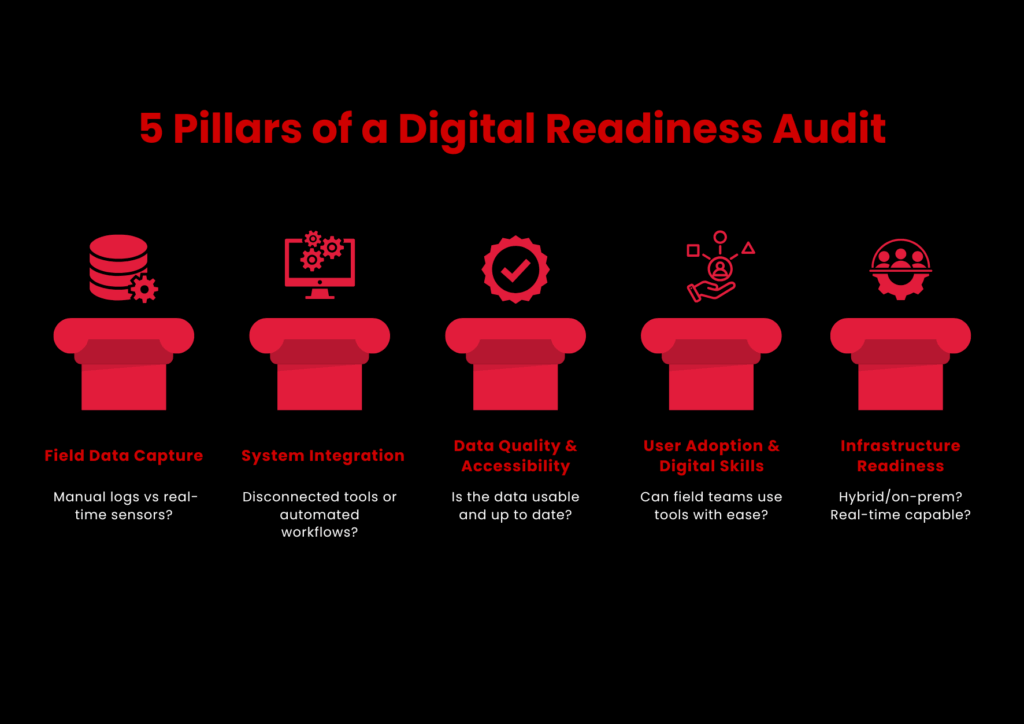
    Pillars of Digital Readiness Audit

    A successful digital transformation in oil and gas starts with a clear-eyed view of your current tools, gaps, and data flows.

    Focus Areas for a Practical Digital Audit

    Your audit should consider five priority areas:

    1. Field Data Capture
      • Do you still use manual logs or spreadsheets for day-to-day production, asset status, or safety reports?
      • Do you have sensors or edge devices? Are they available and connected?
      • Is field data captured in real-time or batched uploads?
    2. System Integration
      • Are SCADA, ERP, maintenance software, and reporting tools communicating?
      • Are workflows between systems automated or manually exported/imported?
    3. Data Quality and Accessibility
      • How up-to-date, complete, and clean is your operational data?
      • Do engineers and analysts access insights easily, or do they depend on IT every time?
    4. User Adoption and Digital Skill Levels
      • Are digital tools easy to use by field teams?
      • Is there ongoing training for digital tools besides initial rollouts?
    5. Infrastructure Readiness
      • Are you running on cloud, on-premises, or a hybrid setup?
      • Do remote sites have enough connectivity to support real-time monitoring or analytics?

    Step 3: Prioritize High-Impact Use Cases for Digitization

    A digital roadmap fails when it attempts to do too much or gets the wrong priorities. That’s why this step is about selecting the correct digital use cases to begin with.

    You don’t require a long list. You require the correct 3–5 use cases that align with your field requirements, provide early traction, and enable you to gain momentum.

    How to Select and Prioritize the Right Use Cases

    Use three filters:

    • Business Impact

    Does it materially contribute to your objectives from Step 1? Can it decrease downtime, save money, enhance safety, or accelerate reporting?

    • Feasibility

    Do you have sufficient data and infrastructure to enable it? Can you deploy it with your existing team or partners?

    • Scalability

    If it works in one site, can you expand it across other wells, rigs, or regions?

    Plot your candidates on a simple Impact vs. Effort matrix and focus first on the high-impact, low-effort quadrant.

    These examples have been validated industry-wide in both onshore and offshore environments:

    Use cases  What it solves  Why it works 
    Predictive maintenance for rotating equipment  Unexpected failures, costly unplanned downtime Can reduce maintenance costs by up to 25% and unplanned outages by 70% (GE Digital)
    Automated drilling performance tracking  Slow manual analysis of rig KPIs  Speeds up decision-making during drilling and improves safety 
    Remote monitoring of good conditions  Infrequent site visits, delayed issue detection  Supports real-time response and better resource allocation 
    AI-driven production forecasting  Inaccurate short-term forecasts, missed targets  Helps optimize lift strategies and resource planning 
    Digital permit to work systems  Paper-based HSE workflows  Improves compliance tracking and field audit readiness 


    Don’t select use cases solely on tech appeal. Even AI won’t work if there’s dirty data or your field staff can’t use it confidently.

    Step 4: Build a Phased Roadmap with Realistic Timelines

    Many digital transformation efforts in upstream oil and gas lose momentum because they try to do too much, too fast. Teams get overwhelmed, budgets stretch thin, and progress stalls. The solution? Break your roadmap into manageable phases, tied to clear business outcomes and operational maturity.

    Many upstream leaders leverage oil and gas industry consulting to design phased rollouts that reduce complexity and accelerate implementation.

    Here’s how to do it in practice.

    Consider your shortlist in Step 3. Don’t try to do it all immediately. Rather, classify each use case into one of three buckets:

    • Quick wins (low complexity and ready for piloting)
    • Mid-range initiatives (need integrations or cross-site collaboration)
    • Long-term bets (advanced analytics, AI, or full-scale automation)

    Suppose you begin with production reporting and asset monitoring:

    Phase  What happens  When 
    Test  Pilot asset condition monitoring on 3 pumps Month 1-3
    Expand  Roll out monitoring to 20+ pumps across fields Month 4-12 
    Integrate  Link monitoring with maintenance dispatch + alert automation  Month 13-24


    This strategy prevents your teams from getting tech-fatigued. Every victory wins over trust. And above all, it makes leadership visible, measurable value, nota  digital aspiration.

    Step 5: Monitor, Iterate, and Scale Across Assets

    Once your roadmap is in motion, don’t stop at rollout. You need to keep track of what’s working, fix what isn’t, and expand only what brings real results. This step is about building consistency, not complexity.

    • Regularly review KPIs to determine if targets are being achieved
    • Gather field feedback to identify adoption problems or technical holes
    • Enhance and evolve based on actual usage, not projections
    • Scale established solutions to comparable assets with aligned needs and infrastructure

    This keeps your roadmap current and expanding, rather than wasting time on tools that do not yield results.

    Conclusion

    Creating a digital roadmap for upstream oil and gas operations isn’t a matter of pursuing fads or purchasing more software. Effective use of oil and gas technology is less about adopting every new tool and more about applying the right tech in the right phase of field operations.

    It’s setting your sights on the right objectives, leveraging what you already have better, and deploying technology in a manner that your teams can realistically use and expand upon.

    This guide took you through every step:

    • How to set actual operational priorities
    • How to conduct an audit of your existing capability
    • How to select and deploy high-impact use cases
    • How to get it all done on the ground, over time

    But even the most excellent roadmap requires experience behind it, particularly when field realities, integration nuances, and production pressures are at play.

    That’s where SCSTech is.

    We’ve helped upstream teams design and implement digital strategies that don’t just look good on paper but deliver measurable value across assets, people, and workflows. From early audits to scaled deployments, our oil and gas industry consulting team knows how to align tech decisions with business outcomes.

    If you’re planning to move forward with a digital roadmap, talk to us at SCSTech. We can help you turn the right ideas into real, field-ready results.

  • Can RPA Work With Legacy Systems? Here’s What You Need to Know!

    Can RPA Work With Legacy Systems? Here’s What You Need to Know!

    It’s a question more IT leaders are asking as automation pressures rise and modernization budgets lag behind. 

    While robotic process automation (RPA) promises speed, scale, and relief from manual drudgery, most organizations aren’t operating in cloud-native environments. They’re still tied to legacy systems built decades ago and not exactly known for playing well with new tech.

    So, can RPA actually work with these older systems? Short answer: yes, but not without caveats. This article breaks down how RPA fits into legacy infrastructure, what gets in the way, and how smart implementation can turn technical debt into a scalable automation layer.

    Let’s get into it.

    Understanding the Compatibility Between RPA and Legacy Systems

    Legacy systems aren’t built for modern integration, but that’s exactly where RPA finds its edge. Unlike traditional automation tools that depend on APIs or backend access, RPA Services works through the user interface, mimicking human interactions with software. That means even if a system is decades old, closed off, or no longer vendor-supported, RPA can still operate on it, safely and effectively.

    This compatibility isn’t a workaround — it’s a deliberate strength. For companies running mainframes, terminal applications, or custom-built software, RPA offers a non-invasive way to automate without rewriting the entire infrastructure.

    How RPA Maintains Compatibility with Legacy Systems:

    • UI-Level Interaction: RPA tools replicate keyboard strokes, mouse clicks, and field entries, just like a human operator, regardless of how old or rigid the system is.
    • No Code-Level Dependencies: Since bots don’t rely on source code or APIs, they work even when backend integration isn’t possible.
    • Terminal Emulator Support: Most RPA platforms include support for green-screen mainframes (e.g., TN3270, VT100), enabling interaction with host-based systems.
    • OCR & Screen Scraping: For systems that don’t expose readable text, bots can use optical character recognition (OCR) to extract and process data.
    • Low-Risk Deployment: Because RPA doesn’t alter the underlying system, it poses minimal risk to legacy environments and doesn’t interfere with compliance.

    Common Challenges When Connecting RPA to Legacy Environments

    While RPA is compatible with most legacy systems on the surface, getting it to perform consistently at scale isn’t always straightforward. Legacy environments come with quirks — from unpredictable interfaces to tight access restrictions — that can compromise bot reliability and performance if not accounted for early.

    Some of the most common challenges include:

    1. Unstable or Inconsistent Interfaces

    Legacy systems often lack UI standards. A small visual change — like a shifted field or updated window — can break bot workflows. Since RPA depends on pixel- or coordinate-level recognition in these cases, any visual inconsistency can cause the automation to fail silently.

    2. Limited Access or Documentation

    Many legacy platforms have little-to-no technical documentation. Access might be locked behind outdated security protocols or hardcoded user roles. This makes initial configuration and bot design harder, especially when developers need to reverse-engineer interface logic without support from the original vendor.

    3. Latency and Response Time Issues

    Older systems may not respond at consistent speeds. RPA bots, which operate on defined wait times or expected response behavior, can get tripped up by delays, resulting in skipped steps, premature entries, or incorrect reads.

    Advanced RPA platforms allow dynamic wait conditions (e.g., “wait until this field appears”) rather than fixed timers.

    4. Citrix or Remote Desktop Environments

    Some legacy apps are hosted on Citrix or RDP setups where bots don’t “see” elements the same way they would on local machines. This forces developers to rely on image recognition or OCR, which are more fragile and require constant calibration.

    5. Security and Compliance Constraints

    Many legacy systems are tied into regulated environments — banking, utilities, government — where change control is strict. Even though RPA is non-invasive, introducing bots may still require IT governance reviews, user credential rules, and audit trails to pass compliance.

    Best Practices for Implementing RPA with Legacy Systems

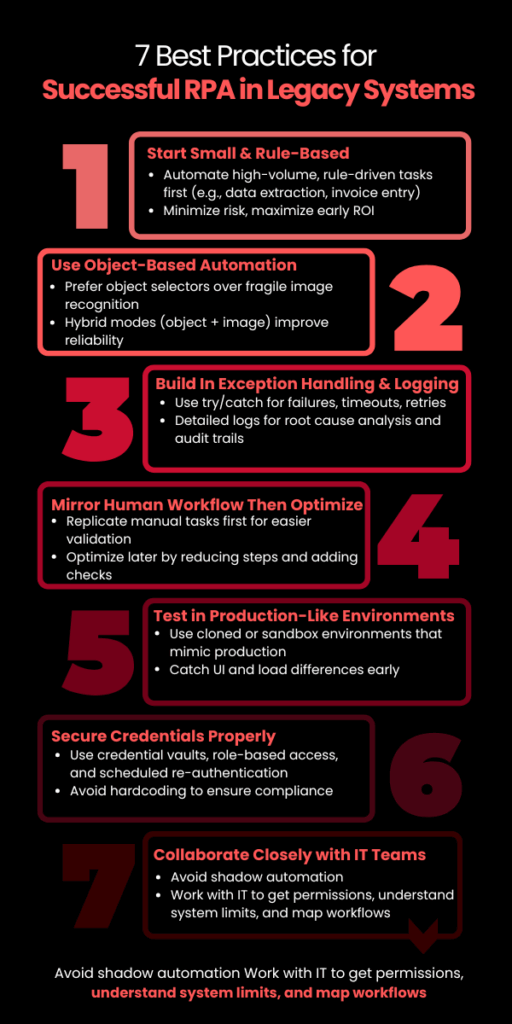
    Best Practices for Successful RPA in Legacy Systems

    Implementing RPA Development Services in a legacy environment is not plug-and-play. While modern RPA platforms are built to adapt, success still depends on how well you prepare the environment, design the workflows, and choose the right processes.

    Here are the most critical best practices:

    1. Start with High-Volume, Rule-Based Tasks

    Legacy systems often run mission-critical functions. Instead of starting with core processes, begin with non-invasive, rule-driven workflows like:

    • Data extraction from mainframe screens
    • Invoice entry or reconciliation
    • Batch report generation

    These use cases deliver ROI fast and avoid touching business logic, minimizing risk. 

    2. Use Object-Based Automation Where Possible

    When dealing with older apps, UI selectors (object-based interactions) are more stable than image recognition. But not all legacy systems expose selectors. Identify which parts of the system support object detection and prioritize automations there.

    Tools like UiPath and Blue Prism offer hybrid modes (object + image) — use them strategically to improve reliability.

    3. Build In Exception Handling and Logging from Day One

    Legacy systems can behave unpredictably — failed logins, unexpected pop-ups, or slow responses are common. RPA bots should be designed with:

    • Try/catch blocks for known failures
    • Timeouts and retries for latency
    • Detailed logging for root-cause analysis

    Without this, bot failures may go undetected, leading to invisible operational errors — a major risk in high-compliance environments.

    4. Mirror the Human Workflow First — Then Optimize

    Start by replicating how a human would perform the task in the legacy system. This ensures functional parity and easier stakeholder validation. Once stable, optimize:

    • Reduce screen-switches
    • Automate parallel steps
    • Add validations that the system lacks

    This phased approach avoids early overengineering and builds trust in automation.

    5. Test in Production-Like Environments

    Testing legacy automation in a sandbox that doesn’t behave like production is a common failure point. Use a cloned environment with real data or test after hours in production with read-only roles, if available.

    Legacy UIs often behave differently depending on screen resolution, load, or session type — catch this early before scaling.

    6. Secure Credentials with Vaults or IAM

    Hardcoding credentials for bots in legacy systems is a major compliance red flag. Use:

    • RPA-native credential vaults (e.g., CyberArk integrations)
    • Role-based access controls
    • Scheduled re-authentication policies

    This reduces security risk while keeping audit logs clean for governance teams.

    7. Loop in IT, Not Just Business Teams

    Legacy systems are often undocumented or supported by a single internal team. Avoid shadow automation. Work with IT early to:

    • Map workflows accurately
    • Get access permissions
    • Understand system limitations

    Collaboration here prevents automation from becoming brittle or blocked post-deployment.

    RPA in legacy environments is less about brute-force automation and more about thoughtful design under constraint. Build with the assumption that things will break — and then build workflows that recover fast, log clearly, and scale without manual patchwork.

    Is RPA a Long-Term Solution for Legacy Systems?

    Yes, but only when used strategically. 

    RPA isn’t a forever fix for legacy systems, but it is a durable bridge, one that buys time, improves efficiency, and reduces operational friction while companies modernize at their own pace.

    For utility, finance, and logistics firms still dependent on legacy environments, RPA offers years of viable value when:

    • Deployed with resilience and security in mind
    • Designed around the system’s constraints, not against them
    • Scaled through a clear governance model

    However, RPA won’t modernize the core, it enhances what already exists. For long-term ROI, companies must pair automation with a roadmap that includes modernization or system transformation in parallel.

    This is where SCSTech steps in. We don’t treat robotic process automation as a tool; we approach it as a tactical asset inside larger modernization strategy. Whether you’re working with green-screen terminals, aging ERP modules, or disconnected data silos, our team helps you implement automation that’s reliable now, but aligned with where your infrastructure needs to go.

  • How AgTech Startups Use GIS to Optimize Irrigation and Crop Planning

    How AgTech Startups Use GIS to Optimize Irrigation and Crop Planning

    Farming isn’t uniform. In the evolving landscape of agriculture & technology, soil properties, moisture levels, and crop needs can change dramatically within meters — yet many irrigation strategies still treat fields as a single, homogenous unit.

    GIS (Geographic Information Systems) offers precise, location-based insights by layering data on soil texture, elevation, moisture, and crop growth stages. This spatial intelligence lets AgTech startups move beyond blanket irrigation to targeted water management.

    By integrating GIS with sensor data and weather models, startups can tailor irrigation schedules and volumes to the specific needs of micro-zones within a field. This approach reduces inefficiencies, helps conserve water, and supports consistent crop performance.

    Importance of GIS in Agriculture for Irrigation and Crop Planning

    Agriculture isn’t just about managing land. It’s about managing variation. Soil properties shift within a few meters. Rainfall patterns change across seasons. Crop requirements differ from one field to the next. Making decisions based on averages or intuition leads to wasted water, underperforming yields, and avoidable losses.

    GIS (Geographic Information Systems) is how AgTech startups leverage agriculture & technology innovations to turn this variability into a strategic advantage.

    GIS gives a spatial lens to data that was once trapped in spreadsheets or siloed systems. With it, agri-tech innovators can:

    • Map field-level differences in soil moisture, slope, texture, and organic content — not as general trends but as precise, geo-tagged layers.
    • Align irrigation strategies with crop needs, landform behavior, and localized weather forecasts.
    • Support real-time decision-making, where planting windows, water inputs, and fertilizer applications are all tailored to micro-zone conditions.

    To put it simply: GIS enables location-aware farming. And in irrigation or crop planning, location is everything.

    A one-size-fits-all approach may lead to 20–40% water overuse in certain regions and simultaneous under-irrigation in others. By contrast, GIS-backed systems can reduce water waste by up to 30% while improving crop yield consistency, especially in water-scarce zones.

    GIS Data Layers Used for Irrigation and Crop Decision-Making

    GIS Data Layers Powering Smarter Irrigation and Crop Planning

    The power of GIS lies in its ability to stack different data layers — each representing a unique aspect of the land — into a single, interpretable visual model. For AgTech startups focused on irrigation and crop planning, these layers are the building blocks of smarter, site-specific decisions.

    Let’s break down the most critical GIS layers used in precision agriculture:

    1. Soil Type and Texture Maps

    • Determines water retention, percolation rate, and root-zone depth
    • Clay-rich soils retain water longer, while sandy soils drain quickly
    • GIS helps segment fields into soil zones so that irrigation scheduling aligns with water-holding capacity

    Irrigation plans that ignore soil texture can lead to overwatering on heavy soils and water stress on sandy patches — both of which hurt yield and resource efficiency.

    2. Slope and Elevation Models (DEM – Digital Elevation Models)

    • Identifies water flow direction, runoff risk, and erosion-prone zones
    • Helps calculate irrigation pressure zones and place contour-based systems effectively
    • Allows startups to design variable-rate irrigation plans, minimizing water pooling or wastage in low-lying areas

    3. Soil Moisture and Temperature Data (Often IoT Sensor-Integrated)

    • Real-time or periodic mapping of subsurface moisture levels powered by artificial intelligence in agriculture
    • GIS integrates this with surface temperature maps to detect drought stress or optimal planting windows

    Combining moisture maps with evapotranspiration models allows startups to trigger irrigation only when thresholds are crossed, avoiding fixed schedules.

    4. Crop Type and Growth Stage Maps

    • Uses satellite imagery or drone-captured NDVI (Normalized Difference Vegetation Index)
    • Tracks vegetation health, chlorophyll levels, and biomass variability across zones
    • Helps match irrigation volume to crop growth phase — seedlings vs. fruiting stages have vastly different needs

    Ensures water is applied where it’s needed most, reducing waste and improving uniformity.

    5. Historical Yield and Input Application Maps

    • Maps previous harvest outcomes, fertilizer applications, and pest outbreaks
    • Allows startups to overlay these with current-year conditions to forecast input ROI

    GIS can recommend crop shifts or irrigation changes based on proven success/failure patterns across zones.

    By combining these data layers, GIS creates a 360° field intelligence system — one that doesn’t just react to soil or weather, but anticipates needs based on real-world variability.

    How GIS Helps Optimize Irrigation in Farmlands

    Optimizing irrigation isn’t about simply adding more sensors or automating pumps. It’s about understanding where, when, and how much water each zone of a farm truly needs — and GIS is the system that makes that intelligence operational.

    Here’s how AgTech startups are using GIS to drive precision irrigation in real, measurable steps:

    1. Zoning Farmlands Based on Hydrological Behavior

    Using GIS, farmlands are divided into irrigation management zones by analyzing soil texture, slope, and historical moisture retention.

    • High clay zones may need less frequent, deeper irrigation
    • Sandy zones may require shorter, more frequent cycles
    • GIS maps these zones down to a 10m x 10m (or even finer) resolution, enabling differentiated irrigation logic per zone

    Irrigation plans stop being uniform. Instead, water delivery matches the absorption and retention profile of each micro-zone.

    2. Integrating Real-Time Weather and Evapotranspiration Data

    GIS platforms integrate satellite weather feeds and localized evapotranspiration (ET) models — which calculate how much water a crop is losing daily due to heat and wind.

    • The system then compares ET rates with real-time soil moisture data
    • When depletion crosses a set threshold (say, 50% of field capacity), GIS triggers or recommends irrigation — tailored by zone

    3. Automating Variable Rate Irrigation (VRI) Execution

    AgTech startups link GIS outputs directly with VRI-enabled irrigation systems (e.g., pivot systems or drip controllers).

    • Each zone receives a customized flow rate and timing
    • GIS controls or informs nozzles and emitters to adjust water volume on the move
    • Even during a single irrigation pass, systems adjust based on mapped need levels

    4. Detecting and Correcting Irrigation Inefficiencies

    GIS helps track where irrigation is underperforming due to:

    • Blocked emitters or leaks
    • Pressure inconsistencies
    • Poor infiltration zones

    By overlaying actual soil moisture maps with intended irrigation plans, GIS identifies deviations — sometimes in near real-time.

    Alerts are sent to field teams or automated systems to adjust flow rates, fix hardware, or reconfigure irrigation maps.

    5. Enabling Predictive Irrigation Based on Crop Stage and Forecasts

    GIS tools layer crop phenology models (growth stage timelines) with weather forecasts.

    • For example, during flowering stages, water demand may spike 30–50% for many crops.
    • GIS platforms model upcoming rainfall and temperature shifts, helping plan just-in-time irrigation events before stress sets in.

    Instead of reactive watering, farmers move into data-backed anticipation — a fundamental shift in irrigation management.

    GIS transforms irrigation from a fixed routine into a dynamic, responsive system — one that reacts to both the land’s condition and what’s coming next. AgTech startups that embed GIS into their irrigation stack aren’t just conserving water; they’re building systems that scale intelligently with environmental complexity.

    Conclusion

    GIS is no longer optional in modern agriculture & technology — it’s how AgTech startups bring precision to irrigation and crop planning. From mapping soil zones to triggering irrigation based on real-time weather and crop needs, GIS turns field variability into a strategic advantage.

    But precision only works if your data flows into action. That’s where SCSTech comes in. Our GIS solutions help AgTech teams move from scattered data to clear, usable insights, powering smarter irrigation models and crop plans that adapt to real-world conditions.

  • Using GIS Mapping to Identify High-Risk Zones for Earthquake Preparedness

    Using GIS Mapping to Identify High-Risk Zones for Earthquake Preparedness

    GIS mapping combines seismicity, ground conditions, building exposure, and evacuation routes into multi-layer, spatial models. This gives a clear, specific image of where the greatest dangers are — a critical function in disaster response software designed for earthquake preparedness.

    Using this information, planners and emergency responders can target resources, enhance infrastructure strength, and create effective evacuation plans individualized for the zones that require it most.

    In this article, we dissect how GIS maps pinpoint high-risk earthquake areas and why this spatial accuracy is critical to constructing wiser, life-saving readiness plans.

    Why GIS Mapping Matters for Earthquake Preparedness?

    When it comes to earthquake resilience, geography isn’t just a consideration — it’s the whole basis of risk. The key to minimal disruption versus disaster is where the infrastructure is located, how the land responds when stressed, and what populations are in the path.

    That’s where GIS mapping steps in — not as a passive data tool, but as a central decision engine for risk identification and GIS and disaster management planning.

    Here’s why GIS is indispensable:

    • Earthquake risk is spatially uneven. Some zones rest directly above active fault lines, others lie on liquefiable soil, and many are in structurally vulnerable urban cores. GIS doesn’t generalize — it pinpoints. It visualizes how these spatial variables overlap and create compounded risks.
    • Preparedness needs layered visibility. Risk isn’t just about tectonics. It’s about how seismic energy interacts with local geology, critical infrastructure, and human activity. GIS allows planners to stack these variables — seismic zones, building footprints, population density, utility lines — to get a granular, real-time understanding of risk concentration.
    • Speed of action depends on the clarity of data. During a crisis, knowing which areas will be hit hardest, which routes are most likely to collapse, and which neighborhoods lack structural resilience is non-negotiable. GIS systems provide this insight before the event, enabling governments and agencies to act, not react.

    GIS isn’t just about making maps look smarter. It’s about building location-aware strategies that can protect lives, infrastructure, and recovery timelines.

    Without GIS, preparedness is built on assumptions. With it, it’s built on precision.

    How GIS Identifies High-Risk Earthquake Zones

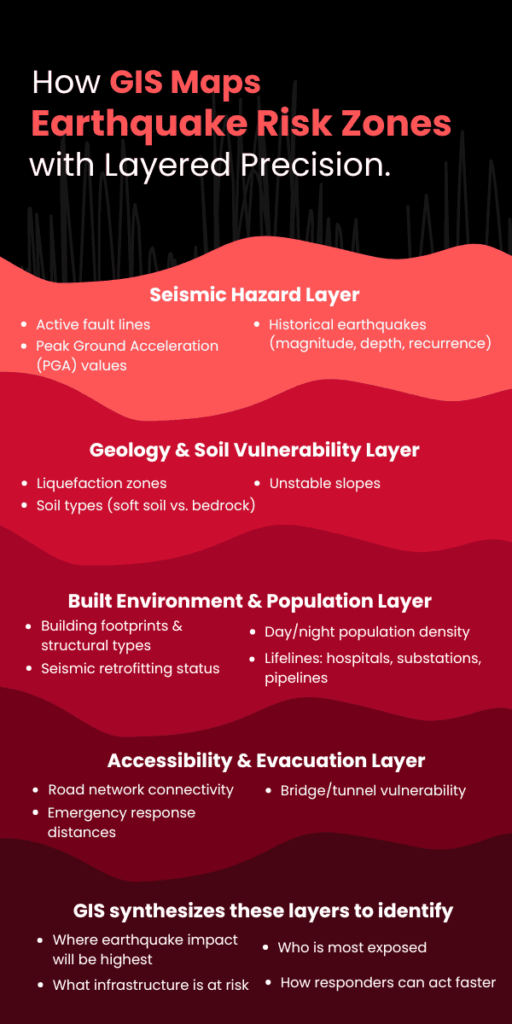
    How GIS Maps Earthquake Risk Zones with Layered Precision

    Not all areas within an earthquake-prone region carry the same level of risk. Some neighborhoods are built on solid bedrock. Others sit on unstable alluvium or reclaimed land that could amplify ground shaking or liquefy under stress. What differentiates a moderate event from a mass-casualty disaster often lies in these invisible geographic details.

    Here’s how it works in operational terms:

    1. Layering Historical Seismic and Fault Line Data

    GIS platforms integrate high-resolution datasets from geological agencies (like USGS or national seismic networks) to visualize:

    • The proximity of assets to fault lines
    • Historical earthquake occurrences — including magnitude, frequency, and depth
    • Seismic zoning maps based on recorded ground motion patterns

    This helps planners understand not just where quakes happen, but where energy release is concentrated and where recurrence is likely.

    2. Analyzing Geology and Soil Vulnerability

    Soil type plays a defining role in earthquake impact. GIS systems pull in geoengineering layers that include:

    • Soil liquefaction susceptibility
    • Slope instability and landslide zones
    • Water table depth and moisture retention capacity

    By combining this with surface elevation models, GIS reveals which areas are prone to ground failure, wave amplification, or surface rupture — even if those zones are outside the epicenter region.

    3. Overlaying Built Environment and Population Exposure

    High-risk zones aren’t just geological — they’re human. GIS integrates urban planning data such as:

    • Building density and structural typology (e.g., unreinforced masonry, high-rise concrete)
    • Age of construction and seismic retrofitting status
    • Population density during day/night cycles
    • Proximity to lifelines like hospitals, power substations, and water pipelines

    These layers turn raw hazard maps into impact forecasts, pinpointing which blocks, neighborhoods, or industrial zones are most vulnerable — and why.

    4. Modeling Accessibility and Emergency Constraints

    Preparedness isn’t just about who’s at risk — it’s also about how fast they can be reached. GIS models simulate:

    • Evacuation route viability based on terrain and road networks
    • Distance from emergency response centers
    • Infrastructure interdependencies — e.g., if one bridge collapses, what neighborhoods become unreachable?

    GIS doesn’t just highlight where an earthquake might hit — it shows where it will hurt the most, why it will happen there, and what stands to be lost. That’s the difference between reacting with limited insight and planning with high precision.

    Key GIS Data Inputs That Influence Risk Mapping

    Accurate identification of earthquake risk zones depends on the quality, variety, and granularity of the data fed into a GIS platform. Different datasets capture unique risk factors, and when combined, they paint a comprehensive picture of hazard and vulnerability.

    Let’s break down the essential GIS inputs that drive earthquake risk mapping:

    1. Seismic Hazard Data

    This includes:

    • Fault line maps with exact coordinates and fault rupture lengths
    • Historical earthquake catalogs detailing magnitude (M), depth (km), and frequency
    • Peak Ground Acceleration (PGA) values: A critical metric used to estimate expected shaking intensity, usually expressed as a fraction of gravitational acceleration (g). For example, a PGA of 0.4g indicates ground shaking with 40% of Earth’s gravity force — enough to cause severe structural damage.

    GIS integrates these datasets to create probabilistic seismic hazard maps. These maps often express risk in terms of expected ground shaking exceedance within a given return period (e.g., 10% probability of exceedance in 50 years).

    2. Soil and Geotechnical Data

    Soil composition and properties modulate seismic wave behavior:

    • Soil type classification (e.g., rock, stiff soil, soft soil) impacts the amplification of seismic waves. Soft soils can increase shaking intensity by up to 2-3 times compared to bedrock.
    • Liquefaction susceptibility indexes quantify the likelihood that saturated soils will temporarily lose strength, turning solid ground into a fluid-like state. This risk is highest in loose sandy soils with shallow water tables.
    • Slope and landslide risk models identify areas where shaking may trigger secondary hazards such as landslides, compounding damage.

    GIS uses Digital Elevation Models (DEM) and borehole data to spatially represent these factors. Combining these with seismic data highlights zones where ground failure risks can triple expected damage.

    3. Built Environment and Infrastructure Datasets

    Structural vulnerability is central to risk:

    • Building footprint databases detail the location, size, and construction material of each structure. For example, unreinforced masonry buildings have failure rates up to 70% at moderate shaking intensities (PGA 0.3-0.5g).
    • Critical infrastructure mapping covers hospitals, fire stations, water treatment plants, power substations, and transportation hubs. Disruption in these can multiply casualties and prolong recovery.
    • Population density layers often leverage census data and real-time mobile location data to model daytime and nighttime occupancy variations. Urban centers may see population densities exceeding 10,000 people per square kilometer, vastly increasing exposure.

    These datasets feed into risk exposure models, allowing GIS to calculate probable damage, casualties, and infrastructure downtime.

    4. Emergency Access and Evacuation Routes

    GIS models simulate accessibility and evacuation scenarios by analyzing:

    • Road network connectivity and capacity
    • Bridges and tunnels’ structural health and vulnerability
    • Alternative routing options in case of blocked pathways

    By integrating these diverse datasets, GIS creates a multi-dimensional risk profile that doesn’t just map hazard zones, but quantifies expected impact with numerical precision. This drives data-backed preparedness rather than guesswork.

    Conclusion 

    By integrating seismic hazard patterns, soil conditions, urban vulnerability, and emergency logistics, GIS equips utility firms, government agencies, and planners with the tools to anticipate failures before they happen and act decisively to protect communities, exactly the purpose of advanced methods to predict natural disasters and robust disaster response software.

    For organizations committed to leveraging cutting-edge technology to enhance disaster resilience, SCSTech offers tailored GIS solutions that integrate complex data layers into clear, operational risk maps. Our expertise ensures your earthquake preparedness plans are powered by precision, making smart, data-driven decisions the foundation of your risk management strategy.

  • 5 Ways Digital Twin Technology is Helping Utility Firms Predict and Prevent Failures

    5 Ways Digital Twin Technology is Helping Utility Firms Predict and Prevent Failures

    Utility companies encounter expensive equipment breakdowns that halt service and compromise safety. The greatest challenge is not repairing breakdowns, it’s predicting when they will occur.

    As part of a broader digital transformation strategy, digital twin tech produces virtual, real-time copies of physical assets, fueled by real-time sensor feeds such as temperature, vibration, and load. This dynamic model replicates asset health in real-time as it evolves.

    Utilities identify early warning signs, model stress conditions, and predict failure horizons with digital twins. Maintenance becomes a proactive intervention in response to real conditions instead of reactive repairs.

    The Digital Twin Technology Role in Failure Prediction 

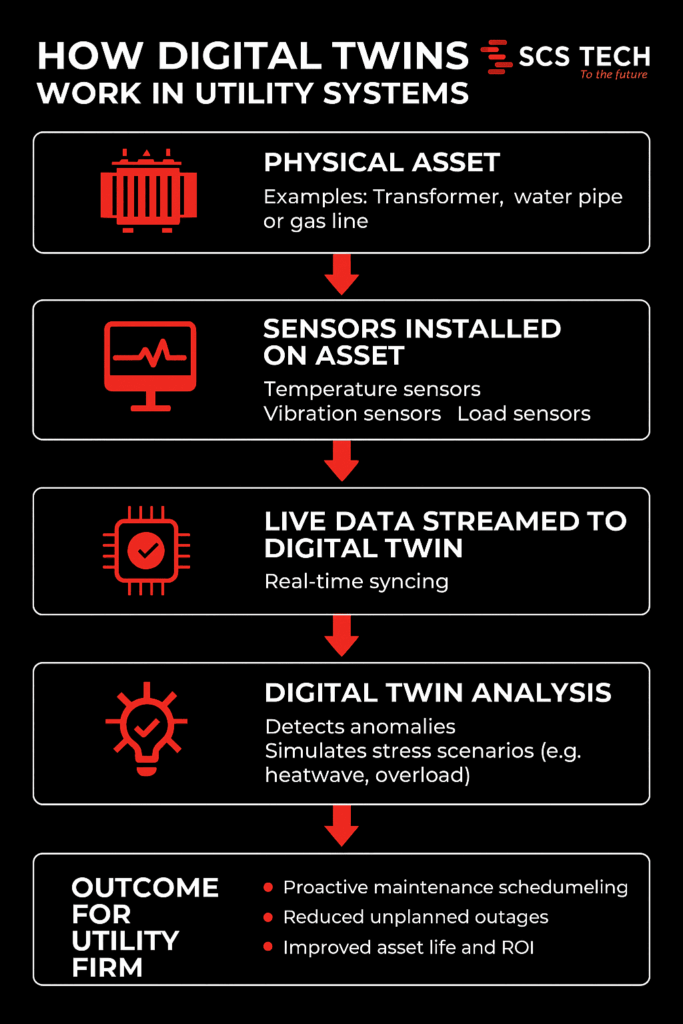
    How Digital Twins work in Utility Systems

    Utility firms run on tight margins for error. A single equipment failure — whether it’s in a substation, water main, or gas line — can trigger costly downtimes, safety risks, and public backlash. The problem isn’t just failure. It’s not knowing when something is about to fail.

    Digital twin technology changes that.

    At its core, a digital twin is a virtual replica of a physical asset or system. But this isn’t just a static model. It’s a dynamic, real-time environment fed by live data from the field.

    • Sensors on physical assets capture metrics like:
      • Temperature
      • Pressure
      • Vibration levels
      • Load fluctuations
    • That data streams into the digital twin, which updates in real time and mirrors the condition of the asset as it evolves.

    This real-time reflection isn’t just about monitoring — it’s about prediction. With enough data history, utility firms can start to:

    • Detect anomalies before alarms go off
    • Simulate how an asset might respond under stress (like heatwaves or load spikes)
    • Forecast the likely time to failure based on wear patterns

    As a result, maintenance shifts from reactive to proactive. You’re no longer waiting for equipment to break or relying on calendar-based checkups. Instead:

    • Assets are serviced based on real-time health
    • Failures are anticipated — and often prevented
    • Resources are allocated based on actual risk, not guesswork

    In high-stakes systems where uptime matters, this shift isn’t just an upgrade — it’s a necessity.

    Ways Digital Twin Technology is Helping Utility Firms Predict and Prevent Failures

    1. Proactive Maintenance Through Real-Time Monitoring

    In a typical utility setup, maintenance is either time-based (like changing oil every 6 months) or event-driven (something breaks, then it gets fixed). Neither approach adapts to how the asset is actually performing.

    Digital twins allow firms to move to condition-based maintenance, using real-time data to catch failure indicators before anything breaks. This shift is a key component of any effective digital transformation strategy that utility firms implement to improve asset management.

    Take this scenario:

    • A substation transformer is fitted with sensors tracking internal oil temperature, moisture levels, and load current.
    • The digital twin uses this live stream to detect subtle trends, like a slow rise in dissolved gas levels, which often points to early insulation breakdown.
    • Based on this insight, engineers know the transformer doesn’t need immediate replacement, but it does need inspection within the next two weeks to prevent cascading failure.

    That level of specificity is what sets digital twins apart from basic SCADA systems.

    Other real-world examples include:

    • Water utilities detecting flow inconsistencies that indicate pipe leakage, before it becomes visible or floods a zone.
    • Wind turbine operators identifying torque fluctuations in gearboxes that predict mechanical fatigue.

    Here’s what this proactive monitoring unlocks:

    • Early detection of failure patterns — long before traditional alarms would trigger.
    • Targeted interventions — send teams to fix assets showing real degradation, not just based on the calendar.
    • Shorter repair windows — because issues are caught earlier and are less severe.
    • Smarter budget use — fewer emergency repairs and lower asset replacement costs.

    This isn’t just monitoring for the sake of data. It’s a way to read the early signals of failure — and act on them before the problem exists in the real world.

    2. Enhanced Vegetation Management and Risk Mitigation

    Vegetation encroachment is a leading cause of power outages and wildfire risks. Traditional inspection methods are often time-consuming and less precise. Digital twins, integrated with LiDAR and AI technologies, offer a more efficient solution. By creating detailed 3D models of utility networks and surrounding vegetation, utilities can predict growth patterns and identify high-risk areas.

    This enables utility firms to:

    • Map the exact proximity of vegetation to assets in real-time
    • Predict growth patterns based on species type, local weather, and terrain
    • Pinpoint high-risk zones before branches become threats or trigger regulatory violations

    Let’s take a real-world example:

    Southern California Edison used Neara’s digital twin platform to overhaul its vegetation management.

    • What used to take months to determine clearance guidance now takes weeks
    • Work execution was completed 50% faster, thanks to precise, data-backed targeting

    Vegetation isn’t going to stop growing. But with a digital twin watching over it, utility firms don’t have to be caught off guard.

    3. Optimized Grid Operations and Load Management

    Balancing supply and demand in real-time is crucial for grid stability. Digital twins facilitate this by simulating various operational scenarios, allowing utilities to optimize energy distribution and manage loads effectively. By analyzing data from smart meters, sensors, and other grid components, potential bottlenecks can be identified and addressed proactively.

    Here’s how it works in practice:

    • Data from smart meters, IoT sensors, and control systems is funnelled into the digital twin.
    • The platform then runs what-if scenarios:
      • What happens if demand spikes in one region?
      • What if a substation goes offline unexpectedly?
      • How do EV charging surges affect residential loads?

    These simulations allow utility firms to:

    • Balance loads dynamically — shifting supply across regions based on actual demand
    • Identify bottlenecks in the grid — before they lead to voltage drops or system trips
    • Test responses to outages or disruptions — without touching the real infrastructure

    One real-world application comes from Siemens, which uses digital twin technology to model substations across its power grid. By creating these virtual replicas, operators can:

    • Detect voltage anomalies or reactive power imbalances quickly
    • Simulate switching operations before pushing them live
    • Reduce fault response time and improve grid reliability overall

    This level of foresight turns grid management from a reactive firefighting role into a strategic, scenario-tested process.

    When energy systems are stretched thin, especially with renewables feeding intermittent loads, a digital twin becomes less of a luxury and more of a grid operator’s control room essential.

    4. Improved Emergency Response and Disaster Preparedness

    When a storm hits, a wildfire spreads, or a substation goes offline unexpectedly, every second counts. Utility firms need more than just a damage report — they need situational awareness and clear action paths.

    Digital twins give operators that clarity, before, during, and after an emergency.

    Unlike traditional models that provide static views, digital twins offer live, geospatially aware environments that evolve in real time based on field inputs. This enables faster, better-coordinated responses across teams.

    Here’s how digital twins strengthen emergency preparedness:

    • Pre-event scenario planning
      • Simulate storm surges, fire paths, or equipment failure to see how the grid will respond
      • Identify weak links in the network (e.g. aging transformers, high-risk lines) and pre-position resources accordingly
    • Real-time situational monitoring
      • Integrate drone feeds, sensor alerts, and field crew updates directly into the twin
      • Track which areas are inaccessible, where outages are expanding, and how restoration efforts are progressing
    • Faster field deployment
      • Dispatch crews with exact asset locations, hazard maps, and work orders tied to real-time conditions
      • Reduce miscommunication and avoid wasted trips during chaotic situations

    For example, during wildfires or hurricanes, digital twins can overlay evacuation zones, line outage maps, and grid stress indicators in one place — helping both operations teams and emergency planners align fast.

    When things go wrong, digital twins don’t just help respond — they help prepare, so the fallout is minimised before it even begins.

    5. Streamlined Regulatory Compliance and Reporting

    For utility firms, compliance isn’t optional, it’s a constant demand. From safety inspections to environmental impact reports, regulators expect accurate documentation, on time, every time. Gathering that data manually is often time-consuming, error-prone, and disconnected across departments.

    Digital twins simplify the entire compliance process by turning operational data into traceable, report-ready insights.

    Here’s what that looks like in practice:

    • Automated data capture
      • Sensors feed real-time operational metrics (e.g., line loads, maintenance history, vegetation clearance) into the digital twin continuously
      • No need to chase logs, cross-check spreadsheets, or manually input field data
    • Built-in audit trails
      • Every change to the system — from a voltage dip to a completed work order — is automatically timestamped and stored
      • Auditors get clear records of what happened, when, and how the utility responded
    • On-demand compliance reports
      • Whether it’s for NERC reliability standards, wildfire mitigation plans, or energy usage disclosures, reports can be generated quickly using accurate, up-to-date data
      • No scrambling before deadlines, no gaps in documentation

    For utilities operating in highly regulated environments — especially those subject to increasing scrutiny over grid safety and climate risk — this level of operational transparency is a game-changer.

    With a digital twin in place, compliance shifts from being a back-office burden to a built-in outcome of how the grid is managed every day.

    Conclusion

    Digital twin technology is revolutionizing the utility sector by enabling predictive maintenance, optimizing operations, enhancing emergency preparedness, and ensuring regulatory compliance. By adopting this technology, utility firms can improve reliability, reduce costs, and better serve their customers in an increasingly complex and demanding environment.

    At SCS Tech, we specialize in delivering comprehensive digital transformation solutions tailored to the unique needs of utility companies. Our expertise in developing and implementing digital twin strategies ensures that your organization stays ahead of the curve, embracing innovation to achieve operational excellence.

    Ready to transform your utility operations with proven digital utility solutions? Contact one of the leading digital transformation companies—SCS Tech—to explore how our tailored digital transformation strategy can help you predict and prevent failures.

  • What Happens When GIS Meets IoT: Real-Time Mapping for Smarter Cities

    What Happens When GIS Meets IoT: Real-Time Mapping for Smarter Cities

    Urban problems like traffic congestion and energy wastage are on the increase as cities get more connected. 

    While the Internet of Things (IoT) generates a great deal of data, it often lacks spatial awareness, so cities cannot respond in an effective manner. In practice, 74% of IoT projects are considered to fail, often due to issues like integration challenges, insufficient skills, and poorly defined business cases. 

    Including Geographic Information Systems (GIS) with IoT offers cities location-based real-time intelligence to make traffic, energy, and safety management decisions more informed. The integration of GIS with IoT is the key to transforming urban data into actionable intelligence that maximizes city operations.

    The Impact of IoT Without GIS Mapping: Why Spatial Context Matters

    In today’s intelligent cities, IoT devices are amassing enormous quantities of data regarding traffic, waste disposal, energy consumption, and others. Yet without the indispensable geographic context of GIS, such data can stay disconnected, rendering cities with siloed, uninterpretable data. 

    IoT data responds to the query of “what” is occurring, yet GIS responds to the all-important question of “where” it is occurring—and spatial awareness is fundamental for informed, timely decision-making.

    Challenges faced by cities without GIS mapping:

    • Limited Understanding of Data Location: IoT sensors can sense problems, such as an increase in traffic jams, but without GIS, one does not know where precisely the issue lies. Is it a concentrating bottleneck or a city-wide problem? Without geospatial context, deciding which routes to upgrade is a shot in the dark.
    • Inefficiency in Response Time: If the whereabouts of a problem are not known, it will take longer to respond to it. For example, waste collection vehicles can receive information about a full bin, but without GIS, it is not known which bin to service first. This can cause inefficiencies and delays.
    • Difficult Pattern Discovery: It’s difficult for urban planners to determine patterns if data isn’t geographically based. For instance, crime areas within a neighborhood won’t reveal themselves until you put crime data on top of traffic flow maps, retail maps, or other IoT maps.
    • Blind Data: Context-less data is worthless. IoT sensors are tracking all sorts of metrics, but without GIS to organize and visualize that data on a geographic basis, it’s often overwhelming and worthless. Cities may be tracking millions of data points with no discernible plan about how to react to them.

    By integrating GIS with IoT, cities can shift from reactive to proactive management, ensuring that urban dynamics are continuously improved in real-time.

    How Real-Time GIS Mapping Enhances Urban Management

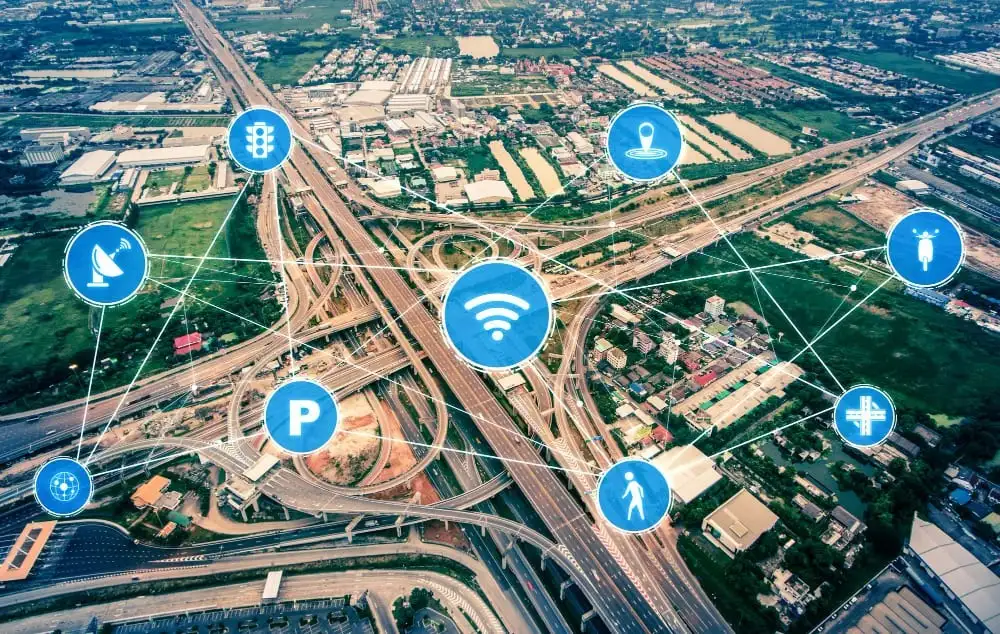
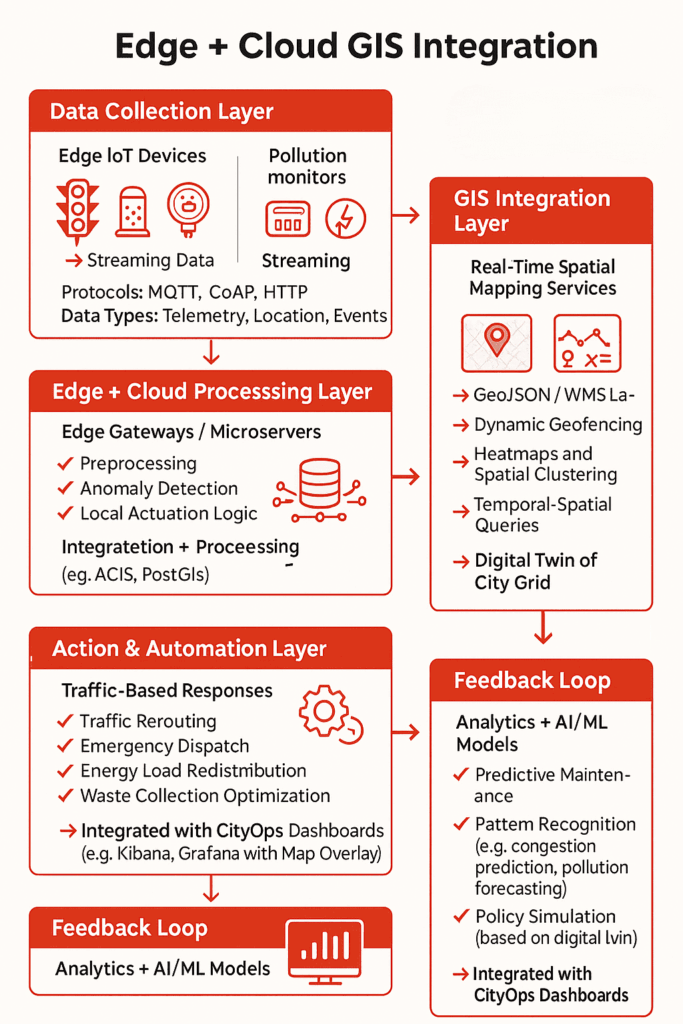
    Edge + GIS Mapping

    IoT devices stream real-time telemetry—air quality levels, traffic flow, water usage—but without GIS, this data lacks geospatial context.

    GIS integrates these telemetry feeds into spatial data layers, enabling dynamic geofencing, hotspot detection, and live mapping directly on the city’s grid infrastructure. This allows city systems to trigger automated responses—such as rerouting traffic when congestion zones are detected via loop sensors, or dispatching waste trucks when fill-level sensors cross geofenced thresholds.

    Instead of sifting through unstructured sensor logs, operators get geospatial dashboards that localize problems instantly, speeding up intervention and reducing operational lag.

    That’s how GIS mapping services transform isolated IoT data points into a unified, location-aware command system for real-time, high-accuracy urban management.

    In detail, here’s how real-time GIS mapping improves urban management efficiency:

    1. Real-Time Decision Making

    With GIS, IoT data can be overlaid on a map, modern GIS mapping services enable cities to make on-the-fly decisions by integrating data streams directly into live, spatial dashboards, making responsiveness a built-in feature of urban operations. Whether it’s adjusting traffic signal timings based on congestion, dispatching emergency services during a crisis, or optimizing waste collection routes, real-time GIS mapping provides the spatial context necessary for precise, quick action.

    • Traffic Management: Real-time traffic data from IoT sensors can be displayed on GIS maps, enabling dynamic route optimization and better flow management. City officials can adjust traffic lights or divert traffic in real time to minimize congestion.
    • Emergency Response: GIS mapping enables emergency responders to access real-time data about traffic, weather conditions, and road closures, allowing them to make faster, more informed decisions.

    2. Enhanced Urban Planning and Resource Optimization

    GIS allows cities to optimize infrastructure and resources by identifying trends and patterns over time. Urban planners can examine data in a spatial context, making it easier to plan for future growth, optimize energy consumption, and reduce costs.

    • Energy Management: GIS can track energy usage patterns across the city, allowing for more efficient allocation of resources. Cities can pinpoint high-energy-demand areas and develop strategies for energy conservation.
    • Waste Management: By combining IoT data on waste levels with GIS, cities can optimize waste collection routes and schedules, reducing costs and improving service efficiency.

    3. Improved Sustainability and Liveability

    Cities can use real-time GIS mapping to make informed decisions that promote sustainability and improve liveability. With a clear view of spatial patterns, cities can address challenges like air pollution, water management, and green space accessibility more effectively.

    • Air Quality Monitoring: With real-time data from IoT sensors, GIS can map pollution hotspots and allow city officials to take corrective actions, like deploying air purifiers or restricting traffic in affected areas.
    • Water Management: GIS can help manage water usage by mapping areas with high consumption or leakage, ensuring that water resources are used efficiently and wastefully high-demand areas are addressed.

    4. Data-Driven Policy Making

    Real-time GIS mapping provides city officials with a clear, data-backed picture of urban dynamics. By analyzing data in a geographic context, cities can create policies and strategies that are better aligned with the actual needs of their communities.

    • Urban Heat Islands: By mapping temperature data in real-time, cities can identify areas with higher temperatures. This enables them to take proactive steps, such as creating more green spaces or installing reflective materials, to cool down the environment.
    • Flood Risk Management: GIS can help cities predict flood risks by mapping elevation data, rainfall patterns, and drainage systems. When IoT sensors detect rising water levels, real-time GIS data can provide immediate insight into which areas are at risk, allowing for faster evacuation or mitigation actions.

    Advancements in GIS-IoT Integration: Powering Smarter Urban Decisions

    The integration of GIS and IoT isn’t just changing urban management—it’s redefining how cities function in real time. At the heart of this transformation lies a crucial capability: spatial intelligence. Rather than treating it as a standalone concept, think of it as the evolved skill set cities gain when GIS and IoT converge.

    Spatial intelligence empowers city systems to interpret massive volumes of geographically referenced data—on the fly. And with today’s advancements, that ability is more real-time, accurate, and actionable than ever before. As this shift continues, GIS companies in India are playing a critical role in enabling municipalities to implement smart city solutions at scale.

    What’s Fueling This Leap in Capability?

    Here’s how recent technological developments are enhancing the impact of real-time GIS in urban management:

    • 5G Connectivity: Ultra-low latency enables IoT sensors—from traffic signals to air quality monitors—to stream data instantly. This dramatically reduces the lag between problem detection and response.
    • Edge Computing: By processing data at or near the source (like a traffic node or waste disposal unit), cities avoid central server delays. This results in faster analysis and quicker decisions at the point of action.
    • Cloud-Enabled GIS Platforms: Cloud integration centralizes spatial data, enabling seamless, scalable access and collaboration across departments.
    • AI and Predictive Analytics in GIS: With machine learning layered into GIS, spatial patterns can be not only observed but predicted. For instance, analyzing pedestrian density can help adjust signal timings before congestion occurs.
    • Digital Twins of Urban Systems: Many cities are now creating real-time digital replicas of their physical infrastructure. These digital twins, powered by GIS-IoT data streams, allow planners to simulate changes before implementing them in the real world.

    Why These Advancements Matter Now

    Urban systems are more complex than ever—rising populations, environmental stress, and infrastructure strain demand faster, smarter decision-making. What once took weeks of reporting and data aggregation now happens in real time. Real-time GIS mapping isn’t just a helpful upgrade—it’s a necessary infrastructure for:

    • Preemptively identifying traffic bottlenecks before they paralyze a city.
    • Monitoring air quality by neighborhood and deploying mobile clean-air units.
    • Allocating energy dynamically based on real-time consumption patterns.

    Rather than being an isolated software tool, GIS is evolving into a live, decision-support system. It is an intelligent layer across the city’s digital and physical ecosystems.

    For businesses involved in urban infrastructure, SCS Tech provides advanced GIS mapping services that take full advantage of these cutting-edge technologies, ensuring smarter, more efficient urban management solutions.

    Conclusion

    Smart cities aren’t built on data alone—they’re built on context. IoT can tell you what’s happening, but without GIS, you won’t know where or why. That’s the gap real-time mapping fills.

    When cities integrate GIS with IoT, they stop reacting blindly and start solving problems with precision. Whether it’s managing congestion, cutting energy waste, or improving emergency response, GIS and IoT are indeed gamechangers.

    At SCS Tech, we help city planners and infrastructure teams make sense of complex data through real-time GIS solutions. If you’re ready to turn scattered data into smart decisions, we’re here to help.

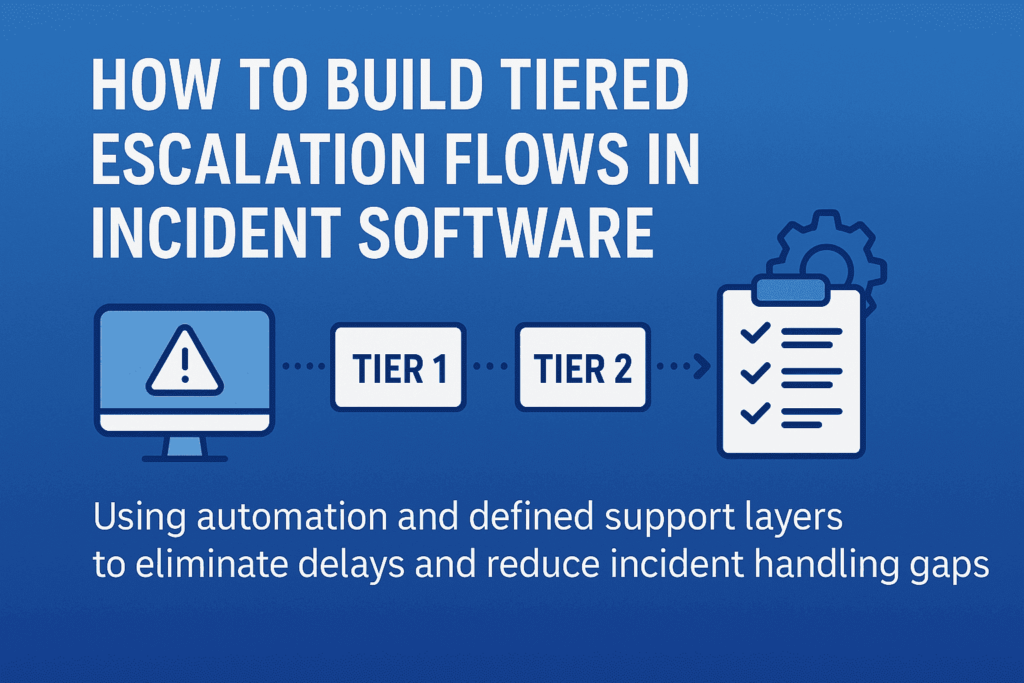
  • How to Structure Tier-1 to Tier-3 Escalation Flows with Incident Software

    How to Structure Tier-1 to Tier-3 Escalation Flows with Incident Software

    When an alert hits your system, there’s a split-second decision that determines how long it lingers: Can Tier-1 handle this—or should we escalate?

    Now multiply that by hundreds of alerts a month, across teams, time zones, and shifts—and you’ve got a pattern of knee-jerk escalations, duplicated effort, and drained senior engineers stuck cleaning up tickets that shouldn’t have reached them in the first place.

    Most companies don’t lack talent—they lack escalation logic. They escalate based on panic, not process.

    Here’s how incident software can help you fix that—by structuring each tier with rules, boundaries, and built-in context, so your team knows who handles what, when, and how—without guessing.

    The Real Problem with Tiered Escalation (And It’s Not What You Think)

    Tiered Escalation
    Most escalation flows look clean—on slides. In reality? It’s a maze of sticky notes, gut decisions, and “just pass it to Tier-2” habits.

    Here’s what usually goes wrong:

    • Tier-1 holds on too long—hoping to fix it, wasting response time
    • Or escalates too soon—with barely any context
    • Tier-2 gets it, but has to re-diagnose because there’s no trace of what’s been done
    • Tier-3 ends up firefighting issues that were never filtered properly

    Why does this happen? Because escalation is treated like a transfer, not a transition. And without boundary-setting and logic, even the best software ends up becoming a digital dumping ground.

    That’s where structured escalation flows come in—not as static chains, but as decision systems. A well-designed incident management software helps implement these decision systems by aligning every tier’s scope, rules, and responsibilities. Each tier should know:

    • What they’re expected to solve
    • What criteria justifies escalation
    • What information must be attached before passing the baton

    Anything less than that—and escalation just becomes escalation theater.

    Structuring Escalation Logic: What Should Happen at Each Tier (with Boundaries)

    Escalation tiers aren’t ranks—they’re response layers with different scopes of authority, context, and tools. Here’s how to structure them so everyone acts, not just reacts.

    Tier-1: Containment and Categorization—Not Root Cause

    Tier-1 isn’t there to solve deep problems. They’re the first line of control—triaging, logging, and assigning severity. But often they’re blamed for “not solving” what they were never supposed to.

    Here’s what Tier-1 should do:

    • Acknowledge the alert within the SLA window
    • Check for known issues in a predefined knowledge base or past tickets
    • Apply initial containment steps (e.g., restart service, check logs, run diagnostics)
    • Classify and tag the incident: severity, affected system, known symptoms
    • Escalate with structured context (timestamp, steps tried, confidence level)

    Your incident management software should enforce these checkpoints—nothing escalates without it. That’s how you stop Tier-2 from becoming Tier-1 with more tools.

    Tier-2: Deep Dive, Recurrence Detection, Cross-System Insight

    This team investigates why it happened, not just what happened. They work across services, APIs, and dependencies—often comparing live and historical data.

    What should your software enable for Tier-2?

    • Access to full incident history, including diagnostic steps from Tier-1
    • Ability to cross-reference logs across services or clusters
    • Contextual linking to other open or past incidents (if this looks like déjà vu, it probably is)
    • Authority to apply temporary fixes—but flag for deeper RCA (root cause analysis) if needed

    Tier-2 should only escalate if systemic issues are detected, or if business impact requires strategic trade-offs.

    Tier-3: Permanent Fixes and Strategic Prevention

    By the time an incident reaches Tier-3, it’s no longer about restoring function—it’s about preventing it from happening again.

    They need:

    • Full access to code, configuration, and deployment pipelines
    • The authority to roll out permanent fixes (sometimes involving product or architecture changes)
    • Visibility into broader impact: Is this a one-off? A design flaw? A risk to SLAs?

    Tier-3’s involvement should trigger documentation, backlog tickets, and perhaps even blameless postmortems. Escalating to Tier-3 isn’t a failure—it’s an investment in system resilience.

    Building Escalation into Your Incident Management Software (So It’s Not Just a Ticket System)

    Most incident tools act like inboxes—they collect alerts. But to support real escalation, your software needs to behave more like a decision layer, not a passive log.

    Here’s how that looks in practice.

    1. Tier-Based Views

    When a critical alert fires, who sees it? If everyone on-call sees every ticket, it dilutes urgency. Tier-based visibility means:

    • Tier-1 sees only what’s within their response scope
    • Tier-2 gets automatically alerted when severity or affected systems cross thresholds
    • Tier-3 only gets pulled when systemic patterns emerge or human escalation occurs

    This removes alert fatigue and brings sharp clarity to ownership. No more “who’s handling this?”

    2. Escalation Triggers

    Your escalation shouldn’t rely on someone deciding when to escalate. The system should flag it:

    • If Tier-1 exceeds time to resolve
    • If the same alert repeats within X hours
    • If affected services reach a certain business threshold (e.g., customer-facing)

    These triggers can auto-create a Tier-2 task, notify SMEs, or even open an incident war room with pre-set stakeholders. Think: decision trees with automation.

    3. Context-Rich Handoffs 

    Escalation often breaks because Tier-2 or Tier-3 gets raw alerts, not narratives. Your software should automatically pull and attach:

    • Initial diagnostics
    • Steps already taken
    • System health graphs
    • Previous related incidents
    • Logs, screenshots, and even Slack threads

    This isn’t a “notes” field. It’s structured metadata that keeps context alive without relying on the person escalating.

    4. Accountability Logging

    A smooth escalation trail helps teams learn from the incident—not just survive it.

    Your incident software should:

    • Timestamp every handoff
    • Record who escalated, when, and why
    • Show what actions were taken at each tier
    • Auto-generate a timeline for RCA documentation

    This makes postmortems fast, fair, and actionable—not hours of Slack archaeology.

    When escalation logic is embedded, not documented, incident response becomes faster and repeatable—even under pressure.

    Common Pitfalls in Building Escalation Structures (And How to Avoid Them)

    While creating a smooth escalation flow sounds simple, there are a few common traps teams fall into when setting up incident management systems. Avoiding these pitfalls ensures your escalation flows work as they should when the pressure is on.

    1. Overcomplicating Escalation Triggers

    Adding too many layers or overly complex conditions for when an escalation should happen can slow down response times. Overcomplicating escalation rules can lead to delays and miscommunication.

    Keep escalation triggers simple but actionable. Aim for a few critical conditions that must be met before escalating to the next tier. This keeps teams focused on responding, not searching through layers of complexity. For example:

    • If a high-severity incident hasn’t been addressed in 15 minutes, auto-escalate.
    • If a service has reached 80% of capacity for over 5 minutes, escalate to Tier-2.

    2. Lack of Clear Ownership at Each Tier

    When there’s uncertainty about who owns a ticket, or ownership isn’t transferred clearly between teams, things slip through the cracks. This creates chaos and miscommunication when escalation happens.

    Be clear on ownership at each level. Your incident software should make this explicit. Tier-1 should know exactly what they’re accountable for, Tier-2 should know the moment a critical incident is escalated, and Tier-3 should immediately see the complete context for action.

    Set default owners for every tier, with auto-assignment based on workload. This eliminates ambiguity during time-sensitive situations.

    3. Underestimating the Importance of Context

    Escalations often fail because they happen without context. Passing a vague or incomplete incident to the next team creates bottlenecks.

    Ensure context-rich handoffs with every escalation. As mentioned earlier, integrate tools for pulling in logs, diagnostics, service health, and team notes. The team at the next tier should be able to understand the incident as if they’ve been working on it from the start. This also enables smoother collaboration when escalation happens.

    4. Ignoring the Post-Incident Learning Loop

    Once the incident is resolved, many teams close the issue and move on, forgetting to analyze what went wrong and what can be improved in the future.

    Incorporate a feedback loop into your escalation process. Your incident management software should allow teams to mark incidents as “postmortem required” with a direct link to learning resources. Encourage root-cause analysis (RCA) after every major incident, with automated templates to capture key findings from each escalation level.

    By analyzing the incident flow, you’ll uncover bottlenecks or gaps in your escalation structure and refine it over time.

    5. Failing to Test the Escalation Flow

    Thinking the system will work perfectly the first time is a mistake. Incident software can fail when escalations aren’t tested under realistic conditions, leading to inefficiencies during actual events.

    Test your escalation flows regularly. Simulate incidents with different severity levels to see how your system handles real-time escalations. Bring in Tier-1, Tier-2, and Tier-3 teams to practice. Conduct fire drills to identify weak spots in your escalation logic and ensure everyone knows their responsibilities under pressure.

    Wrapping Up

    Effective escalation flows aren’t just about ticket management—they are a strategy for ensuring that your team can respond to critical incidents swiftly and intelligently. By avoiding common pitfalls, maintaining clear ownership, integrating automation, and testing your system regularly, you can build an escalation flow that’s ready to handle any challenge, no matter how urgent. 

    At SCS Tech, we specialize in crafting tailored escalation strategies that help businesses maintain control and efficiency during high-pressure situations. Ready to streamline your escalation process and ensure faster resolutions? Contact SCS Tech today to learn how we can optimize your systems for stability and success.

  • How Custom Cybersecurity Prevents HIPAA Penalties and Patient Data Leaks?

    How Custom Cybersecurity Prevents HIPAA Penalties and Patient Data Leaks?

    Every healthcare provider today relies on digital systems. 

    But too often, those systems don’t talk to each other in a way that keeps patient data safe. This isn’t just a technical oversight; it’s a risk that shows up in compliance audits, government penalties, and public breaches. In fact, most HIPAA violations aren’t caused by hackers, they stem from poor system integration, generic cybersecurity tools, or overlooked access logs.

    And when those systems fail to catch a misstep, the aftercoming cost can be severe: it will be more than six-figure fines, federal audits, and long-term reputational damage.

    That’s where custom cybersecurity solutions adds more tools to align security with the way your healthcare operations actually run. When security is designed around your clinical workflows, your APIs, and your data-sharing practices, it doesn’t just protect — it prevents.

    In this article, we’ll unpack how integrated, custom-built cybersecurity helps healthcare organizations stay compliant, avoid HIPAA penalties, and defend what matters most: patient trust.

    Understanding HIPAA Compliance and Its Real-World Challenges

    HIPAA isn’t just a legal framework, it’s a daily operational burden for any healthcare provider managing electronic Protected Health Information (ePHI). While the regulation is clear about what must be protected, it’s far less clear about how to do it, especially in systems that weren’t built with healthcare in mind.

    Here’s what makes HIPAA compliance difficult in practice:

    • Ambiguity in Implementation: The security rule requires “reasonable and appropriate safeguards,” but doesn’t define a universal standard. That leaves providers guessing whether their security setup actually meets expectations.
    • Fragmented IT Systems: Most healthcare environments run on a mix of EHR platforms, custom apps, third-party billing systems, and legacy hardware. Stitching all of this together while maintaining consistent data protection is a constant challenge.
    • Hidden Access Points: APIs, internal dashboards, and remote access tools often go unsecured or unaudited. These backdoors are commonly exploited during breaches, not because they’re poorly built, but because they’re not properly configured or monitored.
    • Audit Trail Blind Spots: HIPAA requires full auditability of ePHI, but without custom configurations, many logging systems fail to track who accessed what, when, and why.

    Even good IT teams struggle here, not because they’re negligent, but because most off-the-shelf cybersecurity solutions aren’t designed to speak HIPAA natively. That’s what puts your organization at risk: doing what seems secure, but still falling short of what’s required.

    That’s where custom cybersecurity solutions fill the gap, not by adding complexity, but by aligning every protection with real HIPAA demands.

    How Custom Cybersecurity Adapts to the Realities of Healthcare Environments

    Custom Cybersecurity

    Custom cybersecurity tailors every layer of your digital defense to match your exact workflows, compliance requirements, and system vulnerabilities.

    Here’s how that plays out in real healthcare environments:

    1. Role-Based Access, Not Just Passwords

    In many healthcare systems, user access is still shockingly broad — a receptionist might see billing details, a technician could open clinical histories. Not out of malice, just because default systems weren’t built with healthcare’s sensitivity in mind.

    That’s where custom role-based access control (RBAC) becomes essential. It doesn’t just manage who logs in — it enforces what they see, tied directly to their role, task, and compliance scope.

    For instance, under HIPAA’s “minimum necessary” rule, a front desk employee should only view appointment logs — not lab reports. A pharmacist needs medication orders, not patient billing history.

    And this isn’t just good practice — it’s damage control.

    According to Verizon’s Data Breach Investigations Report, over 29% of breaches stem from internal actors, often unintentionally. Custom RBAC shrinks that risk by removing exposure at the root: too much access, too easily given.

    Even better? It simplifies audits. When regulators ask, “Who accessed what, and why?” — your access map answers for you.

    1. Custom Alert Triggers for Suspicious Activity

    Most off-the-shelf cybersecurity tools flood your system with alerts — dozens or even hundreds a day. But here’s the catch: when everything is an emergency, nothing gets attention. And that’s exactly how threats slip through.

    Custom alert systems work differently. They’re not based on generic templates — they’re trained to recognize how your actual environment behaves.

    Say an EMR account is accessed from an unrecognized device at 3:12 a.m. — that’s flagged. A nurse’s login is used to export 40 patient records in under 30 seconds? That’s blocked. The system isn’t guessing — it’s calibrated to your policies, your team, and your workflow rhythm.

    1. Encryption That Works with Your Workflow

    HIPAA requires encryption, but many providers skip it because it slows down their tools. A custom setup integrates end-to-end encryption that doesn’t disrupt EHR speed or file transfer performance. That means patient files stay secure, without disrupting the care timeline.

    1. Logging That Doesn’t Leave Gaps

    Security failures often escalate due to one simple issue: the absence of complete, actionable logging. When logs are incomplete, fragmented, or siloed across systems, identifying the source of a breach becomes nearly impossible. Incident response slows down. Compliance reporting fails. Liability increases.

    A custom logging framework eliminates this risk. It captures and correlates activity across all touchpoints — not just within core systems, but also legacy infrastructure and third-party integrations. This includes:

    • Access attempts (both successful and failed)
    • File movements and transfers
    • Configuration changes across privileged accounts
    • Vendor interactions that occur outside standard EHR pathways

    The HIMSS survey underscores that inadequate monitoring poses significant risks, including data breaches, highlighting the necessity for robust monitoring strategies.

    Custom logging is designed to meet the audit demands of regulatory agencies while strengthening internal risk postures. It ensures that no security event goes undocumented, and no question goes unanswered during post-incident reviews.

    The Real Cost of HIPAA Violations — and How Custom Security Avoids Them

    HIPAA violations don’t just mean a slap on the wrist. They come with steep financial penalties, brand damage, and in some cases, criminal liability. And most of them? They’re preventable with better-fit security.

    Breakdown of Penalties:

    • Tier 1 (Unaware, could not have avoided): up to $50,000 per violation
    • Tier 4 (Willful neglect, not corrected): up to $1.9 million annually
    • Fines are per violation — not per incident. One breach can trigger dozens or hundreds of violations.

    But penalties are just the surface:

    • Investigation costs: Security audits, data recovery, legal reviews
    • Downtime: Systems may be partially or fully offline during containment
    • Reputation loss: Patients lose trust. Referrals drop. Insurance partners get hesitant.
    • Long-term compliance monitoring: Some organizations are placed under corrective action plans for years

    Where Custom Security Makes the Difference:

    Most breaches stem from misconfigured tools, over-permissive access, or lack of monitoring, all of which can be solved with custom security. Here’s how:

    • Precision-built access control prevents unnecessary exposure, no one gets access they don’t need.
    • Real-time monitoring systems catch and block suspicious behavior before it turns into an incident.
    • Automated compliance logging makes audits faster and proves you took the right steps.

    In short: custom security shifts you from reactive to proactive, and that makes HIPAA penalties exponentially less likely.

    What Healthcare Providers Should Look for in a Custom Cybersecurity Partner

    Off-the-shelf security tools often come with generic settings and limited healthcare expertise. That’s not enough when patient data is on the line, or when HIPAA enforcement is involved. Choosing the right partner for custom cybersecurity solution isn’t just a technical decision; it’s a business-critical one.

    What to prioritize:

    • Healthcare domain knowledge: Vendors should understand not just firewalls and encryption, but how healthcare workflows function, where PHI flows, and what technical blind spots tend to go unnoticed.
    • Experience with HIPAA audits: Look for providers who’ve helped other clients pass audits or recover from investigations — not just talk compliance, but prove it.
    • Custom architecture, not pre-built packages: Your EHR systems, patient portals, and internal communication tools are unique. Your security setup should mirror your actual tech environment, not force it into generic molds.
    • Threat response and simulation capabilities: Good partners don’t just build protections — they help you test, refine, and drill your incident response plan. Because theory isn’t enough when systems are under attack.
    • Built-in scalability: As your organization grows — new clinics, more providers, expanded services — your security architecture should scale with you, not become a roadblock.

    Final Note

    Cybersecurity in healthcare isn’t just about stopping threats, it’s about protecting compliance, patient trust, and uninterrupted care delivery. When HIPAA penalties can hit millions and breaches erode years of reputation, off-the-shelf solutions aren’t enough. Custom cybersecurity solutions allow your organization to build defense systems that align with how you actually operate, not a one-size-fits-all mold.

    At SCS Tech, we specialize in custom security frameworks tailored to the unique workflows of healthcare providers. From HIPAA-focused assessments to system-hardening and real-time monitoring, we help you build a safer, more compliant digital environment.

    FAQs

    1. Isn’t standard HIPAA compliance software enough to prevent penalties?

    Standard tools may cover the basics, but they often miss context-specific risks tied to your unique workflows. Custom cybersecurity maps directly to how your organization handles data, closing gaps generic tools overlook.

    2. What’s the difference between generic and custom cybersecurity for HIPAA?

    Generic solutions are broad and reactive. Custom cybersecurity is tailored, proactive, and built around your specific infrastructure, user behavior, and risk landscape — giving you tighter control over compliance and threat response.

    3. How does custom security help with HIPAA audits?

    It allows you to demonstrate not just compliance, but due diligence. Custom controls create detailed logs, clear risk management protocols, and faster access to proof of safeguards during an audit.


  • Logistics Firms Are Slashing Fuel Costs with AI Route Optimization—Here’s How

    Logistics Firms Are Slashing Fuel Costs with AI Route Optimization—Here’s How

    Route optimization that are based on static data and human choice tend to fall short of possibilities to save money, resulting in inefficiencies and wasted fuel use.

    Artificial intelligence route optimization fills the gap by taking advantage of real-time data, predictive algorithms, and machine learning that dynamically alter routes in response to current conditions, including changes in traffic and weather. Using this technology, logistics companies can not only improve delivery time but also save huge amounts of fuel—lessening costs as well as environmental costs.

    In this article, we’ll dive into how AI-powered route optimization is transforming logistics operations, offering both short-term savings and long-term strategic advantages.

    What’s Really Driving the Fuel Problem in Logistics Today?

    Per gallon of gasoline costs $3.15. But that’s not the problem logistics are dealing with. The problem is the inefficiency at multiple points in the delivery process. 

    Here’s a breakdown of the key contributors to the fuel problem:

    • Traffic and Congestion: Delivery trucks idle almost 30% of the time in traffic conditions in urban regions. Static route plans do not take into consideration real-time traffic congestion, which results in excess fuel consumption and late delivery.
    • Idling and Delays: Cumulative waiting times at the delivery points or loading/unloading stations. Idling raises the fuel consumption level and lowers productivity overall.
    • Inefficient Rerouting: Drivers often have to rely on outdated route plans, which fail to adapt to sudden changes like road closures, accidents, or detours, leading to inefficient rerouting and excess fuel use.
    • Poor Driver Habits: Poor driving habits—like speeding, harsh braking, or rapid acceleration—can reduce fuel efficiency by as much as 30% on highways and 10 – 40% in city driving.
    • Static Route Plans: Classical planning tends to presume that the first route is the optimal route, without considering actual-time environmental changes.

    While traditional route planning focuses solely on distance, the modern logistics challenge is far more complex.

    The problem isn’t just about distance—it’s about the time between decision-making moments. Decision latency—the gap between receiving new information (like traffic updates) and making a change—can have a profound impact on fuel usage. With every second lost, logistics firms burn more fuel.

    Traditional methods simply can’t adapt quickly enough to reduce fuel waste, but with the addition of AI, decisions can be automated in real-time, and routes can be adjusted dynamically to optimize the fuel efficiency.

    The Benefits of AI Route Optimization for Logistic Companies

    AI Route Optimization for Logistics Companies

    1. Reducing Wasted Miles and Excessive Idling

    Fuel consumption is heavily influenced by wasted time. 

    Unlike traditional systems that rely on static waypoints or historical averages, AI models are fed with live inputs from GPS signals, driver telemetry, municipal traffic feeds, and even weather APIs. These models use predictive analytics to detect emerging traffic patterns before they become bottlenecks and reroute deliveries proactively—sometimes before a driver even encounters a slowdown.

    What does this mean for logistics firms?

    • Fuel isn’t wasted reacting to problems—it’s saved by anticipating them.
    • Delivery ETAs stay accurate, which protects SLAs and reduces penalty risks.
    • Idle time is minimized, not just in traffic but at loading docks, thanks to integrations with warehouse management systems that adjust arrival times dynamically.

    The AI chooses the smartest options, prioritizing consistent movement, minimal stops, and smooth terrain. Over hundreds of deliveries per day, these micro-decisions lead to measurable gains: reduced fuel bills, better driver satisfaction, and more predictable operational costs.

    This is how logistics firms are moving from reactive delivery models to intelligent, pre-emptive routing systems—driven by real-time data, and optimized for efficiency from the first mile to the last.

    1. Smarter, Real-Time Adaptability to Traffic Conditions

    AI doesn’t just plan for the “best” route at the start of the day—it adapts in real time. 

    Using a combination of live traffic feeds, vehicle sensor data, and external data sources like weather APIs and accident reports, AI models update delivery routes in real time. But more than that, they prioritize fuel efficiency metrics—evaluating elevation shifts, average stop durations, road gradient, and even left-turn frequency to find the path that burns the least fuel, not just the one that arrives the fastest. This level of contextual optimization is only possible with a robust AI/ML service that can continuously learn and adapt from traffic data and driving conditions.

    The result?

    • Route changes aren’t guesswork—they’re cost-driven.
    • On long-haul routes, fuel burn can be reduced by up to 15% simply by avoiding high-altitude detours or stop-start urban traffic.
    • Over time, the system becomes smarter per region—learning traffic rhythms specific to cities, seasons, and even lanes.

    This level of adaptability is what separates rule-based systems from machine learning models: it’s not just a reroute, it’s a fuel-aware, performance-optimized redirect—one that scales with every mile logged.

    1. Load Optimization for Fuel Efficiency

    Whether a truck is carrying a full load or a partial one, AI adjusts its recommendations to ensure the vehicle isn’t overworking itself, driving fuel consumption up unnecessarily. 

    For instance, AI accounts for vehicle weight, cargo volume, and even the terrain—knowing that a fully loaded truck climbing steep hills will consume more fuel than one carrying a lighter load on flat roads. 

    This leads to more tailored, precise decisions that optimize fuel usage based on load conditions, further reducing costs.

    What Does AI Route Optimization Actually Work?

    AI route optimization is transforming logistics by addressing the inefficiencies that traditional routing methods can’t handle. It moves beyond static plans, offering a dynamic, data-driven approach to reduce fuel consumption and improve overall operational efficiency. Here’s a clear breakdown of how AI does this:

    Predictive vs. Reactive Routing

    Traditional systems are reactive by design: they wait for traffic congestion to appear before recalculating. By then, the vehicle is already delayed, the fuel is already burned, and the opportunity to optimize is gone.

    AI flips this entirely.

    It combines:

    • Historical traffic patterns (think: congestion trends by time-of-day or day-of-week),
    • Live sensor inputs from telematics systems (speed, engine RPM, idle time),
    • External data streams (weather services, construction alerts, accident reports),
    • and driver behavior models (based on past performance and route habits)

    …to generate routes that aren’t just “smart”—they’re anticipatory.

    For example, if a system predicts a 60% chance of a traffic jam on Route A due to a football game starting at 5 PM, and the delivery is scheduled for 4:45 PM, it will reroute the vehicle through a slightly longer but consistently faster highway path—preventing idle time before it starts.

    This kind of proactive rerouting isn’t based on a single event; it’s shaped by millions of data points and fine-tuned by machine learning models that improve with each trip logged. With every dataset processed, an AI/ML service gains more predictive power, enabling it to make even more fuel-efficient decisions in future deliveries. Over time, this allows logistics firms to build an operational strategy around predictable fuel savings, not just reactive cost-cutting.

    Real-Time Data Inputs (Traffic, Weather, Load Data)

    AI systems integrate:

    • Traffic flow data from GPS providers, municipal feeds, and crowdsourced platforms like Waze.
    • Weather intelligence APIs to account for storm patterns, wind resistance, and road friction risks.
    • Vehicle telematics for current load weight, which affects acceleration patterns and optimal speeds.

    Each of these feeds becomes part of a dynamic route scoring model. For example, if a vehicle carrying a heavy load is routed into a hilly region during rainfall, fuel consumption may spike due to increased drag and braking. A well-tuned AI system reroutes that load along a flatter, dryer corridor—even if it’s slightly longer in distance—because fuel efficiency, not just mileage, becomes the optimized metric.

    This data fusion also happens at high frequency—every 5 to 15 seconds in advanced systems. That means as soon as a new traffic bottleneck is detected or a sudden road closure occurs, the algorithm recalculates, reducing decision latency to near-zero and preserving route efficiency with no human intervention.

    Vehicle-Specific Considerations

    Heavy-duty trucks carrying full loads can consume up to 50% more fuel per mile than lighter or empty ones, according to the U.S. Department of Energy. That means sending two different trucks down the same “optimal” route—without factoring in grade, stop frequency, or road surface—can result in major fuel waste.

    AI takes this into account in real time, adjusting:

    • Route incline based on gross vehicle weight and torque efficiency
    • Stop frequency based on vehicle type (e.g., hybrid vs. diesel)
    • Fuel burn curves that shift depending on terrain and traffic

    This level of precision allows fleet managers to assign the right vehicle to the right route—not just any available truck. And when combined with historical performance data, the AI can even learn which vehicles perform best on which corridors, continually improving the match between route and machine.

    Automatic Rerouting Based on Traffic/Data Drift

    AI’s real-time adaptability means that as traffic conditions change, or if new data becomes available (e.g., a road closure), the system automatically reroutes the vehicle to a more efficient path. 

    For example, if a major accident suddenly clogs a key highway, the AI can detect it within seconds and reroute the vehicle through a less congested arterial road—without the driver needing to stop or call dispatch. 

    Machine Learning: Continuous Improvement Over Time

    The most powerful aspect of AI is its machine learning capability. Over time, the system learns from outcomes—whether a route led to a fuel-efficient journey or created unnecessary delays. 

    With this knowledge, it continuously refines its algorithms, becoming better at predicting the most efficient routes and adapting to new challenges. AI doesn’t just optimize based on past data; it evolves and gets smarter with every trip.

    Bottom Line

    AI route optimization is not just a technological upgrade—it’s a strategic investment. 

    Firms that adopt AI-powered planning typically cut fuel expenses by 7–15%, depending on fleet size and operational complexity. But the value doesn’t stop there. Reduced idling, smarter rerouting, and fewer detours also mean less wear on vehicles, better delivery timing, and higher driver output.

    If you’re ready to make your fleet leaner, faster, and more fuel-efficient, SCS Tech’s AI logistics suite is built to deliver exactly that. Whether you need plug-and-play solutions or a fully customised AI/ML service, integrating these technologies into your logistics workflow is the key to sustained cost savings and competitive advantage. Contact us today to learn how we can help you drive smarter logistics and significant cost savings.