Category: land record management

  • How GIS Companies in India Use Satellites and Drones to Improve Land Records & Property Management?

    How GIS Companies in India Use Satellites and Drones to Improve Land Records & Property Management?

    India, occupying just 2.4% of the world’s entire land area, accommodates 18% of the world’s population, resulting in congested land resources, high-speed urbanization, and loss of productive land. For sustainable land management, reliable land records, effective land use planning, and better property management are essential.

    To meet the demand, Geographic Information System (GIS) companies use satellite technology and drones to establish precise, transparent, and current land records while facilitating effective property management. The latest technologies are revolutionizing land surveying, cadastral mapping, property valuation, and land administration, enhancing decision-making immensely.

    This in-depth blog discussion addresses all steps involved in how GIS companies in India utilize satellites and drones to improve land records and property management.

    How Satellite Technology is Used in Land Records & Property Management

    Satellite imagery is the foundation of contemporary land management, as it allows for exact documentation, analysis, and tracking of land lots over massive regions. In contrast to error-prone, time-consuming ground surveys, satellite-based land mapping provides high-scale, real-time, and highly accurate knowledge.

    how satellite technology aids land records management

    The principal benefits of employing satellites in land records management are:

    • Extensive Coverage: Satellites can simultaneously cover entire states or the whole nation, enabling mass-scale mapping.
    • Availability of Historical Data: Satellite images taken decades ago enable monitoring of land-use patterns over decades, facilitating settlement of disputes relating to ownership.
    • Accessibility from Remote Locations: No requirement for physical field visits; the authorities can evaluate land even from remote areas.

    1. Cadastral Mapping – Determining Accurate Property Boundaries

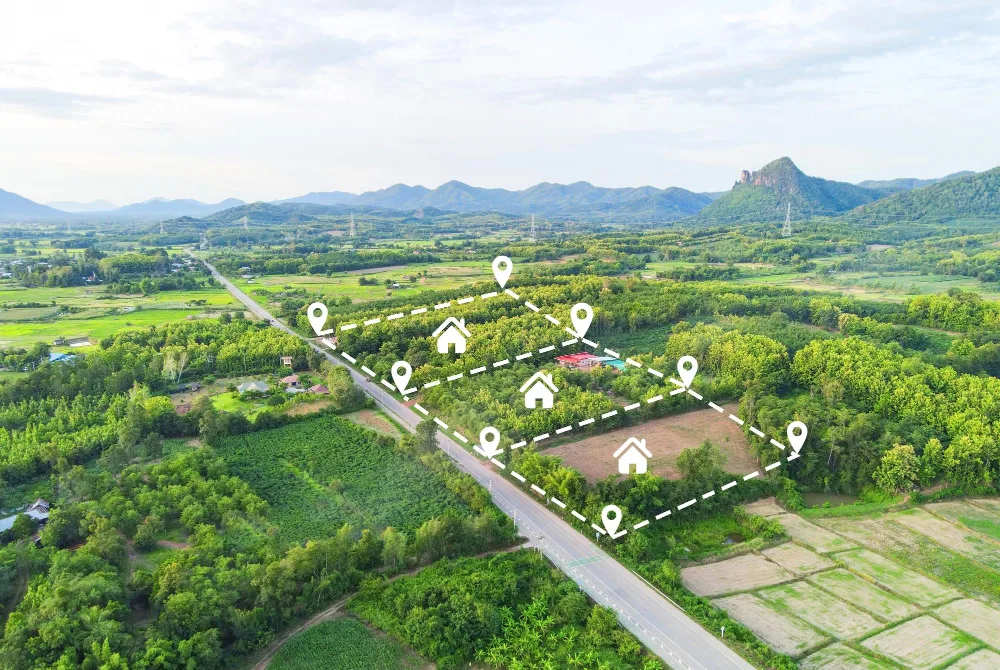
    Cadastral maps are the legal basis for property ownership. Traditionally, they were manually drafted, with the result that they contained errors, boundary overlap, and owner disputes. Employing satellite imaging, GIS companies in India can now:

    • Map land parcels digitally, depicting boundaries accurately.
    • Cross-check land titles by layering historical data over satellite-derived cadastral data.
    • Identify encroachments by matching old records against new high-resolution imagery.

    For example, a landowner asserting additional land outside their legal boundary can be easily located using satellite-based cadastral mapping, assisting local authorities in correcting such instances.

    2. Land Use and Land Cover Classification (LULC)

    Land use classification is essential for urban, conservation, and infrastructure planning. GIS companies in India examine satellite images to classify land, including:

    • Agricultural land
    • Forests and protected areas
    • Residential, commercial, and industrial areas
    • Water bodies and wetlands
    • Barren land

    Such a classification aids the government in regulating zoning laws, tracking illegal land conversions, and enforcing environmental rules.

    For instance, the illegal conversion of agricultural land into residential areas can be easily identified using satellite imagery, allowing regulatory agencies to act against unlawful real estate development simultaneously.

    3. Automated Change Detection – Tracking Illegal Construction & Encroachments

    One of the biggest challenges in land administration is the proliferation of illegal constructions and unauthorized encroachments. Satellite-based GIS systems offer automated change detection, wherein:

    • Regular satellite scans detect new structures that do not match approved plans.
    • Illegal mining, deforestation, or land encroachments are flagged in real-time.
    • Land conversion violations (e.g., illegally converting wetlands into commercial zones) are automatically reported to authorities.

    For example, a satellite monitoring system identified the unauthorized expansion of a residential colony into government land in Rajasthan, which prompted timely action and legal proceedings.

    4. Satellite-Based Property Taxation & Valuation

    Correct property valuation is critical for equitable taxation and the generation of revenues. Property valuation traditionally depended on physical surveys, but satellites have made it a streamlined process:

    • Location-based appraisal: Distance to highways, commercial centers, and infrastructure developments is included in the tax calculation.
    • Footprint building analysis: Machine learning-based satellite imaging calculates covered areas, avoiding tax evasion.
    • Market trend comparison: Satellite photos and property sale data enable the government to levy property taxes equitably.

    For example, the municipal government in Bangalore utilized satellite images to spot almost 30,000 properties that had not been appropriately reported in tax returns, and the property tax revenue went up.

    How Drone Technology is Applied to Land Surveys & Property Management

    While satellites give macro-level information, drones collect high-accuracy, real-time, and localized data. Drones are indispensable in regions where extreme precision is required, such as:

    • Urban land surveys with millimeter-level accuracy.
    • Land disputes demanding legally admissible cadastral records.
    • Surveying terrain in hilly, forested, or inaccessible areas.
    • Rural land mapping under government schemes such as SVAMITVA.

    1. Drone-Based Cadastral Mapping & Land Surveys

    Drones with LiDAR sensors, high-resolution cameras, and GPS technology undertake automated cadastral surveys, allowing:

    • Accurate land boundary mapping, dispelling disputes.
    • Faster surveying (weeks rather than months), cutting down administrative delays.
    • Low-cost operations compared to conventional surveying.

    For example, drones are being employed to map rural land digitally under the SVAMITVA Scheme, issuing official property titles to millions of landholders.

    2. 3D Modeling for Urban & Infrastructure Planning

    Drones produce precise 3D maps that offer:

    • Correct visualization of cityscapes for planning infrastructure projects.
    • Topography models that facilitate flood control and disaster management.
    • Better land valuation insights based on elevation, terrain, and proximity to amenities.

    For example, Mumbai’s urban planning department used drone-based 3D mapping to assess redevelopment projects, ensuring efficient use of land resources.

    3. AI-Powered Analysis of Drone Data

    Modern GIS software integrates Artificial Intelligence (AI) and Machine Learning (ML) to:

    • Detect unauthorized construction automatically.
    • Analyze terrain data for thoughtful city planning.
    • Classify land parcels for taxation and valuation purposes.

    For instance, a Hyderabad-based drone-based AI system identified illegal constructions and ensured compliance with urban planning regulations.

    Integration of GIS, Satellites & Drones into Land Information Systems

    Satellite and drone data are integrated into Intelligent Land Information Systems (ILIS) by GIS companies in India that encompass:

    A. System of Record (Digital Land Registry)

    • Geospatial database correlating land ownership, taxation, and legal titles.
    • Blockchain-based digital land records resistant to tampering.
    • Uninterrupted connectivity with legal and financial organizations.

    B. System of Insight (Automated Land Valuation & Analytics)

    • Artificial intelligence-based property valuation models based on geography, land topology, and urbanization.
    • Automated taxation ensures equitable revenue collection.

    C. System of Engagement (Public Access & Governance)

    • Internet-based GIS portals enable citizens to confirm property ownership electronically.
    • Live dashboards monitor land transactions, conflicts, and valuation patterns.

    Conclusion

    GIS, satellite imagery, and drones have transformed India’s land records and property management by making accurate mapping, real-time tracking, and valuation efficient. Satellites give high-level insights, while drones provide high-precision surveys, lowering conflicts and enhancing taxation.

    GIS companies in India like SCS Tech, with their high-end GIS strength, facilitate such data-based land administration, propelling India towards a transparent, efficient, and digitally integrated system of governance, guaranteeing equitable property rights, sustainable planning, and economic development.

  • Why Are Governments Using Blockchain in eGovernance Solutions for Land Records?

    Why Are Governments Using Blockchain in eGovernance Solutions for Land Records?

    What if you couldn’t prove the land you live on is actually yours? Sounds scary, right? That’s the reality for many people due to outdated land records. In India, only 69% of land has been mapped digitally under the Digital Land Record Management Program, leaving large gaps. This highlights the urgent need for a system in eGovernance solutions that is secure, transparent, and tamper-proof.

    This is where blockchain comes in. Its unparalleled ability to serve transparency, security, and efficiency puts it at the core of modern eGovernance solutions for land records. In this blog, let’s understand why blockchain is changing the face of this significant aspect of governance. But before let’s dive into the challenges that we faced due to traditional land record systems.

    Challenges in Traditional Land Record Systems

    The present system regarding the management of land records has significant flaws. Let’s take a closer look at them:

    Vulnerability to Fraud

    Traditional systems have fake documents, duplicate registrations, and unauthorized changes. Such issues bring legal disputes and make property transactions risky. Think of buying a property only to discover it had already been sold to another person based on forged papers. Blockchain can remove such risks because records are tamper-proof.

    Lack of Transparency

    Traditional systems often store records in centralized databases. Accessing these records is a bureaucratic maze, leading to confusion and mistrust. Blockchain’s open ledgers make records visible to all stakeholders, reducing disputes.

    Inefficiency and Bureaucracy

    Traditional processes are slow and costly, from waiting in long queues to paying multiple intermediaries. This inefficiency discourages investment and delays transactions. By streamlining processes, blockchain makes land transactions faster and more affordable.

    Data Integrity Issues

    Centralized systems are prone to natural disasters, cyberattacks, or human error. Blockchain’s decentralized nature ensures that data remains secure and accessible, no matter what.

    Why Are Governments Using Blockchain in eGovernance Solutions for Land Records?

    Governments are increasingly adopting blockchain technology to improve eGovernance solutions, particularly in managing land records. This transition is motivated by several critical factors:

    1. Immutable Ledger

    A significant need is reliable, tamper-proof records of land. More often, traditional systems are prone to fraud, such as forgery and unauthorized amendments. This kind of ledger ensures that records entered cannot be deleted or modified without consensus, thus increasing trust in the integrity of ownership documentation over land.

    Blockchain technology has a decentralized ledger where all the transactions concerning land ownership are permanently recorded. Each transaction is enclosed in a block that connects subsequent blocks, thus offering security regarding the chain of custody. This structure ensures that any kind of attempt to alter the record would require all the following blocks to be changed, making such attempts impracticable.

    2. Increased Transparency

    Transparency is essential in developing trust among all stakeholders involved in real estate transactions. Centralized databases can hide information, leading to confusion and disputes about property ownership in traditional systems. Governments can minimize misunderstandings and increase public confidence by providing transparent access to land records.


    Blockchain enables all parties involved, such as government agencies, property owners, and potential buyers, to access the same information about land ownership and transaction history in a shared ledger. Real-time access means all parties have up-to-date data, allowing them to verify ownership claims without intermediaries independently.

    3. Enhanced Security

    This is because land record management involves very sensitive information on property ownership, and therefore, security is a significant concern. With traditional systems, unauthorized access and data breaches can compromise the integrity of the land records.

    Blockchain allows all stakeholders including government agencies, property owners as well as potential buyers to view an agreed-to version of truth regarding land ownership and transactional history in a shared ledger. Real-time access will provide immediate data for all parties, and that’s how they will authenticate claims of ownership independently, without anyone’s interference.

    4. Simplified Process via Smart Contract

    The bureaucratic nature of traditional land registration processes often results in delays and increased costs for property transactions. Reducing reliance on intermediaries can expedite these processes and lower administrative burdens on government agencies.

    Smart contracts are self-executing contracts with all of the terms written directly into code. They automate many aspects of land transactions. For instance, they can automatically verify ownership during sales or transfers, eliminating the need for notaries or registrars. This automation accelerates transactions and improves operational efficiency within government agencies responsible for land registration.

    5. Decentralization

    Centralized control over land records poses risks such as data loss or manipulation due to individual malfeasance or systemic failures. Decentralization mitigates these risks by distributing data across multiple nodes.

    Blockchain runs on a decentralized network, storing data in multiple nodes instead of in a central database kept by a single entity. It minimizes the probability of losing or altering data and increases resistance against cyberattacks so that land records do not become inaccessible if some nodes go offline.

    Landmark Initiative for Land Records Modernization in Bihar

    The Bihar government is undertaking its first-ever state-wide land survey to modernize records. The project was launched in August 2023 and aimed at modifying the ownership records of around 44,000 villages by making them more transparent and reduced in terms of dispute.

    The exercise has been divided into two phases, one to be carried out on around 5,000 villages and the remaining in the next phase. However, due to complexities such as untransferred ownership and incomplete mutation processes, the deadline has been extended to July 2026. Landowners now have until March 2025 to submit claims online through a simplified self-declaration process.

    This initiative also includes plans for urban land surveys, with a pilot project proposed for six urban local bodies. Digitizing land records is the goal of the Bihar government in streamlining governance, making land ownership more transparent, and empowering citizens.

    These efforts are part of a broader vision of ensuring efficient land administration and reducing the potential conflicts that arise from ambiguous records. Once completed, this project is expected to transform land governance in the state, fostering trust and accountability among citizens while enabling smoother economic and legal transactions involving land.

    Conclusion

    In essence, blockchain in eGovernance solutions enhances transparency, security, and efficiency in transactions about the properties. Most significantly, the main challenges posed by traditional systems- fraud, inefficiency, and mistrust-could now be addressed and placed within a more substantial framework that enables better land administration.

    For successful adoption, governments must establish regulatory frameworks that validate blockchain records as official property documentation, ensure compatibility with existing systems, and promote public awareness of its advantages. Companies like SCS Tech are enabling these advancements by offering tailored blockchain solutions. By implementing blockchain effectively, governments can create more trustworthy governance structures, protect citizens’ property rights, and transform land record management into a secure and transparent process.