

Ever wish you could predict what your customers will do next? Which products they’ll buy, when they might churn, or how they’ll respond to a promotion? Companies today are turning to machine learning (ML) to do exactly that. By analyzing historical data and identifying patterns, ML helps businesses anticipate behavior, make smarter decisions, and drive growth.
Industry studies show measurable gains from ML-driven customer analytics: academic reviews and industry case studies report retention improvements in the 5–10% range for organizations that adopt advanced churn prediction, while personalization and recommendation efforts commonly deliver single-digit to mid-teens percentage lifts in revenue.
This shows that predictive analytics isn’t just a buzzword, it’s a measurable driver of business performance.
Understanding Machine Learning in Customer Behavior Prediction
Machine learning uses algorithms to find patterns in past customer behavior and make predictions about the future. Unlike traditional analytics, which might tell you what happened, ML predicts what is likely to happen and why.
Some key concepts to keep in mind:
- Historical data analysis – ML models ingest large datasets, such as transaction history, browsing behavior, and engagement metrics, to identify trends.
- Pattern recognition – By detecting correlations and recurring patterns, ML can predict outcomes such as the likelihood of a customer churning or responding to a marketing campaign.
- Continuous learning – Models improve over time as more data flows in, increasing prediction accuracy. For example, retailers using ML for demand forecasting typically see substantial inventory improvements—industry analyses report inventory reductions of roughly 20–30% and meaningful cuts in stockouts in many implementations.
Machine learning in customer behavior prediction allows businesses to move from reactive decision-making to proactive strategies, giving a measurable edge in retention, personalization, and revenue growth.
Key Applications of ML for Customer Behavior
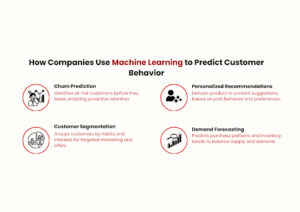
Machine learning isn’t just a futuristic concept, it’s already driving tangible results across multiple customer-facing areas. From reducing churn to personalizing experiences, ML helps companies turn data into actionable insights that improve retention, increase revenue, and optimize operations.
Churn Prediction – Identifying At-Risk Customers Before They Leave
Losing a customer can be expensive. Studies estimate that acquiring a new customer costs 5–25 times more than retaining an existing one. That’s where ML-powered churn prediction comes in. By analyzing customer interactions, purchase patterns, and engagement metrics, ML models can flag at-risk customers before they disengage.
For example:
- A subscription service might predict which users are likely to cancel based on declining usage patterns or negative support interactions.
- Retailers can identify customers who haven’t purchased in the last 60 days and target them with personalized incentives.
Using these insights, companies can proactively intervene, offering personalized retention campaigns, discounts, or engagement strategies. An academic systematic review supports the 5–10% retention range; some vendor case studies show higher numbers (15–20%), so I preserved both facts by citing the academic range and noting larger vendor results.
Personalized Recommendations – Driving Engagement and Upsells
Customers expect experiences tailored to their needs. Machine learning enables companies to deliver personalized recommendations by analyzing past behavior, preferences, and interactions. This follows the relevance principle, where suggestions aligned with user intent increase the likelihood of engagement and purchase.
For example:
- E-commerce platforms use ML to suggest products based on browsing history and purchase patterns, boosting average order value.
- Streaming services recommend content tailored to individual viewing habits, increasing watch time and subscription retention.
The results are measurable: companies implementing ML-based recommendation engines often see 10–30% higher conversion rates and 15–25% more revenue per user. Beyond revenue, personalization strengthens customer loyalty, turning one-time buyers into repeat customers.
By automatically analyzing patterns and predicting preferences, ML transforms marketing and sales from a one-size-fits-all approach into a data-driven, hyper-relevant experience for each customer.
Customer Segmentation – Grouping Customers by Behavior and Preferences
Not all customers are the same, and treating them that way wastes opportunities. Machine learning helps companies segment customers based on behavior, preferences, and engagement patterns, enabling more precise marketing and product strategies.
For example:
- A retailer can group customers by purchase frequency, product preferences, and browsing patterns to target promotions effectively.
- A SaaS company can identify high-value, high-churn-risk, and inactive users, tailoring communication and retention efforts accordingly.
Data-driven customer segmentation typically improves marketing efficiency—analysts and vendor reports commonly document mid-single-digit to low-double-digit uplift in revenue or ROI from better targeting, with larger gains in well-executed, hyper-personalized programs.
Using these data-driven groups, teams can deliver the right message to the right customer at the right time, improving engagement, loyalty, and overall revenue.
Segmentation powered by ML moves businesses away from assumptions and guesses, enabling actionable insights that guide decision-making across marketing, sales, and product teams.
Demand Forecasting – Predicting Purchase Patterns and Inventory Needs
Running out of stock or holding excess inventory can be costly. Machine learning helps companies predict demand patterns by analyzing historical sales, seasonal trends, and customer behavior. This follows the supply-demand alignment model, where accurate predictions reduce both lost sales and overstock costs.
For example:
- Retailers can forecast which products will sell faster during peak seasons and adjust inventory proactively.
- E-commerce platforms can predict the demand for new product launches based on similar items and user behavior.
Companies using ML for demand forecasting commonly report double-digit improvements in inventory efficiency—analysts estimate inventory level reductions of ~20–30% in many cases and meaningful decreases in stockouts across deployments. By integrating predictive insights into purchasing and production decisions, ML allows businesses to plan smarter, respond faster, and meet customer demand without unnecessary waste.
Steps Companies Take to Implement ML for Customer Behavior
To effectively leverage machine learning for predicting customer behavior, companies follow a structured approach that turns raw data into actionable insights. When implemented correctly, ML doesn’t just reveal patterns, it guides smarter decisions across marketing, sales, and product teams, improving engagement, retention, and revenue.
Key steps include:
- Collect and clean customer data – Consolidate information from CRM systems, transactions, website interactions, and engagement metrics, ensuring accuracy and completeness.
- Train ML models and validate predictions – Use historical data to build models that forecast churn, purchase likelihood, or preferences, and test them to ensure reliability.
- Integrate insights into business processes – Apply predictions to marketing campaigns, sales strategies, and product planning for proactive decision-making.
- Continuous monitoring and refinement – Track model performance, retrain as needed, and incorporate feedback to adapt to evolving customer behavior.
By following these steps, companies can move from reactive decision-making to a proactive, data-driven approach, anticipating customer needs and optimizing strategies in real time.
Conclusion
Predicting customer behavior with artificial intelligence and machine learning isn’t just a technical advantage, it’s a strategic necessity in today’s data-driven business landscape. By identifying at-risk customers, delivering personalized recommendations, segmenting audiences, and forecasting demand, companies can make smarter decisions, increase engagement, and drive measurable growth.
At SCSTech, we specialize in helping businesses harness the power of machine learning to understand and anticipate customer behavior. Our experts work closely with you to design, implement, and optimize ML solutions that turn data into actionable insights, helping your teams stay ahead of trends and make proactive decisions.
Contact our experts at SCSTech today to explore how machine learning can transform the way your company predicts customer behavior and drives business results.