

If you’re weighing MDR versus EDR, you probably know what each provides, but deciding between the two isn’t always easy. The actual challenge is determining which one suits your security maturity, internal capabilities, and response readiness.
Some organizations already have analysts, 24×7 coverage, and SIEM tools, so EDR could play well there. Others are spread thin, suffering from alert fatigue or gaps in threat response; that’s where MDR is more appropriate.
This guide takes you through that decision step by step, so you can match the correct solution with how your team actually functions today.
Core Differences Between MDR and EDR
Both MDR and EDR enhance your cybersecurity stance, but they address different requirements based on the maturity and resources of your organization. They represent two levels of cybersecurity services, offering either internal control or outsourced expertise, depending on your organization’s readiness.
EDR offers endpoints for continuous monitoring, alerting on suspicious behavior. It gives your team access to rich forensic data, but your security staff must triage alerts and take action.
MDR includes all EDR functions and adds a managed service layer. A dedicated security team handles alert monitoring, threat hunting, and incident response around the clock.
Here’s a clear comparison:
| Feature | EDR | MDR |
| Core Offering | Endpoint monitoring & telemetry | EDR platform + SOC-led threat detection & response |
| Internal Skill Needed | High analysts, triage, and response | Low–Moderate oversight, not 24×7 operational burden |
| Coverage | Endpoint devices | Endpoints and often network/cloud visibility |
| Alert Handling | Internal triage and escalation | Provider triages and escalates confirmed threats |
| Response Execution | Manual or semi-automated | Guided or remote hands-on response by experts |
| Cost Approach | Licensing + staffing | Subscription service with bundled expertise |
Security Maturity and Internal Capabilities
Before choosing EDR or MDR, assess your organization’s security maturity, your team’s resources, expertise, and operational readiness.
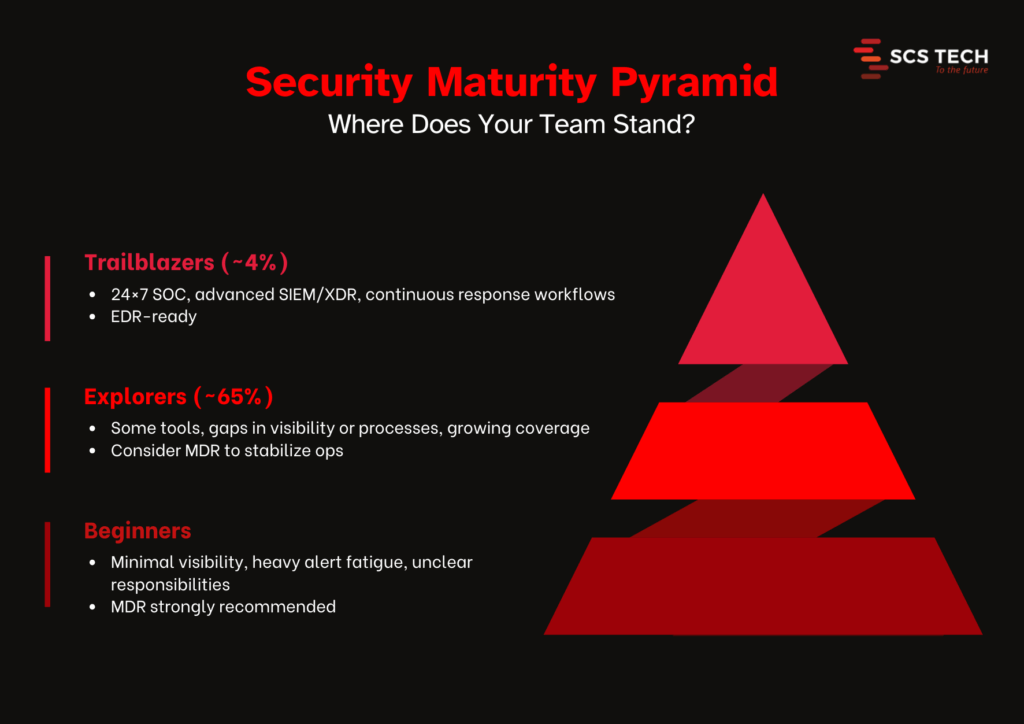
How Mature Is Your Security Program?
A recent Kroll study reveals that 91% of companies overestimate their detection-and-response maturity, but only 4% are genuinely “Trailblazers” in capability. Most fall into the “Explorer” category, awareness exists, but full implementation lags behind.
That’s where cybersecurity consulting adds value, bridging the gap between awareness and execution through tailored assessments and roadmaps.
Organizations with high maturity (“Trailblazers”) experience 30% fewer major security incidents, compared to lower-tier peers, highlighting the pay-off of well-executed cyber defenses
When EDR Is a Better Fit
EDR suits organizations that already have a capable internal security team and tools and can manage alerts and responses themselves:
According to Trellix, 84% of critical infrastructure organizations have adopted EDR or XDR, but only 35% have fully deployed capabilities, leaving room for internal teams to enhance operations
EDR is appropriate when you have a scalable IT security service in place that supports endpoint monitoring and incident resolution internally.
- 24×7 analyst coverage or strong on-call SOC support
- SIEM/XDR systems and internal threat handling processes
- The capacity to investigate and respond to alerts continuously
An experienced SOC analyst put it this way:
“It kills me when… low‑risk computers don’t have EDR … those blindspots let ransomware spread.”
EDR delivers strong endpoint visibility, but its value depends on skilled staff to translate alerts into action.
When MDR Is a Better Fit
MDR is recommended when internal security capabilities are limited or stretched:
- Integrity360 reports a global cybersecurity skills shortage of 3.1 million, with 60% of organizations struggling to hire or retain talent.
- A WatchGuard survey found that only 27% of organizations have the resources, processes, and technology to handle 24×7 security operations on their own.
- MDR adoption is rising fast: Gartner forecasts that 50% of enterprises will be using MDR by 2025.
As demand for managed cybersecurity services increases, MDR is becoming essential for teams looking to scale quickly without increasing internal overhead.
MDR makes sense if:
- You lack overnight coverage or experienced analysts
- You face frequent alert fatigue or overwhelming logs
- You want SOC-grade threat hunting and guided incident response
- You need expert support to accelerate maturity
Choose EDR if you have capable in-house staff, SIEM/XDR tools, and the ability to manage alerts end-to-end. Choose MDR if your internal team lacks 24×7 support and specialist skills, or if you want expert-driven threat handling to boost maturity.
MDR vs. EDR by Organization Type
Not every business faces the same security challenges or has the same capacity to deal with them. What works for a fast-growing startup may not suit a regulated financial firm. That’s why choosing between EDR and MDR isn’t just about product features; it depends on your size, structure, and the way you run security today.
Here’s how different types of organizations typically align with these two approaches.
1. Small Businesses & Startups
- EDR fit? Often challenging. Many small teams lack 24×7 security staff and deep threat analysis capabilities. Managing alerts can overwhelm internal resources.
- MDR fit? Far better match. According to Integrity360, 60% of organizations struggle to retain cybersecurity talent, something small businesses feel intensely. MDR offers affordable access to SOC-grade expertise without overwhelming internal teams.
2. Mid-Sized Organizations
- EDR fit? Viable for those with a small IT/Security team (1–3 analysts). Many mid-size firms use SIEM and EDR to build internal detection capabilities. More maturity here means lower reliance on external services.
- MDR fit? Still valuable. Gartner projects that 50% of enterprises will use MDR by 2025, indicating that even mature mid-size companies rely on it to strengthen SOC coverage and reduce alert fatigue.
Many also use cybersecurity consulting services during transition phases to audit gaps before fully investing in internal tools or MDR contracts.
3. Large Enterprises & Regulated Industries
- EDR fit? Solid choice. Enterprises with in-house SOC, SIEM, and XDR solutions benefit from direct control over endpoints. They can respond to threats internally and integrate EDR into broader defense strategies.
- MDR fit? Often used as a complementary service. External threat hunting and 24×7 monitoring help bridge coverage gaps without replacing internal teams.
4. High-Risk Sectors (Healthcare, Finance, Manufacturing)
- EDR fit? Offered compliance and detection coverage, but institutions report resource and skill constraints, and 84% of critical infrastructure organizations report partial or incomplete adoption.
- MDR fit? Ideal for the following reasons:
- Compliance: MDR providers usually provide support for standards such as HIPAA, PCI-DSS, and SOX.
- Threat intelligence: Service providers consolidate knowledge from various sectors.
- 24×7 coverage: Constant monitoring is very important for industries with high-value or sensitive information.
In these sectors, having a layered IT security service becomes non-negotiable to meet compliance, visibility, and response needs effectively.
Final Take: MDR vs. EDR
Choosing between EDR and MDR should be made based on how ready your organization is to detect and respond to threats using internal resources.
- EDR works if you have an expert security team that can address alerts and investigations in-house.
- MDR is more appropriate if your team requires assistance with monitoring, analysis, and response to incidents.
SCS Tech provides both advanced IT security service offerings and strategic guidance to align your cybersecurity technology with real-time operational capability. If you have the skills and coverage within your team, we offer sophisticated EDR technology that can be integrated into your current processes. If you require extra assistance, our MDR solution unites software and managed response to minimize risk without creating operational overhead.
Whether your team needs endpoint tools or full-service cybersecurity services, the decision should align with your real-time capabilities, not assumptions. If you’re not sure where to go, SCS Tech is there to evaluate your existing configuration and suggest a solution suitable for your security maturity and resource levels.