Blog

  • Understanding The 7 Layers of Metaverse

    Understanding The 7 Layers of Metaverse

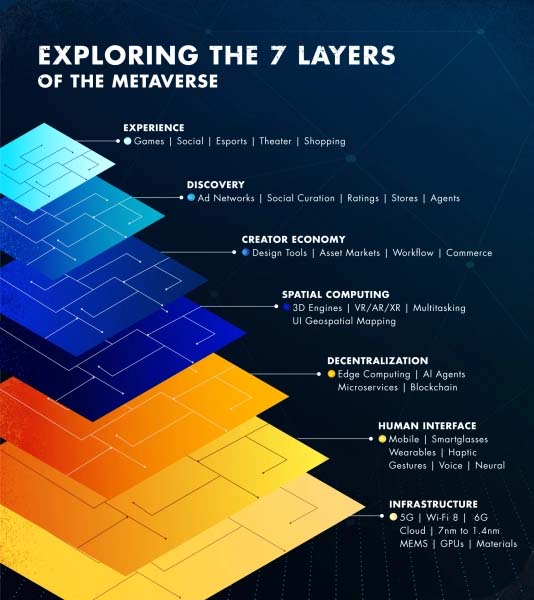
    When it comes to describing the metaverse, definitions and opinions abound. And while it’s difficult to put something as vast, conceptual, and, frankly, still emerging as the metaverse into quantifiable terms, Jon Radoff, entrepreneur, author and game designer, breaks it down logically and thoroughly in Measuring the Metaverse. He moves up the value chain from infrastructure at the bottom to experience at the top, stopping at human interface, decentralization, spatial computing, creator economy, and discovery along the way.

    A common framework is necessary in Radoff’s view of the metaverse. He writes, “And while there will be many proprietary (and very fun) theme parks in the metaverse, I’m even more excited by the opportunity in the Switzerlands: a metaverse powered by a robust creator-economy enabled through decentralization.”

    This, of course, isn’t the first seven-layer model to lay out a critical framework. The IT world has long adhered to the seven layers of the OSI Model to organize networking functions into a universal set of rules and requirements to support interoperability among different products and software. Perhaps Radoff’s seven-layer model will become a similar conceptual framework for the metaverse.


    Layer 1: Experience

    Many people think of the metaverse as 3D space that will surround us. But the metaverse is not 3D or 2D, or even necessarily graphical; it is about the inexorable dematerialization of physical space, distance, and objects. It includes 3D games like Fortnite on our game consoles, Beat Saber in our virtual reality headsets, and Roblox on our computers. It also includes Alexa in our kitchen, Zoom in our virtual offices, Clubhouse on our phones, and Peloton in our home gyms.

    What happens when physical space is dematerialized? Formerly scarce experiences may become abundant. Games show us the path forward: in a game, you can dream of being a rock star, a Jedi, a race car driver, or anything else you might imagine. Imagine what happens when you apply this to more familiar experiences. For example, a concert in physical space can sell only a few seats in the front row — but a virtual concert can generate a personalized plane of existence around each individual in which you always enjoy the best seat in the house.

    Games will evolve to incorporate more events that are informed by live entertainment, such as the music concerts and immersive theater that have already emerged in Fortnite, Roblox, and Rec Room. Esports and online communities will be augmented by social entertainment. Meanwhile, traditional industries such as travel, education, and live performance will be reshaped around game-thinking and the virtual economy of abundance.

    The live events I’ve touched upon here lead to another facet of metaverse experiences: the content-community complex. Whereas once customers were only consumers of content, they are now content-creators and content-amplifiers as well. In the past, there was the notion of “user-generated content” when referring to mundane features like blog comments or uploading a video. Now, content isn’t simply generated by people: it emerges from their interactions and feeds into the substance of the conversations within their communities. Content begets content: a virtual flywheel of content, events, and social interaction. When we talk about “immersion” in the future, we’ll be referring not only to immersion within a graphical space or a story-world, but also to the social immersion and how it sparks interaction and propels content.

    Layer 2: Discovery

    The discovery layer is about the push and pull that introduces people to new experiences. This is a vast ecosystem, and one of the most lucrative for many businesses — including some of the largest in the world. Broadly speaking, most discovery systems can be classified as either inbound (the person is actively seeking information about an experience) or outbound (marketing that was not specifically requested by the person, even if they opted in).

    Inbound:

    • Real-time presence
    • Community-driven content
    • N of your friends like App
    • App stores (along with reviews, ratings systems, and categorization/tagging)
    • Curation — via featured application listings in stores, taste-makers, and “influencers”
    • Search engines
    • Earned media

    Outbound:

    • Display advertising
    • Spam (email, LinkedIn, Discord)
    • Notifications

    Most of the above are familiar to internet users at this point, so I’ll focus here on the aspects of discovery that will elevate in importance in the metaverse.

    First, community-driven content is a far more cost-effective means of discovery than most forms of marketing. When people really care about the content or the events they are participating in, they’ll spread the word. As content itself gets easier to exchange, trade, and share within more metaverse contexts, the content itself will also become a marketing asset. An example that’s already emerged is NFTs: love them or hate them, two of their key advantages are the relative ease with which they can be supplied to decentralized exchanges and the economics that favor more direct creator-community engagement. Content marketplaces will become an alternative to application marketplaces as a means of discovery.

    A specific form of community surfacing is real-time presence features. Instead of focusing on what people like, this is about what people are actually doing right now. This is highly relevant in a metaverse where so much of the value will come from interacting with friends through shared experiences.

    The various walled gardens for certain games make good use of real-time presence: if you login to Steam, Battle.net, Xbox or PlayStation, you’ll see what games your friends are playing right now. Outside of games, Clubhouse shows the power of this structure: deciding which room to join is largely oriented toward your curated list of people you follow.

    Just as we are dematerializing physical reality, the metaverse is also digitizing social structures. Whereas earlier stages of the Internet were defined by social media “stickiness” around a few monolithic providers, a decentralized identity ecosystem may shift the power toward the social groups themselves, allowing them to move frictionlessly across collective experiences. Clubs emerge on Clubhouse and plan a party in Rec Room; guilds move between games; a circle of friends jumps between experiences on Roblox. This is the marketing implication of the content-community complex.

    Real-time presence detection that spans the multitude of activities in the metaverse is one of the greatest discovery opportunities for creators. Discord has a presence-detection SDK that works across different game environments; once that (or something like it) is adopted more pervasively and surfaced more apparently, we’ll increasingly transition from asynchronous “social networking” to real-time “social activity.” Experiences that give community leaders the tools to launch activities that people actually want to join into will lead the way.

    Layer 3: Creator Economy

    Not only are the experiences of the metaverse becoming increasingly immersive, social, and real-time, but the number of creators who craft them is increasing exponentially. This layer contains all of the technology that creators use on a daily basis to craft the experiences that people enjoy.

    Previous creator economies developed in consistent patterns, whether in the metaverse, games, web development, or e-commerce:

    Pioneer Era: The first people to create experiences for a given technology have no tools available, so they build everything from scratch. The first websites were coded directly in HTML; people implemented their own shopping carts for e-commerce sites; programmers wrote directly to the graphics hardware for games.

    Engineering Era: After the early successes in a creative market, there’s an explosion of the number of people on teams. Build-from-scratch is usually too slow and expensive to support needs, and workflow grows more complex. The earliest tooling in a market tends to relieve overloaded engineers by supplying them with SDKs and middleware to save them time. For example, Ruby on Rails (along with a huge number of other application server stacks) made it easier for developers to create data-driven websites. In games, graphics libraries such as OpenGL and DirectX arrived to provide programmers with the ability to render 3D graphics without knowing much low-level coding.

    Creator Era: Ultimately, designers and creators don’t want coding bottlenecks to slow them down — and coders would rather add their abilities to the unique aspects of a project. This era is defined by a dramatic and exponential rise in the number of creators. Creators gain tools, templates, and marketplaces of content that reorient development from a bottoms-up, code-centered process to a top-down, creatively centered process.

    Today, you can launch an e-commerce website in Shopify in minutes without knowing a single line of code. Websites can be created and maintained in Wix or Squarespace. 3D graphics experiences can be crafted within game engines such as Unity and Unreal without ever touching the lower-level rendering APIs — using visual interfaces within their studio environments.

    Experiences in the metaverse will be increasingly live, social, and continuously updated. Thus far, creator-driven experiences in the metaverse are oriented around centrally managed platforms such as Roblox, Rec Room, and Manticore — where a full suite of integrated tooling, discovery, social networking, and monetization functions has empowered an unprecedented number of people to craft experiences for others. Our vision at Beamable is to equip independent creators with the same capabilities, but in a decentralized and open manner.

    Layer 4: Spatial Computing

    Spatial computing proposes hybrid real/virtual computation that erodes the barriers between the physical and the ideal worlds. … Wherever possible the machine in space and space in the machine should be allowed to bleed into each other. Sometimes this means bringing space into the computer, sometime[s] this means injecting computation into objects. Mostly it means designing systems that push through the traditional boundaries of screen and keyboard without getting hung up there and melting into interface or meek simulation.

    Spatial computing has exploded into a large category of technology that enables us to enter into and manipulate 3D spaces, and to augment the real world with more information and experience. I divide the software of spatial computing from the enabling hardware layer, which I detail under the Human Interface section below. For the key aspects of software, this includes:

    • 3D engines to display geometry and animation (Unity and Unreal)
    • Mapping and interpreting the inside and outside world — geospatial mapping (Niantic Planet-Scale AR and Cesium) and object recognition
    • Voice and gesture recognition
    • Data integration from devices (Internet of Things) and biometrics from people (for identification purposes as well as quantified self applications in health/fitness)
    • Next-generation user interfaces to support concurrent information streams and analysis

    Layer 5: Decentralization

    The ideal structure of the metaverse is the opposite of the OASIS of Ready Player One, where it was controlled by a single entity. Experimentation and growth increase dramatically when options are maximized and systems are interoperable and built within competitive markets where creators are sovereign over their own data and creations.

    The simplest example of decentralization is the Domain Name System (DNS), which maps individual IP addresses to names, saving you from having to enter a number each time you want to go somewhere online.

    Distributed computing and microservices provide a scalable ecosystem for developers to tap into online capabilities — everything from commerce systems to specialized AI to various game systems — without needing to focus on building or integrating back-end capabilities.

    Blockchain technology, which enables value-exchange between software, self-sovereign identity and new ways of unbundling and bundling content and currencies — is a large part of decentralization. This area of innovation is called Web3, which frees financial assets from centralized control and custody — and within decentralized finance (DeFi), we already see examples of connecting financial legos to form novel applications. With the advent of NFTs and blockchains optimized for the sort of microtransactions required by games and metaverse experiences, we’ll see a wave of innovation around decentralized markets and applications for game assets as well.

    “Far edge” computing will push the cloud closer to our homes — even into our vehicles — to enable powerful applications at low latency, without burdening our devices with all of the work. Computing power will become more like a utility on a grid (not unlike electricity) and less like a datacenter.

    Layer 6: Human Interface

    Computer devices are getting closer to our bodies, transforming us into cyborgs.

    Smartphones are no longer phones. They are highly portable, always-connected, and powerful computers that happen to have a phone application preinstalled. They’re only getting more powerful; and with further miniaturization, the right sensors, embedded AI technology, and low-latency access to powerful edge computing systems, they’ll absorb more and more applications and experiences from the metaverse.

    The Oculus Quest is essentially a smartphone that’s been refactored into a VR device; this untethering gives us a sense of where the future is heading.

    In a few years the Quest 2 ought to be reminiscent of the mobile brick-phone from decades past; soon we’ll have smartglasses that can perform all the functions of a smartphone along with AR and VR applications.

    Beyond smartglasses, there is a growing industry experimenting with new ways to bring us closer to our machines:

    • 3D-printed wearables integrated into fashion and clothing
    • Miniaturized biosensors, some even printed on the skin
    • Maybe even consumer neural interfaces?

    Layer 7: Infrastructure

    The infrastructure layer includes the technology that enables our devices, connects them to the network, and delivers content.

    5G networks will dramatically improve bandwidth while reducing network contention and latency. 6G will increase speeds by yet another order of magnitude.

    Enabling the untethered functionality, high performance, and miniaturization required by the next generation of mobile devices, smartglasses, and wearables will require increasingly powerful and tinier hardware: semiconductors that are imminently dropping to 3nm processes and beyond; microelectromechanical systems (MEMS) that enable tiny sensors; and compact, long-lasting batteries.

    Internet 3.0

    The metaverse is not “a” metaverse. It is the next generation of the Internet: a multiverse. The abundant adventures in this space will surround us both socially and graphically.

    And while there will be many proprietary (and very fun) theme parks in the metaverse, I’m even more excited by the opportunity in the Switzerlands: a metaverse powered by a robust creator-economy enabled through decentralization.
  • Geospatial Intelligence for Efficient Supply Chains

    Geospatial Intelligence for Efficient Supply Chains

    The science of where things are is changing how we interact with the physical world. Geospatial science is changing how we think, and how we react. It allows us to look at the physical world as a comprehensive framework that integrates organizations and everyday life into it. Supply chains, being notoriously difficult to manage, especially in varied geography like India’s. The power of GIS lies in its ability to convert this accurate qualitative geospatial analysis into easy-to-use and easy to comprehend visual solutions. A virtual geospatial nexus.

    Hundreds of organizations around the world are using GIS to make maps to solve complex problems, this is changing how the world works. GIS helps to illuminate issues that are driven by geography. One of the best examples is that we have used GIS intelligence to analyze post-monsoon droughts for better agricultural output.

    Geospatial intelligence enabling Supply Chains


    One unique project is the digitization of an entire dairy supply chain via IoT we have been working on a project that uses GIS functionality tools throughout the entire supply chain from farm to fork.

    This project works in three stages, cattle monitoring, product procurement, and cold chain management. The cattle are monitored with a wearable pedometer, that relays location data, along with temperature and resting behavior. This helps monitor sleep patterns and disorders, keeping a check on the health and productivity of the animals.

    In the next stage of the supply chain, the milk is procured by an automatic collection unit, enabled with IoT. This enables the detection of impurities and increased transparency, allowing for real-time tracking of quantity and quality, then facilitating automatic payments. And all of this can be done remotely. The last stage calls for cold chain monitoring.

    Cold chain is notoriously hard to monitor and execute. SCS Tech is able to monitor the shelf life, collection, and transportation of milk via a web-based monitoring system. This system, when applied to milk coolers, silos or deep freezers allows real-time volume and temperature monitoring, alerts for equipment malfunction, and optimization of the power supply. This allows for remote monitoring and delivery of milk, assuring the quality and quantity throughout the supply chain.

    A Geospatial Nexus

    This geographic reality can be beamed onto organizations. And for many departments – emergency response, customer service, or government, the issues they are facing today can be resolved by bringing this information together in real-time. There is not too distant a future where we could visualize the relationship between cancers and pollution, to say, ‘we can quantify and relate these factors and as a result, respond’.

    A snapshot of the working of a Geospatial intelligence-enabled platform

    When SCS Tech was conceived, we built systems, first small, and focused on particular departments like engineering, marketing, or city planning. With focused projects, companies could make better decisions once they could identify all factors. From there we are moving on to transforming entire organizations, working our way towards building a geospatial nexus allowing organizations and society to be more conscious of the environment while making the most out of their operations.


  • What’s the Difference Between Intranets and Extranets and How Are They Useful?

    What’s the Difference Between Intranets and Extranets and How Are They Useful?

    In 2021, the percentage of companies switching to remote work has drastically increased. This makes businesses turn to implementing intranets and extranets to organize collaboration among employees, as well as with customers and partners. For example, 70% of companies consider an intranet valuable or very valuable to their employees, while extranets are widely used among the B2B community.

    What is an intranet?

    According to Gartner, an intranet uses techniques similar to the internet, but it can be accessed only by a company’s employees. Intranets offer features to address internal communication and collaboration, project and task management. For example, in an intranet, employees can track the latest project updates and important business news.

    Intranets are widely used in onboarding. For example, they can provide multimedia training tools for intro learning and collaboration tools for new hires and their tutors.

    An intranet’s key functionality includes:

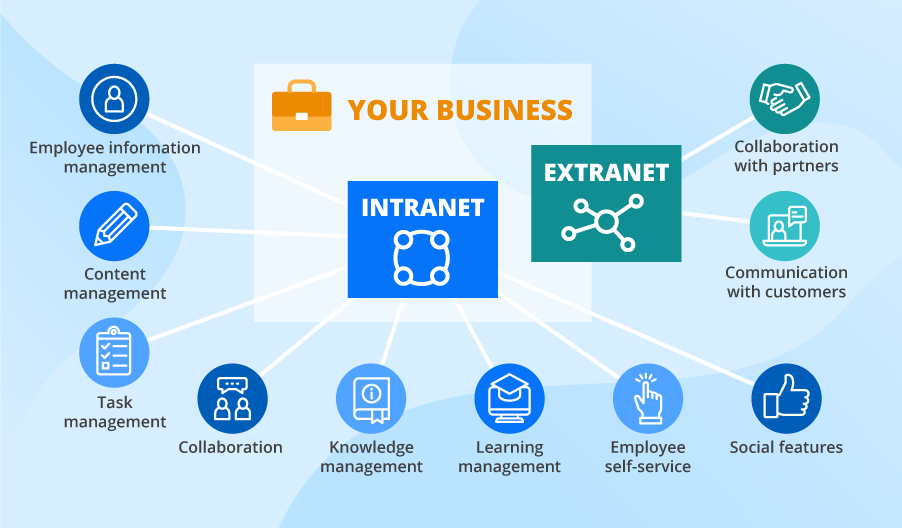
    • Employee information management. Employees can edit their profiles that contain both personal (e.g., a name, an address, contacts) and work-related information (e.g., a position, a department, qualifications).
    • Content management. Intranets not only serve as a source of information but also allow users to create, modify and publish various digital content (e.g., documents, news, guides, policies).
    • Project and task management. Project teams can use an intranet to track project and tasks, including progress, deadlines, related documents and discussions, and more.
    • Employee collaboration and communication. Intranets offer department and team sites for effective collaboration on projects, tasks, and documents as well as provide communication tools (e.g., instant messaging and video conferencing).
    • Knowledge management. Intranet users can process, store, improve, make corporate knowledge easily accessible and actively reused.
    • Learning management. Intranets provide creating, scheduling and delivering trainings to employees, including knowledge assessment and certification. Also, employees can enroll into a relevant training via an intranet.
    • Employee self-service. Employees can submit various requests (e.g., vacation, equipment maintenance, training) via an intranet and track their fulfillment.
    • Social features. These intranet features help improve employee engagement and motivation. They include integration with social media, forums, blogs, mentions, comments, likes, surveys, communities, and gamification features like badges, points, and leaderboards.

    What is an extranet?

    Extranets connect organizations with their suppliers, customers, business partners, or other third parties. They help engage external participants in internal business processes, for example, to streamline procurement operations and support a real-time supply chain.

    An extranet’s key functionality includes:

    • Collaboration with partners. These features include bid management, vendor assessment and approval workflows, and more (for vendor portals).
    • Communication with customers and customer self-service. Customers can place service requests and track their resolution, find answers to their questions about your product or service in a knowledge base, exchange ideas and opinions about your brand via discussion boards.

    Benefits of using an intranet

    • Efficient employee communication and collaboration. Such features as chats, discussion boards, real-time collaboration on documents, and more allow your employees to stay in touch even if they’re working remotely.
    • Facilitated project management. Project teams can create, modify, and notify their members about task updates via an intranet. And project managers can track the project progress and assess the team’s performance.
    • Increased employee productivity. Using one digital workspace saves time and effort otherwise spent on switching between disparate tools (e.g., email, video conferencing applications, messengers, project management software), which helps improve employee productivity.

    Benefits of using an extranet

    • Facilitated business process management. Extranets allow automating processes like vendor assessment and approval, order placement, billing, and more. Besides, your customers and partners get access to the information you want to share with them without calling or emailing you.
    • Corporate and personal data safety. An extranet is a more secure way to exchange data than, for example, an email, as it offers granular access control, multifactor authentication, encryption of data at rest and in transit, audit trail, and other security measures.
    • Improved visibility into business operations. With an extranet, you can see every action taken, let’s say, during the order fulfilment, as well as who did them. This makes the whole process traceable and enhances quality control.

    Intranet vs. extranet

    An intranet can become a suitable solution for creating a safe digital working environment for your employees, increase employee motivation, and strengthen the sense of community.

    An extranet, in its turn, can enable remote collaboration with your customers, vendors and partners and save the time and efforts of all the parties via automation and creating full visibility into the collaboration process.

    Facilitate employee and business collaboration

    It might be overwhelming to choose intranet or extranet functionality that would be enough to meet your business needs, implement, and support your solution. If you need help with any of these tasks, feel free to contact Scs Tech team.

  • The Role of Artificial Intelligence in the Future of Education

    The Role of Artificial Intelligence in the Future of Education

    “Artificial Intelligence is no longer a distant utopia. Many things have happened since John McCarthy coined the term at the 1956 Dartmouth Conference”.

    What was once just a dream is now a reality – smart virtual assistants, chatbots, smart home devices, self-driving cars, drones, and other intelligent systems have become commonplace.

    AI technologies are now all around us, shaping every aspect of our lives and changing the world in the process. It’s a booming domain that brings us one step closer to the world of tomorrow.

    It’s obvious that AI has had a tremendous impact on all industries in recent years. Manufacturing, healthcare, transportation, finance and e-commerce are just some of the industries taking advantage of AI systems.

    But there’s one field that even though is not normally linked to AI, is taking big leaps towards embracing its applications. We’re talking about education.

    Education systems all over the world are regarded as being somewhat rigid and reluctant to change.

    However, educational institutions realized the great potential AI technology has and how it can empower both teachers and students, so they are now trying to catch up with the trends and join the AI movement.

    Professionals in the domain agree that AI is essential for the future of learning and it will reshape the way we approach education. So let’s take a look at how AI will influence education in the years to come.


    Learning as a personalized experience

    We all know that people learn differently. Every person has personal preferences as well as strengths and weaknesses when it comes to learning. Traditional teaching methods make no difference between students, having a one-size-fits-all approach.

    As a result, some students fail to attain their full potential, while others struggle to keep up with the curriculum. AI helps correct these shortcomings and transform learning into a personalized experience.

    Adaptive learning platforms are able to create learning profiles for students, based on their abilities, preferences, learning styles and the challenges they face. The curriculum and the teaching methods are adapted to students’ needs.

    Teachers can give personalized counsel and adjust class-assignments so that each student can work on what he needs to improve.

    Additionally, AI can help students receive extra support. Educational assistants enhance the learning process by answering questions from students, providing the information they need and helping with assignments, without the teacher’s intervention, so students can set their own pace and learn whenever it’s more convenient for them.


    Helping teachers with administrative tasks

    Besides teaching, tutors and educators have other tasks they need to fulfill that require just as much effort and commitment. They also have organizational and administrative responsibilities that can take up a lot of their time.

    Teachers have to handle tasks such as organizing educational material, evaluating assignments, grading exams, managing paperwork, communicating with the parents etc.

    Fortunately, AI can make their job easier and help with many of the above-mentioned activities. Let’s take grading for example. Automated grading is a life savior for teachers when they have to go through thousands of tests.

    AI can take care of other tasks such as logistics issues, keeping the paperwork up to date, and providing feedback for students or serving as a communication channel for teacher-parent interactions.

    Furthermore, education administrators can really benefit from integrating AI solutions into their activity. AI can help with a series of administrative duties from budget management to processing student application forms, procurement of materials or HR management.

    The result will be higher administrative efficiency, lower costs and a clear overall view of the institution.


    Education without boundaries

    A traditional education system comes with many limitations. AI can help get rid of boundaries and make learning easily accessible for everyone.

    There are students who can’t attend school in person or who, for various reasons, skipped school years. There’s also an increased interest in high-quality online courses for students all ages.

    AI gives people the possibility to pursue their educational objectives, no matter where they are in the world. Those who want to further their education can forget about time and space restrictions, thanks to AI systems. They can learn anytime, anywhere and adjust the learning process to their needs and environment.


    Customized textbooks

    AI is slowly changing the way we use textbooks. Soon enough, thick old-school textbooks, packed with unnecessary information will be a thing of the past. New technologies are making way for customized study guides that cater to students’ needs.

    Teachers will no longer waste their time going through manuals to extract the necessary information and put it in a form that makes it easier for students to understand and assimilate.

    Digital textbooks created by AI systems will become commonplace in the educational environment. They put the spotlight on smart content, helping students learn in a more efficient manner.


    Course creation

    AI can do a lot more than providing support for courses. It can also be used as a tool for creating courses and bringing real-time improvements in the educational process. AI-powered courses come with many advantages.

    For example, when attending an online class, students will receive suggestions and assistance as they progress, according to their personal evolution and they will receive support each time they struggle to complete a task.

    Teachers will also be helped by receiving notifications when complicated issues arise, so they can offer further details and focus more on important aspects.


    What AI means for teachers

    Since intelligent systems will handle so many tasks that were once performed by teachers, some people got the idea that the rise of AI technologies in education might render teachers obsolete. But in reality, this is highly unlikely to happen.

    A more realistic scenario would be a future in which AI becomes a reliable assistant for teachers, helping them fulfill their responsibilities with higher efficiency.

    There’s a good reason why things will go in this direction. People will always require and respond better to human interaction.

    While AI can be of great help, students still need a teacher to connect with, someone that can guide and inspire them in a way that no machine ever will.

  • AI in Retail: The Ideal Tool to Deliver Seamless Customer Experience and Drive Profitable Growth

    AI in Retail: The Ideal Tool to Deliver Seamless Customer Experience and Drive Profitable Growth

    Traditional analytics methods have worked perfectly fine for the data-driven retail industry for decades. However, Artificial Intelligence (AI) and Machine Learning (ML) have established an entirely new level of data processing which leads to richer business insights and customer relations. Data scientists could open a new world of opportunities to business owners to extract correlations and variance from thousands of AI /ML models. The importance of AI in the retail industry is finally being recognized. According to surveys, the retail business currently spends roughly $49 million. By 2023, when AI is factored in, it is predicted to reach $12 billion. In terms of spending, AI in the retail business is expected to grow by more than 200 percent by 2023. The growth in the global artificial intelligence in the retail market is driven by factors such as eternally growing smart device and internet users, increasing awareness about AI and big data and analytics, government initiatives on digitalization, and supply chain optimization. Furthermore, enterprises’ demands for restructuring business processes, adoption of the multichannel or omnichannel retailing strategy, mainlining inventory accuracy, and growing need to enhance end-user experience are fuelling the growth of this market.

    The use cases of AI in the retail sector are quite compelling. AI empowers both backends and frontend of e-commerce business. It can help retail businesses to estimate demand forecasts to drive higher margins, can increase the efficiency of the supply chain, give valuable insights for making smart business decisions. On the customer side, AI can personalize customers’ shopping experience by providing personal recommendations, 24×7 chatbots, etc.

    Because of the rapid rise in online retail businesses, the retail industry was less affected by COVID-19 than other industries. Before the COVID-19 outbreak, over 80% of purchasers were accustomed to purchasing things in physical storefronts. However, due to quarantine orders, customers purchased their products more online.

    AI solutions, whether for online or offline commerce, have a lot of room to grow in the future. For the time being, we can show you several real-world AI applications that have shown business value.

    Why Does Your Retail Business Need AI Optimization? 

    Today customer experience has surpassed product and pricing as the one major brand differentiator. Brands that fail to deliver the best possible customer experience will likely deliver less than optimal returns regardless of having a world-class product. To seamlessly create a more engaged business-to-consumer interaction and a great experience for customers, retailers need more tools at their disposal, with AI as their first choice.

    Here are the few benefits businesses can gain from boosting customer engagement, experience, and success by utilizing AI:

    Everyday operations become efficient

    Creating a seamless customer experience and profitable business starts behind the scenes. Retailers must find efficient and profitable ways to deal with these mundane and routine tasks like:

    AI in the retail supply chain can be used for quick product delivery and improved inventory control like restocking — forecasting the demand for a particular product by considering a sales history, weather, location, trends, promotions, and other parameters.

    Picking and packing delivered by the robots is relatively fast ROI when compared to the manual processes. Moreover, robots can collaborate and are designed to open, fill, seal, label, and pack orders together.

    Machine Learning models help in recognizing and classifying millions of items from various sellers and categorizing them according to customer requirements.

    The number of products returned can be reduced due to the early analysis of future purchase trends. Algorithms analyze previous searches, purchases, transactions, and even seasonal trends.

    Personalized customer experience

    With an increasingly digitized world, today, brands are realizing that AI is the real gamechanger in personalizing the customer experience. As customers’ expectations are changing dramatically, retailers are mounting to the challenges with the help of AI, Machine Learning, and Big Data.

    To gauge customer interests and preferences, retailers use advanced Machine Learning algorithms to analyze browser history, past purchases, page views and clicks, social interactions (impressions, likes, shares, and comments), the duration of a page viewed, location, etc. In-store, AI can further enrich the shopping experience with:

    Navigation: AI-enabled kiosks or robots can improve the in-store experience of customers. In-store kiosks and robots use natural language voice commands or touch screen interfaces to provide useful information to customers regarding product location.

    Smart checkouts: Shopping carts with ARM-based cameras can automatically recognize the customer’s purchases, prepare orders, and enable payments through a mobile device.

    AI-driven AR: Many retail stores offer virtual trial rooms, make-up, or product apps, which use AI-driven Augmented Reality interfaces to let customers test products without physically trying them on.

    Visual search and recommendations: Image recognition technology allows people to upload images of the item they are interested in and get products of similar patterns, colors, and shapes. AI recommends products related to the one reviewed by the user and based on the previous purchases.

    Better pricing strategy

    Retail pricing is a core aspect of any business, several studies show that the price that customers pay for an item is almost always among their top concerns. Also, most of the customers wait for the time for a price drop, and they wait for arriving of the product at an ideal cost. Retailers attract customers by forecasting the price of a product based on demand, seasonal trends, competitors’ price, various product characteristics, the release date of new models of the same item in the market, etc.

    AI helps businesses alter the prices of their products, by envisioning the likely outcomes of various pricing strategies. To be able to execute this, systems collect information about other products, promotional activities, sales figures, customer preferences, product locations, and additional data. Businesses can exhibit the best offers to increase customers’ footfall and boost companies’ bottom line.

    Data security efforts have become accurate

    Retailers are combating data leaks, cyber threats, malicious activities, and the prevention of shoplifting by adopting various advanced security measures such as IoT, AI, and Machine Learning. Also, the amount of information that the retailers collect, and process are immense. While it’s not possible to eliminate retail shrinkage, AI excludes time-consuming research tasks and provides curated analysis of risks, reducing the amount of time security analysts take to make the critical decision. Retailers, considering the vast amount of consumer and employee data they possess, should pull out all stops to ensure a robust data security platform to avoid the devastating effects of cybercrime. For this reason, most retailers use AI abilities to provide solid data security.

    Retail requires these data-centric solutions, that result in highly personalized experiences and product recommendations, accurate forecasts, inventory efficiencies, and overall smarter business. Our AI, ML, Data, and Analytics Engineering Services power their Digital Next transformation actions by providing transparency, agility, and flexibility with retail-driven advanced analytics through flexible and scalable solutions.

    We being an AI platform-led digital transformation, product engineering, and solutions company, conversational AI is an area of focus for us. Our solutions enable enterprises to engage customers and ensure speedy resolution of issues with the use of natural language processing, AI, and analytics to intelligently recognize and respond to customer text and voice queries.

  • Smart Building Technology: Concept, Features, and Application

    Smart Building Technology: Concept, Features, and Application

    In the digital era, it is no longer enough for buildings to provide space, keep occupants warm, and please the eye. New demands require the digital market to offer advanced complex solutions like smart buildings.

    A smart building is a structure based on IoT technology that uses hardware, software, and connectivity to manage HVAC, lighting, security, etc., and create a comfortable and safe environment for occupants. The above elements interlinked form a complex solution that collects and analyzes building operation data in real time and improves building upkeep and maintenance as well as the experience of its occupants.

    Why Opt for Smart Building

    • Comfort for occupants due to controlling lighting, temperature, humidity, and other parameters and allowing for personalized comfort settings.
    • Automated control of a building’s HVAC, electrical, lighting, shading, access, and security systems based on collecting and analyzing data on environmental conditions, occupant behavior, and more.
    • Cost optimization due to analyzing building usage patterns and making adjustments to improve a building’s upkeep, optimize HVAC operation, match occupancy patterns to energy use, enhance space utilization efficiency, and more.
    • Reduced environmental impact due to analyzing indoor and outdoor environment conditions, occupants’ behavior, and other data to optimize energy and water consumption patterns and reduce emissions.
    • Integration capabilities due to which there is no need to construct or move to a new building to benefit from the smart technology. Modern smart building solutions can be embedded into older structures.
    • Preventive maintenance due to analyzing real-time and historical equipment data and detecting patterns leading to a potential failure.
    • Enhanced health and well-being due to supporting physical distancing efforts through space optimization and access control systems and improving indoor air quality through efficient HVAC operation, and more.


    Use Cases of Smart Building Technology

    Smart offices like the Edge in Amsterdam, Netherlands, or Capital Tower in Singapore use smart building technology to adjust building operations to workers’ needs and enhance employee satisfaction and productivity. Occupants of these buildings can book available office spaces, have seamless access to location information and personalized comfort settings. Building managers can handle maintenance and sanitization requests and get space and energy efficiency optimized.

    For example, with the help of a special app, the Edge knows the routine of each of its occupants: it books workplaces based on their business schedules, knows which cars they drive and takes care of parking arrangements accordingly, remembers each occupant’s lighting and temperature preferences. Every aspect of building operation from energy use to coffee machines is monitored via its central dashboards, which helps optimize building resources and cut upkeep costs whenever possible.

    Smart offices are also capable of addressing global challenges like air purification or fighting extreme temperatures. For example, with its five air purification systems, Glumac’s Shanghai office, China, ensures the best indoor air quality in Shanghai. And Hindmarsh Shire Council Corporate Center in Melbourne, Australia, has a series of underground thermal chambers and a ventilation system to maintain a comfortable indoor climate.

    Smart hospitals can bring better treatment outcomes, enhanced staff productivity, and cost-effectiveness, as proven by the Ankara City Hospital, Turkey, or the Sint-Maarten Hospital in Mechelen, Belgium. These hospitals are intelligent ecosystems with a central building management platform that controls the subsystems. Smart building hardware and software are used to lower infection risks, optimize the use and maintenance of medical equipment, facilitate patient and visitor registration, provide individual comfort settings for patients, improve energy use, and more.

    Smart data centers prioritize uptime, energy efficiency, physical security, and fire safety. They use smart building solutions that operate 24/7/365 as in NxtGen Data Center in Bangalore, India, or Interxion Data Center in Vienna, Austria. They leverage smart power supply systems that provide power independently from the public power grid, smoke detectors that identify incipient fires and activate response measures, and security management systems that ensure perimeter protection, intrusion detection, and visitor management.

    Smart life science facilities face unique challenges like biosafety hazards or intellectual property loss and use specialized smart solutions for cleanrooms, laboratories, and critical storage facilities to address them. For example, Ferring Pharmaceuticals and Develco Pharma use tailored smart building technologies in their production buildings in Saint-Prex, Switzerland, and Schopfheim, Germany. The solutions they use provide security monitoring via smart surveillance systems, control airflows, detect and protect the buildings from fire, and share building operation analytics through real-time dashboards.

  • 4 ways AI can help us enter a new age of Cybersecurity

    4 ways AI can help us enter a new age of Cybersecurity

    • AI is helping companies recover from the pandemic more efficiently.
    • The growing uptake of AI is causing concern for data security in a time of escalating cyberthreats.
    • Well-deployed AI can be used to counter these cybersecurity threats.

    Global catastrophes have historically brought moments of truth for all fields of business. In such times, their inner workings, strengths and weaknesses are laid bare for the whole world to see, as organizations rapidly alter their processes to come to terms with the new reality.

    Businesses that can make bold moves during such challenging times can quickly turn the misfortune into a benefit. So early indications are that businesses that value information as a currency, and have been quick to adapt machine learning and advanced data analytics, have emerged better from the economic aftermath of the pandemic.

    AI and business optimization

    The coronavirus pandemic that continues to ravage the world has forced small businesses into building online ventures. It has also compelled them to adopt AI-enabled platforms that offer consumer insights and help enterprises to deliver “hyper-personalized” products to online buyers.

    Additionally, AI has so far helped companies that are struggling to create safe and contagion-free work environments by setting up on-demand online labour forces.

    In a business context, AI has the potential to perform automated, repetitive tasks that would otherwise have been left for humans. It helps improve efficiency, reduces cost and saves time that could be invested in other business functions.

    However, AI requires massive amounts of data to learn about consumer trends, predict consumer behaviour and find the “next best action” to enhance customer satisfaction and boost sales. But this predictive intelligence can also foresee demand and supply behaviours and help in quality control processes in manufacturing facilities

    The trouble is that gathering and storing this data securely while safeguarding the interests of your stakeholders is no easy task. In the age of digital transformation, where everything is interconnected and shared online, internet of things (IoT) security poses a significant risk for users.

    In recent years, there has been a dramatic increase – 15% to 21%, according to various estimates ­– in security breaches. Leading platforms such as Facebook, Twitter, and Yahoo have become victims, compromising millions of dollars’ worth of users’ data.

    This does not only mean people must set better passwords, but also mandates that these platforms have higher standards for cybersecurity. Since data science and AI will be shaping the next stages of IoT development, data-rich companies must create efficient and trustworthy approaches to turn data into useful and actionable insights.

    Cybersecurity in the age of AI

    Data collection and AI algorithms are becoming the cornerstone of the cybersecurity industry. Automated decision-making and evaluation processes provide a wider range of protection from malicious activity than legacy solutions. For instance, AI can be proactive and monitor devices for suspicious activity, instead of relying on slowly updated malware databases.

    AI developments in cybersecurity should emphasize on making systems safer and more secure for consumers to use. Let’s take a look at how to do this right:

    1. Identify threats early

    Combine conventional threat intelligence (a list of all known cyberthreats to date) and use machine learning to understand risks. This should result in a better, more efficient system of threat detection and prevention.

    This can also help to identify any loophole or threat present in the data.

    In fact, machine learning can also be used to spot any abnormality or potential vulnerability in the midst of “normal” activity and warn users of a threat before it could compromise essential data. With the right systems in place, your hackers won’t even realize that you know of their presence, so you can take immediate measures to ensure the safety of your digital infrastructure.

    1. Prevent credit-card fraud

    Unusual activity, such as purchases made from a different device or unusual transactions, can be instantly detected using AI-powered services that help verify the credit-card holder.

    Machine learning can also help users choose passwords by warning them if a password is not safe enough.

    1. Build on the blockchain

    In recent years, cryptocurrencies like Bitcoin and Ethereum have been rising in popularity. These cryptocurrencies are built upon blockchain, an innovative technical solution to store a secure, decentralized record of transactions.

    Blockchain can be used to enable medical records and help in security management by identifying criminal identity loopholes in the system.

    With blockchain technology, verification keys wouldn’t be required anymore. If someone tries to hack the data, the system analyzes the whole mass of data chains. Even if one data node is left uninterrupted by the hacker, the entire system can be restored successfully.

    This makes the entire system far more secure, ensuring that there is no discrete way of tampering with blocks in the chain, and the stored data can remain safe.

    1. Go deep into the data

    One of the main areas where AI can help cybersecurity is by responding to threats almost immediately. For example, in 2016 Google listed around 20,000 sites for having malware within their system. While humans can’t scrutinize millions of websites, machine learning can. It is possible to use relevant AI solutions to analyze every visit to the site, categorize visitors based on their threat level, and deal with them accordingly.

    We are entering an era of hypercomplexity, where all of our information is interconnected

  • What Processes Does IT Service Management (ITSM) Foster and What Do They Do?

    What Processes Does IT Service Management (ITSM) Foster and What Do They Do?

    Editor’s note: This is a general overview of what ITSM processes are and what they can bring to a company.

    Here at SCS Tech, our ITSM consulting team believes that the less chaos in one’s IT infrastructure, the better. And this belief proves to be right with the fact that establishing stable and efficient IT operations is one of the reasons for companies from all over the world to adopt ITSM processes. But what are these ITSM processes and why else would a company want to adopt them? We will go through that in detail below, but let’s briefly clarify the difference between ITSM and ITIL first.

    ITSM is a widespread ideology – a “religion” as some of my colleagues say – of managing IT in an organization by delivering it as a service.

    ITIL is the most popular approach to ITSM, a documented set of best practices for running IT within an organization that is built around certain ITIL processes.

    ITIL processes are often dubbed “ITSM processes,” so for the sake of convenience, I’ll use the ITSM processes term throughout this article to refer to ITIL processes.

    What ITSM processes actually are

    SCS Tech team of ITILv3-certified experts applies ITSM processes in their daily work and implements them for our customers according to the following 5 stages:

    Service Strategy (SS) is the first and foremost stage. Here, you determine what exactly your IT does, explore what your users/customers need and verify whether the IT service is worth it financially. Broadly speaking, SS contributes to the overall understanding of your IT services. Some of the processes here: Service Portfolio, Financial Management, Business Relationship Management, etc.

    Service Description (SD) is the ‘helping hand’ of Service Strategy. It complements strategic findings with a detailed documented description of your services. SD ensures that your IT service delivery will meet the needed requirements, your company will have enough capacity to deliver the services, and these services will be available, secure, etc.

    Service Transition (ST) is responsible for the conversion of your services from paper into real action. Apart from that, ST maintains your services as stable and undisturbed as possible, while allowing them to be dynamic by carefully introducing changes. The processes at this stage, for instance, are Change, Release and Knowledge Management.

    Service Operation (SO) makes sure your services work, and disruptions get solved promptly. There are 5 main processes that help SO do that:

    • Event Management: Monitors how services run. In case of trouble, it notifies you and aims to resolve it.
    • Incident Management: Aims at restoring the normal flow of IT processes as soon as possible. If something isn’t working properly, IT guys implement a quick solution, for instance, a reboot.


    • Problem Management: Deals with the underlying cause of incidents. If any problem is detected, the IT team analyzes why it appeared and how it can be solved properly, so that no similar incidents occur in the future.


    • Request Fulfillment: Tries to take some load off Change Management in ST and deals with low-risk repeated and pre-defined situations. For example, when a newcomer needs a computer installed, an account created, etc.
    • Access Management: Deals with accounts and passwords. Since password resets are the most common inquiries within Access Management, this process can enable a company with, say, 600,000 annual password resets to save as much as $1,850,000 per year by automating the fulfillment of such inquiries. And such savings are not uncommon among our ITSM implementation customers.

    According to our experience of implementing and supporting ITSM solutions for our customers. Incident Management and Request Fulfillment are the most popular processes of the SO stage.

    Continual Service Improvement (CSI) is the last stage aimed at achieving the constant perfection of your services. To do that, your organization needs to monitor IT performance and react to its problem areas.

    Thinking Of Going ITSM?

    Grasping the theory behind ITSM processes is good, but now is the time for you to turn to SCS Tech and see for a fact what ITSM will bring to your organization!


    What ITSM processes bring

    Being a very structured approach to IT services, ITSM can bring lots of benefits. But the other side of the coin shouldn’t be neglected too.

    The Good

    The good side of ITSM processes is that they bring clarity and transparency to your IT structure. But is there something else behind these vague words? Yes, there is. Here is what customers cite as the most prominent outcomes of introducing ITSM in their orgs:


    • ITSM processes help IT departments stabilize IT service availability. Armed with clear what-and-how guidelines, IT teams reduce downtime (when disruptions in services occur) and increase service availability.
    • The decrease in IT teams’ reaction and resolve time, as well as the increase in overall service availability, improves user/customer satisfaction rate.
    • A more effective approach to daily operations and the automation of some of them reduce IT service management costs.
    • ITSM processes ensure that IT services are solid as a rock and at the same time aren’t resisting change. Release and Change Management help achieve ‘cautious’ IT dynamics within the enterprise.


    The Evil

    Although SCS Tech helped them in the end to find solutions to each point in the ‘dark side’ of ITSM, our customers do admit that often there was some resistance in their midst regarding the introduction of ITSM processes. Here are some of the ‘evil things’ about ITSM that caused this resistance:


    • Introducing ITSM processes was viewed as ‘too big of a change’ since it required a lot of time and effort. But most importantly, it required a change in their employees’ way of thinking. And so, learning the new workflows was met with considerable resistance. As a compulsory condition for success in such cases, we see not only the need to have the IT personnel change their approach but also the need to educate the company’s management.
    • Once our customers decided to adopt ITSM processes, they saw that the processes were actually expensive to introduce.
    • At some point, to support ITSM, a company needs to use specific software. Free tools don’t incorporate all ITSM processes and aren’t free to maintain. Mid-level platforms aren’t that expensive but still lack needed functionality. And comprehensive ITSM systems can cost a small fortune. The choice can be overwhelming, but having SCS Tech as an ITSM consultant at their side, our customers managed to easily find a fit solution.
    • A company needs to invest in organizing training for staff to teach them the core concepts of ITIL and also may have to additionally organize training for the users of the new ITSM platform.
    • Some of the ITSM processes (especially, Change Management) bring the element of ‘bureaucracy’ into the work of IT departments. It happens with practically every complex hierarchical structure and is an aftereffect of the IT process formalization.


    The Balance

    Despite all the ‘evil’ that ITSM processes can bring, SCS Tech customers are inclined to think that ITSM is on the light side of the force. Obviously, a company needs to invest in changing their IT structure while introducing ITSM processes. But the benefits (the improvement of IT service delivery and reduced IT support costs) will soon outweigh the difficulties of the implementation process.

    How SCS Tech introduces ITSM processes

    Here is a high-level outline of how SCS Tech ITSM experts usually introduce ITSM processes in our customers’ organizations. Note that this outline does not apply to all cases of introducing ITSM and is subject to change under the specific conditions of a particular customer.

    Step 1: We assess the as-is situation.

    Step 2: We work out an ITSM introduction strategy.

    Step 3: We design a detailed plan.

    Step 4: We gradually introduce ST and SO processes (incident – problem – configuration – change – SLA).

    Step 5: We check for implementation problems (for example, set up mechanisms for controlling the usage of newly implemented processes so that all the effort isn’t in vain).

    Step 6: We continually improve IT service management and start to prepare for going to the next level of ITSM maturity when the customer is ready.

    SCS TECH ITSM PROCESS


    Our ITSM experts think that the key idea here is that no company should try to grasp it all at once. The transformation process has to happen carefully, with one step at a time, achieving specific small-scale goals (reducing operational costs or increasing first-response time). If you have trouble with that, turn to our ITSM consultants to identify your small-scale and forward-looking goals that would be a good place to start your ITSM journey.


  • The Role of Artificial Intelligence in the Future of Education

    The Role of Artificial Intelligence in the Future of Education

    Gone are the days of visiting the library to photocopy a few pages from an encyclopedia for a school project. As generations of children grow up with technology at their fingertips, we live in a world where the internet is their primary source of information, education, and entertainment. A recent survey found that children in the U.S. aged between eight and 12 spend almost five hours a day looking at screens, while teenagers are clocking nearly seven hours a day of screen time – and that’s not counting the time they spend doing schoolwork. Hours spent learning from chalkboards in physical classrooms has also reduced significantly since the start of the COVID-19 pandemic, and the ensuing social restrictions and lock-downs. As technology and society continue to evolve and develop, the way we learn will also continue to change, for children and adults alike.

    The rapid advancement of technologies such as artificial intelligence (AI), machine learning (ML), and robotics impacts all industries, including education. If the education sector hopes to utilize AI’s full potential for everyone, the focus should be to continue exposing the next generation to AI early on and utilizing the technology in the classroom. Teachers are already finding that many students use AI through social media and are, therefore, open to its educational applications.

    There’s also a great professional need for these abilities. “The U.S. Bureau of Labor Statistics sees strong growth for data science jobs skills in its prediction that the data science field will grow about 28 percent through 2026,” says Bernard Schroeder, senior contributor for Forbes. With increased technology comes increased data operations and analysis sophistication, as well as more AI. These changes will ultimately increase the demand for data scientists and other AI specialists

    The role of artificial intelligence in education

    Global Market Insights Inc. predicts that the AI education market could have a market value of $20 billion by 2027. The industry growth is good news, as AI can ultimately reduce the burden on teachers across the globe.

    However, some educators fear that in the future, AI technology might replace the role of the teacher altogether. Fortunately, it doesn’t look like teachers are at risk of being replaced by robots anytime soon. While AI programs can teach students literacy or math, the more complex impartation of social and emotional skills will remain in the domain of humans.

    How artificial intelligence is currently used in education

    How technology is used in classrooms has changed significantly in response to COVID-19. Rather than teaching in front of a classroom full of students, lock-downs forced many educators across the globe to teach remotely, from their homes. Edtech company Promethean surveyed teachers and learned that 86 percent thought AI should be an important part of education.

    Using AI in education holds many benefits for both students and teachers:

    • Learning resources can be accessed from anywhere, at any time
    • Time-consuming, tedious tasks such as record keeping or grading multiple-choice tests can be completed through AI automation
    • Frequently asked questions can be answered through chatbots
    • AI tutors and chatbots can be available to answer questions at any time
    • Learning can be tailored and adapted to each student’s goals and abilities through personalized programs

    How AI is set to change the education market

    The World Economic Forum estimates that, by 2025, a large proportion of companies will have adopted technologies such as ML. They strongly encourage governments and educational institutions to focus on rapidly increasing related education and skills, focusing on both STEM and non-cognitive soft skills to meet the impending need. Advances in technology will cause major disruptions in the workforce, as automation could replace up to 50 percent of existing jobs in the U.S. alone, Microsoft reported. The Microsoft report continues, suggesting students will need to have mastered two facets of this new world by the time they graduate.

    They need to:

    • Know how to utilize ever-changing technology, such as AI, to their advantage
    • Understand how to work with other people in a team to problem-solve effectively

    Preparing students to work alongside AI in the future can start early. As many children are already comfortable with digital technology before entering school, it’s essential to teach them the skills to thrive in a digital workplace. The workforce of the future has its foundation in the now.

  • Digital Transformation Services – Strategy & Framework for Company Transition

    Digital Transformation Services – Strategy & Framework for Company Transition

    What is Digital Transformation?

    The term digital transformation often gets associated with buzzwords like AI, blockchain, cloud, and automation. But what is it? Do you need it? And if so, what will be the benefits of implementing it in your organization.

    Digital transformation means something different for every organization. That’s why it’s a challenging task to provide a clear definition.

    Digital transformation is the integration of digital technology into all areas of a business, fundamentally changing how you operate and deliver value to customers. It’s also a cultural change that requires organizations to continually challenge the status quo, experiment, and get comfortable with failure.

    from this definition, you can clearly see that having a website and a social media presence is not enough anymore.

    There is just one thing we would like to stress. Digital transformation is a long and challenging journey. Arriving at the state from the above definition may take some time and effort.

    Why Companies Need Digital Transformation?

    In 2020 in the US, eCommerce grew by a stunning 44% and represented 21.3% of total retail sales for that year. You may say that year was special but look at the prognosis for the eCommerce market below. This trend is not going to stop.

    The transition of retail companies to the digital world is one of the best examples of what business benefits digital transformation can bring.

    And eCommerce is just the tip of an iceberg of digital transformation that’s taking place as we speak. Can you imagine a bank without online access to its services? The hotel that doesn’t allow for online bookings? Whether we like it or not, the digital world is already here. Soon, the businesses that don’t go along will be niches for enthusiasts. (Do you remember when you last used the paper map?)

    What are the Benefits of Digital Transformation?

    Digital Transformation is all about redefining processes and finding better ways to do business. The most straightforward gain from going down this path is saving resources and time.

    What are Digital Transformation Services?

    We already discussed what Digital Transformation is, but what are Digital Transformation Services? There’s going to be no surprise. They are all the services you can buy that help you take your business in the digital direction.  From collecting data about business processes to implementing chosen technology – external transformation experts can be of help.

    There are three main types of Digital Transformation services:

    • Digital transformation consulting
    • Digital transformation strategy
    • Digital transformation implementation

    Let’s discuss all of them in more detail.

    Digital Transformation Consulting

    While it might be a bit counter-intuitive to trust external experts with decisions about your organization, a fresh look at business processes can uncover hidden potential and help see new possibilities. Transformation consultants come equipped with knowledge about the industry, typical customer journey, and market dynamics.

    When they combine their domain expertise with insights they gain from the leaders and the team, they can come up with an effective transformation strategy with measurable business outcomes.

    However, consulting services don’t have to end there. Some providers offer comprehensive digital transformation solutions and take care of every part of the process.

    Digital Transformation Strategy and Framework

    Drafting a digital transformation strategy is the first step towards the real revolution. Such a document considers business processes and aligns them with technology, business needs, and customer expectations.  It examines the technology landscape to look for solutions that are best suited for the company’s expectations and budget.

    When working on digital transformation strategy, experts analyze three dimensions:

    • Current technological status
    • Business requirements
    • Internal IT experts’ capability

    Let’s take a closer look at each of them.

    Current Technological Status

    Transformation consultants take a look at all the technology that is used at the moment. They examine existing solutions paying attention to their use and effectiveness. They take into account what software is used by your clients and cooperators. Compatibility is vital.

    When they know everything about the current IT solutions implemented in your company, they are ready for the next step.

    SCS Tech can help you strategize your company current technological status.

    Collecting Business Requirements

    Organizations have different expectations regarding their digital transformation. It’s the consultants’ job to introduce innovation without disrupting daily operations.

    Once they gather data about technology in use and insights about the expected outcome, it’s time for them to draft the plan. Transformation services should align with the client’s needs and capabilities. A bespoke custom-built system is going to provide a better experience than even the best out-of-the-box solution.

    However, sometimes both approaches can be combined to provide the best experience at a competitive price.

    Maintaining Innovation

    There is one more thing that should be kept in mind during the digital transformation. Once all the new systems are built, they’ll need to be maintained. Is the organization ready for this? Does it have enough capacity, or will additional people be required?

    Thinking about HR issues when preparing the transformation roadmap can spare you unpleasant surprises at the implementation phase.

    Digital Transformation Implementation

    Digital transformation implementation is when the strategy comes to life. Digital transformation services that stay on paper don’t bring results. Sure, planning is essential, but only moving past the brainstorming phase can enhance clients and team experience.

    It’s important to remember that the development phase can falsify some assumptions made at the planning phase. IT leaders must rely on their experience to suggest the best solutions, even if it means deviating from the original strategy. After all, digital transformation is all about flexibility and experiments.

    What is the Best Place to Start the Digital Transformation in Your Company?

    Up to this place, this article mainly covered the theory of digital transformation solutions. From now on, we’re going to give you more practical advice.

    No two organizations are the same. Businesses differ, and so differ their needs. Hence the generic advice on where to start your digital transformation journey would be useless.

    However, we are sure that it’s worth hiring an external expert who will help with the preparation. His insight into a business landscape, the services you provide, operating models, your products, and the technology you use is priceless.

    Experts gather data, talk to people, and assess your business strategy. Coming from outside the industry, they can identify problems you weren’t aware of. At the same time, they may also suggest simple improvements for things that “have always been done this way.”

    Even if you decide your transformation is going to be done by the internal IT leaders, DT consulting should vastly enhance the overall experience.

    Identify Pain Points

    Another universal piece of advice for starting a digital transformation is:

    identify your organization’s pain points and aim to improve them.

    Depending on the type of your business, this might mean applying different solutions. Your sales team might welcome a new CRM. Maybe your website needs some extra care regarding UX? Or do the documents need to be printed and scanned repeatedly? Think of experiences you want to enhance.

    Typical digital transformation starts from cloud services and data integration. Those two basic steps open the gate for future digital services development.

    Practical Aspects of DT

    Companies starting the digital transformation journey need to take into consideration:

    • People
    • Budget
    • Expected results.

    This paragraph is going to answer the most common questions regarding the practical aspects of DT.

    How to Prepare your Organization for Digital Transformation?

    People

    Successful digital transformation starts from talking to people. No matter if you decide to collect data and do the talking yourself or hire an external expert. You need insights from the team. And you need your team to be cognizant of a change.

    Budget

    Budget is not a sexy thing to mention, but you need to know upfront how much you can spend. Plan your solutions accordingly. It’s better to have one small implementation than a lot of big plans.

    What to Expect During DT?

    The best way is to take the Agile approach and expect the unexpected. As they say, things have to get worse before they get better. Introducing new solutions tends to be painful. That’s why it’s so crucial to preparing organizations for a change before it starts. It gives you a chance to reduce pushback from the team, which is only natural when you disrupt the usual way.

    How to Measure the Outcome?

    This is how we arrived at the expected results section. As with any business process transformation, you have to find out KPIs to be monitored.

    Here is our list of suggestions:

    • the number of licenses in use vs. licenses bought
    • hours saved
    • revenue from new digital services
    • customer experience

    As with everything regarding digital transformation, the metrics should mirror the organization’s structure and needs.