Tag: Artificial Intelligence

  • Can RPA Work With Legacy Systems? Here’s What You Need to Know!

    Can RPA Work With Legacy Systems? Here’s What You Need to Know!

    It’s a question more IT leaders are asking as automation pressures rise and modernization budgets lag behind. 

    While robotic process automation (RPA) promises speed, scale, and relief from manual drudgery, most organizations aren’t operating in cloud-native environments. They’re still tied to legacy systems built decades ago and not exactly known for playing well with new tech.

    So, can RPA actually work with these older systems? Short answer: yes, but not without caveats. This article breaks down how RPA fits into legacy infrastructure, what gets in the way, and how smart implementation can turn technical debt into a scalable automation layer.

    Let’s get into it.

    Understanding the Compatibility Between RPA and Legacy Systems

    Legacy systems aren’t built for modern integration, but that’s exactly where RPA finds its edge. Unlike traditional automation tools that depend on APIs or backend access, RPA Services works through the user interface, mimicking human interactions with software. That means even if a system is decades old, closed off, or no longer vendor-supported, RPA can still operate on it, safely and effectively.

    This compatibility isn’t a workaround — it’s a deliberate strength. For companies running mainframes, terminal applications, or custom-built software, RPA offers a non-invasive way to automate without rewriting the entire infrastructure.

    How RPA Maintains Compatibility with Legacy Systems:

    • UI-Level Interaction: RPA tools replicate keyboard strokes, mouse clicks, and field entries, just like a human operator, regardless of how old or rigid the system is.
    • No Code-Level Dependencies: Since bots don’t rely on source code or APIs, they work even when backend integration isn’t possible.
    • Terminal Emulator Support: Most RPA platforms include support for green-screen mainframes (e.g., TN3270, VT100), enabling interaction with host-based systems.
    • OCR & Screen Scraping: For systems that don’t expose readable text, bots can use optical character recognition (OCR) to extract and process data.
    • Low-Risk Deployment: Because RPA doesn’t alter the underlying system, it poses minimal risk to legacy environments and doesn’t interfere with compliance.

    Common Challenges When Connecting RPA to Legacy Environments

    While RPA is compatible with most legacy systems on the surface, getting it to perform consistently at scale isn’t always straightforward. Legacy environments come with quirks — from unpredictable interfaces to tight access restrictions — that can compromise bot reliability and performance if not accounted for early.

    Some of the most common challenges include:

    1. Unstable or Inconsistent Interfaces

    Legacy systems often lack UI standards. A small visual change — like a shifted field or updated window — can break bot workflows. Since RPA depends on pixel- or coordinate-level recognition in these cases, any visual inconsistency can cause the automation to fail silently.

    2. Limited Access or Documentation

    Many legacy platforms have little-to-no technical documentation. Access might be locked behind outdated security protocols or hardcoded user roles. This makes initial configuration and bot design harder, especially when developers need to reverse-engineer interface logic without support from the original vendor.

    3. Latency and Response Time Issues

    Older systems may not respond at consistent speeds. RPA bots, which operate on defined wait times or expected response behavior, can get tripped up by delays, resulting in skipped steps, premature entries, or incorrect reads.

    Advanced RPA platforms allow dynamic wait conditions (e.g., “wait until this field appears”) rather than fixed timers.

    4. Citrix or Remote Desktop Environments

    Some legacy apps are hosted on Citrix or RDP setups where bots don’t “see” elements the same way they would on local machines. This forces developers to rely on image recognition or OCR, which are more fragile and require constant calibration.

    5. Security and Compliance Constraints

    Many legacy systems are tied into regulated environments — banking, utilities, government — where change control is strict. Even though RPA is non-invasive, introducing bots may still require IT governance reviews, user credential rules, and audit trails to pass compliance.

    Best Practices for Implementing RPA with Legacy Systems
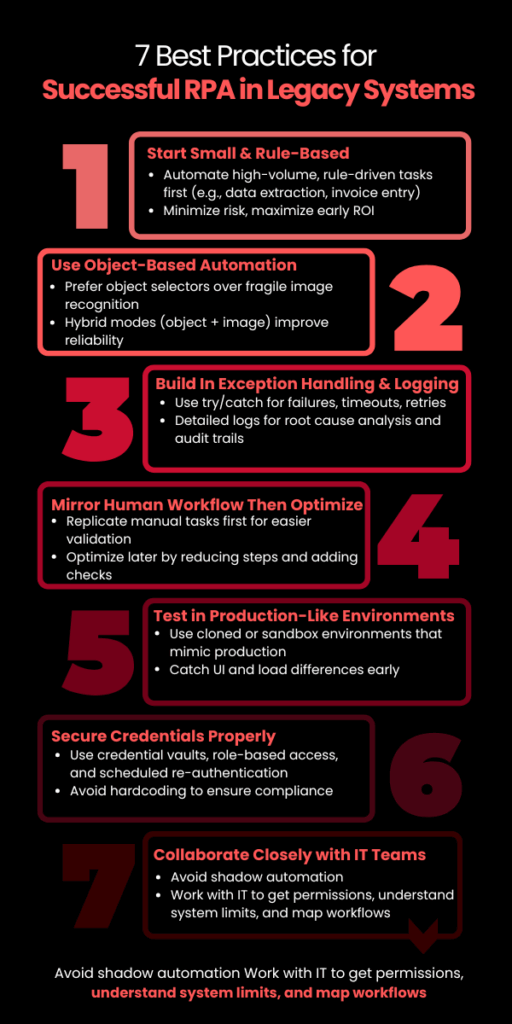
    Best Practices for Successful RPA in Legacy Systems

    Implementing RPA Development Services in a legacy environment is not plug-and-play. While modern RPA platforms are built to adapt, success still depends on how well you prepare the environment, design the workflows, and choose the right processes.

    Here are the most critical best practices:

    1. Start with High-Volume, Rule-Based Tasks

    Legacy systems often run mission-critical functions. Instead of starting with core processes, begin with non-invasive, rule-driven workflows like:

    • Data extraction from mainframe screens
    • Invoice entry or reconciliation
    • Batch report generation

    These use cases deliver ROI fast and avoid touching business logic, minimizing risk. 

    2. Use Object-Based Automation Where Possible

    When dealing with older apps, UI selectors (object-based interactions) are more stable than image recognition. But not all legacy systems expose selectors. Identify which parts of the system support object detection and prioritize automations there.

    Tools like UiPath and Blue Prism offer hybrid modes (object + image) — use them strategically to improve reliability.

    3. Build In Exception Handling and Logging from Day One

    Legacy systems can behave unpredictably — failed logins, unexpected pop-ups, or slow responses are common. RPA bots should be designed with:

    • Try/catch blocks for known failures
    • Timeouts and retries for latency
    • Detailed logging for root-cause analysis

    Without this, bot failures may go undetected, leading to invisible operational errors — a major risk in high-compliance environments.

    4. Mirror the Human Workflow First — Then Optimize

    Start by replicating how a human would perform the task in the legacy system. This ensures functional parity and easier stakeholder validation. Once stable, optimize:

    • Reduce screen-switches
    • Automate parallel steps
    • Add validations that the system lacks

    This phased approach avoids early overengineering and builds trust in automation.

    5. Test in Production-Like Environments

    Testing legacy automation in a sandbox that doesn’t behave like production is a common failure point. Use a cloned environment with real data or test after hours in production with read-only roles, if available.

    Legacy UIs often behave differently depending on screen resolution, load, or session type — catch this early before scaling.

    6. Secure Credentials with Vaults or IAM

    Hardcoding credentials for bots in legacy systems is a major compliance red flag. Use:

    • RPA-native credential vaults (e.g., CyberArk integrations)
    • Role-based access controls
    • Scheduled re-authentication policies

    This reduces security risk while keeping audit logs clean for governance teams.

    7. Loop in IT, Not Just Business Teams

    Legacy systems are often undocumented or supported by a single internal team. Avoid shadow automation. Work with IT early to:

    • Map workflows accurately
    • Get access permissions
    • Understand system limitations

    Collaboration here prevents automation from becoming brittle or blocked post-deployment.

    RPA in legacy environments is less about brute-force automation and more about thoughtful design under constraint. Build with the assumption that things will break — and then build workflows that recover fast, log clearly, and scale without manual patchwork.

    Is RPA a Long-Term Solution for Legacy Systems?

    Yes, but only when used strategically. 

    RPA isn’t a forever fix for legacy systems, but it is a durable bridge, one that buys time, improves efficiency, and reduces operational friction while companies modernize at their own pace.

    For utility, finance, and logistics firms still dependent on legacy environments, RPA offers years of viable value when:

    • Deployed with resilience and security in mind
    • Designed around the system’s constraints, not against them
    • Scaled through a clear governance model

    However, RPA won’t modernize the core, it enhances what already exists. For long-term ROI, companies must pair automation with a roadmap that includes modernization or system transformation in parallel.

    This is where SCSTech steps in. We don’t treat robotic process automation as a tool; we approach it as a tactical asset inside larger modernization strategy. Whether you’re working with green-screen terminals, aging ERP modules, or disconnected data silos, our team helps you implement automation that’s reliable now, but aligned with where your infrastructure needs to go.

  • Embracing Hybrid Cloud IT Infrastructure Solutions as the New Norm

    Embracing Hybrid Cloud IT Infrastructure Solutions as the New Norm

    In today’s world, where data breaches are becoming alarmingly frequent, how can companies strike the right balance between ensuring robust security and maintaining the scalability required for growth?

    Well, hybrid cloud architectures might just be the answer to this! They provide a solution by enabling sensitive data to reside in secure private clouds while leveraging the expansive resources of public clouds for less critical operations.

    As hybrid cloud becomes the norm, it empowers organizations to optimize their IT infrastructure solutions, ensuring they remain competitive and agile in a continuously ever-changing digital landscape.

    This blog is about the importance of hybrid cloud solutions as the new norm in IT infrastructure solutions.

    Embracing Hybrid Cloud IT Infrastructure Solutions as the New Norm


    Hybrid cloud IT infrastructure solutions
    Hybrid cloud IT infrastructure solutions

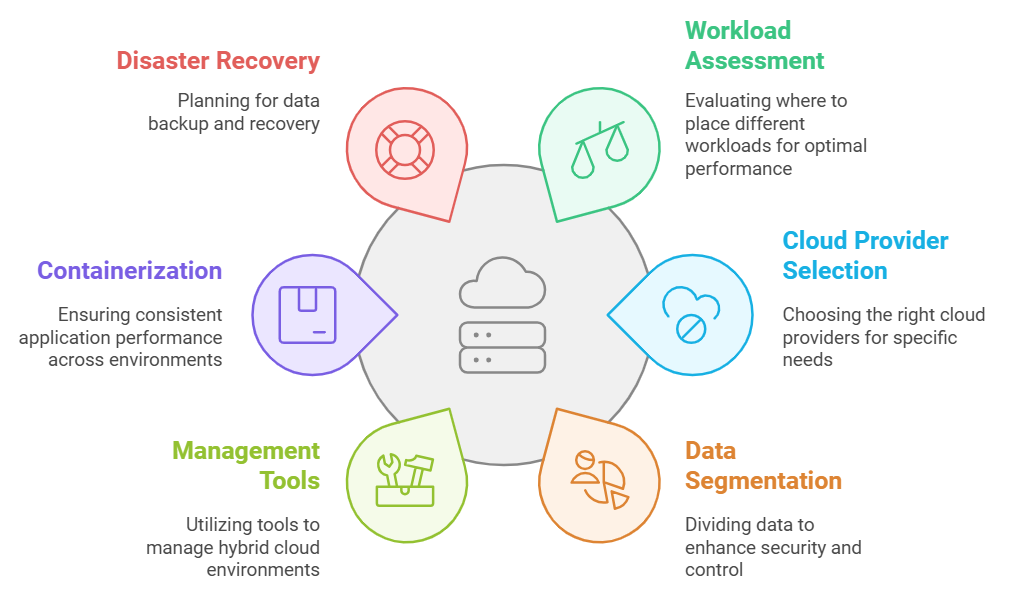
    1. Evaluating Organizational Needs and Goals

    • Assess Workloads: Determine which workloads best suit public clouds, private clouds, or on-premises environments. For example, latency-sensitive applications may remain on-premises, while scalable web applications thrive in public clouds.
    • Set Objectives: Define specific goals such as cost reduction, enhanced security, or improved scalability to effectively guide the hybrid cloud strategy.

    2. Designing a Tailored Architecture

    • Select Cloud Providers: Select public and private cloud providers based on features such as scalability, global reach, and compliance capabilities.
    • Integrate Platforms: Use orchestration tools or middleware to integrate public and private clouds with on-premises systems for smooth data flow and operations.

    3. Data Segmentation

    • Data Segmentation: Maintain sensitive data on private clouds or on-premises systems for better control.
    • Unified Security Policies: Define detailed frameworks for all environments, including encryption, firewalls, and identity management systems.
    • Continuous Monitoring: Utilize advanced monitoring tools to identify and mitigate threats in real-time.

    4. Embracing Advanced Management Tools

    • Hybrid Cloud Management Platforms: Solutions such as VMware vRealize, Microsoft Azure Arc, or Red Hat OpenShift make it easier to manage hybrid clouds.
    • AI-Driven Insights: Utilize AI & ML services to optimize resource utilization, avoid waste, and predict potential failures.

    5. Flexibility through Containerization

    • Containers: Docker and Kubernetes ensure that applications operate uniformly across different environments.
    • Microservices: Breaking an application into smaller, independent components allows for better scalability and performance optimization.

    6. Disaster Recovery and Backup Planning

    • Distribute Backups: Spread the backups across public and private clouds to prevent data loss during outages.
    • Failover Mechanisms: Configure the hybrid cloud with automatic failover systems to ensure business continuity.

    7. Audits and Updates

    • Audit Resources: Regularly assess resource utilization to remove inefficiencies and control costs.
    • Ensure Compliance: Periodically review data handling practices to comply with regulations like GDPR, HIPAA, or ISO standards.

    Emerging Trends Shaping the Future of Hybrid Cloud

    1. AI and Automation Integration

    Artificial Intelligence (AI) and automation are changing hybrid cloud environments to make them more innovative and efficient.

    • Automated Resource Allocation: AI dynamically adjusts resources according to the workload’s real-time demands for better performance. For example, AI & ML services can automatically reroute resources during traffic spikes to prevent service disruptions.
    • Predictive Analytics: Historical time series data analysis to predict potential failures to avoid faults and reduce downtime.
    • Improved monitoring: The AI-driven tools enable granular views of performance metrics, usage patterns, and cost analysis to help better make decisions.
    • AI for Security: AI detects anomalies, responds to potential threats, and strengthens hybrid environments’ security.

    2. Edge computing is on the rise

    Edging involves processing data near its sources; it combines well with hybrid cloud strategies, particularly in IoT and real-time applications.

    • Real-time Processing: Autonomous vehicles will benefit through edge computing, where sensor data is computed locally for instantaneous decisions.
    • Optimized Bandwidth: It conserves bandwidth as the critical data is processed locally, and the necessary information alone is sent to the cloud.
    • Better Resilience: With hybrid environments and edge devices, distributed workloads are more resilient when networks break.
    • Support for Emerging Tech: Hybrid systems use low-latency edge computing, especially for implementing AR and Industry 4.0 technologies.

    3. Sustainability Focus

    Hybrid cloud solutions would be crucial in aligning IT operations with and supporting environmental sustainability goals.

    • Effective utilization of resources: Hybrid could shift workloads into low-carbon environments like a public cloud provider powered by renewable sources.
    • Dynamic scaling: By scaling resources on demand through hybrid clouds, they keep energy wastage down over periods of low use
    • Green data centers: Harnessing sustainable IT infrastructure solutions by AWS and Microsoft Azure providers reduces carbon footprints.
    • Carbon Accounting: Analytics tools in hybrid platforms give accurate carbon emission measures, which allows organizations to reduce their carbon footprint.

    4. Unified Security Frameworks

    Hybrid cloud environments require consistent and robust security measures to protect distributed data.

    • Policy Enforcement: Unified frameworks apply security policies across all environments, ensuring consistency.
    • Integrated Tools: Data protection is enhanced by features like encryption, multi-factor authentication, and identity access management (IAM).
    • Threat Detection: Machine learning algorithms detect and prevent real-time threats, reducing vulnerability.
    • Compliance Simplification: Unified frameworks provide built-in auditing and reporting capabilities that simplify compliance with regulations.

    5. Hybrid Cloud and Multicloud Convergence

    Increasingly, hybrid cloud strategies are being used with multi-cloud to maximize flexibility and efficiency.

    • Diversification of vendors: Reduced dependency on one vendor can ensure resilience and help build more robust services.
    • Optimized Costs: Strategically spreading workloads across IT infrastructure solution providers can help leverage cost efficiencies and unique features.
    • Improved Interoperability: Tools such as Kubernetes ensure smooth operations across diverse cloud environments, thus enhancing flexibility and collaboration.

    Conclusion

    The future of hybrid cloud IT infrastructure solutions is shaped by transformative trends emphasizing agility, scalability, and innovation. As organizations embrace AI and automation, edge computing, sustainability, and unified security frameworks, they get better prepared to thrive in a fast-changing digital world.

    Proactively dealing with these trends can help achieve operational excellence and bring long-term growth and resilience in the age of digital transformation. SCS Tech enables businesses to navigate this evolution seamlessly, offering cutting-edge solutions tailored to modern hybrid cloud needs.

  • The Role of Artificial Intelligence in the Future of Education

    The Role of Artificial Intelligence in the Future of Education

    “Artificial Intelligence is no longer a distant utopia. Many things have happened since John McCarthy coined the term at the 1956 Dartmouth Conference”.

    What was once just a dream is now a reality – smart virtual assistants, chatbots, smart home devices, self-driving cars, drones, and other intelligent systems have become commonplace.

    AI technologies are now all around us, shaping every aspect of our lives and changing the world in the process. It’s a booming domain that brings us one step closer to the world of tomorrow.

    It’s obvious that AI has had a tremendous impact on all industries in recent years. Manufacturing, healthcare, transportation, finance and e-commerce are just some of the industries taking advantage of AI systems.

    But there’s one field that even though is not normally linked to AI, is taking big leaps towards embracing its applications. We’re talking about education.

    Education systems all over the world are regarded as being somewhat rigid and reluctant to change.

    However, educational institutions realized the great potential AI technology has and how it can empower both teachers and students, so they are now trying to catch up with the trends and join the AI movement.

    Professionals in the domain agree that AI is essential for the future of learning and it will reshape the way we approach education. So let’s take a look at how AI will influence education in the years to come.


    Learning as a personalized experience

    We all know that people learn differently. Every person has personal preferences as well as strengths and weaknesses when it comes to learning. Traditional teaching methods make no difference between students, having a one-size-fits-all approach.

    As a result, some students fail to attain their full potential, while others struggle to keep up with the curriculum. AI helps correct these shortcomings and transform learning into a personalized experience.

    Adaptive learning platforms are able to create learning profiles for students, based on their abilities, preferences, learning styles and the challenges they face. The curriculum and the teaching methods are adapted to students’ needs.

    Teachers can give personalized counsel and adjust class-assignments so that each student can work on what he needs to improve.

    Additionally, AI can help students receive extra support. Educational assistants enhance the learning process by answering questions from students, providing the information they need and helping with assignments, without the teacher’s intervention, so students can set their own pace and learn whenever it’s more convenient for them.


    Helping teachers with administrative tasks

    Besides teaching, tutors and educators have other tasks they need to fulfill that require just as much effort and commitment. They also have organizational and administrative responsibilities that can take up a lot of their time.

    Teachers have to handle tasks such as organizing educational material, evaluating assignments, grading exams, managing paperwork, communicating with the parents etc.

    Fortunately, AI can make their job easier and help with many of the above-mentioned activities. Let’s take grading for example. Automated grading is a life savior for teachers when they have to go through thousands of tests.

    AI can take care of other tasks such as logistics issues, keeping the paperwork up to date, and providing feedback for students or serving as a communication channel for teacher-parent interactions.

    Furthermore, education administrators can really benefit from integrating AI solutions into their activity. AI can help with a series of administrative duties from budget management to processing student application forms, procurement of materials or HR management.

    The result will be higher administrative efficiency, lower costs and a clear overall view of the institution.


    Education without boundaries

    A traditional education system comes with many limitations. AI can help get rid of boundaries and make learning easily accessible for everyone.

    There are students who can’t attend school in person or who, for various reasons, skipped school years. There’s also an increased interest in high-quality online courses for students all ages.

    AI gives people the possibility to pursue their educational objectives, no matter where they are in the world. Those who want to further their education can forget about time and space restrictions, thanks to AI systems. They can learn anytime, anywhere and adjust the learning process to their needs and environment.


    Customized textbooks

    AI is slowly changing the way we use textbooks. Soon enough, thick old-school textbooks, packed with unnecessary information will be a thing of the past. New technologies are making way for customized study guides that cater to students’ needs.

    Teachers will no longer waste their time going through manuals to extract the necessary information and put it in a form that makes it easier for students to understand and assimilate.

    Digital textbooks created by AI systems will become commonplace in the educational environment. They put the spotlight on smart content, helping students learn in a more efficient manner.


    Course creation

    AI can do a lot more than providing support for courses. It can also be used as a tool for creating courses and bringing real-time improvements in the educational process. AI-powered courses come with many advantages.

    For example, when attending an online class, students will receive suggestions and assistance as they progress, according to their personal evolution and they will receive support each time they struggle to complete a task.

    Teachers will also be helped by receiving notifications when complicated issues arise, so they can offer further details and focus more on important aspects.


    What AI means for teachers

    Since intelligent systems will handle so many tasks that were once performed by teachers, some people got the idea that the rise of AI technologies in education might render teachers obsolete. But in reality, this is highly unlikely to happen.

    A more realistic scenario would be a future in which AI becomes a reliable assistant for teachers, helping them fulfill their responsibilities with higher efficiency.

    There’s a good reason why things will go in this direction. People will always require and respond better to human interaction.

    While AI can be of great help, students still need a teacher to connect with, someone that can guide and inspire them in a way that no machine ever will.

  • AI in Retail: The Ideal Tool to Deliver Seamless Customer Experience and Drive Profitable Growth

    AI in Retail: The Ideal Tool to Deliver Seamless Customer Experience and Drive Profitable Growth

    Traditional analytics methods have worked perfectly fine for the data-driven retail industry for decades. However, Artificial Intelligence (AI) and Machine Learning (ML) have established an entirely new level of data processing which leads to richer business insights and customer relations. Data scientists could open a new world of opportunities to business owners to extract correlations and variance from thousands of AI /ML models. The importance of AI in the retail industry is finally being recognized. According to surveys, the retail business currently spends roughly $49 million. By 2023, when AI is factored in, it is predicted to reach $12 billion. In terms of spending, AI in the retail business is expected to grow by more than 200 percent by 2023. The growth in the global artificial intelligence in the retail market is driven by factors such as eternally growing smart device and internet users, increasing awareness about AI and big data and analytics, government initiatives on digitalization, and supply chain optimization. Furthermore, enterprises’ demands for restructuring business processes, adoption of the multichannel or omnichannel retailing strategy, mainlining inventory accuracy, and growing need to enhance end-user experience are fuelling the growth of this market.

    The use cases of AI in the retail sector are quite compelling. AI empowers both backends and frontend of e-commerce business. It can help retail businesses to estimate demand forecasts to drive higher margins, can increase the efficiency of the supply chain, give valuable insights for making smart business decisions. On the customer side, AI can personalize customers’ shopping experience by providing personal recommendations, 24×7 chatbots, etc.

    Because of the rapid rise in online retail businesses, the retail industry was less affected by COVID-19 than other industries. Before the COVID-19 outbreak, over 80% of purchasers were accustomed to purchasing things in physical storefronts. However, due to quarantine orders, customers purchased their products more online.

    AI solutions, whether for online or offline commerce, have a lot of room to grow in the future. For the time being, we can show you several real-world AI applications that have shown business value.

    Why Does Your Retail Business Need AI Optimization? 

    Today customer experience has surpassed product and pricing as the one major brand differentiator. Brands that fail to deliver the best possible customer experience will likely deliver less than optimal returns regardless of having a world-class product. To seamlessly create a more engaged business-to-consumer interaction and a great experience for customers, retailers need more tools at their disposal, with AI as their first choice.

    Here are the few benefits businesses can gain from boosting customer engagement, experience, and success by utilizing AI:

    Everyday operations become efficient

    Creating a seamless customer experience and profitable business starts behind the scenes. Retailers must find efficient and profitable ways to deal with these mundane and routine tasks like:

    AI in the retail supply chain can be used for quick product delivery and improved inventory control like restocking — forecasting the demand for a particular product by considering a sales history, weather, location, trends, promotions, and other parameters.

    Picking and packing delivered by the robots is relatively fast ROI when compared to the manual processes. Moreover, robots can collaborate and are designed to open, fill, seal, label, and pack orders together.

    Machine Learning models help in recognizing and classifying millions of items from various sellers and categorizing them according to customer requirements.

    The number of products returned can be reduced due to the early analysis of future purchase trends. Algorithms analyze previous searches, purchases, transactions, and even seasonal trends.

    Personalized customer experience

    With an increasingly digitized world, today, brands are realizing that AI is the real gamechanger in personalizing the customer experience. As customers’ expectations are changing dramatically, retailers are mounting to the challenges with the help of AI, Machine Learning, and Big Data.

    To gauge customer interests and preferences, retailers use advanced Machine Learning algorithms to analyze browser history, past purchases, page views and clicks, social interactions (impressions, likes, shares, and comments), the duration of a page viewed, location, etc. In-store, AI can further enrich the shopping experience with:

    Navigation: AI-enabled kiosks or robots can improve the in-store experience of customers. In-store kiosks and robots use natural language voice commands or touch screen interfaces to provide useful information to customers regarding product location.

    Smart checkouts: Shopping carts with ARM-based cameras can automatically recognize the customer’s purchases, prepare orders, and enable payments through a mobile device.

    AI-driven AR: Many retail stores offer virtual trial rooms, make-up, or product apps, which use AI-driven Augmented Reality interfaces to let customers test products without physically trying them on.

    Visual search and recommendations: Image recognition technology allows people to upload images of the item they are interested in and get products of similar patterns, colors, and shapes. AI recommends products related to the one reviewed by the user and based on the previous purchases.

    Better pricing strategy

    Retail pricing is a core aspect of any business, several studies show that the price that customers pay for an item is almost always among their top concerns. Also, most of the customers wait for the time for a price drop, and they wait for arriving of the product at an ideal cost. Retailers attract customers by forecasting the price of a product based on demand, seasonal trends, competitors’ price, various product characteristics, the release date of new models of the same item in the market, etc.

    AI helps businesses alter the prices of their products, by envisioning the likely outcomes of various pricing strategies. To be able to execute this, systems collect information about other products, promotional activities, sales figures, customer preferences, product locations, and additional data. Businesses can exhibit the best offers to increase customers’ footfall and boost companies’ bottom line.

    Data security efforts have become accurate

    Retailers are combating data leaks, cyber threats, malicious activities, and the prevention of shoplifting by adopting various advanced security measures such as IoT, AI, and Machine Learning. Also, the amount of information that the retailers collect, and process are immense. While it’s not possible to eliminate retail shrinkage, AI excludes time-consuming research tasks and provides curated analysis of risks, reducing the amount of time security analysts take to make the critical decision. Retailers, considering the vast amount of consumer and employee data they possess, should pull out all stops to ensure a robust data security platform to avoid the devastating effects of cybercrime. For this reason, most retailers use AI abilities to provide solid data security.

    Retail requires these data-centric solutions, that result in highly personalized experiences and product recommendations, accurate forecasts, inventory efficiencies, and overall smarter business. Our AI, ML, Data, and Analytics Engineering Services power their Digital Next transformation actions by providing transparency, agility, and flexibility with retail-driven advanced analytics through flexible and scalable solutions.

    We being an AI platform-led digital transformation, product engineering, and solutions company, conversational AI is an area of focus for us. Our solutions enable enterprises to engage customers and ensure speedy resolution of issues with the use of natural language processing, AI, and analytics to intelligently recognize and respond to customer text and voice queries.

  • Smart Building Technology: Concept, Features, and Application

    Smart Building Technology: Concept, Features, and Application

    In the digital era, it is no longer enough for buildings to provide space, keep occupants warm, and please the eye. New demands require the digital market to offer advanced complex solutions like smart buildings.

    A smart building is a structure based on IoT technology that uses hardware, software, and connectivity to manage HVAC, lighting, security, etc., and create a comfortable and safe environment for occupants. The above elements interlinked form a complex solution that collects and analyzes building operation data in real time and improves building upkeep and maintenance as well as the experience of its occupants.

    Why Opt for Smart Building

    • Comfort for occupants due to controlling lighting, temperature, humidity, and other parameters and allowing for personalized comfort settings.
    • Automated control of a building’s HVAC, electrical, lighting, shading, access, and security systems based on collecting and analyzing data on environmental conditions, occupant behavior, and more.
    • Cost optimization due to analyzing building usage patterns and making adjustments to improve a building’s upkeep, optimize HVAC operation, match occupancy patterns to energy use, enhance space utilization efficiency, and more.
    • Reduced environmental impact due to analyzing indoor and outdoor environment conditions, occupants’ behavior, and other data to optimize energy and water consumption patterns and reduce emissions.
    • Integration capabilities due to which there is no need to construct or move to a new building to benefit from the smart technology. Modern smart building solutions can be embedded into older structures.
    • Preventive maintenance due to analyzing real-time and historical equipment data and detecting patterns leading to a potential failure.
    • Enhanced health and well-being due to supporting physical distancing efforts through space optimization and access control systems and improving indoor air quality through efficient HVAC operation, and more.


    Use Cases of Smart Building Technology

    Smart offices like the Edge in Amsterdam, Netherlands, or Capital Tower in Singapore use smart building technology to adjust building operations to workers’ needs and enhance employee satisfaction and productivity. Occupants of these buildings can book available office spaces, have seamless access to location information and personalized comfort settings. Building managers can handle maintenance and sanitization requests and get space and energy efficiency optimized.

    For example, with the help of a special app, the Edge knows the routine of each of its occupants: it books workplaces based on their business schedules, knows which cars they drive and takes care of parking arrangements accordingly, remembers each occupant’s lighting and temperature preferences. Every aspect of building operation from energy use to coffee machines is monitored via its central dashboards, which helps optimize building resources and cut upkeep costs whenever possible.

    Smart offices are also capable of addressing global challenges like air purification or fighting extreme temperatures. For example, with its five air purification systems, Glumac’s Shanghai office, China, ensures the best indoor air quality in Shanghai. And Hindmarsh Shire Council Corporate Center in Melbourne, Australia, has a series of underground thermal chambers and a ventilation system to maintain a comfortable indoor climate.

    Smart hospitals can bring better treatment outcomes, enhanced staff productivity, and cost-effectiveness, as proven by the Ankara City Hospital, Turkey, or the Sint-Maarten Hospital in Mechelen, Belgium. These hospitals are intelligent ecosystems with a central building management platform that controls the subsystems. Smart building hardware and software are used to lower infection risks, optimize the use and maintenance of medical equipment, facilitate patient and visitor registration, provide individual comfort settings for patients, improve energy use, and more.

    Smart data centers prioritize uptime, energy efficiency, physical security, and fire safety. They use smart building solutions that operate 24/7/365 as in NxtGen Data Center in Bangalore, India, or Interxion Data Center in Vienna, Austria. They leverage smart power supply systems that provide power independently from the public power grid, smoke detectors that identify incipient fires and activate response measures, and security management systems that ensure perimeter protection, intrusion detection, and visitor management.

    Smart life science facilities face unique challenges like biosafety hazards or intellectual property loss and use specialized smart solutions for cleanrooms, laboratories, and critical storage facilities to address them. For example, Ferring Pharmaceuticals and Develco Pharma use tailored smart building technologies in their production buildings in Saint-Prex, Switzerland, and Schopfheim, Germany. The solutions they use provide security monitoring via smart surveillance systems, control airflows, detect and protect the buildings from fire, and share building operation analytics through real-time dashboards.

  • 4 ways AI can help us enter a new age of Cybersecurity

    4 ways AI can help us enter a new age of Cybersecurity

    • AI is helping companies recover from the pandemic more efficiently.
    • The growing uptake of AI is causing concern for data security in a time of escalating cyberthreats.
    • Well-deployed AI can be used to counter these cybersecurity threats.

    Global catastrophes have historically brought moments of truth for all fields of business. In such times, their inner workings, strengths and weaknesses are laid bare for the whole world to see, as organizations rapidly alter their processes to come to terms with the new reality.

    Businesses that can make bold moves during such challenging times can quickly turn the misfortune into a benefit. So early indications are that businesses that value information as a currency, and have been quick to adapt machine learning and advanced data analytics, have emerged better from the economic aftermath of the pandemic.

    AI and business optimization

    The coronavirus pandemic that continues to ravage the world has forced small businesses into building online ventures. It has also compelled them to adopt AI-enabled platforms that offer consumer insights and help enterprises to deliver “hyper-personalized” products to online buyers.

    Additionally, AI has so far helped companies that are struggling to create safe and contagion-free work environments by setting up on-demand online labour forces.

    In a business context, AI has the potential to perform automated, repetitive tasks that would otherwise have been left for humans. It helps improve efficiency, reduces cost and saves time that could be invested in other business functions.

    However, AI requires massive amounts of data to learn about consumer trends, predict consumer behaviour and find the “next best action” to enhance customer satisfaction and boost sales. But this predictive intelligence can also foresee demand and supply behaviours and help in quality control processes in manufacturing facilities

    The trouble is that gathering and storing this data securely while safeguarding the interests of your stakeholders is no easy task. In the age of digital transformation, where everything is interconnected and shared online, internet of things (IoT) security poses a significant risk for users.

    In recent years, there has been a dramatic increase – 15% to 21%, according to various estimates ­– in security breaches. Leading platforms such as Facebook, Twitter, and Yahoo have become victims, compromising millions of dollars’ worth of users’ data.

    This does not only mean people must set better passwords, but also mandates that these platforms have higher standards for cybersecurity. Since data science and AI will be shaping the next stages of IoT development, data-rich companies must create efficient and trustworthy approaches to turn data into useful and actionable insights.

    Cybersecurity in the age of AI

    Data collection and AI algorithms are becoming the cornerstone of the cybersecurity industry. Automated decision-making and evaluation processes provide a wider range of protection from malicious activity than legacy solutions. For instance, AI can be proactive and monitor devices for suspicious activity, instead of relying on slowly updated malware databases.

    AI developments in cybersecurity should emphasize on making systems safer and more secure for consumers to use. Let’s take a look at how to do this right:

    1. Identify threats early

    Combine conventional threat intelligence (a list of all known cyberthreats to date) and use machine learning to understand risks. This should result in a better, more efficient system of threat detection and prevention.

    This can also help to identify any loophole or threat present in the data.

    In fact, machine learning can also be used to spot any abnormality or potential vulnerability in the midst of “normal” activity and warn users of a threat before it could compromise essential data. With the right systems in place, your hackers won’t even realize that you know of their presence, so you can take immediate measures to ensure the safety of your digital infrastructure.

    1. Prevent credit-card fraud

    Unusual activity, such as purchases made from a different device or unusual transactions, can be instantly detected using AI-powered services that help verify the credit-card holder.

    Machine learning can also help users choose passwords by warning them if a password is not safe enough.

    1. Build on the blockchain

    In recent years, cryptocurrencies like Bitcoin and Ethereum have been rising in popularity. These cryptocurrencies are built upon blockchain, an innovative technical solution to store a secure, decentralized record of transactions.

    Blockchain can be used to enable medical records and help in security management by identifying criminal identity loopholes in the system.

    With blockchain technology, verification keys wouldn’t be required anymore. If someone tries to hack the data, the system analyzes the whole mass of data chains. Even if one data node is left uninterrupted by the hacker, the entire system can be restored successfully.

    This makes the entire system far more secure, ensuring that there is no discrete way of tampering with blocks in the chain, and the stored data can remain safe.

    1. Go deep into the data

    One of the main areas where AI can help cybersecurity is by responding to threats almost immediately. For example, in 2016 Google listed around 20,000 sites for having malware within their system. While humans can’t scrutinize millions of websites, machine learning can. It is possible to use relevant AI solutions to analyze every visit to the site, categorize visitors based on their threat level, and deal with them accordingly.

    We are entering an era of hypercomplexity, where all of our information is interconnected

  • The Role of Artificial Intelligence in the Future of Education

    The Role of Artificial Intelligence in the Future of Education

    Gone are the days of visiting the library to photocopy a few pages from an encyclopedia for a school project. As generations of children grow up with technology at their fingertips, we live in a world where the internet is their primary source of information, education, and entertainment. A recent survey found that children in the U.S. aged between eight and 12 spend almost five hours a day looking at screens, while teenagers are clocking nearly seven hours a day of screen time – and that’s not counting the time they spend doing schoolwork. Hours spent learning from chalkboards in physical classrooms has also reduced significantly since the start of the COVID-19 pandemic, and the ensuing social restrictions and lock-downs. As technology and society continue to evolve and develop, the way we learn will also continue to change, for children and adults alike.

    The rapid advancement of technologies such as artificial intelligence (AI), machine learning (ML), and robotics impacts all industries, including education. If the education sector hopes to utilize AI’s full potential for everyone, the focus should be to continue exposing the next generation to AI early on and utilizing the technology in the classroom. Teachers are already finding that many students use AI through social media and are, therefore, open to its educational applications.

    There’s also a great professional need for these abilities. “The U.S. Bureau of Labor Statistics sees strong growth for data science jobs skills in its prediction that the data science field will grow about 28 percent through 2026,” says Bernard Schroeder, senior contributor for Forbes. With increased technology comes increased data operations and analysis sophistication, as well as more AI. These changes will ultimately increase the demand for data scientists and other AI specialists

    The role of artificial intelligence in education

    Global Market Insights Inc. predicts that the AI education market could have a market value of $20 billion by 2027. The industry growth is good news, as AI can ultimately reduce the burden on teachers across the globe.

    However, some educators fear that in the future, AI technology might replace the role of the teacher altogether. Fortunately, it doesn’t look like teachers are at risk of being replaced by robots anytime soon. While AI programs can teach students literacy or math, the more complex impartation of social and emotional skills will remain in the domain of humans.

    How artificial intelligence is currently used in education

    How technology is used in classrooms has changed significantly in response to COVID-19. Rather than teaching in front of a classroom full of students, lock-downs forced many educators across the globe to teach remotely, from their homes. Edtech company Promethean surveyed teachers and learned that 86 percent thought AI should be an important part of education.

    Using AI in education holds many benefits for both students and teachers:

    • Learning resources can be accessed from anywhere, at any time
    • Time-consuming, tedious tasks such as record keeping or grading multiple-choice tests can be completed through AI automation
    • Frequently asked questions can be answered through chatbots
    • AI tutors and chatbots can be available to answer questions at any time
    • Learning can be tailored and adapted to each student’s goals and abilities through personalized programs

    How AI is set to change the education market

    The World Economic Forum estimates that, by 2025, a large proportion of companies will have adopted technologies such as ML. They strongly encourage governments and educational institutions to focus on rapidly increasing related education and skills, focusing on both STEM and non-cognitive soft skills to meet the impending need. Advances in technology will cause major disruptions in the workforce, as automation could replace up to 50 percent of existing jobs in the U.S. alone, Microsoft reported. The Microsoft report continues, suggesting students will need to have mastered two facets of this new world by the time they graduate.

    They need to:

    • Know how to utilize ever-changing technology, such as AI, to their advantage
    • Understand how to work with other people in a team to problem-solve effectively

    Preparing students to work alongside AI in the future can start early. As many children are already comfortable with digital technology before entering school, it’s essential to teach them the skills to thrive in a digital workplace. The workforce of the future has its foundation in the now.

  • The 6 Most Important Technologies in Machine Learning

    The 6 Most Important Technologies in Machine Learning

    With the sudden technological boom within the IT and development organizations a couple of years ago, both Artificial Intelligence (AI) and Machine Learning have now become the trending careers for a lot of people to follow. With so many businesses coming up and clamouring for the best new talent, today, the industry is experiencing a shortage of skilled and qualified professionals. However, a plethora of tech professionals have rushed to fill in this gap by learning all of the technologies associated with machines learning and AI and adding them to their skillset.

    Since this is mainly limited to key learning languages and does not break new ground, most people in these industries are now beginning to realise the importance of looking beyond the learning languages as these will decide the future. There is no simple solution as to which technology to watch out for as things are in a constant state of flux and all the new and old frameworks are constantly evolving.

    However, since it has been established that AI is rapidly transforming every sphere of our life (think Siri and the like), there are certain key AI technologies to focus on so that one can take machine learning projects to the next level. Here is an informative list of the six best technologies one can use:-

    • Keras: This is an open source software library that focuses on simplifying the creation of deep learning models. Written in Python, it can also be deployed on top of many other AI technologies such as Theano and TensorFlow. It runs optimally on both CPUs and GPUs, plus it is known for its user-friendliness as well as fast prototyping.


    • Torch: One of the oldest such technologies released all the way back in 2002, it is a machine learning library that has a variety of algorithms to offer for deep learning. With an open source framework, you will be provided with the best speed and flexibility without having to worry about any complexities getting in the way.


    • Caffe: Being one of the more recent options, the best part about Caffe is that it inspires a degree of innovation with an expressive architecture along with the provision of a vibrant community. This machine learning framework primarily focuses on speed, expressiveness and modularity.


    • TensorFlow: With the initial release of this open source machine learning framework being 2015, it has been deployed across many different platforms and is easy to use. Created by Google at first, now all the top tech giants such as eBay, Dropbox, Intel and Uber use it extensively. With the help of flowgraphs, one can develop neural networks.


    • Theano: This is basically an open source Python library that you can use to fashion various machine learning models. Being one of the oldest libraries, it is regarded as an Industry standard. It simplifies the process of optimizing, defining and assessing mathematical expressions.


    • Microsoft Cognitive Toolkit: Initially released about three years back, this is an AI solution that you can use to take your machine learning projects to the next level in every way. Certain studies have revealed that the open source framework can train certain algorithms to function like the human brain.


    One has to take note of the fact that building a machine learning application is one thing, but selecting the ideal technology from the many options out there is another ball game altogether. It is anything but a simple task to achieve and evaluating many different options before selecting the final one is a must.

    Furthermore, learning how the various machine learning technologies work separately and with each other will be a key component of your decision-making process in totality. Most importantly, it will also play a decisive role in ensuring that you stay ahead of the pack with regard to your contemporaries.

  • Current trends in Artificial Intelligence (AI) Application to Oil and Gas Industry

    Current trends in Artificial Intelligence (AI) Application to Oil and Gas Industry

    In recent years, artificial intelligence (AI), in its many integrated flavors from neural networks to
    genetic optimization to fuzzy logic, has made solid steps toward becoming more accepted in the mainstream of the oil and gas industry.On the basis of recent developments in the field of Oil & Gas upstream, it is becoming clear that petroleum industry has realized the immense potential offered by intelligent systems. Moreover, with the advent of new sensors that are permanently placed in the wellbore, very large amounts of data that carry important and vital information are now available.

    To make the most of these innovative hardware tools, an operator intervention is required to handle the software to process the data in real time. Intelligent systems are the only viable techniques capable of bringing real-time analysis and decision-making power to the new hardware.

    An integrated, intelligent software tool must have several important attributes, such as the ability to integrate hard (statistical) and soft (intelligent) computing and to integrate several AI
    techniques. The most used techniques in the Oil and Gas sector are:

    Genetic Algorithm (GA), inspired by the biological evolution of species in natural
    environment, consists of a stochastic algorithm in which three key parameters must be
    defined:
    1. Chromosomes, or better, vectors constituted by a fixed number of parameters
    (genes).
    2. A collection of chromosomes called genotype, which represents the individuals of
    a population.
    3. The operations of selection, mutation, and crossover to produce a population from
    one generation (parents) to the next (offspring).

    Fuzzy Logic (FL) is a mathematical tool able to covert crisp (discrete) information as
    input and to predict the correspondent crisp outlet by means of a knowledge base
    (database) and a specific reasoning mechanism. To achieve such goal, the crisp
    information is firstly converted into a continuous (fuzzy) form, secondly processed by an
    inference engine and at least re-converted to a crisp form.

    Artificial neural network (ANN) is constituted by a large number simple processing
    units, characterized by a state of activation, which communicate between them by sending
    signals of different weight. The overall interaction of the units produces, together with an external input, a processed output. The latter is also responsible of changing the state of
    activation of the units themselves.

    AI applications in Oil and Gas industry

    Exploration & Production (E&P) sector

    Most of the resources in the Oil and gas field is centered in drilling operation in which artificial
    intelligence finds natural application. Drilling success and safety are related to an accurate
    prediction of the likely performance of different factors such as:
    • Pre-drilling settings (rig, logistics and associated drilling risks)
    • Drilling equipment (casing and tubing pipes, drilling mud)
    • Downhole machinery behavior (vibrations, torque limits)

    The development of models, implemented by AI systems, permits to avoid the necessity of
    disposing of real-time data and to produce smart outcomes in order to quickly re-establish optimum operating conditions.

    Relatively to the selection of Drill bits, trained artificial neural networks (ANNs) have been used:
    they are able to suggest the best drill bit to select (roller cone, diamond insert or a hybrid) analyzing a user defined database. The latter should include information relative to the IADC bit codes correlated with specific geological data.

    Neural and network system (commonly GRNNs) gave accurate results in the prediction of mud
    the fracture gradient. As input parameters to the model, the depth of the well, the overburden
    gradient and the Poisson ratio must be provided. It is important to keep in mind that the results will strictly depend upon the range of the data set, and that extrapolations may loss in accuracy.

    In the planning stages of a well, drilling engineers are responsible for the establishment of the
    different depths at which the well must be cased to ensure an overall desired perforation depth. To avoid casing collapse, a neural network approach adopting a BPNN based spreadsheet program can be used. Back-propagating neural networks (BPNN) are constituted by a defined number of “layers”. Each layer is interconnected with the other: in particular, the input layer is connected with hidden layers which are in turn connected to the output layer. This neural net, provided of an historical well archive, is fed (input layer) with specific data of the well under consideration (i.e. location, depth, casing strength). Furthermore, the BPNN is able to estimate an “experienced”casing case probability.

    Another example of AI application is given by the real time drilling optimization in which
    artificial intelligence system are adopted to improved monitoring of downhole parameters
    optimizing the drilling operation.

    A crucial real-time operation is the Estimation of hole cleaning efficiency in terms of cutting
    concentration. During the drilling process, the wellbore is filled with many rock fragments
    (cuttings) generated by the mechanical action of the drill bit. In order to remove those cuttings
    from the well, a drilling fluid, or drilling mud, is pumped from the drill bit and exits from the
    wellhead: the cuttings are lifted and carried on the top of the well. According to this, the cutting concentration (expressed as a %) is the residual amount of rock fragments into the well after the cleaning action of the mud (Figure 5 gives a visual idea of the situation described). Inefficient removal of the drilled cuttings may lead, in some severe cases, to the loss of the well due to stuck pipe.

    For the estimation of the hole cleaning efficiency, artificial feed-forward neural network with
    back-propagation (BPNN) can be used. As input to the model all the parameters which affect the cutting concentration must be given. The latter are divided in specific parameters of the drilling (rate of penetration, inclination angle of the wellbore) or in parameters regarding the rheology conditions of the mud (viscosity, density).

    Future-proof your operations, onshore or offshore

    Whether you focus on exploration, extraction, transportation, storage, or production, at SCS Tech, we cater to all sectors of the oil and gas industry. From crude oil to natural gas and natural gas liquids, from refineries to gas treatment and petrochemical production, from pipelines to storage facilities, our service solutions and expertise give you the competitive edge. We ensure and boost the performance of the turbomachinery that lies at the heart of your value-adding process.


  • Why Conversational AI and Chatbots are Perfect for Digital Health

    Why Conversational AI and Chatbots are Perfect for Digital Health

    Over the last decade, the continued evolution of digital healthcare and the impact that next-generation technology will have on patient wellness and diagnostic outcomes has been a recurring conversation. Providers have been looking to make the most of the tech-centric tools that are increasingly available, while those in need of care or the right advice at the right time now expect the medical sector to be investing in digital solutions to physical problems.

    The integration of tech into public health and wellness is nothing new, but the demands of the connected society have only raised awareness of what is possible but also flagged up the opportunities for engagement in the digital space.

    Healthcare has never shied away from technology, albeit some recent improvements can be hit-and-miss – electronic health records are only as useful as the data that has been input, for example. However, there is a consensus among providers and medical professionals that the industry is willing to accept some disruption if it has a positive impact on the overall patient experience.

    In terms of technology with the power to both disrupt and improve the way that people engage with digital health, there is an argument to be made that conversational AI (which includes Machine Learning) and Natural Language Processing (NLP) can be the missing link. After all, if Alexa et al can answer questions about the weather, start your car in the morning and tell jokes, then there is no reason why virtual assistants can’t provide you with the medical advice that you need, when you need it.

    The Chatbot will See You Now

    According to the World Economic Forum, virtual assistants – and, by association, chatbots – are not only being used in a diverse set of industries (healthcare, education, retail, tourism, and more), but also offer opportunities for companies to integrate NLP into routine or mundane activities. For instance, Amazon’s Alexa is the chatbot that the average person associates with the tech, but the key element in every interaction is the ability of NLP to understand what it is being asked and respond with the appropriate information.

    The problem, the WEF said in a November 2021 blog post, is that building the chatbot is the easy part. Often, it is the conversational aspect that throws a digital spanner into the works. When you are talking to a finance bot or trying to return a pair of shoes, the stilted nature of these exchanges is rarely an issue. In a sector such as healthcare, it is the conversation and the information that is being dispensed that is a key part of how comfortable an end-user is with knowing that they are not engaged with a human being.

    In rural parts of the world, the use of so-called health bots has already helped alleviate some of the pressure on localized health providers.

    This is not limited to first-world or so-called developed countries, but their integration takes on a particular resonance in regions where access to tech is not easily available. In Rwanda, for example, there is often only one doctor and six healthcare workers per 10,000 people, with the WEF noting that these tools are allowing patients to have access to doctors, nurses, and relevant healthcare information.

    The caveat is that there is still some concern that a well-documented stigma surrounding chatbots in general could prevent people from interacting with them in the first place – for the record, this is also not unique to developing countries, there seems to be a global mistrust of chatbots as an accurate or effective engagement tool!

    Conversational AI and chatbots are not new per se, but they can suffer from falling under a broad definition of what they actually are. Simply put, a “chatbot” is AI software that simulates a human conversation with end-users – this can be text or voice – with the aim being to leverage machine learning algorithms and NLP to deliver required outcomes.

    The healthcare sector has been experimenting with these solutions for some time, with Mobile Health News reporting in May 2020 that a leading healthcare provider was integrating bots into its Emergency Department EHR system. More recently, the World Health Organization launched a women’s health chatbot dedicated to breast cancer messaging – for context, this new digital experience follows hot on the heels of bots that delivered information on COVID-19, mental health and smoking cessation.

    So, the bots are already here, but the question that we need to address is how we can use conversational AI and/or chatbots in addressing not only patient concerns but also alleviate the worry or concerns that a person has. Additionally, we should consider both the challenges to overcome and the advantages of using virtual assistants to deliver care and wellness.

    The Future is Already Here

    We all interact with digital experiences every day of our lives, so it makes perfect sense that the technologies we often use without thinking should be mirrored in the healthcare sector. And while the industry still relies far too much on legacy technology (disparate IT systems, pagers instead of wearables), the integration of digital health solutions is picking up pace.

    Conversational AI has been part of the digital landscape for at least five years, although the average person is likely to only know these virtual assistants as Alexa, Siri and Google Assistant (useful tool, unimaginative name). Chatbots fit into the same category, but their integration into the connected society is less heralded and, arguably, overlooked in terms of the access to knowledge and the assistance they can provide.

    However, these tools are here to stay and there is a defined need for them to become not only part of the digital health landscape but also a familiar resource for people to turn to. The effective use of chatbots to provide the right medical or clinical information at the right time is not a futuristic concept, these solutions are here now. What matters is how healthcare and life sciences companies choose to use them.

    To learn more about SCS Tech Expertise, click here