Unplanned downtime costs the oil and gas industry billions each year. In fact, research shows that companies with a reactive maintenance approach spend 36% more time in downtime than those using data-driven, predictive maintenance strategies. The difference?
A potential $34 million in annual savings. With such high stakes, it’s no longer a question of whether the oil and gas industry should adopt digital transformation in oil and gas — it’s about how to implement these innovations to maximize efficiency and reduce costly downtime.
The answer lies in Digital Oilfields (DOFs), which seamlessly integrate advanced technologies to optimize operations, improve asset reliability, and cut costs.
In this blog, let’s explore how Digital Oilfields revolutionize operations and reshape the future of the oil and gas industry.
How Does Digital Oilfields Seamless Integration Revolutionize Operations?
Digital Oilfields solutions implement Industrial IoT (IIoT) for Oil & Gas, real-time analysis, and automation to streamline operations, predict likely breakdowns, and drive peak asset efficiency. Predictive maintenance for Oil & Gas enables firms to visualize equipment in real-time, predict breakdowns in advance, and do everything possible to avoid downtime.
Digital Oilfield transformation replaced traditional operations with man-critical and reactive modes to data-centered, AI-led decision-making. This improves the oil and gas industry’s safety, sustainability, and profitability. However, the need to understand the key causes of downtime is crucial in addressing these challenges and minimizing operational disruptions.
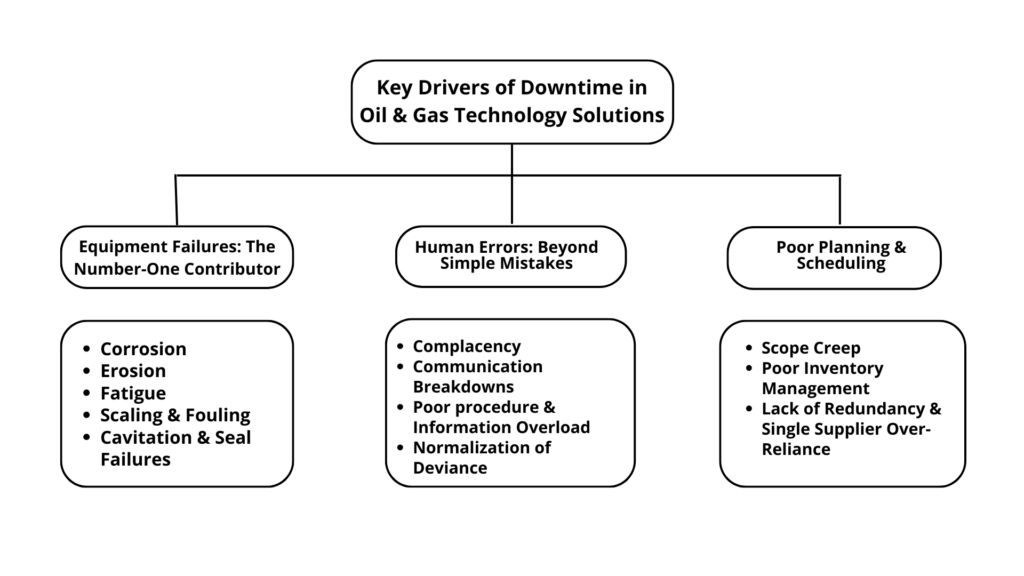
The Key Drivers of Downtime in Oil & Gas Technology Solutions
1. Equipment Failures: The Number-One Contributor
Equipment breakdown is one of the significant sources of unplanned downtime. Several reasons are involved, including:
- Corrosion: Sour crude (high sulfur) pipelines deteriorate over time by electrochemical action, especially at welds, bends, and dead legs.
- Erosion: Sand-and-similar-abrasive-content high-speed fluids in fracking erosion erode pump impellers, chokes, and pipes.
- Fatigue: Alternating pressure changes and vibration fatigue cause pipes to be damaged, usually at stress concentrators and threaded joints.
- Scaling & Fouling: Mineral (such as calcium carbonate) and organic depositing in heat exchangers and pipes diminishes flow efficiency and causes shutdowns.
- Cavitation & Seal Failures: Shock waves from collapsing vapor bubbles form when sudden pressure drops create vapor bubbles, which wear out the seals and pump impellers.
2. Human Errors: Beyond Simple Mistakes
Human error accounts for most of the oil and gas downtime due to the following:
- Complacency: Routine work causes operators to overlook warning signs.
- Communication Breakdowns: Communication breakdowns between operations, maintenance, and engineering personnel can delay problem-solving.
- Poor Procedures & Information Overload: Inadequate procedures and excessive information overload can lead to misestimation.
- Normalization of Deviance: Repeatedly exceeding operating limits by a small margin can lead to failures of catastrophic magnitude.
3. Poor Planning & Scheduling
Maintenance schedules and turnarounds, if not planned well, can cause downtime due to:
- Scope Creep: Unplanned expansion of maintenance work that causes delay.
- Poor Inventory Management: No spares available, resulting in prolonged downtime.
- Lack of Redundancy & Single Supplier Over-Reliance: Supply chain interruption can bring operations to a standstill.
With these major challenges in mind, the next logical step is understanding how Digital Oilfields tackle them.
How Digital Oilfields Minimize Downtime?
1. Real-Time Monitoring with Industrial IoT in Oil & Gas
The newest IoT sensors bring critical information about equipment conditions so that proactive maintenance practices can be exercised. Some of those are:
- Vibration Sensors: Picks up pump and compressor misalignments and bearing wear.
- Acoustic Sensors: Picks up pipeline and pressure system leaks by detecting ultrasonic noises.
- Corrosion Probes: Quantifies corrosion type, rate, and causative factors for effective mitigation.
- Multiphase Flow Meters: Offers precise measurement of oil, gas, and water flow rates to prevent slugging and optimize production.
2. Predictive Maintenance in Oil & Gas: AI-Driven Insights
Artificial Intelligence (AI) and as well as Machine Learning (ML) based predictive analytics allow companies to predict failures before their occurrence. Some of the key applications are:
- Failure Prediction Models: AI models consider historical failure records to predict the future failure of equipment.
- Remaining Useful Life (RUL) Estimation: Machine learning estimates the time before a component fails, allowing for proper maintenance planning.
- Anomaly Detection: Detects deviations in normal operating conditions, indicating future problems.
- Prescriptive Analytics: Provides accurate recommendations for proactive actions to optimize equipment life.
3. Automation & Remote Operations: Reduction of Human Error
- Automated Control Systems: Allows operating conditions (e.g., temperature, flow rates, pressures) to be managed with real-time feedback.
- Robotic Inspections: Robotic scanning of pipes and offshore rigs reduces human exposure to hazardous conditions.
- Remote Monitoring & Control Centers: Operators remotely manage Assets from centralized facilities for enhanced productivity and savings.
4. Digital Twins: Virtual Copies to Optimize
Digital Twins are virtual copies of physical assets using AI to imitate real-time operations which include:
- Real-Time Data Sync: Synchronizes with real-time sensor inputs in real-time.
- Scenario Planning & Training: Mimics several operating scenarios to predict simulation and train operators.
5. Advanced Digital Oilfield Technologies
- Tank & LPG Level Monitors: Detect leaks and temperature stratification and predict evaporation/condensation rates.
- Smart Flow Meters: Recognize multiphase flows and detect anomalies.
- Thief Hatch Sensors: Recognize intrusions and monitor gas emissions.
Conclusion
The oil and gas industry is an area of convergence where industrial IoT, predictive maintenance, and automation are no longer a necessity. As digital oilfields offer more than digitization, they represent a shifting paradigm that decreases downtime, enhances safety, and delivers improved profitability.
Therefore, businesses with digital oilfields can leverage the real potential of oil and gas technology solutions by using analytics, real-time monitoring, and AI-driven automation.
With this technology, businesses can hence achieve operational excellence and success in the long run. SCS Tech supports oil and gas companies with cutting-edge digital solutions to re-imagine their businesses to be efficient, resilient, and industry-fit for the future.