Tag: #blockchain

  • Blockchain Applications in Supply Chain Transparency with IT Consultancy

    Blockchain Applications in Supply Chain Transparency with IT Consultancy

    The majority of supply chains use siloed infrastructures, unverifiable paper records, and multi-party coordination to keep things moving operationally. But as regulatory requirements become more stringent and source traceability is no longer optional, such traditional infrastructure is not enough without the right IT consultancy support.

    Blockchain fills this void by creating a common, tamper-evident layer of data that crosses suppliers, logistics providers, and regulatory authorities, yet does not replace current systems.

    This piece examines how blockchain technology is being used in actual supply chain settings to enhance transparency where traditional systems lack.

    Why Transparency in Supply Chains Is Now a Business Imperative

    Governments are making it mandatory. Investors are requiring it. And operational risks are putting into the spotlight firms that lack it. A digital transformation consultant can help organizations navigate these pressures, as supply chain transparency has shifted from a long-term aspiration to an instant priority.

    Here’s what’s pushing the change:

    • Regulations worldwide are getting stricter quickly. The Corporate Sustainability Due Diligence Directive (CSDDD) from the European Union will require large companies to monitor and report on. Environmental and Human Rights harm within their supply chains. If a company is found to be in contravention of the legislation, the fine could be up to 5% of global turnover.
    • Uncertainty about supply chains carries significant financial and reputational exposure.
    • Today’s consumers want assurance. Consumers increasingly want proof of sourcing, whether it be “organic,” “conflict-free,” or “fair trade.” Greenwashing or broad assurances will no longer suffice.

    Blockchain’s Role in Transparency of Supply Chains
    Blockchain is designed to address a key weakness of modern supply chains, however. The reality of fragmented systems, vendors, and borders is a lack of end-to-end visibility. 

    Here’s how it delivers that transparency in practice:

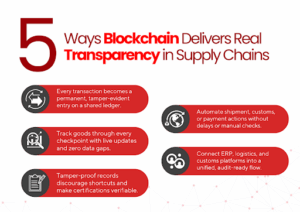
    1. Immutable Records at Every Step

    Each transaction, whether it’s raw material sourcing, shipping, or quality checks is logged as a permanent, timestamped entry.

    No overwriting. No backdating. No selective visibility. Every party sees a shared version of the truth.

    2. Real-Time Traceability

    Blockchain lets you track goods as they move through each checkpoint, automatically updating status, location, and condition. This prevents data gaps between systems and reduces time spent chasing updates from vendors.

    3. Supplier Accountability

    When records are tamper-proof and accessible, suppliers are less likely to cut corners.

    It’s no longer enough to claim ethical sourcing; blockchain makes it verifiable, down to the certificate or batch.

    4. Smart Contracts for Rule Enforcement

    Smart contracts automate enforcement:

    • Was the shipment delivered on time?
    • Did all customs documents clear?

    If not, actions can trigger instantly, with no manual approvals or bottlenecks.

    5. Interoperability Across Systems

    Blockchain doesn’t replace your ERP or logistics software. Instead, it bridges them, connecting siloed systems into a single, auditable record that flows across the supply chain.

    From tracking perishable foods to verifying diamond origins, blockchain has already proven its role in cleaning up opaque supply chains with results that traditional systems couldn’t match.

    Real-World Applications of Blockchain in Supply Chain Tracking

    Blockchain’s value in supply chains is being applied in industries where source verification, process integrity, and document traceability are non-negotiable. Below are real examples where blockchain has improved visibility at specific supply chain points.

    1. Food Traceability — Walmart & IBM Food Trust

    Challenge: Tracing food origins during safety recalls used to take Walmart 6–7 days, leaving a high contamination risk.

    Application: By using IBM’s blockchain platform, Walmart reduced trace time to 2.2 seconds.

    Outcome: This gives its food safety team near-instant visibility into the supply path, lot number, supplier, location, and temperature history, allowing faster recalls with less waste.

    2. Ethical Sourcing — De Beers with Tracr

    Challenge: Tracing diamonds back to ensure they are conflict-free has long relied on easily forged paper documents.

    Application: De Beers applied Tracr, a blockchain network that follows each diamond’s journey from mine to consumer.

    Outcome: Over 1.5 million diamonds are now digitally certified, with independently authenticated information for extraction, processing, and sale. This eliminates reliance on unverifiable supplier assurances.

    3. Logistics Documentation — Maersk’s TradeLens

    Challenge: Ocean freight involves multiple handoffs, ports, customs, and shippers, each using siloed paper-based documents, leading to fraud and delays.

    Application: Maersk and IBM launched TradeLens, a blockchain platform connecting over 150 participants, including customs authorities and ports.

    Outcome: Shipping paperwork is now in alignment among stakeholders near real-time, reducing delays and administrative charges in world trade.

    All of these uses revolve around a specific point of supply chain breakdown, whether that’s trace time, trust in supplier data, or document synchronisation. Blockchain does not solve supply chains in general. It solves traceability when systems, as they exist, do not.

    Business Benefits of Using Blockchain for Supply Chain Visibility

    For teams responsible for procurement, logistics, compliance, and supplier management, blockchain doesn’t just offer transparency; it simplifies decision-making and reduces operational friction.

    Here’s how:

    • Speedier vendor verification: Bringing on a new supplier no longer requires weeks of documentation review. With blockchain, you have access to pre-validated certifications, transaction history, and sourcing paths, already logged and transferred.
    • Live tracking in all tiers: No more waiting for updates from suppliers. You can follow product movement and status changes in real-time, from raw material to end delivery through every tier in your supply chain.
    • Less paper documentation: Smart contracts eliminate unnecessary paper documentation on shipment, customs clearance, and vendor pay. Less time reconciling data between systems, fewer errors, and no conflicts.
    • Better readiness for audits: When an audit comes or a regulation changes, you are not panicking. Your sourcing and shipping information is already time-stamped and locked in place, ready to be reviewed without cleanup.
    • Lower dispute rates with suppliers: Blockchain prevents “who said what” situations. When every shipment, quality check, and approval is on-chain, accountability is the default.
    • More consumer-facing claims: If sustainability is the core of your business, ethical sourcing, or authenticity of products, blockchain allows you to validate it. Instead of saying it, you show the data to support it.

    Conclusion 

    Blockchain evolved from a buzzword to an underlying force for supply chain transparency. And yet to introduce it into actual production systems, where vendors, ports, and regulators still have disconnected workflows, is not a plug-and-play endeavor—this is where expert IT consultancy becomes essential.

    That’s where SCS Tech comes in.

    We support forward-thinking teams, SaaS providers, and integrators with custom-built blockchain modules that slot into existing logistics stacks, from traceability tools to permissioned ledgers that align with your partners’ tech environments.

    FAQs 

    1. If blockchain data is public, how do companies protect sensitive supply chain details?

    Most supply chain platforms use permissioned blockchains, where only authorized participants can access specific data layers. You control what’s visible to whom, while the integrity of the full ledger stays intact.

    2. Can blockchain integrate with existing ERP or logistics software?

    Yes. Blockchain doesn’t replace your systems; it connects them. Through APIs or middleware, it links ERP, WMS, or customs tools so they share verified records without duplicating infrastructure.

    3. Is blockchain only useful for high-value or global supply chains?

    Not at all. Even regional or mid-scale supply chains benefit, especially where supplier verification, product authentication, or audit readiness are essential. Blockchain works best where transparency gaps exist, not just where scale is massive.

  • What Role Does Blockchain Play in Streamlining Identity Verification for eGovernance Solutions?

    What Role Does Blockchain Play in Streamlining Identity Verification for eGovernance Solutions?

    What if identity verification didn’t mean endless waits, repeated paperwork, and constant data theft risks? These problems are the setbacks of outdated systems, slowing down public services and putting sensitive information at risk. Blockchain solves these issues by streamlining identity verification in eGovernance solutions. It reduces paperwork, speeds up validation, and ensures transparency and security in the process used by governments to verify citizens.

    Blockchain provides a real-time auditable record because of its unique, decentralized, and tamperproof architecture. By this, blockchains ensure clarity between citizens as well as governmental institutions.

    But how exactly does blockchain revolutionize identity verification in eGovernance? In this blog we will first look into its impact before taking a more detailed look at the key flaws of traditional identity systems and why an upgrade is long overdue.

    The Problems of Traditional Identity Verification in eGovernance

    1. Centralized Databases Are Easy Prey for Cyberattacks

    Most government identity verification systems rely on central databases, representing an attractive target for attackers. The recent OPM hack in the U.S. demonstrated this risk. Once hacked, sensitive citizen data is instantly available on the dark web.

    1. Data Silos and Repetitive Verification Processes

    Government agencies are not interlinked; each agency maintains a separate database of identities. This has created the need for citizens to continuously furnish the same information for services like health, social security, and driving licenses.

    1. Lack of Transparency and Trust

    Citizens do not know where and how their identity data is stored and accessed. An auditable system cannot be available; identity misuse and unauthorized access become widespread. The lack of public trust in the eGovernance solution prevails.

    1. High Costs and Inefficiencies

    Complex identity verification systems, fraud fighting and manual checking of documents impose a burden on government resources. Inefficiencies in service delivery and increased operational costs result.

    What Role Does Blockchain Play in Streamlining Identity Verification for eGovernance Solutions?

    Blockchain redefines the entire landscape of verification through identities. Let’s break it down as to how it solves the above issues:

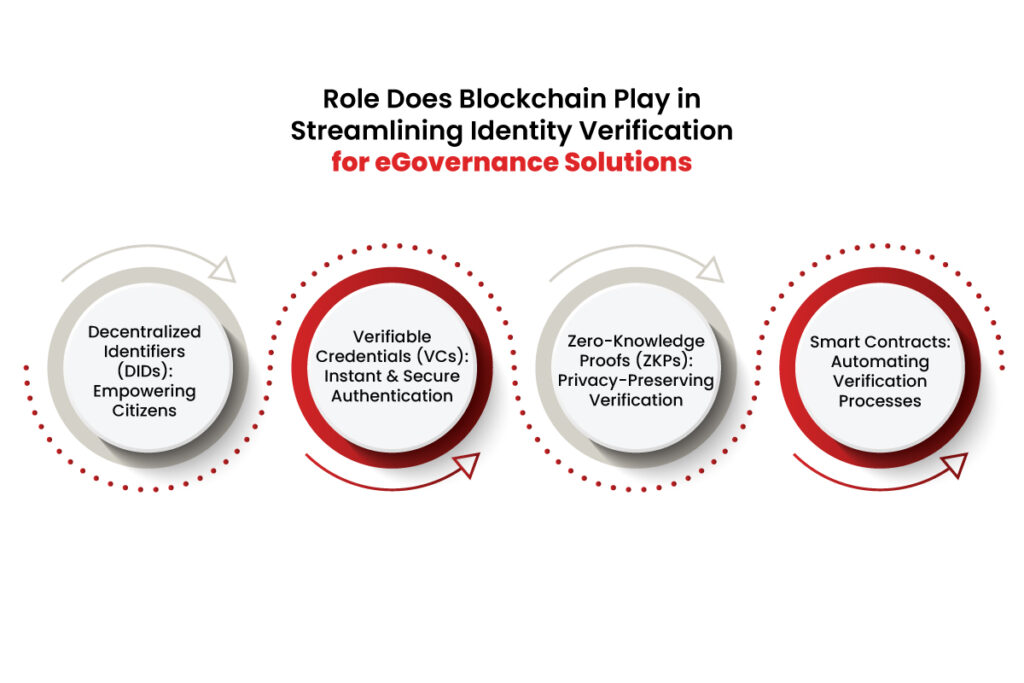
    • Decentralized Identifiers (DIDs): Empowering Citizens

    DIDs allow people to be in control of their digital identity. Instead of government-issued IDs stored in centralized databases, users store their credentials on a blockchain. Citizens selectively disclose only the necessary information, which enhances privacy.

    • Verifiable Credentials (VCs): Instant and Secure Authentication

    VCs are cryptographically signed digital documents demonstrating identity attributes like age, citizenship, or educational qualifications. Governments can issue VCs to citizens and use them to access public services without excessive disclosure of personal data.

    • Zero-Knowledge Proofs (ZKPs): Privacy-Preserving Verification

    With ZKPs, a person may prove identity and conceal all details. For instance, one citizen can prove they are above 18 years old without revealing their birth date. This minimizes the data exposure and theft of one’s identity.

    • Smart Contracts: Automating Verification Processes

    Smart contracts enforce pre-defined verification rules without any human intervention. For example, a smart contract can immediately approve or reject citizen’s applications for government benefits based on the eligibility criteria by checking the VC.

    Role of Blockchain in Streamlining Identity Verification for eGovernance Solutions

    Real-Time eGovernance Blockchain Solutions

    1. Safe Digital Voting

    Blockchain ensures secure voting and increases the integrity of elections. Citizens get registered with a DID, receive a VC from an electoral commission, and vote anonymously on a tamper-proof ledger. ZKPs verify whether a voter is eligible to vote without disclosing their identity.

    1. Digital Identity Wallet for Social Welfare Programs

    Governments can provide VCs that prove their entitlement to welfare schemes. These are kept in digital purses, and the citizen will withdraw his benefit without requiring documents each time.

    1. Cross-Border Identity Verification

    The immigrants possess blockchain-verified credentials for identity, educational qualifications, and work experience. Immigration departments use smart contracts that authenticate credentials to help avoid tedious delays and paperwork over the authenticity of the same.

    Solution of Blockchain’s Issues in eGovernance

    Even though blockchain comes with many advantages, its significant concerns that need to be addressed are scalability, interoperability, and governance. Here’s how they are being addressed:

    1. Scalability Solutions

    Rollups and sidechains are some of the layer-2 scaling solutions that make it possible to achieve high transaction throughput and reduce congestion on the blockchain to increase efficiency.

    1. Interoperability Across Platforms

    Cross-chain bridges and atomic swaps protocols facilitate identity verification across multiple blockchain networks and jurisdictions to be integrated with existing eGovernance frameworks seamlessly.

    1. Privacy and Compliance

    Homomorphic encryption and secure multi-party computation further enhance data privacy while maintaining compliance with GDPR. The governance framework should be well-defined by governments to govern blockchain-based identity systems.

    1. Quantum-Resistant Cryptography

    With the evolution of quantum computing, blockchain networks have been moving towards quantum-resistant cryptographic algorithms for long-term security.

    Future of Blockchain Identity in eGovernance

    The adoption of blockchain for identity verification is just beginning. Future advancements will include:

    • Self-Sovereign Identity (SSI): Citizens will fully own and control their digital identities without intermediaries.
    • AI-Powered Identity Verification: AI will detect fraud, improve security, and enhance user experience.
    • Decentralized Autonomous Organizations (DAOs): It is the management of digital identities in a transparent, autonomous manner and decentralized one.
    • Metaverse Identities: Blockchain can facilitate secure identities maintained virtually in virtual worlds and digital transactions.

    Conclusion

    Blockchain for identity verification is revolutionizing eGovernance solutions. It eliminates centralized vulnerabilities, reduces verification costs, and enhances trust in blockchain-based identity solutions, opening avenues for efficient, transparent, and secure public services.

    The future digital identity will be decentralized, user-centric, and fraud-resistant for governments and institutions embracing this technology.

    SCS Tech is committed to create this future to help businesses and governments navigate this ever-changing digital landscape. Blockchain identity solutions aren’t just the future—they are the present.

  • Why Are Governments Using Blockchain in eGovernance Solutions for Land Records?

    Why Are Governments Using Blockchain in eGovernance Solutions for Land Records?

    What if you couldn’t prove the land you live on is actually yours? Sounds scary, right? That’s the reality for many people due to outdated land records. In India, only 69% of land has been mapped digitally under the Digital Land Record Management Program, leaving large gaps. This highlights the urgent need for a system in eGovernance solutions that is secure, transparent, and tamper-proof.

    This is where blockchain comes in. Its unparalleled ability to serve transparency, security, and efficiency puts it at the core of modern eGovernance solutions for land records. In this blog, let’s understand why blockchain is changing the face of this significant aspect of governance. But before let’s dive into the challenges that we faced due to traditional land record systems.

    Challenges in Traditional Land Record Systems

    The present system regarding the management of land records has significant flaws. Let’s take a closer look at them:

    Vulnerability to Fraud

    Traditional systems have fake documents, duplicate registrations, and unauthorized changes. Such issues bring legal disputes and make property transactions risky. Think of buying a property only to discover it had already been sold to another person based on forged papers. Blockchain can remove such risks because records are tamper-proof.

    Lack of Transparency

    Traditional systems often store records in centralized databases. Accessing these records is a bureaucratic maze, leading to confusion and mistrust. Blockchain’s open ledgers make records visible to all stakeholders, reducing disputes.

    Inefficiency and Bureaucracy

    Traditional processes are slow and costly, from waiting in long queues to paying multiple intermediaries. This inefficiency discourages investment and delays transactions. By streamlining processes, blockchain makes land transactions faster and more affordable.

    Data Integrity Issues

    Centralized systems are prone to natural disasters, cyberattacks, or human error. Blockchain’s decentralized nature ensures that data remains secure and accessible, no matter what.

    Why Are Governments Using Blockchain in eGovernance Solutions for Land Records?

    Governments are increasingly adopting blockchain technology to improve eGovernance solutions, particularly in managing land records. This transition is motivated by several critical factors:

    1. Immutable Ledger

    A significant need is reliable, tamper-proof records of land. More often, traditional systems are prone to fraud, such as forgery and unauthorized amendments. This kind of ledger ensures that records entered cannot be deleted or modified without consensus, thus increasing trust in the integrity of ownership documentation over land.

    Blockchain technology has a decentralized ledger where all the transactions concerning land ownership are permanently recorded. Each transaction is enclosed in a block that connects subsequent blocks, thus offering security regarding the chain of custody. This structure ensures that any kind of attempt to alter the record would require all the following blocks to be changed, making such attempts impracticable.

    2. Increased Transparency

    Transparency is essential in developing trust among all stakeholders involved in real estate transactions. Centralized databases can hide information, leading to confusion and disputes about property ownership in traditional systems. Governments can minimize misunderstandings and increase public confidence by providing transparent access to land records.


    Blockchain enables all parties involved, such as government agencies, property owners, and potential buyers, to access the same information about land ownership and transaction history in a shared ledger. Real-time access means all parties have up-to-date data, allowing them to verify ownership claims without intermediaries independently.

    3. Enhanced Security

    This is because land record management involves very sensitive information on property ownership, and therefore, security is a significant concern. With traditional systems, unauthorized access and data breaches can compromise the integrity of the land records.

    Blockchain allows all stakeholders including government agencies, property owners as well as potential buyers to view an agreed-to version of truth regarding land ownership and transactional history in a shared ledger. Real-time access will provide immediate data for all parties, and that’s how they will authenticate claims of ownership independently, without anyone’s interference.

    4. Simplified Process via Smart Contract

    The bureaucratic nature of traditional land registration processes often results in delays and increased costs for property transactions. Reducing reliance on intermediaries can expedite these processes and lower administrative burdens on government agencies.

    Smart contracts are self-executing contracts with all of the terms written directly into code. They automate many aspects of land transactions. For instance, they can automatically verify ownership during sales or transfers, eliminating the need for notaries or registrars. This automation accelerates transactions and improves operational efficiency within government agencies responsible for land registration.

    5. Decentralization

    Centralized control over land records poses risks such as data loss or manipulation due to individual malfeasance or systemic failures. Decentralization mitigates these risks by distributing data across multiple nodes.

    Blockchain runs on a decentralized network, storing data in multiple nodes instead of in a central database kept by a single entity. It minimizes the probability of losing or altering data and increases resistance against cyberattacks so that land records do not become inaccessible if some nodes go offline.

    Landmark Initiative for Land Records Modernization in Bihar

    The Bihar government is undertaking its first-ever state-wide land survey to modernize records. The project was launched in August 2023 and aimed at modifying the ownership records of around 44,000 villages by making them more transparent and reduced in terms of dispute.

    The exercise has been divided into two phases, one to be carried out on around 5,000 villages and the remaining in the next phase. However, due to complexities such as untransferred ownership and incomplete mutation processes, the deadline has been extended to July 2026. Landowners now have until March 2025 to submit claims online through a simplified self-declaration process.

    This initiative also includes plans for urban land surveys, with a pilot project proposed for six urban local bodies. Digitizing land records is the goal of the Bihar government in streamlining governance, making land ownership more transparent, and empowering citizens.

    These efforts are part of a broader vision of ensuring efficient land administration and reducing the potential conflicts that arise from ambiguous records. Once completed, this project is expected to transform land governance in the state, fostering trust and accountability among citizens while enabling smoother economic and legal transactions involving land.

    Conclusion

    In essence, blockchain in eGovernance solutions enhances transparency, security, and efficiency in transactions about the properties. Most significantly, the main challenges posed by traditional systems- fraud, inefficiency, and mistrust-could now be addressed and placed within a more substantial framework that enables better land administration.

    For successful adoption, governments must establish regulatory frameworks that validate blockchain records as official property documentation, ensure compatibility with existing systems, and promote public awareness of its advantages. Companies like SCS Tech are enabling these advancements by offering tailored blockchain solutions. By implementing blockchain effectively, governments can create more trustworthy governance structures, protect citizens’ property rights, and transform land record management into a secure and transparent process.

  • How Do Blockchain-Powered eGovernance Solutions Improve Public Service Delivery?

    How Do Blockchain-Powered eGovernance Solutions Improve Public Service Delivery?

    Do you hope for governments to be able to deliver faster, more transparent, and more efficient services in this digital world? Blockchain-powered eGovernance solutions are likely to help with this and become the foundational technology for 30% of the world’s customer base, from simple, everyday devices to commercial activities, by 2030. It will signal a fundamental shift in how public service delivery takes place and make governance smarter, safer, and more accessible.

    In this blog, we’ll explore how blockchain-powered eGovernance solutions improve public services. These advancements are reshaping how governments serve their citizens, from automating workflows to enhancing transparency.

    1. Decentralization: Building Resilient Systems

    Distributed Systems for Reliable Services

    Traditional systems are primarily based on centralized databases, prone to cyberattacks, downtime, and data breaches. With the power of Distributed Ledger Technology (DLT), blockchain changes this by distributing data across multiple nodes. This decentralization ensures that the system functions seamlessly if one part of the network fails. Governments can enhance service reliability and eliminate the risks associated with single points of failure.

    Faster and More Efficient Processes

    Centralized systems can create a bottleneck because they function off one control point. Blockchain removes the bottleneck because multiple departments can access and share real-time information. For example, processing permits or verifying applications becomes quicker if multiple agencies can update and access the record simultaneously. Such gives citizens less waiting time in government offices and more efficiency in their governments.

    2. Effectiveness Through Smart Contracts

    Automation Made Easy

    Imagine filing a tax return and processing the refund instantly without human intervention. Blockchain makes this possible through smart contracts—self-executing agreements coded to perform actions when certain conditions are met. These contracts automate fund disbursements, application approvals, or service verifications, significantly reducing delays and manual errors.

    Streamlining Government Workflows

    Governments would handle repetitive jobs, such as checking documents or issuing licenses. Through the rule and procedure codification in a smart contract, these jobs are automated, reducing errors and making them consistent. This saves time and allows employees to focus on more important things, increasing productivity and citizen satisfaction.

    3. Transparency: The Basis of Trust

    Open Access to Transactions

    Blockchain records every transaction on a public ledger accessible to all stakeholders. Citizens can see how public funds are allocated, ensuring accountability. For example, in infrastructure projects, blockchain can show how funds are spent at each stage, reducing doubts and fostering trust in government actions.

    Immutable Records for Audits

    This ensures that once recorded, data is immutable, hence unchangeable unless the network has agreed to its alteration. It makes auditing very simple and tamper-proof. The governments will be able to maintain records that are easy to verify but hard to alter, reducing further corruption and assuring ethical administration.

    4. Building Citizen Trust

    Reliable and Transparent Systems

    Blockchain’s design inherently fosters trust. Citizens know their data is secure, and their interactions with government entities are recorded transparently and immutable. For example, once a land ownership record is stored on the blockchain, it cannot be changed without alerting the entire network, ensuring property rights remain secure.

    Empowering Citizens through Accountability

    For example, transparency in the governance process allows citizens to hold officials responsible. If funds allocated to education or health are visible in a blockchain, citizens can check the discrepancies in the ledger and thus strengthen their trust in such public institutions; at the same time, these institutions will forge a collaborative relationship with citizens.

    5. Secure Digital Identities

    Self-Sovereign Identity for Privacy

    Blockchain facilitates self-sovereign identity (SSI). It gives individuals complete control of their personal information. Unlike systems that store secret information in centralized databases, blockchain stores information in blockchains. It puts citizens in the best position to decide who shall access their data and for what purpose. There is a reduced likelihood of identity theft, and personal privacy is amplified.

    Simplification of Accessibility to Services

    Using blockchain-powered eGovernance solutions, citizens will have secure digital IDs that facilitate verification faster. Rather than sending the same set of documents repeatedly for various services from the government, they will use a blockchain-based ID to check their eligibility on the go. This would reduce the access time to public services and enhance the convenience level with data safety.

    6. Cost Saving: A Wise Use of Resources

    Reducing Administrative Costs

    This kind of paper trail and manual procedure costs governments massive amounts. With blockchain, such paper trails do not exist. Records are digitalized, and workflows are automated. For example, property registration or certificate issuing on blockchain automatically reduces administrative overhead.

    Fraud Prevention and Elimination of Mistakes

    Fraudulent actions and human mistakes can be costly for governments. Blockchain’s openness and immutable ledger reduce these risks because it leaves a transparent and tamper-proof history of the transactions. Not only does it save money in investigations, but it also ensures accurate delivery of services with no rework or additional costs incurred.

    7. Improved Data Security

    Encryption for Stronger Safeguards

    Blockchain uses advanced cryptographic techniques to secure data. Each block is linked to the one before it, creating a nearly impossible chain to alter without detection. Sensitive information, such as health records or tax data, is protected from unauthorized access, ensuring citizen data remains secure.

    Defense Against Cyberattacks

    In traditional systems, hackers will always target centralized databases. With blockchain, data is spread across different nodes, meaning that cybercriminals will find it much more challenging to access large volumes of information or manipulate the same. Therefore, public services will remain accessible and trustworthy, even in cyber attacks.

    Conclusion

    It’s not just an upgrade in technology but rather the need for governance in modern society. Blockchain can solve all inefficiencies presented by traditional public administrations by decentralizing systems, automating workflows, facilitating transparent processes, and improving cost efficiency. The improvement in this technology develops citizens’ participation, engenders trust, and makes governance in a fast-to-be-digitized world robust.

    Companies like SCS Tech are leading the way by offering innovative blockchain-powered eGovernance solutions that help governments modernize their systems effectively. As governments worldwide continue exploring blockchain, the positive effects will stretch beyond improving service delivery. They will ensure they have developed transparent, efficient, and secure governance structures, hence meeting the demands of tech-savvy citizens today.

  • Transforming Today’s Business Landscape: The Impact of Blockchain Technology

    Transforming Today’s Business Landscape: The Impact of Blockchain Technology

    In the new digital era, businesses seek essential new technologies for their survival. Digital transformation enables strategic decision-making, streamlining of business processes, and the adoption of new business models through the use of disruptive technologies in the market.

    Blockchain stands out as a pivotal technology driving business evolution. While blockchain has gained significant traction in the market in connection with cryptocurrencies like Bitcoin, there is still confusion surrounding the terminology. Many individuals mistakenly view blockchain as synonymous with Bitcoin and use the terms interchangeably.

    This confusion leads to the misconception that blockchain for business solely revolves around cryptocurrencies. However, blockchain for business is established on a permissioned distributed ledger technology that fosters trust among partners. Operating on a peer-to-peer network, it enhances transaction transparency, data resilience, and security, while reducing operational costs.

    Ways Blockchain Can Enhance the Current Business Model

    Blockchain technology offers numerous benefits to businesses, offering fresh opportunities to transform current business models by cutting costs, reducing intermediary involvement, and fostering greater trust within an ecosystem. Here are ten ways that businesses can incorporate blockchain into their digital transformation efforts.

    • Smart contracts are self-executing contracts stored on a blockchain network, executing terms and conditions automatically. They eliminate the need for intermediaries in legal actions, promoting efficient business operations.
    • Blockchain technology simplifies payment processes by connecting parties on the same platform, allowing direct communication between healthcare facilities and insurance providers. This transparency enhances efficiency by providing immediate access to patient information and payment details, streamlining cash flow for businesses.
    • Blockchain in Supply Chain Management enables SMEs to track products/services from manufacturing to delivery, ensuring transparency, combating counterfeiting, and enhancing security. Example: Walmart uses blockchain to track pork items’ provenance and condition, ensuring transparency in its food supply chain.
    • Blockchain technology enhances hiring by preventing fake documents, saving time in verification, and prompting companies to engage with blockchain development firms for innovative business applications.
    • Blockchain technology enhances marketing campaigns by allowing real-time tracking of client information and behaviour. This empowers marketers to create effective campaigns, increase ROI, and authenticate traffic for better outcomes.
    • Blockchain technology in business offers robust security through decentralization, transparency, and lower cyber-attack risks. It enables digital identity protection and control over information access and usage for users.
    • Blockchain technology in business boosts customer engagement by empowering users, ensuring transparency, enabling quick transactions, and helping identify loyal customers.
    • Blockchain technology offers improved speed and efficiency by automating processes, reducing human errors, and enabling transactions to be completed in seconds.
    • Businesses seek cost-effective solutions and improved processes. Blockchain adoption reduces costs by eliminating third-party vendor expenses, central players, and the need for extensive transaction validation. This makes blockchain crucial for financial management.
    • Blockchain adoption allows businesses to raise capital through Initial Token Offerings (ITOs), where investors can buy tokens representing equity or revenue share. ITOs offer a viable capital-raising alternative for businesses of all sizes.

    The Future of Blockchain in the Business World

    Blockchain introduces a distributed ledger system that enhances the media supply chain and reduces copyright violations by providing security, data analysis, and control. The significance of blockchain is on the rise as various sectors such as healthcare, logistics, manufacturing, and IT are adopting this technology to address and predict real-time challenges.

    Blockchain technology holds immense promise in shaping the future of business. It has the potential to introduce new ideas, integrate existing concepts, and provide a comprehensive understanding of the market landscape. The impact of blockchain on small and large businesses hinges on how effectively we leverage its capabilities in our economic ecosystem.


  • The new era of energy industry empowered by technology

    The new era of energy industry empowered by technology


    Table of Content

    • Introduction
    • Innovation & Changes
    • Technical Empowerment
    • Renewable Resources

    An era of change

    The energy industry is going through a significant technological transition that will push the limits of the traditional energy delivery systems. In place of conventional fossil fuels, the new wave of technology is offering workable solutions that can maximise how much we use natural resources.

    These innovative options offer intelligent and data-driven solutions that encourage the development of smart infrastructure. These solutions include built-in digital intelligence that is changing how energy is produced, distributed, managed, and stored.

    The establishment of a new consumer model known as “Prosumer”—which depicts a situation where customers produce and consume energy while living outside of direct subsidy—came about as a result of consideration over efficient energy usage and consumer habits.

    The innovation that prompted the advent of energy 4.0

    The energy sector adopted rising tech trends including Internet of Things (IoT), Big Data, Blockchain, Machine Learning, Cloud Computing, and the Digital Twin technology without hesitation after realising the power of cutting-edge technology in other industries.

    The ways in which energy and utility businesses conduct business, connect with their customer bases, and engage with them have all being reinvented by the aforementioned technology. Technically speaking, it has greatly improved operation flow, performance optimisation, and the development of smart grids, better managed renewable energy sources, and cogently distributed power. These technological advancements have consequently led to a fresh round of ideas for integrating technology and the systems that enable it into (new) business models and strategies.

    “Simultaneously, hardware manufacturers and software development companies have been gathering experience in creating and integrating business-driven solutions with huge corporate systems, with an emphasis on internal reliability and ecological safety. As of now, with costs decreasing and technologies growing at an exponential pace, digitalization presents opportunities for Energy 4.0 companies to establish new business models and sustainable strategies of producing and delivering energy” – is stated in a research study conducted by MobiDev.

    The technological empowerment within the industry

    The idea of IoT and its capabilities have been extensively debated during the last ten years. The physical environment may be integrated with computer systems thanks to this intelligent “network of physical devices” that includes sensors, electronics, actuators, and connection resources.

    Energy 4.0 is the adoption of technologies like big data, artificial intelligence, and machine learning to take advantage of sensor data, automation, and machine-to-machine (M2M) communication to enhance operational performance. The industry is well on its way to transforming its operations into a global network of linked, standalone devices that are all delivering digital data to a platform that can gather, process, and share it in real time.

    Transparency within a platform that executes and records transactions is one of a ledger technology’s most potent advantages. Given how frequently assets change hands before a settlement is made, it is also useful for tracking ownership. As all parties are using the same platform, blockchain technology enables transactions like energy trading to be recorded and settled at the minute, without the need for an intermediary and with little to no requirement for reconciliation.

    The use of digital twins is expanding quickly and is becoming increasingly popular as an innovation trend. A digital twin is a depiction of a real-world thing or process that mimics it digitally without really replacing it. The digital twin allows for real-time KPI monitoring by utilising the data collected by an IoT system connected to its physical twin.

    Future energy will be renewable

    We are well on our way to a future where social innovation will integrate renewables into smart grids and produce clean and dependable energy sources, made possible by the digital transformation of the energy sector.

    Consumers are increasingly favouring renewable energy sources, which encourages the energy business to invest in more environmentally friendly technology. Greater opportunities are presented by digital innovation for businesses, consumers, and society as a whole since it motivates them to engage in environmentally friendly energy solutions that lower prices and give them more control over their energy use.


  • An introduction to Blockchain Technology and its potential uses

    An introduction to Blockchain Technology and its potential uses

    Even while blockchain technology is still in its nascent stages today, it is finding increasing use in important industries outside of the realm of digital currencies. Through the upkeep of immutable distributed ledgers in thousands of nodes, blockchain is the primary technology utilised to produce the digital currency, Bitcoin. The 21st century will see a huge impact from this disruptive technology on institutional operations, company operations, education, and our daily lives.  It has the power to alter the current Internet from “The Internet of Information Sharing” to “The Internet of Value Exchange.”

    Blockchain technology is anticipated to fundamentally alter how business, industry, and education operate while also accelerating the worldwide transition to a knowledge-based economy. This ground-breaking technology has numerous potential uses because of its immutability, transparency, and integrity for all transactions carried out in a blockchain network.

    The following structure illustrates a sample blockchain transaction flow. A peer-to-peer blockchain network is used by User A to start a transaction with User B. The network uses a cryptographic proof of identification (a set of public and private keys) to specifically identify users A and B. The transaction will then be published to the blockchain network’s memory pool while awaiting transaction validation and verification. Reaching consensus is the process of getting a predetermined number of approved nodes to create a new block. Following a consensus, a brand-new “block” is created across the entire blockchain network, and each node updates its individual copy of the blockchain ledger. All of the transactions that took place during this time are contained in this block.

    Advantages of blockchain technology

    Reliability: because blockchain networks are decentralised, the databases of all transaction records have changed from being closed, centralised ledgers maintained by a small number of recognised institutions to being open, distributed ledgers maintained by tens of thousands of nodes.

    Trust: blockchain network also decentralises trust. With organised ledgers, blockchain networks serve as new trust bearers. A group of tamper-proof nodes form a network that shares these ledgers.

    Security: the one-way hash function, a mathematical operation that transforms a variable-length input text into a fixed-length binary sequence, is used by the blockchain network. There is no obvious connection between the input and the output.

    Efficiency: every piece of data is automatically put through pre-defined processes. Blockchain technology can therefore both dramatically lower labour costs and increase productivity. Blockchain technology may hasten the clearing and settlement of some financial transactions, resulting in a quicker and more effective reconciliation procedure.

    Applications using blockchain technology

    • Blockchain offers a number of advantages in the financial and banking sectors in terms of improved record-keeping, security, and transparency. It makes it the ideal option for banking needs like fraud protection, client onboarding, and anti-money laundering.
    • By 2025, the worldwide blockchain market for healthcare is expected to reach $5.61 billion. Using blockchain technology could help resolve expensive and urgent issues in the healthcare sector. Such as inconsistent records, patient data loss or theft, banking information, and test results.
    • Blockchain can be a great solution for the insurance industry and aid in the reduction of underwriting, the identification of fraud, and the enhancement of cyber insurance plans. By 2023, the global insurance blockchain industry might reach $1.39 billion.
    • Businesses that spend a lot of money protecting themselves against breaches are also concerned about cyber security, not only SMEs. Blockchain system nodes automatically compare the data and warn any information that is falsified.
    • Blockchain technology is being used in education by some colleges and institutions, and the majority of them do so to support academic degree management and assumptive evaluation for learning outcomes.
    • Supply chain management can be challenging and involves a lot of data. Data storage using blockchain-based systems would guarantee quick access and strong security because altering the data would be impossible without reporting it as a result.
  • A complete guide on Cloud Computing

    A complete guide on Cloud Computing

    One of the technologies influencing how we work and play is cloud computing. The cloud helps businesses eliminate IT problems and promotes security, productivity, and efficiency. It also enables small enterprises to utilize cutting-edge computing technologies at a significantly lesser cost. Here is what you need to know about the cloud and how it can benefit your company.

    On-Demand Computing

    The term “cloud” describes online-accessible servers and software that anyone can use. You are spared from hosting and managing your hardware and software as a result. Additionally, it implies that you can use these systems from any location where you have internet access.

    Every day, you encounter cloud computing. You are accessing data that is kept on a server somewhere in the world whenever you check your Gmail inbox, look at a photo on your Dropbox account, or watch your favorite shows on Netflix. Even though the emails, videos, or other files you require are not physically present on your computer, you may quickly, simply, and affordably access them owing to contemporary cloud computing technology.

    Public, Private, and Hybrid Cloud

    Private, public, and hybrid deployment strategies are the three main types of cloud computing. In the end, all three models will give customers access to their business-critical documents and software from any location, at any time. It all depends on how they approach the task. The kind of cloud you should use for your company depends on several variables, including the purposes for which you intend to use it, applicable laws on data storage and transmission, and other aspects.

    Private Cloud

    A single entity is served via private clouds. While some companies construct and manage their ecosystems, others rely on service providers to do so. In either case, private clouds are expensive and hostile to the cloud’s advantages for the economy and IT labor productivity. Private clouds, however, are their sole choice because certain organizations are subject to greater data privacy and regulatory constraints than others.

    Public Cloud

    Distributed across the open internet, public clouds are hosted by cloud service providers. Customers can avoid having to buy, operate, and maintain their own IT infrastructure by using the most widely used and least-priced public clouds.

    Hybrid Cloud

    A hybrid cloud combines one or more public clouds with private clouds. Imagine you operate in a sector where data privacy laws are extremely rigorous. While you don’t want to host legally required data in the cloud, you do want to be able to access it there. To access data saved in your private cloud, you also want to deploy your CRM in the cloud. Using a hybrid cloud is the most sensible choice under these circumstances.

    Everything as a Service

    The cloud “stack” is made up of numerous levels. The collection of frameworks, tools and other elements that make up the infrastructure supporting cloud computing is referred to as a stack. Software as a Service (SaaS), Platform as a Service (PaaS), and Infrastructure as a Service (IaaS) components are included in this. Customers that use these services have varied degrees of control and accountability over their cloud environment.


    Infrastructure as a Service

    The customer oversees managing everything with IaaS, including the OS, middle-ware, data, and applications. Other duties, including virtualization, servers, storage, and networking obligations, are handled by the service provider. Customers are charged by how many resources, including CPU cycles, memory, bandwidth, and others, they consume. Microsoft Azure and Amazon Web Services are two examples of IaaS products.

    Platform as a Service

    Customers can create, test, and host their applications using PaaS solutions. The consumer oversees managing their software and data; otherwise, the service provider takes care of everything. You don’t have to be concerned about operating systems, software upgrades, or storage requirements if you use PaaS solutions. Customers of PaaS pay for any computing resources they use. Google App Engine and SAP Cloud are a couple of examples of PaaS technologies.

    Software as a Service

    Customers acquire licenses to utilize an application hosted by the provider under the SaaS model. Customers often buy annual or monthly subscriptions per user instead of how much of a certain computer resource they consumed, unlike IaaS and PaaS models. Microsoft 365, Dropbox, and DocuSign are a few popular SaaS products. Small firms that lack the capital or IT resources to implement the most cutting-edge technologies would benefit greatly from SaaS solutions.

    Benefits of the Cloud

    Reduced IT costs: By using cloud computing services, recurrent costs for monitoring and maintaining an IT infrastructure can be greatly decreased.

    Scalability: When necessary, developers can increase storage and processing capability by using cloud services. Additionally, development teams do not have to spend time or money upgrading cloud computing services.

    Collaboration efficiency: For the agile technology sector, cooperation has always been a need. Professionals from all around the world may work and collaborate using current cloud services. With these functionalities, teams may communicate with clients or other teams online while collaborating in real-time and sharing resources.

    Flexibility: Cloud computing can provide a great deal of flexibility in addition to helping to lower operational costs. Developers and other key stakeholders now have easier access to crucial data metrics at any time and from any location.

    Automatic updates: Teams may use the most recent resources available while managing and meeting IT standards thanks to automatic updates. Cloud computing is a popular technology because it allows users to access the newest tools and resources without having to spend a fortune.


  • Top IT Trends to look out for in 2023

    Top IT Trends to look out for in 2023

    Technology is still one of the main drivers of global change. Technology advancements give businesses more opportunities to increase efficiency and develop new products. Business leaders can make better plans for the future by keeping an eye on the development of new technologies, foreseeing how businesses might use them, and comprehending the factors that influence innovation and adoption. Keep reading to know about the new tech innovation and trends which will become a critical force for change in the world.

    Artificial Intelligence  

    Artificial intelligence has long been the subject of hype. If you are a tech professional, you might not enjoy how pervasive artificial intelligence has become. For both creative and routine activities, AI has already proven its brilliance in navigation apps, cell phones, and more. The buzz surrounding AI won’t go away anytime soon. It will become more accessible because of the expanding ecosystem of as-a-service platforms and low-code or no-code AI systems.

    Synthetic content is a promising area of AI to keep an eye on. It involves using the AI’s imagination to produce brand-new, unprecedented sights, sounds, or data. We can anticipate seeing the development of AI that is useful in both business and entertainment in 2023. Precedence Research predicts that by 2030, the global AI market would be worth $1,597.1 billion. We may anticipate new opportunities in programming, development, testing, and many other sectors as AI becomes more prevalent in a variety of industries.

    Metaverse

    Metaverse can now be classified as “a more digital environment.” Within the next five years, it is anticipated that the experience of immersive online environments and next-level user experiences will develop significantly. The phrase “metaverse” is used to refer to a highly immersive 3D virtual world that is created by combining AR, VR, and MR technologies by developing a virtual environment in which users can engage in social interaction, play games, do commerce, and more. The online experience is enhanced by the metaverse platform.

    The metaverse has the potential to open doors to new artistic, social, and professional opportunities in 2023. In the next five years, the tech giant Facebook plans to add 10,000 new, highly trained jobs for the metaverse. Talented metaverse engineers, marketers, architects, and visionaries will have more opportunities as a result.

    Blockchain

    Blockchain technology has become more and more popular, and many sizable firms are headed in that direction. As a result, there is a huge need for developers in the field of blockchain technology. The network’s decentralization, security, and data privacy are among blockchain’s advantages. Applications for blockchain technology go well beyond digital currency like bitcoin. Blockchain’s worth will significantly rise, reaching $176 billion by 2025 and $3.1 trillion by 2030, as predicted by Gartner. Whether they are little businesses or established corporations, everyone wants a piece of the blockchain industry.

    Quantum Computing

    There is a contemporary competition taking place on a worldwide basis to develop quantum computing. Quantum computing, which uses subatomic particles to develop new ways to process and store data, is expected to make it possible for computers to be a trillion times faster than the fastest regular processors currently available. The concern around quantum computing is that it might make our current encryption methods obsolete.

    Therefore, any country that makes significant investments in the development of quantum computing will have the ability to decrypt the encryption used by other countries, corporations, security systems, and other entities. In 2023, keep an eye on this development as nations including the US, UK, China, and Russia invest heavily in the creation of quantum computing technology.

    Hyper-automation

    Hyper-automation enables the automatic completion of repetitive tasks without manual or human input. It modifies both new and existing gear and processes using robotic process automation (RPA), machine learning, and artificial intelligence (AI). By using digital transformation to improve cost and resource efficiency, a business can prosper in a more competitive world. To succeed in the current market, businesses must increase production, cut costs, and run more effectively. With the aid of hyper-automation services, you can advance.

    Datafication

    The transition of all the physical items in our lives into data-driven digital gadgets is known as datafication. In conclusion, it converts labor-intensive, manual processes into data-driven technologies. Data has been a part of everything for longer than we can remember, from our cell phones to our workplace software, industrial machinery, and AI-powered products.

    As a result, handling our data in a secure and safe manner has become a sought-after skill in our sector. Datafication can turn unprocessed data into knowledge if done correctly. This has already been advantageous to numerous businesses.

    Industry Cloud Platforms

    Businesses can increase the flexibility of their workload management by using industrial cloud platforms. They can expedite adjustments to data analysis, corporate operations, and compliance processes. To enhance adaptability, quicken time to value, and meet the demands of vertical industry sectors, they combine platforms, software, and infrastructure as a service.

    Sustainable Tech

    In the future, we’ll start to see a move toward sustainable technology. We all rely on technology, including computers, cell phones, and tablets, but where are the parts needed to make these devices come from? The public will be more interested in where rare earth materials come from and how we use them. Additionally, we use cloud services like Netflix and Spotify, which continue to operate in big data centers that use a lot of electricity. As consumers demand energy-efficient goods and services supported by more sustainable technologies, efforts to boost supply chain transparency will probably continue in 2023.