Tag: #business

  • 5 Ways Digital Twin Technology is Helping Utility Firms Predict and Prevent Failures

    5 Ways Digital Twin Technology is Helping Utility Firms Predict and Prevent Failures

    Utility companies encounter expensive equipment breakdowns that halt service and compromise safety. The greatest challenge is not repairing breakdowns, it’s predicting when they will occur.

    As part of a broader digital transformation strategy, digital twin tech produces virtual, real-time copies of physical assets, fueled by real-time sensor feeds such as temperature, vibration, and load. This dynamic model replicates asset health in real-time as it evolves.

    Utilities identify early warning signs, model stress conditions, and predict failure horizons with digital twins. Maintenance becomes a proactive intervention in response to real conditions instead of reactive repairs.

    The Digital Twin Technology Role in Failure Prediction 

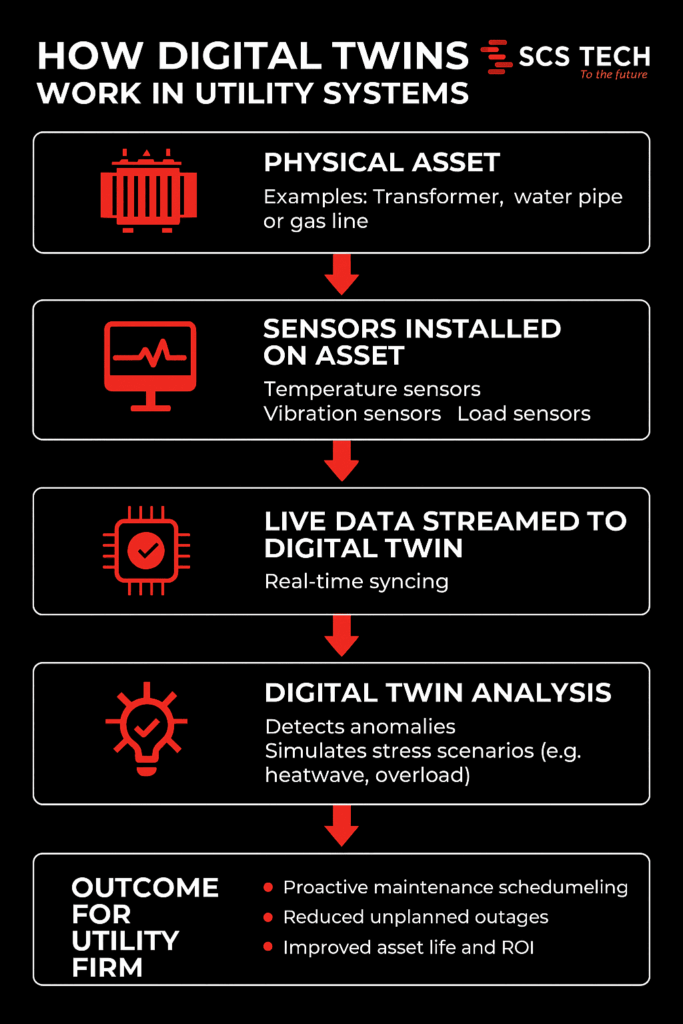
    How Digital Twins work in Utility Systems

    Utility firms run on tight margins for error. A single equipment failure — whether it’s in a substation, water main, or gas line — can trigger costly downtimes, safety risks, and public backlash. The problem isn’t just failure. It’s not knowing when something is about to fail.

    Digital twin technology changes that.

    At its core, a digital twin is a virtual replica of a physical asset or system. But this isn’t just a static model. It’s a dynamic, real-time environment fed by live data from the field.

    • Sensors on physical assets capture metrics like:
      • Temperature
      • Pressure
      • Vibration levels
      • Load fluctuations
    • That data streams into the digital twin, which updates in real time and mirrors the condition of the asset as it evolves.

    This real-time reflection isn’t just about monitoring — it’s about prediction. With enough data history, utility firms can start to:

    • Detect anomalies before alarms go off
    • Simulate how an asset might respond under stress (like heatwaves or load spikes)
    • Forecast the likely time to failure based on wear patterns

    As a result, maintenance shifts from reactive to proactive. You’re no longer waiting for equipment to break or relying on calendar-based checkups. Instead:

    • Assets are serviced based on real-time health
    • Failures are anticipated — and often prevented
    • Resources are allocated based on actual risk, not guesswork

    In high-stakes systems where uptime matters, this shift isn’t just an upgrade — it’s a necessity.

    Ways Digital Twin Technology is Helping Utility Firms Predict and Prevent Failures

    1. Proactive Maintenance Through Real-Time Monitoring

    In a typical utility setup, maintenance is either time-based (like changing oil every 6 months) or event-driven (something breaks, then it gets fixed). Neither approach adapts to how the asset is actually performing.

    Digital twins allow firms to move to condition-based maintenance, using real-time data to catch failure indicators before anything breaks. This shift is a key component of any effective digital transformation strategy that utility firms implement to improve asset management.

    Take this scenario:

    • A substation transformer is fitted with sensors tracking internal oil temperature, moisture levels, and load current.
    • The digital twin uses this live stream to detect subtle trends, like a slow rise in dissolved gas levels, which often points to early insulation breakdown.
    • Based on this insight, engineers know the transformer doesn’t need immediate replacement, but it does need inspection within the next two weeks to prevent cascading failure.

    That level of specificity is what sets digital twins apart from basic SCADA systems.

    Other real-world examples include:

    • Water utilities detecting flow inconsistencies that indicate pipe leakage, before it becomes visible or floods a zone.
    • Wind turbine operators identifying torque fluctuations in gearboxes that predict mechanical fatigue.

    Here’s what this proactive monitoring unlocks:

    • Early detection of failure patterns — long before traditional alarms would trigger.
    • Targeted interventions — send teams to fix assets showing real degradation, not just based on the calendar.
    • Shorter repair windows — because issues are caught earlier and are less severe.
    • Smarter budget use — fewer emergency repairs and lower asset replacement costs.

    This isn’t just monitoring for the sake of data. It’s a way to read the early signals of failure — and act on them before the problem exists in the real world.

    2. Enhanced Vegetation Management and Risk Mitigation

    Vegetation encroachment is a leading cause of power outages and wildfire risks. Traditional inspection methods are often time-consuming and less precise. Digital twins, integrated with LiDAR and AI technologies, offer a more efficient solution. By creating detailed 3D models of utility networks and surrounding vegetation, utilities can predict growth patterns and identify high-risk areas.

    This enables utility firms to:

    • Map the exact proximity of vegetation to assets in real-time
    • Predict growth patterns based on species type, local weather, and terrain
    • Pinpoint high-risk zones before branches become threats or trigger regulatory violations

    Let’s take a real-world example:

    Southern California Edison used Neara’s digital twin platform to overhaul its vegetation management.

    • What used to take months to determine clearance guidance now takes weeks
    • Work execution was completed 50% faster, thanks to precise, data-backed targeting

    Vegetation isn’t going to stop growing. But with a digital twin watching over it, utility firms don’t have to be caught off guard.

    3. Optimized Grid Operations and Load Management

    Balancing supply and demand in real-time is crucial for grid stability. Digital twins facilitate this by simulating various operational scenarios, allowing utilities to optimize energy distribution and manage loads effectively. By analyzing data from smart meters, sensors, and other grid components, potential bottlenecks can be identified and addressed proactively.

    Here’s how it works in practice:

    • Data from smart meters, IoT sensors, and control systems is funnelled into the digital twin.
    • The platform then runs what-if scenarios:
      • What happens if demand spikes in one region?
      • What if a substation goes offline unexpectedly?
      • How do EV charging surges affect residential loads?

    These simulations allow utility firms to:

    • Balance loads dynamically — shifting supply across regions based on actual demand
    • Identify bottlenecks in the grid — before they lead to voltage drops or system trips
    • Test responses to outages or disruptions — without touching the real infrastructure

    One real-world application comes from Siemens, which uses digital twin technology to model substations across its power grid. By creating these virtual replicas, operators can:

    • Detect voltage anomalies or reactive power imbalances quickly
    • Simulate switching operations before pushing them live
    • Reduce fault response time and improve grid reliability overall

    This level of foresight turns grid management from a reactive firefighting role into a strategic, scenario-tested process.

    When energy systems are stretched thin, especially with renewables feeding intermittent loads, a digital twin becomes less of a luxury and more of a grid operator’s control room essential.

    4. Improved Emergency Response and Disaster Preparedness

    When a storm hits, a wildfire spreads, or a substation goes offline unexpectedly, every second counts. Utility firms need more than just a damage report — they need situational awareness and clear action paths.

    Digital twins give operators that clarity, before, during, and after an emergency.

    Unlike traditional models that provide static views, digital twins offer live, geospatially aware environments that evolve in real time based on field inputs. This enables faster, better-coordinated responses across teams.

    Here’s how digital twins strengthen emergency preparedness:

    • Pre-event scenario planning
      • Simulate storm surges, fire paths, or equipment failure to see how the grid will respond
      • Identify weak links in the network (e.g. aging transformers, high-risk lines) and pre-position resources accordingly
    • Real-time situational monitoring
      • Integrate drone feeds, sensor alerts, and field crew updates directly into the twin
      • Track which areas are inaccessible, where outages are expanding, and how restoration efforts are progressing
    • Faster field deployment
      • Dispatch crews with exact asset locations, hazard maps, and work orders tied to real-time conditions
      • Reduce miscommunication and avoid wasted trips during chaotic situations

    For example, during wildfires or hurricanes, digital twins can overlay evacuation zones, line outage maps, and grid stress indicators in one place — helping both operations teams and emergency planners align fast.

    When things go wrong, digital twins don’t just help respond — they help prepare, so the fallout is minimised before it even begins.

    5. Streamlined Regulatory Compliance and Reporting

    For utility firms, compliance isn’t optional, it’s a constant demand. From safety inspections to environmental impact reports, regulators expect accurate documentation, on time, every time. Gathering that data manually is often time-consuming, error-prone, and disconnected across departments.

    Digital twins simplify the entire compliance process by turning operational data into traceable, report-ready insights.

    Here’s what that looks like in practice:

    • Automated data capture
      • Sensors feed real-time operational metrics (e.g., line loads, maintenance history, vegetation clearance) into the digital twin continuously
      • No need to chase logs, cross-check spreadsheets, or manually input field data
    • Built-in audit trails
      • Every change to the system — from a voltage dip to a completed work order — is automatically timestamped and stored
      • Auditors get clear records of what happened, when, and how the utility responded
    • On-demand compliance reports
      • Whether it’s for NERC reliability standards, wildfire mitigation plans, or energy usage disclosures, reports can be generated quickly using accurate, up-to-date data
      • No scrambling before deadlines, no gaps in documentation

    For utilities operating in highly regulated environments — especially those subject to increasing scrutiny over grid safety and climate risk — this level of operational transparency is a game-changer.

    With a digital twin in place, compliance shifts from being a back-office burden to a built-in outcome of how the grid is managed every day.

    Conclusion

    Digital twin technology is revolutionizing the utility sector by enabling predictive maintenance, optimizing operations, enhancing emergency preparedness, and ensuring regulatory compliance. By adopting this technology, utility firms can improve reliability, reduce costs, and better serve their customers in an increasingly complex and demanding environment.

    At SCS Tech, we specialize in delivering comprehensive digital transformation solutions tailored to the unique needs of utility companies. Our expertise in developing and implementing digital twin strategies ensures that your organization stays ahead of the curve, embracing innovation to achieve operational excellence.

    Ready to transform your utility operations with proven digital utility solutions? Contact one of the leading digital transformation companies—SCS Tech—to explore how our tailored digital transformation strategy can help you predict and prevent failures.

  • Why AI/ML Models Are Failing in Business Forecasting—And How to Fix It

    Why AI/ML Models Are Failing in Business Forecasting—And How to Fix It

    You’re planning the next quarter. Your marketing spend is mapped. Hiring discussions are underway. You’re in talks with vendors for inventory.

    Every one of these moves depends on a forecast. Whether it’s revenue, demand, or churn—the numbers you trust are shaping how your business behaves.

    And in many organizations today, those forecasts are being generated—or influenced—by artificial intelligence and machine learning models.

    But here’s the reality most teams uncover too late: 80% of AI-based forecasting projects stall before they deliver meaningful value. The models look sophisticated. They generate charts, confidence intervals, and performance scores. But when tested in the real world—they fall short.

    And when they fail, you’re not just facing technical errors. You’re working with broken assumptions—leading to misaligned budgets, inaccurate demand planning, delayed pivots, and campaigns that miss their moment.

    In this article, we’ll walk you through why most AI/ML forecasting models underdeliver, what mistakes are being made under the hood, and how SCS Tech helps businesses fix this with practical, grounded AI strategies.

    Reasons AI/ML Forecasting Models Fail in Business Environments

    Let’s start where most vendors won’t—with the reasons these models go wrong. It’s not technology. It’s the foundation, the framing, and the way they’re deployed.

    1. Bad Data = Bad Predictions

    Most businesses don’t have AI problems. They have data hygiene problems.

    If your training data is outdated, inconsistent, or missing key variables, no model—no matter how complex—can produce reliable forecasts.

    Look out for these reasons: 

    • Mixing structured and unstructured data without normalization
    • Historical records that are biased, incomplete, or stored in silos
    • Using marketing or sales data that hasn’t been cleaned for seasonality or anomalies

    The result? Your AI isn’t predicting the future. It’s just amplifying your past mistakes.

    2. No Domain Intelligence in the Loop

    A model trained in isolation—without inputs from someone who knows the business context—won’t perform. It might technically be accurate, but operationally useless.

    If your forecast doesn’t consider how regulatory shifts affect your cash flow, or how a supplier issue impacts inventory, it’s just an academic model—not a business tool.

    At SCS Tech, we often inherit models built by external data teams. What’s usually missing? Someone who understands both the business cycle and how AI/ML models work. That bridge is what makes predictions usable.

    3. Overfitting on History, Underreacting to Reality

    Many forecasting engines over-rely on historical data. They assume what happened last year will happen again.

    But real markets are fluid:

    • Consumer behavior shifts post-crisis
    • Policy changes overnight
    • One viral campaign can change your sales trajectory in weeks
    • AI trained only on the past becomes blind to disruption.

    A healthy forecasting model should weigh historical trends alongside real-time indicators—like sales velocity, support tickets, sentiment data, macroeconomic signals, and more.

    4. Black Box Models Break Trust

    If your leadership can’t understand how a forecast was generated, they won’t trust it—no matter how accurate it is.

    Explainability isn’t optional. Especially in finance, operations, or healthcare—where decisions have regulatory or high-cost implications—“the model said so” is not a strategy.

    SCS Tech builds AI/ML services with transparent forecasting logic. You should be able to trace the input factors, know what weighted the prediction, and adjust based on what’s changing in your business.

    5. The Model Works—But No One Uses It

    Even technically sound models can fail because they’re not embedded into the way people work.

    If the forecast lives in a dashboard that no one checks before a pricing decision or reorder call, it’s dead weight.

    True forecasting solutions must:

    • Plug into your systems (CRM, ERP, inventory planning tools)
    • Push recommendations at the right time—not just pull reports
    • Allow for human overrides and inputs—because real-world intuition still matters

    How to Improve AI/ML Forecasting Accuracy in Real Business Conditions

    Let’s shift from diagnosis to solution. Based on our experience building, fixing, and operationalizing AI/ML forecasting for real businesses, here’s what actually works.


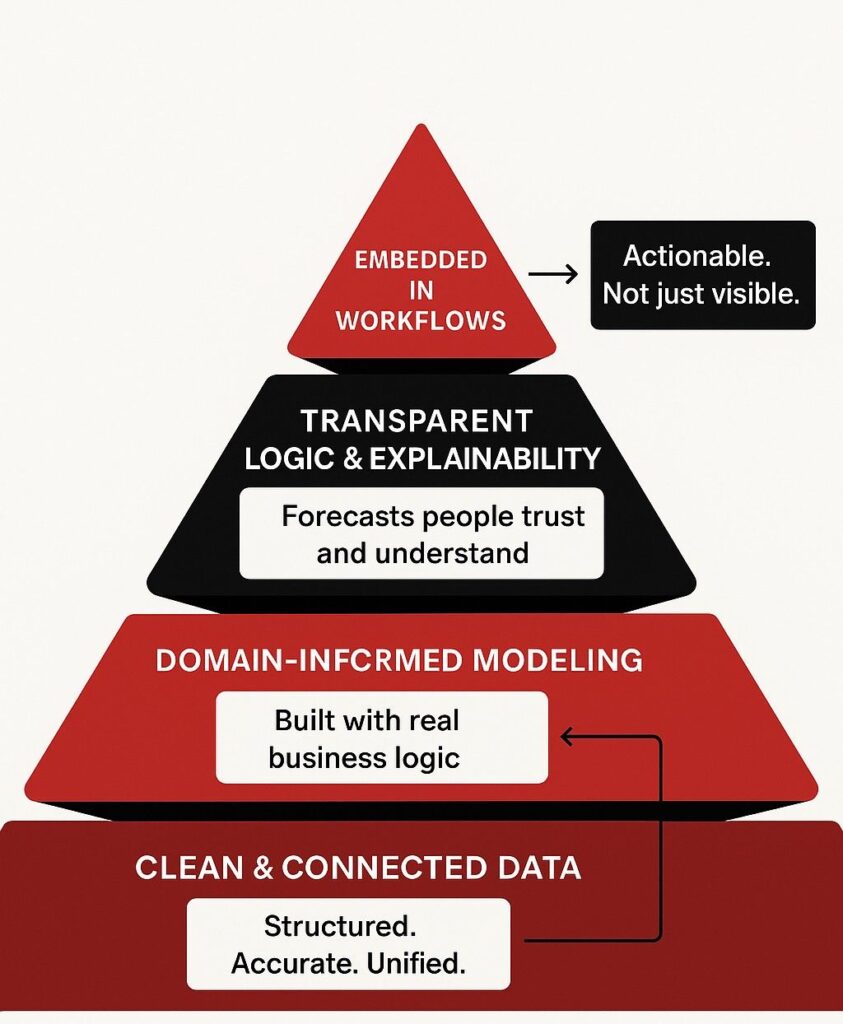
    How to Improve AI/ML Forecasting Accuracy

    Focus on Clean, Connected Data First

    Before training a model, get your data streams in order. Standardize formats. Fill the gaps. Identify the outliers. Merge your CRM, ERP, and demand data.

    You don’t need “big” data. You need usable data.

    Pair Data Science with Business Knowledge

    We’ve seen the difference it makes when forecasting teams work side by side with sales heads, finance leads, and ops managers.

    It’s not about guessing what metrics matter. It’s about modeling what actually drives margin, retention, or burn rate—because the people closest to the numbers shape better logic.

    Mix Real-Time Signals with Historical Trends

    Seasonality is useful—but only when paired with present conditions.

    Good forecasting blends:

    • Historical performance
    • Current customer behavior
    • Supply chain signals
    • Marketing campaign performance
    • External economic triggers

    This is how SCS Tech builds forecasting engines—as dynamic systems, not static reports.

    Design for Interpretability

    It’s not just about accuracy. It’s about trust.

    A business leader should be able to look at a forecast and understand:

    • What changed since last quarter
    • Why the forecast shifted
    • Which levers (price, channel, region) are influencing results

    Transparency builds adoption. And adoption builds ROI.

    Embed the Forecast Into the Flow of Work

    If the prediction doesn’t reach the person making the decision—fast—it’s wasted.

    Forecasts should show up inside:

    • Reordering systems
    • Revenue planning dashboards
    • Marketing spend allocation tools

    Don’t ask users to visit your model. Bring the model to where they make decisions.

    How SCS Tech Builds Reliable, Business-Ready AI/ML Forecasting Solutions

    SCS Tech doesn’t sell AI dashboards. We build decision systems. That means:

    • Clean data pipelines
    • Models trained with domain logic
    • Forecasts that update in real time
    • Interfaces that let your people use them—without guessing

    You don’t need a data science team to make this work. You need a partner who understands your operation—and who’s done this before. That’s us.

    Final Thoughts

    If your forecasts feel disconnected from your actual outcomes, you’re not alone. The truth is, most AI/ML models fail in business contexts because they weren’t built for them in the first place.

    You don’t need more complexity. You need clarity, usability, and integration.

    And if you’re ready to rethink how forecasting actually supports business growth, we’re ready to help. Talk to SCS Tech. Let’s start with one recurring decision in your business. We’ll show you how to turn it from a guess into a prediction you can trust.

    FAQs

    1. Can we use AI/ML forecasting without completely changing our current tools or tech stack?

    Absolutely. We never recommend tearing down what’s already working. Our models are designed to integrate with your existing systems—whether it’s ERP, CRM, or custom dashboards.

    We focus on embedding forecasting into your workflow, not creating a separate one. That’s what keeps adoption high and disruption low.

    1. How do I explain the value of AI/ML forecasting to my leadership or board?

    You explain it in terms they care about: risk reduction, speed of decision-making, and resource efficiency.

    Instead of making decisions based on assumptions or outdated reports, forecasting systems give your team early signals to act smarter:

    • Shift budgets before a drop in conversion
    • Adjust production before an oversupply
    • Flag customer churn before it hits revenue

    We help you build a business case backed by numbers, so leadership sees AI not as a cost center, but as a decision accelerator.

    1. How long does it take before we start seeing results from a new forecasting system?

    It depends on your use case and data readiness. But in most client scenarios, we’ve delivered meaningful improvements in decision-making within the first 6–10 weeks.

    We typically begin with one focused use case—like sales forecasting or procurement planning—and show early wins. Once the model proves its value, scaling across departments becomes faster and more strategic.

  • What IT Infrastructure Solutions Do Businesses Need to Support Edge Computing Expansion?

    What IT Infrastructure Solutions Do Businesses Need to Support Edge Computing Expansion?

    Did you know that by 2025, global data volumes are expected to reach an astonishing 175 zettabytes? This will create huge challenges for businesses trying to manage the growing amount of data. So how do businesses manage such vast amounts of data instantly without relying entirely on cloud servers?

    What happens when your data grows faster than your IT infrastructure can handle? As businesses generate more data than ever before, the pressure to process, analyze, and act on that data in real time continues to rise. Traditional cloud setups can’t always keep pace, especially when speed, low latency, and instant insights are critical to business success.

    That’s where edge computing addresses such limitations. By bringing computation closer to where data is generated, it eliminates delays, reduces bandwidth use, and enhances security.

    Therefore, with local processing, and reducing reliance on cloud infrastructure, organizations are allowed to make faster decisions, improve efficiency, and stay competitive in an increasingly data-driven world.

    Read further to understand why edge computing matters and how IT infrastructure solutions help support the same.

    Why do Business Organizations need Edge Computing?

    Regarding business benefits, edge computing is a strategic benefit, not merely a technical upgrade. While edge computing allows organizations to attain better operational efficiencies through reduced latency and improve real-time decision-making to deliver continuous, seamless experiences for customers, mission-critical applications involve processing data on time to enhance reliability and safety – financial services, smart cities.

    As the Internet of Things expands its reach, scaling and decentralized infrastructure solutions become necessary for competing in an aggressively data-driven and rapidly evolving new world. Edge computing has many savings, enabling any company to stretch resources to great lengths and scale costs across operations and edge computing services into a new reality.

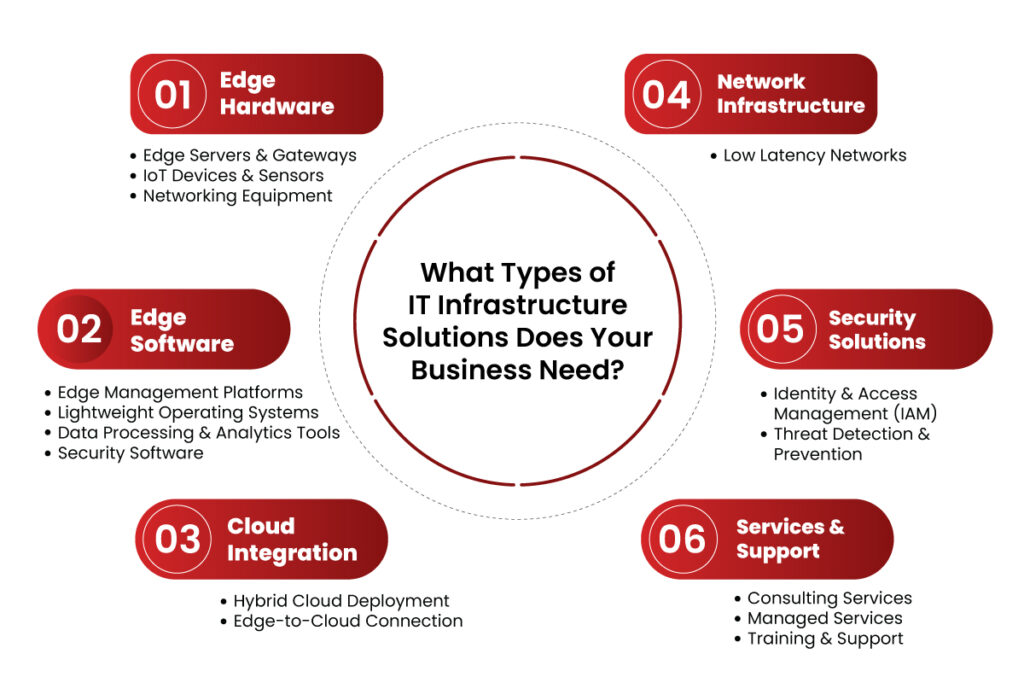
    What Types of IT Infrastructure Solutions Does Your Business Need?

    1. Edge Hardware

    Hardware is the core of any IT infrastructure solutions. For a business to benefit from the advantages of edge computing, the following are needed:

    Edge Servers & Gateways

    Edge servers compute the data at the location, thus avoiding communication back and forth between the centralized data centers. Gateways act as an interface middle layer aggregating and filtering IoT device data before forwarding it to the cloud or edge servers.

    IoT Devices & Sensors

    These are the primary data collectors in an edge computing architecture. Cameras, motion sensors, and environmental monitors collect and process data at the edge to support real-time analytics and instant response.

    Networking Equipment

    A network infrastructure is very important for a seamless communication system. High-speed routers and switches enable fast data transfer between the edge devices and cloud or on-premise servers.

    2. Edge Software

    The core requirement to make data processing effective is that a business must install edge computing feature-supporting software.

    Edge Management Platforms

    Controlling various edge nodes spread over different locations becomes quite complex. Platforms such as Digi Remote Manager enable the remote configuration, deployment, and monitoring of edge devices.

    Lightweight Operating Systems

    Standard OSs consume many resources. Businesses must install OS solutions designed especially for edge devices to utilize available resources effectively.

    Data Processing & Analytics Tools

    Real-time decision-making is imperative at the edge. AI-driven tools allow immediate analysis of data coming in and reduce reliance on cloud processing to enhance operational efficiency.

    Security Software

    Data on the edge is highly susceptible to cyber threats. Security measures like firewalls, encryption, and intrusion detection keep the edge computing environment safe.

    3. Cloud Integration

    While edge computing advises processing near data sources, it does not do away with cloud dependency for extensive storage and analytical functions.

    Hybrid Cloud Deployment

    Business enterprises must accept hybrid clouds, combining seamless integration with the edge and the cloud platform. Services in AWS, Azure, and Google Cloud enable proper data synchronization that an option for a central control panel can replicate.

    Edge-to-Cloud Connection

    Reliable and safe communication between edge devices and cloud data centres is fundamental. 5G, fiber-optic networking, and software-defined networking offer low-latency networking.

    4. Network Infrastructure

    Edge computing involves a robust network delivering low-latency, high-speed data transfer.

    Low Latency Networks

    The technologies, including 5G, provide for lower latency real-time communication. Those organizations that depend on edge computing will require high-speed networking solutions optimized for all their operations. SD-WAN stands for Software-Defined Wide Area Network.

    SD-WAN optimizes the network performance while ensuring data routes remain efficient and secure, even in highly distributed edge environments.

    5. Security Solutions

    Security is one of the biggest concerns with edge computing, as distributed data processing introduces more potential attack points.

    Identity & Access Management (IAM)

    The IAM solutions ensure that only authorized personnel access sensitive edge data. MFA and role-based access controls can be used to reduce security risks.

    Threat Detection & Prevention

    Businesses must deploy real-time intrusion detection and endpoint security at the edge. Cisco Edge Computing Solutions advocates trust-based security models to prevent cyberattacks and unauthorized access.

    6. Services & Support

    Deploying and managing edge infrastructure requires ongoing support and expertise.

    Consulting Services

    Businesses should seek guidance from edge computing experts to design customized solutions that align with industry needs.

    Managed Services

    Managed services for businesses lacking in-house expertise provide end-to-end support for edge computing deployments.

    Training & Support

    Ensuring IT teams understand edge management, security protocols, and troubleshooting is crucial for operational success.

    What Types of IT Infrastructure Solutions Does Your Business Need?

    Conclusion

    As businesses embrace edge computing, they must invest in scalable, secure, and efficient IT infrastructure solutions. The right combination of hardware, software, cloud integration, and security solutions ensures organizations can leverage edge computing benefits for operational efficiency and business growth.

    With infrastructure investment aligned to meet business needs, companies will come out with the best of opportunities in a very competitive, evolving digital landscape. That’s where SCS Tech comes in as an IT infrastructure solution provider, helping businesses with cutting-edge solutions that seamlessly integrate edge computing into their operations. This ensures they stay ahead in the future of computing—right at the edge.

  • How Robotic Process Automation Services Achieve Hyperautomation?

    How Robotic Process Automation Services Achieve Hyperautomation?

    Do you know that the global hyper-automation market is growing at a 12.5% CAGR? The change is fast and represents a transformational period wherein enterprises can no longer settle for automating single tasks. They need to optimize entire workflows for superior efficiency.

    But how does a company move from task automation to full-scale hyperautomation? It all starts with Robotic Process Automation services in india (RPA), the foundational technology that allows organizations to scale beyond the automation of simple tasks and into intelligent, end-to-end workflow optimization.

    Continue reading to see how robotic process automation services in india services powers hyperautomation for businesses, automating workflows to improve speed, accuracy, and digital transformation.

    What is Hyperautomation?

    Hyperautomation, more than just the automation of repetitive tasks, is reaching for an interconnected automation ecosystem that makes processes, data, and decisions flow smoothly. It’s the strategic approach for enterprises to quickly identify, vet, and automate as many business and IT processes as possible and to extend traditional automation to create an impact across the entire organization. RPA, at its core, represents this revolution, which can automate structured rule-based tasks at speed, consistency, and precision.

    However, pure hyper-automation extends beyond RPA and integrates with more technologies like AI, ML, process mining, and intelligent document processing that incorporate to get the entire workflow automated. These technologies enhance decision-making ability, eliminate inefficiencies, and optimize workflows across the enterprise.

    What is the Role of RPA in Hyperautomation?

    1. RPA as the “Hands” of Hyperautomation

    RPA shines with the automation of structured and rule-based work as the execution engine of hyper-automation. RPA bots can execute pre-defined workflows and interact with different systems to perform repetitive duties. For example, during invoice processing, RPA bots can extract data from PDFs and automatically update accounting software, which can be efficient and accurate.

    1. RPA as a Bridge for Legacy Systems

    Many organizations have problems integrating with old infrastructure. RPA solves the problem by simulating human interaction with legacy systems that do not have APIs. This way, automation can work with these systems by simulating user actions. For instance, a bank may use RPA bots to move data from a mainframe to a new reporting tool without needing expensive and complicated API integrations.

    1. RPA for Data Aggregation and Consolidation

    RPA helps automatically collect and aggregate business data. With the support of RPA, businesses can gain a better single view through a consolidated fragmented source of data. For instance, RPA-based sales data collected from different e-commerce channels can provide a performance overview.

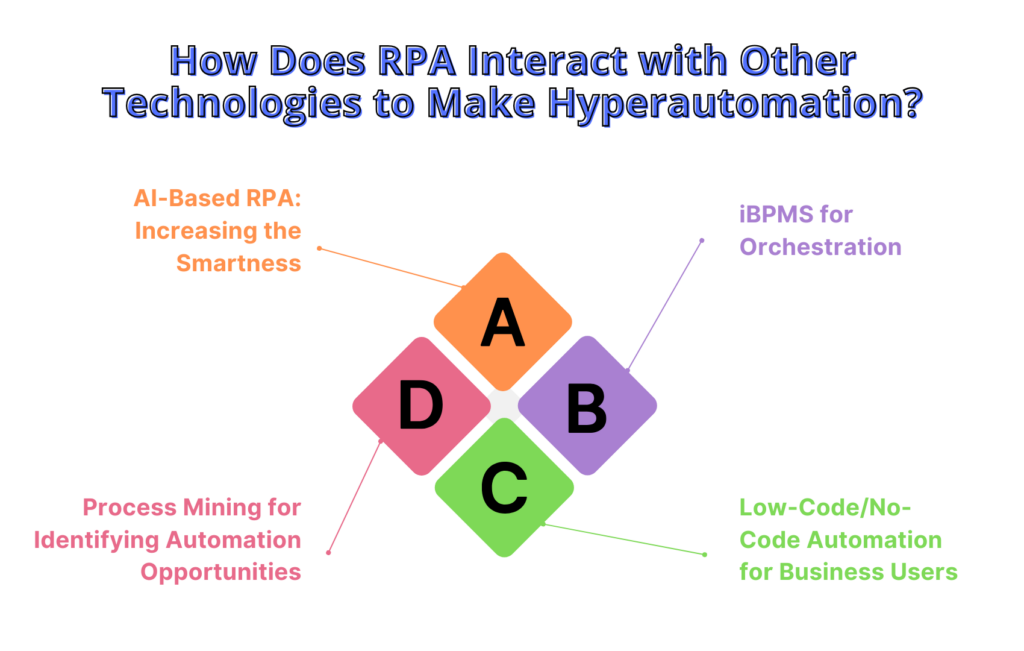
    How Does RPA Interact with Other Technologies to Make Hyperautomation?

    1. AI-Based RPA: Increasing the Smartness

    RPA becomes intelligent by associating with other AI-based technologies.

    • Natural Language Processing (NLP): This facilitates using unstructured emails and chat logs to enable the intelligent routing of communications
    • Machine Learning (ML): These bots increase their performance over time because of the data they draw from the previous records. Hence, it maximizes accuracy and efficiency.
    • Computer Vision: This is an advancement of RPA since it enables one to interface with applications that may or may not contain structured interfaces with no screen present.

    For instance, AI-based RPA can be used in intelligent claims processing in insurance, where it can automatically extract, validate, and route data.

    1. Process Mining for Identifying Automation Opportunities

    Process mining tools assess the workflow and then identify the points of inefficiency by pointing to where automating is likely. The bottleneck found can be automated using RPA, streamlining the processes involved. An example would be if a hospital optimized admission using process mining to automate entry and verification through RPA.

    1. iBPMS for Orchestration

    iBPMS provides governance and real-time automation monitoring; therefore, it executes processes efficiently and effectively. RPA automates some tasks within an extensive process framework managed by iBPMS. For example, order fulfillment in e-commerce involves using RPA to update inventory and ship orders.

    1. Low-Code/No-Code Automation for Business Users

    Low-code/no-code platforms enable nontechnical employees to develop RPA workflows, thus democratizing automation and speeding up hyper-automation adoption. For example, a marketing team can use a low-code tool to automate lead management, freeing time for more strategic activities while improving efficiency.

    RPA's Interaction with Other Technologies to Make Hyperautomation

    What is the Impact Of RPA on Hyperautomation in Terms of Business?

    1. Unleash Full Potential

    Hyperautomation unlocks the true potential of RPA, which is rich in AI, process mining, and intelligent decision-making. The RPA performs mundane tasks, while AI-driven tools optimize workflows and improve decision-making and accuracy.

    For example, RPA bots can process invoice data extraction. AI enhances document classification and validation to ensure everything is automated.

    1. Flexibility and Agility in Operations

    RPA enables businesses to integrate multiple automation tools under one umbrella while still being able to change immediately according to fluctuating market and business situations. This cannot be achieved through static automation, but it provides more scalable and flexible ways of automating workflows with real-time optimization using RPA-based hyperautomation.

    1. Increasing Workforce Productivity

    With the automation of mundane, time-consuming tasks, RPA allows others to apply more of their expertise in strategic thinking, innovation, and customer interaction, thereby improving workforce productivity and further driving the business.

    1. Seamless Interoperability Of Systems

    RPA makes the data exchange and execution of workflows between business units, digital workers or bots, and IT systems invisible. This gives organizations the benefit of faster decisions and effective operations.

    Hyperautomation using RPA provides for efficiency, reduced operational cost, and ROI. Therefore, business benefits range from real-time data processing to automatic compliance checks with easy scalability to stay sustainable and profitable over long periods.

    Conclusion

    Hyperautomation is more than just RPA services—it’s about integrating technologies like AI, process mining, and low-code platforms to drive real transformation.

    Hyperautomation is not just about adding technology to your processes — it’s about rethinking how work flows across your organization. By combining technology intelligently, businesses can automate smarter, work faster, and make decisions with greater accuracy.]

    This powerful digital strategy, driven by RPA services, can not only boost efficiency but also help your organization become more agile, resilient, and future-ready.

    As a leader in the automation solutions firm, SCS Tech supports initiating this digital strategy in organizations to help them move beyond tactical automation to a strategic enabler of that same transformation.

  • Embracing Hybrid Cloud IT Infrastructure Solutions as the New Norm

    Embracing Hybrid Cloud IT Infrastructure Solutions as the New Norm

    In today’s world, where data breaches are becoming alarmingly frequent, how can companies strike the right balance between ensuring robust security and maintaining the scalability required for growth?

    Well, hybrid cloud architectures might just be the answer to this! They provide a solution by enabling sensitive data to reside in secure private clouds while leveraging the expansive resources of public clouds for less critical operations.

    As hybrid cloud becomes the norm, it empowers organizations to optimize their IT infrastructure solutions, ensuring they remain competitive and agile in a continuously ever-changing digital landscape.

    This blog is about the importance of hybrid cloud solutions as the new norm in IT infrastructure solutions.

    Embracing Hybrid Cloud IT Infrastructure Solutions as the New Norm


    Hybrid cloud IT infrastructure solutions
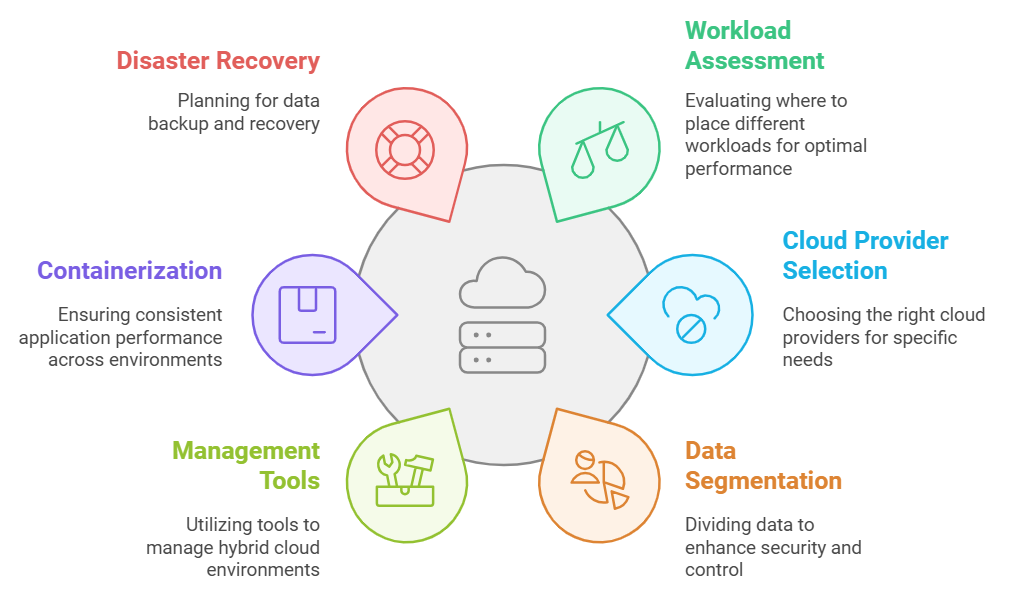
    Hybrid cloud IT infrastructure solutions

    1. Evaluating Organizational Needs and Goals

    • Assess Workloads: Determine which workloads best suit public clouds, private clouds, or on-premises environments. For example, latency-sensitive applications may remain on-premises, while scalable web applications thrive in public clouds.
    • Set Objectives: Define specific goals such as cost reduction, enhanced security, or improved scalability to effectively guide the hybrid cloud strategy.

    2. Designing a Tailored Architecture

    • Select Cloud Providers: Select public and private cloud providers based on features such as scalability, global reach, and compliance capabilities.
    • Integrate Platforms: Use orchestration tools or middleware to integrate public and private clouds with on-premises systems for smooth data flow and operations.

    3. Data Segmentation

    • Data Segmentation: Maintain sensitive data on private clouds or on-premises systems for better control.
    • Unified Security Policies: Define detailed frameworks for all environments, including encryption, firewalls, and identity management systems.
    • Continuous Monitoring: Utilize advanced monitoring tools to identify and mitigate threats in real-time.

    4. Embracing Advanced Management Tools

    • Hybrid Cloud Management Platforms: Solutions such as VMware vRealize, Microsoft Azure Arc, or Red Hat OpenShift make it easier to manage hybrid clouds.
    • AI-Driven Insights: Utilize AI & ML services to optimize resource utilization, avoid waste, and predict potential failures.

    5. Flexibility through Containerization

    • Containers: Docker and Kubernetes ensure that applications operate uniformly across different environments.
    • Microservices: Breaking an application into smaller, independent components allows for better scalability and performance optimization.

    6. Disaster Recovery and Backup Planning

    • Distribute Backups: Spread the backups across public and private clouds to prevent data loss during outages.
    • Failover Mechanisms: Configure the hybrid cloud with automatic failover systems to ensure business continuity.

    7. Audits and Updates

    • Audit Resources: Regularly assess resource utilization to remove inefficiencies and control costs.
    • Ensure Compliance: Periodically review data handling practices to comply with regulations like GDPR, HIPAA, or ISO standards.

    Emerging Trends Shaping the Future of Hybrid Cloud

    1. AI and Automation Integration

    Artificial Intelligence (AI) and automation are changing hybrid cloud environments to make them more innovative and efficient.

    • Automated Resource Allocation: AI dynamically adjusts resources according to the workload’s real-time demands for better performance. For example, AI & ML services can automatically reroute resources during traffic spikes to prevent service disruptions.
    • Predictive Analytics: Historical time series data analysis to predict potential failures to avoid faults and reduce downtime.
    • Improved monitoring: The AI-driven tools enable granular views of performance metrics, usage patterns, and cost analysis to help better make decisions.
    • AI for Security: AI detects anomalies, responds to potential threats, and strengthens hybrid environments’ security.

    2. Edge computing is on the rise

    Edging involves processing data near its sources; it combines well with hybrid cloud strategies, particularly in IoT and real-time applications.

    • Real-time Processing: Autonomous vehicles will benefit through edge computing, where sensor data is computed locally for instantaneous decisions.
    • Optimized Bandwidth: It conserves bandwidth as the critical data is processed locally, and the necessary information alone is sent to the cloud.
    • Better Resilience: With hybrid environments and edge devices, distributed workloads are more resilient when networks break.
    • Support for Emerging Tech: Hybrid systems use low-latency edge computing, especially for implementing AR and Industry 4.0 technologies.

    3. Sustainability Focus

    Hybrid cloud solutions would be crucial in aligning IT operations with and supporting environmental sustainability goals.

    • Effective utilization of resources: Hybrid could shift workloads into low-carbon environments like a public cloud provider powered by renewable sources.
    • Dynamic scaling: By scaling resources on demand through hybrid clouds, they keep energy wastage down over periods of low use
    • Green data centers: Harnessing sustainable IT infrastructure solutions by AWS and Microsoft Azure providers reduces carbon footprints.
    • Carbon Accounting: Analytics tools in hybrid platforms give accurate carbon emission measures, which allows organizations to reduce their carbon footprint.

    4. Unified Security Frameworks

    Hybrid cloud environments require consistent and robust security measures to protect distributed data.

    • Policy Enforcement: Unified frameworks apply security policies across all environments, ensuring consistency.
    • Integrated Tools: Data protection is enhanced by features like encryption, multi-factor authentication, and identity access management (IAM).
    • Threat Detection: Machine learning algorithms detect and prevent real-time threats, reducing vulnerability.
    • Compliance Simplification: Unified frameworks provide built-in auditing and reporting capabilities that simplify compliance with regulations.

    5. Hybrid Cloud and Multicloud Convergence

    Increasingly, hybrid cloud strategies are being used with multi-cloud to maximize flexibility and efficiency.

    • Diversification of vendors: Reduced dependency on one vendor can ensure resilience and help build more robust services.
    • Optimized Costs: Strategically spreading workloads across IT infrastructure solution providers can help leverage cost efficiencies and unique features.
    • Improved Interoperability: Tools such as Kubernetes ensure smooth operations across diverse cloud environments, thus enhancing flexibility and collaboration.

    Conclusion

    The future of hybrid cloud IT infrastructure solutions is shaped by transformative trends emphasizing agility, scalability, and innovation. As organizations embrace AI and automation, edge computing, sustainability, and unified security frameworks, they get better prepared to thrive in a fast-changing digital world.

    Proactively dealing with these trends can help achieve operational excellence and bring long-term growth and resilience in the age of digital transformation. SCS Tech enables businesses to navigate this evolution seamlessly, offering cutting-edge solutions tailored to modern hybrid cloud needs.

  • Transform Your Business with Cutting-Edge IT Infrastructure Solutions

    Transform Your Business with Cutting-Edge IT Infrastructure Solutions

    Did you know that 85% of businesses report increased efficiency and competitive advantage after upgrading their IT infrastructure? With such a significant impact, isn’t it time your company explored these advancements too?

    Advanced IT infrastructure solutions are no longer optional—they’re essential for maintaining a competitive edge and boosting operational efficiency. 

    But what makes modern IT infrastructure so revolutionary?

    At its core, IT infrastructure integrates hyper-converged systems, cloud computing, and edge computing, reshaping traditional business models. These innovations drive powerful cybersecurity measures, seamless data integration, and real-time analytics, ensuring businesses operate with unmatched stability and agility. Moreover, embracing these cutting-edge solutions simplifies remote work, lays the groundwork for future technological advancements, and supports scalability.

    Read on as we delve deeper into how these IT infrastructure solutions are enhancing business operations. 

    Improving Operational Efficiency: Best IT Solutions to Opt For

    Image Source:

    You will come across many IT solutions that can aid in improving the functional efficiency of your business. In this section, you will receive a detailed explanation of the most crucial and popular IT infrastructure solutions.

    Git [Bitbucket, Gitlab, GitHub]

    Git, along with other platforms like Bitbucket, GitHub, and GitLab, is known as the cornerstone of proper source code management. It will do the following:

    • Code modification history maintenance
    • Change the tracking
    • Provide smooth collaboration.

    All these things are extremely vital for IT infrastructure services to become powerful so that they can help all types of businesses.

    Maven

    This is an important DevOps tool that can simplify project management and also create automation. From reporting and documentation to managing builds, Maven can easily boost the reliability and efficiency of all IT infrastructure services.

    Amazon Web Services Global Infrastructure

    AWS [Amazon Web Services] offers a network of data centers across the globe, which, in return, delivers a myriad range of cloud computing services. Through its worldwide data centers, AWS provides over 200 services.

    From storage solutions to virtual services, Amazon Web Service’s infrastructure is created to support the requirements of various businesses. These IT solutions will also offer businesses both scalability and flexibility, which is needed to meet all their IT-related demands.

    The presence of AWS infrastructure across the globe ensures high availability and less latency. For these reasons, AWS stands out as an exceptional choice for corporations with a global footprint. At present, AWS infrastructure is 245 nations and territories, 36 local zones, and 33 regions worldwide.

    AppDynamics

    This particular IT infrastructure solution provides all the important DevOps tools that can enhance observability and prompt delivery. The “Cloud Native App Observability” from AppDynamics will allow comprehensive monitoring, and it’s vital for preserving the best IT infrastructure services.

    Splunk Cloud

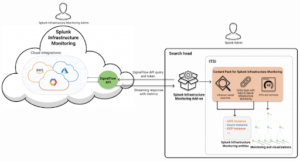
    Image Source:

    This is one of the best IT solutions that offers automation solutions for all DevOps processes, which includes deployment automation. Splunk Cloud’s Automated Deployment Helper can streamline deployments and improve the efficiency of IT infrastructure solutions.

    Cisco Meraki

    This IT infrastructure solution delivers a diverse range of management solutions, which include:

    • Wireless access points
    • Switches
    • Cloud-managed routers

    All these solutions can facilitate network management and improve security. This will enable all businesses to manage the network infrastructure across the globe. Cisco Meraki has a centralised dashboard that offers visibility into the network performance in real-time, which will make it much easier for all businesses to address and detect various problems.

    VMWare Global Infrastructure

    With the help of VMWare, businesses will get many visualisation solutions that can assist them in optimising their respective IT infrastructure. From virtual desktops to servers, the solutions from VMWare are created to enhance security, reduce expenses, and improve the system effectively.

    For this reason, Broadcom declared an acquisition deal of $61 million with VMWare in 2022. Apart from that, VMWare global infrastructure is an ideal option for businesses that aim to modernise their IT infrastructure.

    Besides that, its solution will also let businesses transfer all their workloads between the cloud and on-premises environments, offering both scalability and flexibility.

    IT Infrastructure: Getting to Know It’s Primary Components

    An outstanding IT infrastructure stands out as the backbone of a modern-day business and has some important components. Look at the table below to discover what these components are:

    Components Description
    Storage and Security Robust servers and high capacity and reliable storage solutions are compulsory for managing massive amounts of information and running complicated applications without lag or downtime. This includes options like Storage Area Network and Network Attached Storage.
    Virtualisation Efficiently using computing resources via virtual environments and machines will let all businesses run countless operating applications and systems on one physical server. This will help lessen the cost and improve the scalability.
    Network Powerful networking can simplify data transfer and communication outside and inside the company. Reliable and high-speed network connections will support real-time collaboration, remote access, and cloud services.
    Remote Access Efficient and safe remote working abilities will allow employees to gain access to all the important resources whenever they want. In return, it will improve flexibility and productivity. Solutions, such as VPN and SASE, will offer secure connections to remote user
    Security Exceptional security measures can shield all systems and data from cyber-related threats. This includes providing security updates, intrusion detection systems, firewalls, and encryption. A multi-layered security approach can identify and prevent attacks.
    Disaster Recovery Making sure all the data is properly backed up and retrieved easily during emergencies can prevent data loss. It will also allow the business to continue operating, and periodic off-site and on-site backups are essential for maintaining data integrity.

    Conclusion

    IT solutions play a pivotal role in enhancing global business operations, driving efficiency, and optimizing overall IT infrastructure. Businesses seeking robust IT infrastructure solutions can benefit from experts at SCS Tech India Pvt Ltd, who deliver exceptional solutions to our customers.

    In addition to IT infrastructure, we specialize in cybersecurity, eGovernance, AI/ML services, and digital transformation. Our expertise extends across diverse sectors including agriculture, education, oil and gas, urban development, and critical infrastructure, ensuring tailored solutions that meet specific business needs.

  • Leveraging AI and ML Services to Enhance Business Efficiency

    Leveraging AI and ML Services to Enhance Business Efficiency

    In an environment where market conditions are volatile and customer preferences are ever-changing, AI and ML services offer advanced automation, predictive analytics, and enhanced customer experiences. 

    These technologies improve decision-making, operational efficiency, and customer satisfaction. As the AI and ML market continues to grow, choosing the right service provider becomes critical. Future trends in AI and ML, such as edge technology, collaborative learning, and ethical AI, promise to further drive innovation and resilience in the market.

    In this blog, we will discuss the benefits, future implications, and the role of AI and ML services in business operations in detail.

    Understanding AI and ML

    Artificial Intelligence (AI) involves creating smart systems capable of performing tasks that typically require human intelligence, such as problem-solving, learning, decision-making, and understanding language. Machine Learning (ML), a subset of AI, focuses on developing algorithms that enable systems to learn from data and improve over time without explicit programming.

    Understanding the distinction between AI and ML is crucial for appreciating their unique contributions to business operations. Machine learning applications span various sectors, with customer-centric use cases being particularly prevalent. According to a study, 57% of respondents identify customer experience as the primary use case for AI and ML.

    Source

    Below are the differences between Artificial Intelligence (AI) and Machine Learning (ML) in the context of business operations:

    Aspect Artificial Intelligence (AI) Machine Learning (ML)
    Scope Encompasses a wide range of technologies including ML, natural language processing, robotic process automation, and more. Specifically focused on using data to train models and make predictions or decisions without explicit programming.
    Application in Business Can automate complex tasks, provide advanced analytics, enhance decision-making processes, and improve customer interactions. Primarily used for predictive analytics, customer segmentation, recommendation systems, and anomaly detection.
    Data Dependency Can operate with rules-based systems and logical operations, not always data-dependent. Highly dependent on large datasets for training and improving model accuracy.
    Example Use Cases Chatbots, autonomous vehicles, fraud detection, virtual assistants, and personalized marketing. Sales forecasting, customer churn prediction, recommendation engines, and image recognition.
    Implementation Complexity Often more complex to implement, requiring integration of multiple technologies and larger computational resources. Typically involves implementing specific algorithms and models, which can be simpler in scope compared to full AI systems.
    Human Intervention Can function with less human intervention once fully developed, especially in autonomous systems. Requires ongoing human oversight for model training, tuning, and validation.
    Output Interpretation Can provide more comprehensive and context-aware outputs, often mimicking human-like understanding. Outputs are generally predictions or classifications, often requiring human interpretation.
    Adaptability Designed to adapt to a wide range of scenarios and environments, often with built-in learning mechanisms. Adaptability is limited to the scope of the trained data; new scenarios require re-training or additional data.
    Ethical Considerations Broader ethical implications including job displacement, decision transparency, and bias. Primarily concerns around data privacy, algorithmic bias, and the integrity of the training data.

    Benefits of AI and ML on Business Operations

    The adoption of AI and ML services brings numerous benefits to businesses-

    Enhanced Decision-Making

    AI and ML enable organizations to analyze vast datasets in real-time, uncovering patterns and trends that would otherwise remain unnoticed. This capability empowers businesses to make more informed decisions, fostering proactive planning rather than reactive responses.

    Improved Customer Experiences

    Personalization is paramount in today’s customer-centric landscape. Advanced AI algorithms enable businesses to understand customer preferences and behaviors, facilitating tailored recommendations and support. This personalized approach enhances customer satisfaction, loyalty, and ultimately, profitability.

    Operational Efficiency

    AI-driven automation streamlines workflows, ensuring timely delivery of goods and services, predicting potential failures, and detecting fraudulent activities. Such efficiencies minimize costs, reduce errors, and optimize overall business performance.

    Facilitating Innovation

    AI ML technologies facilitate rapid prototyping and market prediction, enabling businesses to identify new opportunities and develop innovative products and services that resonate with dynamic market demands.

    Factors To Consider While Selecting the Right AI ML Services Provider

    The global machine learning market has exhibited robust growth, valued at $15.44 billion in 2021 and projected to reach $209.91 billion by 2029, reflecting a notable compound annual growth rate (CAGR) of 38.8%, as reported by Fortune Business Insights. Additionally, the machine learning platforms market is expected to hit $31.36 billion by 2028, according to Proficient Market Insights.

    Businesses aiming to enhance their operations and productivity must carefully choose their AI ML services provider. Several key factors must be considered:

    • Skills and Knowledge

    Businesses should prioritize providers with deep expertise in their industry and relevant use cases. Experience in executing successful projects can provide valuable insights and customized solutions.

    • Flexibility and Adaptability

    Providers must demonstrate the ability to scale AI and Machine Learning solutions effectively, accommodating future growth and adapting to evolving business needs seamlessly.

    • Maintaining Compliance with Safety

    Ensuring data security and compliance with industry regulations are paramount. Businesses should verify that prospective providers adhere strictly to safety protocols and privacy laws.

    Future implications of AI and ML

    AI and ML have transcended futuristic concepts to become integral in everyday applications, offering solutions to diverse challenges. Yet, the evolution of AI ML services continues, with several future implications:

    • Edge Tech

    Edge technology processes data closer to its source, revolutionizing AI and ML applications by minimizing latency, enhancing real-time analysis, and facilitating decentralized AI and IoT solutions. The global market for Edge AI Tech is valued at approximately $20.39 billion as of 2023.

    • Group Learning

    Collaborative learning methodologies enable teams to train models using decentralized data sources while maintaining privacy and security, fostering innovation in AI model development.

    • Improving AI Ethics

    The growing prominence of AI necessitates a heightened focus on ethical considerations. Organizations must prioritize transparency, accountability, fairness, and bias reduction in AI development and deployment to build public trust and ensure responsible usage of AI services.

    Initiatives like AlgorithmWatch exemplify efforts in promoting explainable and ethical AI practices, ensuring accountable algorithmic decision-making.

    Conclusion

    AI ML services help businesses succeed. They are not just tools but change how businesses work. AI & ML can open new doors and create better things for customers.  At SCS Tech India Pvt, we provide effective AI ML solutions and consultations. We also offer ML development, AI-led applications, and Data support. With our top-notch AI ML services, businesses can expect process automation, improved customer interactions, and enhanced analytics. Contact us to make your business stand out and withstand the impacts of a dynamic market.

  • What Sets Leading Machine Learning Companies Apart in Today’s Market?

    What Sets Leading Machine Learning Companies Apart in Today’s Market?

    In today’s rapidly evolving business landscape, integrating machine learning technologies has become paramount for companies striving to stay ahead of the curve. Machine learning, a subset of artificial intelligence (AI), empowers systems to learn from data and make predictions or decisions with minimal human intervention. As businesses increasingly grasp the transformative potential of machine learning, the demand for proficient and innovative machine learning companies has surged.

    In this blog post, we’ll explore machine learning and what sets leading companies apart in today’s competitive market. From expertise and innovation to customized solutions and a commitment to quality, we’ll uncover the key factors that distinguish top-tier machine learning companies.

    AI in business

    Expertise and Innovation in Machine Learning

    Leading machine learning companies stand out due to their unparalleled expertise and commitment to innovation. With seasoned professionals skilled in algorithms, data analysis, and software development, these companies tackle complex challenges with precision.

    Innovation is a hallmark of top-tier machine learning firms. These companies invest in research, collaborate with academia, and engage in knowledge-sharing communities to pioneer new solutions. By staying abreast of trends and anticipating market needs, these companies spearhead transformative change in AI services and machine learning.

    Range of AI/ML Services Offered

    Leading machine learning companies provide various ai services tailored to meet diverse client needs. These firms provide comprehensive solutions, spanning from predictive analytics to natural language processing and computer vision. They enable businesses to glean insights, automate processes, and make data-driven decisions.

    Focusing on continuous innovation, these companies stay ahead of emerging challenges and opportunities, empowering clients to thrive in the digital age.

    Customized Solutions for Business Needs

    Leading machine learning companies excel in providing tailored solutions to meet each client’s unique requirements. These firms design solutions that drive tangible business outcomes by conducting thorough assessments and understanding specific challenges. With a focus on scalability and flexibility, they ensure their solutions adapt to evolving needs, fostering long-term success.

    Commitment to Quality and Performance

    Top-tier machine learning companies prioritize delivering high-quality solutions that exceed client expectations. They maintain rigorous standards throughout development, ensuring accuracy, reliability, and scalability.

    By leveraging robust testing methodologies and quality assurance protocols, these companies validate the performance of their solutions and identify any potential issues or optimizations. This commitment to quality ensures that clients receive reliable and efficient machine-learning solutions that meet their business objectives.

    Furthermore, leading machine learning companies are dedicated to ongoing performance optimization. They continuously monitor and analyze solution performance, identifying opportunities for improvement and innovation. By staying proactive and responsive, these companies ensure that their solutions remain at the forefront of technological advancements and deliver optimal client results.

    Client Success Stories and Testimonials

    Leading machine learning companies showcase their expertise and effectiveness through client success stories and testimonials. These stories highlight real-world applications of their solutions, demonstrating their tangible benefits to businesses across various industries.

    Top-tier machine learning companies offer prospective clients valuable insights into the effectiveness and reliability of their services by sharing success stories and testimonials.Clients’ firsthand accounts of the impact of machine learning solutions on their operations serve as compelling endorsements, instilling confidence in potential clients and reinforcing the company’s credibility.

    Furthermore, success stories and testimonials are powerful marketing tools, enabling machine learning companies to differentiate themselves from competitors and attract new clients. They demonstrate a track record of delivering results and showcase the company’s ability to address diverse challenges and deliver measurable outcomes.

    Conclusion

    In conclusion, leading machine learning companies set themselves apart in today’s market through their expertise, innovation, commitment to quality, and client-eccentric approach. These companies drive business success and foster innovation across industries by leveraging cutting-edge technologies and customized solutions.

    As businesses navigate the complexities of AI services and machine learning, partnering with a trusted and reliable machine learning company becomes essential. By focusing on factors like expertise, innovation, and dedication to quality, businesses can select a partner that aligns with their objectives and enables them to leverage the complete potential of machine learning.

    In an era increasingly defined by digitalization and data, machine-learning companies are pivotal in propelling innovation and shaping the future of business. By embracing AI services and machine learning’s capabilities, businesses can unlock new opportunities, drive efficiency, and stay competitive in today’s dynamic market landscape.

    Ready to harness the power of machine learning for your business? Explore SCS Tech India’s AI/ML services and discover how we can help you achieve your goals. Contact us today to schedule a consultation!


  • Why Are IT Solutions Critical for Modern Business Success?

    Why Are IT Solutions Critical for Modern Business Success?

    In today’s digital age, IT solutions are indispensable for business success. They drive digital transformation, enhance efficiency, and secure data. Let’s explore the critical importance of IT solutions for modern businesses and their role in shaping the future of business.

    The Role of IT Solutions in Digital Transformation

    1. Navigating the Digital Landscape: Digital transformation companies act as guides, helping businesses navigate the complex terrain of the digital landscape. They offer a suite of services, from cloud computing to data analytics, tailored to each business’s unique needs.
    2. Empowering Adaptability: It empowers businesses to adapt to changing market conditions, customer demands, and technological advancements. This agility allows companies to seize new opportunities and stay ahead of the curve.
    3. Driving Innovation: Innovation is at the heart of digital transformation. IT solutions provide the tools and platforms necessary for innovation to flourish. Whether it’s developing new products, streamlining processes, or enhancing customer experiences,
    4. Enhancing Collaboration and communication: Collaboration is essential for driving digital transformation. It facilitates collaboration by breaking down silos, enabling seamless communication and information sharing across departments and teams.

    Leveraging IT Solutions for Enhanced Efficiency and Productivity

    1. Automation of Repetitive Tasks: IT solutions automate routine tasks, giving employees more time to concentrate on strategic activities.
    2. Streamlining Workflows: it enables smoother and more efficient operations by digitizing workflows and eliminating paper-based processes.
    3. Real-Time Data Insights:  it uses data analytics tools to provide real-time insights into business performance, allowing for informed decision-making.
    4. Integration of Business Functions: Enterprise resource planning (ERP) systems consolidate different business functions, such as finance, HR, and supply chain management, into one unified platform.

    Enhancing Customer Experience through IT Solutions

    1. Personalized Interactions: IT solutions enable businesses to personalize customer interactions based on preferences, purchase history, and behaviour.
    2. Streamlined Communication Channels: Omnichannel communication platforms allow businesses to communicate with customers seamlessly across multiple channels, including email, social media, and live chat.
    3. Centralized Customer Data: Customer relationship management (CRM) systems centralize customer data, offering a comprehensive view of each customer’s interactions and history.
    4. Tailored Services: With insights from data analytics tools, businesses can offer tailored services and recommendations to meet individual customer needs.

    Securing Business Data and Assets with IT Solutions

    1. Cybersecurity Solutions: IT solution providers offer a range of cybersecurity solutions, including network security, endpoint protection, and threat intelligence, to protect against cyber threats.
    2. Data Encryption Technologies: Data encryption technologies safeguard data during transmission and storage, thwarting unauthorized access and preserving confidentiality.
    3. Mitigating Risks: By deploying robust IT security measures, businesses can mitigate the risks linked with cyber threats, preserving their reputation, customer trust, and competitive edge.

    Future Trends and Opportunities in IT Solutions

    As technology progresses, IT solutions are evolving rapidly, opening up new avenues for business growth and innovation. Cloud computing offers scalable data storage, while AI and machine learning streamline automation and data analysis. The Internet of Things facilitates real-time data collection by connecting devices. In this digital landscape, partnering with IT infrastructure solution providers becomes vital for businesses to adapt and capitalize on these trends, ensuring their competitiveness in the digital realm.

    Choosing the Right IT Infrastructure Solution Provider

    Choosing the correct IT infrastructure solution provider is vital for the success of your digital transformation journey. Consider the following factors when choosing a provider:

    1. Expertise and Experience: Seek out an IT infrastructure solutions provider with a demonstrated history of successfully implementing IT solutions and leading digital transformation efforts.
    2. Range of Services: Consider a provider that offers a broad spectrum of digital transformation companies, encompassing cloud computing, cybersecurity, data analytics, and enterprise software solutions.
    3. Reputation and Client Testimonials: Research the provider’s reputation in the industry and seek feedback from past clients to ensure reliability and quality of service.
    4. Alignment with Business Goals: Select a provider that understands your business objectives and can tailor solutions to meet your needs and requirements.
    5. Industry Experience: Look for providers with industry experience. They’ll have a deeper understanding of your specific challenges and opportunities.

    Conclusion

    In conclusion, IT solutions are indispensable for modern businesses. They drive digital transformation, enhance efficiency, and secure data assets. With their help, companies can streamline operations, improve customer experiences, and stay competitive. Emerging trends like cloud computing, AI, and IoT offer exciting growth opportunities. To navigate these changes effectively, businesses must partner with reliable IT infrastructure solution providers to unlock their full potential in the digital age.

    Ready to take your business to the next level with cutting-edge IT solutions? Explore a range of services and solutions at SCS Tech India, your trusted IT infrastructure partner.


  • What Are the Key Services Offered by Top Digital Transformation Services?

    What Are the Key Services Offered by Top Digital Transformation Services?

    In today’s dynamic digital landscape, businesses face the ongoing challenge of adapting to technological advancements and meeting the ever-expanding demands of consumers.

    That’s where digital transformation comes in— a strategic effort to integrate digital tools and strategies to revolutionize business operations and enhance customer experiences.


    Importance of Digital Transformation

    Digital transformation is indispensable for organizations in today’s fast-changing world. It’s a strategic necessity that helps companies maintain competitiveness, enhance efficiency, and drive growth. By embracing digital tools and adopting innovative approaches, businesses can deliver personalized customer experiences, gain a competitive edge, and respond swiftly to market changes.

    Experts are forecasting a staggering growth rate of over 58% between 2021 and 2026, with the market value expected to reach a whopping USD 124.95 billion by 2026 (source). By leveraging digital tools and strategies, you’re not only streamlining operations and boosting efficiency but also tapping into new revenue streams and enhancing the customer experience.

    Benefits of Digital Transformation

    Digital transformation brings numerous benefits to businesses in various industries, helping them succeed in today’s digital era. Here are some important advantages

    1. Enhanced Efficiency: By automating manual processes and streamlining operations, digital transformation enables businesses to work more efficiently. This leads to reduced turnaround times, increased productivity, and cost savings.
    2. Improved Customer Experiences: It allows businesses to deliver personalized and seamless experiences to their customers. Through digital channels, companies can engage with customers in real-time, tailor offerings to their preferences, and provide superior service.
    3. Increased Agility: It equips businesses with the agility to respond quickly to market changes and customer needs. By adopting flexible technologies and agile methodologies, organizations can adapt their strategies and processes in real-time,

    Core Services Offered by Top Digital Transformation Service Providers

    Digital transformation service providers offer a diverse range of solutions tailored to meet the evolving needs of businesses in the digital age. Here are some key services provided by these industry-leading firms:

    1. Cloud Computing Solutions: One of the foundational services offered by digital transformation service providers is cloud computing. These providers offer a range of cloud-based solutions, including Infrastructure as a Service (IaaS), Platform as a Service (PaaS), and Software as a Service (SaaS). Cloud computing enables businesses to access computing resources providing scalability, flexibility, and cost-effectiveness.
    2. Data Analytics and Insights: Digital transformation service providers help businesses unlock the value of their data by offering expertise in data collection, storage, processing, and analysis. By harnessing the power of data, businesses can make informed decisions, optimize operations, and drive strategic growth initiatives.
    3. Artificial Intelligence (AI) and Machine Learning (ML): AI MI services are transformative technological services that play a crucial role in digital transformation initiatives. AI and ML solutions helps to automate processes, enhance decision-making, and drive innovation. These solutions encompass a wide range of applications, including natural language processing, computer vision, etc, to unlock new opportunities and stay ahead of the curve.
    4. Internet of Things (IoT) Integration: IoT is revolutionizing industries by connecting devices, sensors, and machines to the internet, enabling real-time data collection and analysis. From smart manufacturing and connected healthcare to smart cities and intelligent transportation, IoT integration enables businesses to optimize processes, improve efficiency, and deliver innovative products and services.

    Choosing the Right Digital Transformation Services

    Selecting the right digital transformation services is paramount for successful business evolution. Here’s a simplified guide:

    1. Assess Business Needs: Understand your organization’s challenges, identify areas for improvement, and define clear objectives for the digital transformation initiative.  Ensure the provider understands your industry dynamics, compliance requirements, and business challenges, offering tailored solutions that meet your specific needs.

    2. Evaluate Service Providers:

    • Expertise and Experience: Prioritize providers with a proven track record in digital transformation across various industries.
    • Range of Services and Technology Capabilities: Choose a provider offering expertise in key areas such as cloud computing, data analytics, AI, IoT, cybersecurity, and digital marketing.
    • Reputation and Client Testimonials: Research the provider’s reputation, review client testimonials, case studies, and industry awards to gauge their reliability and success in delivering results.
    1. Collaborate and Conduct Due Diligence: Establish open communication channels with potential partners, discuss expectations, and request detailed proposals outlining scope, timelines, deliverables, and pricing.

    Conclusion

    So, if you’re a business owner or leader, here’s the bottom line: digital transformation isn’t just some fancy trend—it’s your ticket to future-proofing your business. By embracing digital innovation and partnering with the right experts, you can unlock new opportunities, drive efficiency, and deliver exceptional value to your customers.

    But here’s the thing: choosing the right digital transformation services is key. It’s not just about jumping on the latest tech bandwagon—it’s about finding solutions that align with your business goals and objectives.At SCS Tech India, we  offer tailored solutions to meet your specific needs and drive your business forward. So, take the time to assess your needs, evaluate service providers.