Smart grids are no longer future tech. They’re already running in many cities, silently balancing demand, managing renewable inputs, and automating fault recovery. But as this infrastructure gets smarter, it also becomes more exposed. Custom cybersecurity solutions are now essential to defend these networks. Cyber attackers are targeting data centers, probing energy infrastructure for weak entry points. A misconfigured substation, an unpatched smart meter, or a compromised third-party module can shut off power.
In this article, you’ll find a clear breakdown of the real risks today’s grids face, and the specific cybersecurity layers that need to be in place before digital operations go live.
Why Smart Grids Are Becoming a Target for Cyber Threats
The move to smart grids brings real-time energy control, dynamic load balancing, and cost savings. But it also exposes utilities to threats they weren’t built to defend against. Here’s why smart grids are now a prime target:
- The attack surface has multiplied. Each smart meter, sensor, and control point is a potential entry. Smart grids can involve millions of endpoints, and attackers only need one weak link.
- Legacy systems are still in play. Many control centers still run SCADA systems using outdated protocols like Modbus or DNP3, often without encryption or proper authentication layers. These weren’t designed with cybersecurity in mind, just reliability.
- Energy infrastructure is an impact target of high value. Compromises to energy grids have more than just outages; they can shut down hospitals, water treatment, and emergency services. That makes them a go-to for politically driven or state-sponsored attackers.
- Malware is becoming more intelligent. Incidents such as Industroyer and TRITON have demonstrated how intelligent malware can be used to hack controls of breakers or shut down safety systems, without evading traditional perimeter security.
Top Cybersecurity Risks Facing Smart Grid Infrastructure
Even well-funded utilities are struggling to stay ahead of cyber threats. Below are the primary risk categories that demand immediate attention in any smart grid environment:
- Unauthorized access to control systems: Weak credentials or remote access tools expose SCADA and substation systems to intruders.
- Data tampering or theft: Latent attacks on sensor or control signal data can mislead operators and disrupt grid stability.
- Malware for SCADA and ICS: Malicious code such as Industroyer can result in operational outages or unrecoverable equipment damage.
- Denial of Service (DoS) attacks: DoS attacks of high volume or of a protocol nature can impede critical communications in grid monitoring or control systems
- Supply chain vulnerabilities in grid components: Malware-infected or hardware-compromised firmware from suppliers may breach trust prior to systems being made live
Key Cybersecurity Measures to Secure Smart Grids
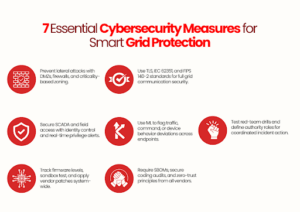
Smart grid cybersecurity is an architecture of policy, protocols, and technology layers across the entire system. The following are the most important actions utilities and municipal planners must take into account when upgrading grid infrastructure:
1. Network Segmentation
IT (corporate) and OT (operational) systems must be fully segregated. If one segment gets hacked, others remain functional.
- Control centers must not have open network paths in common with smart meters or field sensors.
- Implement DMZs (Demilitarized Zones) and internal firewalls to block lateral movement.
- Zone according to system criticality, not ease of access.
2. Encryption Protocols
Grid data needs encryption both in transit and at rest.
- For legacy protocols (like Modbus/DNP3), wrap them with TLS tunnels or replace them with secure variants (e.g., IEC 62351).
- Secure all remote telemetry, command, and firmware update channels.
- Apply FIPS 140-2 validated algorithms for compliance and reliability.
3. Multi-Factor Authentication & Identity Control
Weak or default credentials are still a leading breach point.
- Apply role-based access control (RBAC) for all users.
- Enforce MFA for operators, field technicians, and vendors accessing SCADA or substation devices.
- Monitor for unauthorized privilege escalations in real time.
This is especially vital when remote maintenance or diagnostics is allowed through public networks.
4. AI-Based Intrusion Detection
Static rule-based firewalls are no longer enough.
Deploy machine learning models trained to detect anomalies in:
- Grid traffic patterns
- Operator command sequences
- Device behavior baselines
AI can identify subtle irregularities that humans and static logs may miss, especially across distributed networks with thousands of endpoints.
5. Regular Patching and Firmware Updates
Firmware without patches in smart meters, routers, or remote terminal units (RTUs) can become silent attack points.
Continue patching on a strict timeline:
- Take inventory of all field and control equipment, including firmware levels.
- Test patches in sandboxed testing before grid-wide deployment.
- Establish automated patch policies where feasible, particularly for third-party IoT subcomponents.
6. Third-Party Risk Management
Your network is only as strong as its weakest vendor.
- Audit the secure coding and code-signing practices of supplier development.
- Enforce SBOMs (Software Bills of Materials) to monitor embedded dependencies.
- Confirm vendors implement zero-trust principles into device and firmware design.
7. Incident Response Planning
Detection alone won’t protect you without a tested response plan.
At a minimum:
- Define escalation protocols for cyber events that affect load, control, or customer systems.
- Run red-team or tabletop exercises quarterly.
- Appoint a cross-functional team (cybersecurity, ops, legal, comms) with clear authority to act during live incidents.
These measures only work when applied consistently across hardware, software, and people. For cities and utilities moving toward digitalized infrastructure, building security in from the beginning is no longer a choice; it’s a requirement.
What Urban Energy Planners Should Consider Before Grid Digitization
Smart grid digitization is a strategic transformation that alters the way energy is provided, monitored, and protected. Urban planners, utility boards, and policymakers need to think beyond infrastructure and pose this question: Is the system prepared to mitigate new digital threats from day one?
This is what needs to be on the table prior to mass rollout:
- Risk Assessment First: Perform a complete inventory of current OT and IT systems. Determine what legacy components are unable to support contemporary encryption, remote access control, or patch automation.
- Vendor Accountability: Make each vendor or integrator involved in grid modernization possess demonstrated security protocols, patch policies, and zero-trust infrastructure by design.
- Interoperability Standards: Don’t digitize in isolation. Make sure new digital components (like smart meters or grid-edge devices) can securely communicate with central SCADA systems using standardized protocols.
- Legal and Regulatory Alignment: Local, state, or national compliance frameworks (like NCIIPC, CERT-In, or IEC 62443) must be factored into system design from day one.
Conclusion
Cyberattacks on smart grids are already testing vulnerabilities in aging infrastructure in cities. And protecting these grids isn’t a matter of plugging things in. It takes highly integrated systems and custom cybersecurity solutions that can grow with the threat environment. That’s where SCS Tech comes in. We assist energy vendors, system integrators, and city tech groups with AI-infused development services tailored to critical infrastructure. If you’re building the next phase of digital grid operations, start with security.
That’s where SCS Tech comes in.
We assist energy vendors, system integrators, and city tech groups with AI-infused development services tailored to critical infrastructure.
If you’re building the next phase of digital grid operations, start with security.
FAQs
1. How do I assess if my current grid infrastructure is ready for smart cybersecurity upgrades?
Begin with a gap analysis through your OT (Operational Technology) and IT layers. See what legacy elements are missing encryption, patching, and segmentation. From there, walk through your third-party dependencies and access points; those tend to be the weakest links.
2. We already have firewalls and VPNs. Why isn’t that enough for securing a smart grid?
Firewalls and VPNs are fundamental perimeter protections. Smart grids require stronger controls, such as segmentation in real time, anomaly detection, authentication at the device level, secure firmware pipelines that are secure, and so on. Most grid attacks originate within the network or from trusted vendors.
3. How can we test if our grid’s cybersecurity plan will actually work during an attack?
Conduct red-team or tabletop training simulations with technical and non-technical teams participating. These simulations reveal escalation, detection, or decision-making breakdowns far better found in practice runs than in actual incidents.