Tag: Cybersecurity threats

  • Why Custom Cybersecurity Solutions and Zero Trust Architecture Are the Best Defense Against Ransomware?

    Why Custom Cybersecurity Solutions and Zero Trust Architecture Are the Best Defense Against Ransomware?

    Are you aware that ransomware attacks worldwide increased by 87% in February 2025? The sharp peak highlights the need for organizations to review their cybersecurity strategies. Standard solutions, as often one-size-fits-all, cannot specifically address the vulnerabilities of individual organizations and cannot match evolving cybercriminal methods.

    In contrast, custom cybersecurity solutions are designed to address an organization’s requirements, yielding flexible defences bespoke to its infrastructure. When integrated with Zero Trust Architecture—built around ongoing verification and strict access control—such solutions create a comprehensive defence against increasingly advanced ransomware attacks.

    This blog will examine how custom cybersecurity solutions and Zero Trust Architecture come together to create a strong, dynamic defence against the increasing ransomware threat.

    Custom Cybersecurity Solutions – Targeted Defense Against Ransomware

    Unlike one-size-fits-all generic security tools, customized solutions target unique vulnerabilities and provide adaptive defences suited to the organization’s threat environment. This particularity is crucial in ransomware combat since ransomware frequently attacks specific system weaknesses.

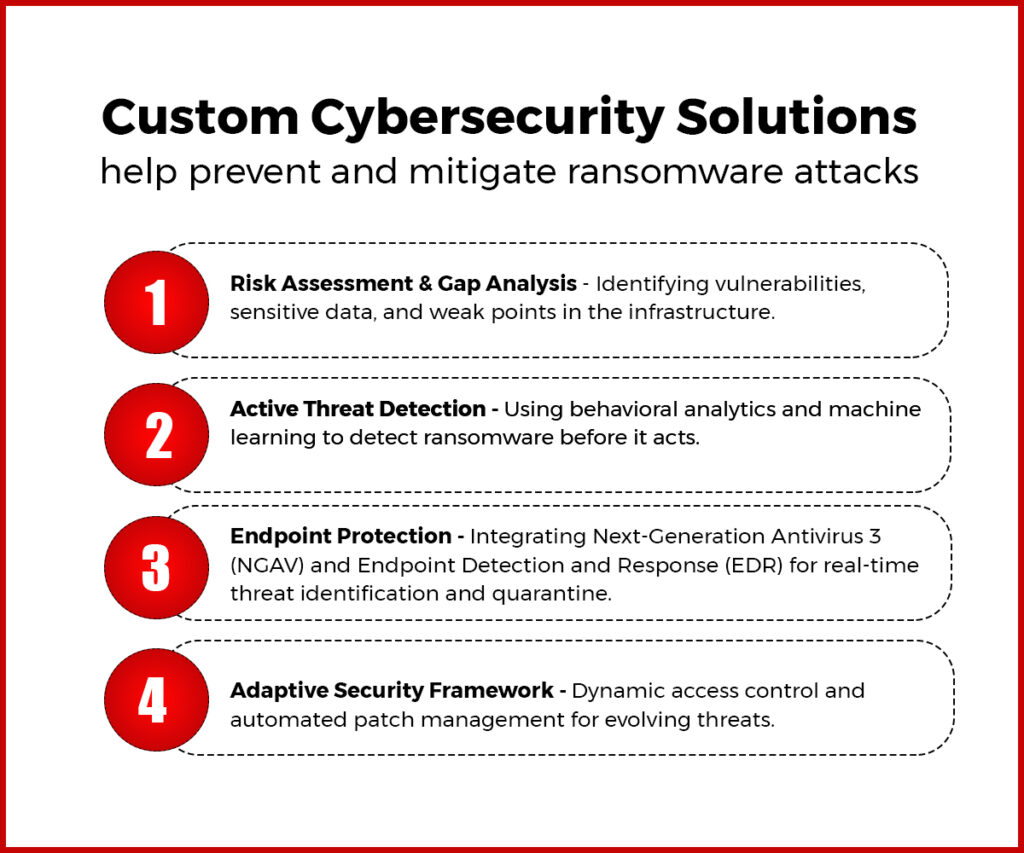
     how custom cybersecurity solutions help prevent and mitigate ransomware attacks?

    Key Features of Custom Cybersecurity Solutions That Fight Ransomware

    1. Risk Assessment and Gap Analysis

    Custom cybersecurity solutions start with thoroughly analysing an organization’s security position. This entails:

    • Asset Identification: Organizations must identify key data and systems that need increased security. These are sensitive customer data, intellectual property, and business data that, if breached, would have devastating effects.
    • Vulnerability Analysis: By doing this analysis, organizations determine vulnerabilities like old software, misconfiguration, or exposed endpoints that ransomware can target. This ensures that security solutions are designed to counter specific risks instead of general protection.

    The result of such intensive evaluation guides the creation of focused security measures that are more efficacious for countering ransomware attacks.

    2. Active Threat Detection

    Custom-made security solutions incorporate the best detection features designed to detect ransomware behaviour before its ability to act. The integral parts are:

    • Behavioral Analytics: These platforms track user and system activity for signs of anomalies suggesting ransomware attempts. For instance, unexpected peaks in file encryption activity or unusual access patterns may indicate a threat.
    • Machine Learning Models: Using machine learning algorithms, organizations can forecast patterns of attacks using historical data and developing trends. These models learn continuously from fresh data, and their capacity to identify threats improves with time.

    This proactive strategy allows organizations to recognize and break up ransomware attacks at the initial phases of the attack cycle, significantly reducing the likelihood of data loss or business disruption.

    3. Endpoint Protection

    Endpoints—laptops, desktops, and servers—are common entry points for ransomware attacks. Customized solutions utilize aggressive endpoint protection that involves:

    • Next-Generation Antivirus (NGAV): Compared to traditional signature-based detection-based antivirus solutions, NGAV applies behaviour-based detection mechanisms for identifying known and unknown threats. This is necessary to identify new ransomware strains that have not received signatures.
    • Endpoint Detection and Response (EDR): EDR solutions scan endpoints in real-time for any suspicious activity and can quarantine a compromised endpoint automatically from the network. Containing this way prevents ransomware from spreading throughout the networks of an organization.

    By putting endpoint security first, bespoke cybersecurity solutions protect against ransomware attacks by making possible entry points secure.

    4. Adaptive Security Framework

    Custom solutions are created to adapt to developing threats to maintain ongoing protection through:

    • Dynamic Access Controls: These controls modify users’ permissions according to up-to-the-minute risk evaluations. For instance, if a user is exhibiting unusual behaviour—such as looking at sensitive files outside regular working hours—the system can restrict their access temporarily until further verification is done.
    • Automated Patch Management: One must stay current with updates to address vulnerabilities that ransomware can exploit. Automated patch management maintains all systems up to the latest security patches without manual intervention.

    This dynamic system enables companies to defend themselves against changing ransomware strategies.

    Zero Trust Architecture (ZTA) – A Key Strategy Against Ransomware

    The Zero Trust Architecture cybersecurity functions on the “never trust, always verify” paradigm. It removes implicit network trust by insisting on ongoing authentication and rigorous access controls on all users, devices, and applications. This makes it highly effective against ransomware because of its focus on reducing trust and verifying all requests to access.

    Key Features of ZTA That Counteract Ransomware

    1. Least Privilege Access

    Ransomware usually takes advantage of over permissions to propagate within networks. ZTA implements least privilege policies through:

    • Limiting User Access: Users are given access only to resources required for their functions. This reduces the impact if an account is compromised.
    • Dynamic Permission Adjustments: Permissions are adjustable by contextual properties like location or device health. For instance, if a user is trying to view sensitive information from an unknown device or location, their access can be denied until additional verification is done.

    This tenet significantly lessens the chances of ransomware spreading within networks.

    2. Micro-Segmentation

    ZTA segments networks into smaller zones or segments; each segment must be authenticated separately. Micro-segmentation restricts the spread of ransomware attacks by:

    • Isolating Infected Systems: When a system is infected with ransomware, micro-segmentation isolates the system from other areas of the network, eliminating lateral movement and further infection.
    • Controlled Segmentation Between Segments: Each segment may have its access controls and monitoring mechanisms installed, enabling more detailed security controls specific to types of data or operations.

    By using micro-segmentation, organizations can considerably lower the risk of ransomware attacks.

    3. Continuous Verification

    In contrast to legacy models that authenticate users one time upon login, ZTA demands continuous verification throughout a session.

    • Real-Time Authentication Verifications: Ongoing checks ensure that stolen credentials cannot be utilized in the long term. If suspicious activity is noted within a user session—e.g., access to unexpected resources—the system may request re-authentication or even deny access.
    • Immediate Access Denial: If a device or user acts suspiciously with signs of a possible ransomware attack (e.g., unexpected file changes), ZTA policies can deny real-time access to stop the damage.

    This ongoing validation process strengthens security by ensuring only valid users retain access during their interactions with the network.

    4. Granular Visibility

    ZTA delivers fine-grained visibility into network activity via ongoing monitoring:

    • Early Ransomware Attack Detection: Through monitoring for off-the-book data transfers or unusual file access behaviour, organizations can recognize early indications of ransomware attacks before they become full-fledged incidents.
    • Real-Time Alerts: The design sends real-time alerts for anomalous activity so that security teams can react promptly to suspected threats and contain threats before they cause critical harm.

    This level of visibility is essential to ensuring an effective defence against advanced ransomware techniques.

    Why Custom Cybersecurity Solutions and Zero Trust Architecture Are Best Against Ransomware?

    1. Holistic Security Coverage

    Custom cybersecurity solutions target organization-specific threats by applying defences to individual vulnerabilities. Zero Trust Architecture delivers generic security guidelines for all users, devices, and applications. They offer complete protection against targeted attacks and more general ransomware campaigns.

    2. Proactive Threat Mitigation

    Custom solutions identify threats early via sophisticated analytics and machine learning algorithms. ZTA blocks unauthorized access completely via least privilege policies and ongoing verification. This two-layered method reduces opportunities for ransomware to enter networks or run successfully.

    3. Minimized Attack Surface

    Micro-segmentation in ZTA eliminates lateral movement opportunities across networks, and endpoint protection in bespoke solutions secures shared entry points against exploitation. Together, they cut the general attack surface for ransomware perpetrators drastically.

    4. Scalability and Flexibility

    Both models fit in perfectly with organizational expansion and evolving threat horizons:

    • Bespoke solutions change through dynamic security controls such as adaptive access controls.
    • ZTA scales comfortably across new users/devices while it enforces rigid verification processes.

    In tandem, they deliver strong defences regardless of organizational size or sophistication.

    Conclusion

    Ransomware threats are a serious concern as they target weaknesses in security systems to demand ransom for data recovery. To defend against these threats, organizations need a strategy that combines specific protection with overall security measures. Custom cybersecurity solutions from SCS Tech provide customised defenses that address these unique risks, using proactive detection and flexible security structures.

    At the same time, zero trust architecture improves security by requiring strict verification at every step. This reduces trust within the network and limits the areas that can be attacked through micro-segmentation and continuous authentication. When used together, these strategies offer a powerful defense against ransomware, helping protect organizations from threats and unauthorized access.

  • Best security tips to avoid a cyber breach

    Best security tips to avoid a cyber breach

    Preventing cyber data breaches is the best defense against the nightmare and expense that comes with them. Nevertheless, you must first identify them in order to be able to stop a data breach. The sorts and costs of data breaches you could experience as a small- to medium-sized business owner are described below, along with tips on how to avoid them.

    When hackers gain access to data and sensitive information, data breaches occur. These breaches are very expensive. According to a data report, the average cost of a data breach is around $3.86 million that too in addition to the irreparable harm to an organization’s reputation. It costs time as well. The identifying of the cause and reprimanding it usually takes up to 280 days.

    You can use a variety of high-level security techniques, such as AI and prepared incident response teams, to stop a data breach. Let’s dig deep into that!

    Limit access to your valuable data –

    Every employee used to have access to all of the files on their computer back in the day. Companies today are discovering the hard way how important it is to restrict access to their most important data. A mailroom employee has no need to see a customer’s financial information, after all. By limiting who is permitted to read specific papers, you reduce the number of workers who might unintentionally click on a hazardous link. Expect to see all records partitioned off as organisations go into the future so that only those who specifically require access will have it. One of those obvious fixes that businesses probably ought to have implemented sooner rather than later.

    Security policy with third party vendors –

    Every firm interacts with a variety of outside vendors. The need to understand who these people are has never been greater. Even permitting visitors onto their property might expose businesses to legal action. It’s necessary to restrict the kinds of documents that these vendors can access.

    Although taking such steps can be a bother for the IT department, the alternative could be a data breach that costs millions of dollars. Demand transparency from the businesses that are permitted to access your sensitive information. Don’t just assume that they are abiding by privacy regulations; verify it. Request background checks for any outside contractors entering your business.

    Employee awareness training –

    Employees are the weakest link in the data security chain, according to recent research. Despite training, workers read dubious emails with the potential to download malware every day. Employers make the error of assuming that one cybersecurity training session is sufficient. Schedule frequent sessions every quarter or even monthly if you’re serious about protecting your crucial data.

    According to marketing studies, the majority of consumers must hear the same message at least seven times before their behaviour starts to change.

    Update Software Regularly–

    Experts advise routinely updating all operating systems and application software. When patches are available, install them. When programmes aren’t constantly patched and updated, your network is exposed. Baseline Security Analyzer, a software from Microsoft, may now be used to periodically check that all programmes are patched and current. This is a simple and affordable solution to fortify your network and thwart attacks before they start.

    Develop a cyber breach response plan –

    What would you do if you discovered a data breach when you arrived to work the following day? Surprisingly few businesses have a reliable breach response strategy in place. Both the company and the employees can understand the potential losses by creating a thorough breach preparedness strategy. Employees want to know the truth; therefore, an employer should be very open about the extent of the violation. A sound response strategy can reduce lost productivity and stop bad press.

    Setting strong passwords –

    One thing that security professionals will emphasise when they visit your organisation to train your staff is the importance of routinely changing all passwords. The majority of people are now aware of how crucial it is to make passwords challenging to crack. We have mastered the use of capital letters, numbers, and special characters when creating passwords, even on our home PCs. Make it as difficult as you can for hackers to enter and steal your belongings.


  • What Is Cyber Risk Management?

    What Is Cyber Risk Management?

    Cyber risk management is the process by which you determine potential cyber threats, and then put measures into place to keep those threats at acceptable levels. Your cyber risk management efforts should be formalized into a plan, which should then be updated often to stay current with evolving cybersecurity threats.

    Considering just how dangerous cyber-criminals can be to your organization, a current cybersecurity framework is no longer just a good idea; it’s required. Cybersecurity risk management is so important that multiple organizations offer guidance and standards to mitigate cyber threats. The National Institute of Standards and Technology (NIST) is one; the International Organization for Standardization (ISO) is another.

    Cybersecurity risk is the likelihood your company might suffer damages because of a successful cyber-attack. This risk includes data breaches, loss of critical information, regulatory enforcement (including monetary penalties) due to a breach, or damage to your reputation after a cybersecurity event. Risk is different from uncertainty in that risk can be measured, and protected against. For example, you can block phishing attempts or build strong firewalls (a risk) but you cannot stop a hurricane from downing your WI-Fi networks for a whole day (uncertainty).

    This means you should evaluate your business several times a year to understand how your company adheres to current information security protocols, and what new threats may have developed since your last analysis. This evaluation is known as a cybersecurity risk assessment. Regular risk assessments will help in implementing a scalable cybersecurity framework for your business.

    What Are the Different Types of Cybersecurity Risk?

    Cybersecurity risks come in many forms, and CISOs should be aware of all them when developing your risk management process. To start, the four most common cyber-attacks are:

    Malware: Malicious software that installs itself that causes abnormal behavior within your information system;
    Phishing: Emails or messages that trick users into revealing personal or sensitive data;
    Man-in-the-Middle attack (MitM): Cyber-criminals eavesdrop on private conversations to steal sensitive information; and
    SQL injection: A string of code is inserted in the server, prompting it to leak private data.

    When building your risk management strategy, prioritize which common cyber incidents you want to prepare for. Strategizing for those most likely to occur within your business, or for those events where regulatory compliance obligates you to address them. Then you can move forward with creating an effective risk management program.

    Why Is Cyber Risk Management Important?

    Your business should always be learning how to adapt to changing cybersecurity standards while also monitoring potential threats.

    A cybersecurity event like an internal data breach or a successful cyber-attack can cause significant financial losses. It can also create disruptions in the day-to-day operations of your business, as you inform employees and customers of the breach and the steps you’ll take in response.

    By maintaining regular cyber risk management you can keep the chances of a cybersecurity event low, protecting your business for the long term.

    What Is the Cybersecurity Risk Management Process?

    Cybersecurity risk management is an ongoing process that involves regular monitoring and frequent analysis of existing security protocols. Generally, a cyber risk manager will work with key stakeholders and decision-makers across the business to draft a cybersecurity risk statement, where potential risks are identified as well as the company’s tolerance for each risk. Then, safety measures and training are matched with each cybersecurity risk.

    The organization then follows policies and procedures in its daily operations to keep cybersecurity threats at a minimum, and the cybersecurity risk manager monitors the overall security posture. From time to time the risk manager should also report on how well security protocols are helping to mitigate cyber risks and potential threats, and make recommendations as necessary to improve security for the evolving threat landscape.

    A follow-up risk assessment may be required to update the risk management strategy currently in place.

    SCS Tech offers cybersecurity services for Large Enterprises and SME’s. Our experts help you navigate your cybersecurity needs as your business scales, whether continuing your current cybersecurity program or building all-new network security.

    To know more about our cybersecurity service visit www.scstechindia.com/

  • Top 5 Reasons Why Cybersecurity is Important

    Top 5 Reasons Why Cybersecurity is Important

    Cyber attacks are widespread, which can harm millions of people. Organizations can be shut down. Services can’t be provided to citizens. Widespread cyber attacks configuration of cloud services with increasing cybercriminal attacks risk the organization and its process.

    The days are gone for simple firewalls antivirus software which helped us to secure our data and identity.

    Cyber threats can arrive from any level of association. Cybersecurity is no longer something any company can ignore. Security regularly affects businesses of all sizes and makes them causing reversible reputational damage to the companies involved.

    Why is cybersecurity critical?

    Cybersecurity is the event or process of recovering and protecting computer systems, devices, networks, and programs from any cyber attack.

    Cyber attacks are increasingly causing danger to your sensitive data, as attackers employ new methods of artificial intelligence and social engineering to your traditional security controls.

    The world is frequently reliant on technology. This dependence will continue as we introduce the next generation of smart internet-enabled devices that have access to our networks via Wi-Fi and Bluetooth.

    Let’s explore its importance:

    1. Cyber-attacks affect all

    Cyber attacks can cause electrical power outages, the disappointment of military equipment, and breaches of national security privileged insights. They can bring about the theft of important, sensitive information like clinical records. They can upset telephone and PC organizations or paralyze frameworks, making information inaccessible.

    Cyber attacks can occur on a worldwide scale, also with programmers breaking government organizations. It is such a danger that atomic plants can be assaulted, causing a nuclear calamity with a considerable number of lives lost. These digital worms made centrifuges heat up and may have caused a blast costing human lives.

    1. Rapid technological change will benefit

    With the launch of the 5G network, a significant expansion of multidimensional cyber attack vulnerability increased. The new system requires a similar redefined cyber strategy. By further stating the increase in cyber attacks of the software, it will be challenging to retool how organizations would save the virtual network of the 21st century. Modern technologies like IoT are increasing the number of devices connected, and there will be approximately 400 billion connected devices by the end of 2022.

    1. Damage to organization and loss of jobs

    There has been a lot of breaches of companies in recent years. Organizations should conduct phishing simulation tests to test the awareness of employees. It should be done initially before and after training to measure the improvement areas of your employees. Creating an incident response strategy will allow organizations to stay ahead of the attack. It will ensure your quick response on the offense to keep the attackers from getting a hold of sensitive data.

    1. Cybersecurity threats faced by individuals

    Not just do countries and organizations face dangers from the actions and intentions of hackers, yet people face numerous risks too. Identity theft is a colossal issue, where hackers steal a person’s very own data and sell it for benefit.

    This likewise puts the individual security of an individual and their family in danger. This happened in various events, and a million of Rs was lost to the detriment of the person in question. In different cases, the programmers use coercion and blackmail in the wake of taking their identity and requesting recover cash to make no further move. This is particularly valid for high-profile identity theft cases of superstars or individuals with high net worth.

    1. Cyber concerns may result in increased regulation and legislation

    With cybersecurity threats increasing, new laws and regulations can be placed to protect the consumer from attacks. It means that increased legislation and regulations may soon become a reality. Citizens need to be made aware of laws that are passed and make sure that their organizations comply with the laws. The laws specified for cybersecurity will result in better functionality and process of the organization resulting in more safe and secure data-driven solutions for clients.

    SCS Tech specializes in designing, building, and running optimized security solutions which help the organization and individuals defend against all cybersecurity attacks. Write to us to learn more about how we can help: info@scstechindia.com