Tag: #dataanalysis

  • How Can Digital Oilfields Reduce Downtime with Oil and Gas Technology Solutions?

    How Can Digital Oilfields Reduce Downtime with Oil and Gas Technology Solutions?

    Unplanned downtime costs the oil and gas industry billions each year. In fact, research shows that companies with a reactive maintenance approach spend 36% more time in downtime than those using data-driven, predictive maintenance strategies. The difference?

    A potential $34 million in annual savings. With such high stakes, it’s no longer a question of whether the oil and gas industry should adopt digital transformation in oil and gas — it’s about how to implement these innovations to maximize efficiency and reduce costly downtime.

    The answer lies in Digital Oilfields (DOFs), which seamlessly integrate advanced technologies to optimize operations, improve asset reliability, and cut costs.

    In this blog, let’s explore how Digital Oilfields revolutionize operations and reshape the future of the oil and gas industry.

    How Does Digital Oilfields Seamless Integration Revolutionize Operations?

    Digital Oilfields solutions implement Industrial IoT (IIoT) for Oil & Gas, real-time analysis, and automation to streamline operations, predict likely breakdowns, and drive peak asset efficiency. Predictive maintenance for Oil & Gas enables firms to visualize equipment in real-time, predict breakdowns in advance, and do everything possible to avoid downtime.

    Digital Oilfield transformation replaced traditional operations with man-critical and reactive modes to data-centered, AI-led decision-making. This improves the oil and gas industry’s safety, sustainability, and profitability. However, the need to understand the key causes of downtime is crucial in addressing these challenges and minimizing operational disruptions.

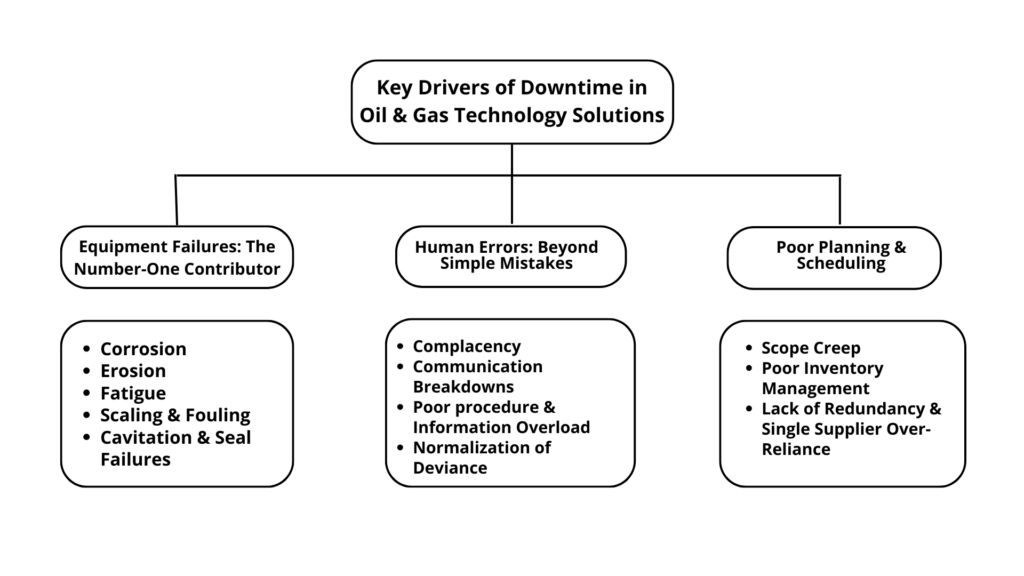
    The Key Drivers of Downtime in Oil & Gas Technology Solutions

    1. Equipment Failures: The Number-One Contributor

    Equipment breakdown is one of the significant sources of unplanned downtime. Several reasons are involved, including:

    • Corrosion: Sour crude (high sulfur) pipelines deteriorate over time by electrochemical action, especially at welds, bends, and dead legs.
    • Erosion: Sand-and-similar-abrasive-content high-speed fluids in fracking erosion erode pump impellers, chokes, and pipes.
    • Fatigue: Alternating pressure changes and vibration fatigue cause pipes to be damaged, usually at stress concentrators and threaded joints.
    • Scaling & Fouling: Mineral (such as calcium carbonate) and organic depositing in heat exchangers and pipes diminishes flow efficiency and causes shutdowns.
    • Cavitation & Seal Failures: Shock waves from collapsing vapor bubbles form when sudden pressure drops create vapor bubbles, which wear out the seals and pump impellers.

    2. Human Errors: Beyond Simple Mistakes

    Human error accounts for most of the oil and gas downtime due to the following:

    • Complacency: Routine work causes operators to overlook warning signs.
    • Communication Breakdowns: Communication breakdowns between operations, maintenance, and engineering personnel can delay problem-solving.
    • Poor Procedures & Information Overload: Inadequate procedures and excessive information overload can lead to misestimation.
    • Normalization of Deviance: Repeatedly exceeding operating limits by a small margin can lead to failures of catastrophic magnitude.

    3. Poor Planning & Scheduling

    Maintenance schedules and turnarounds, if not planned well, can cause downtime due to:

    • Scope Creep: Unplanned expansion of maintenance work that causes delay.
    • Poor Inventory Management: No spares available, resulting in prolonged downtime.
    • Lack of Redundancy & Single Supplier Over-Reliance: Supply chain interruption can bring operations to a standstill.

    With these major challenges in mind, the next logical step is understanding how Digital Oilfields tackle them.
     Key Drivers of Downtime in Oil & Gas Technology Solutions

    How Digital Oilfields Minimize Downtime?

    1. Real-Time Monitoring with Industrial IoT in Oil & Gas

    The newest IoT sensors bring critical information about equipment conditions so that proactive maintenance practices can be exercised. Some of those are:

    • Vibration Sensors: Picks up pump and compressor misalignments and bearing wear.
    • Acoustic Sensors: Picks up pipeline and pressure system leaks by detecting ultrasonic noises.
    • Corrosion Probes: Quantifies corrosion type, rate, and causative factors for effective mitigation.
    • Multiphase Flow Meters: Offers precise measurement of oil, gas, and water flow rates to prevent slugging and optimize production.

    2. Predictive Maintenance in Oil & Gas: AI-Driven Insights

    Artificial Intelligence (AI) and as well as Machine Learning (ML) based predictive analytics allow companies to predict failures before their occurrence. Some of the key applications are:

    • Failure Prediction Models: AI models consider historical failure records to predict the future failure of equipment.
    • Remaining Useful Life (RUL) Estimation: Machine learning estimates the time before a component fails, allowing for proper maintenance planning.
    • Anomaly Detection: Detects deviations in normal operating conditions, indicating future problems.
    • Prescriptive Analytics: Provides accurate recommendations for proactive actions to optimize equipment life.

    3. Automation & Remote Operations: Reduction of Human Error

    • Automated Control Systems: Allows operating conditions (e.g., temperature, flow rates, pressures) to be managed with real-time feedback.
    • Robotic Inspections: Robotic scanning of pipes and offshore rigs reduces human exposure to hazardous conditions.
    • Remote Monitoring & Control Centers: Operators remotely manage Assets from centralized facilities for enhanced productivity and savings.

    4. Digital Twins: Virtual Copies to Optimize

    Digital Twins are virtual copies of physical assets using AI to imitate real-time operations which include:

    • Real-Time Data Sync: Synchronizes with real-time sensor inputs in real-time.
    • Scenario Planning & Training: Mimics several operating scenarios to predict simulation and train operators.

    5. Advanced Digital Oilfield Technologies

    • Tank & LPG Level Monitors: Detect leaks and temperature stratification and predict evaporation/condensation rates.
    • Smart Flow Meters: Recognize multiphase flows and detect anomalies.
    • Thief Hatch Sensors: Recognize intrusions and monitor gas emissions.

    Conclusion

    The oil and gas industry is an area of convergence where industrial IoT, predictive maintenance, and automation are no longer a necessity. As digital oilfields offer more than digitization, they represent a shifting paradigm that decreases downtime, enhances safety, and delivers improved profitability.

    Therefore, businesses with digital oilfields can leverage the real potential of oil and gas technology solutions by using analytics, real-time monitoring, and AI-driven automation.

    With this technology, businesses can hence achieve operational excellence and success in the long run. SCS Tech supports oil and gas companies with cutting-edge digital solutions to re-imagine their businesses to be efficient, resilient, and industry-fit for the future.
  • How big data can make a big difference for your business

    How big data can make a big difference for your business

    Table of Contents

    Big Data and Analytics: What Are They?

    Who utilises the Analytics and Big Data?

    Impressive Advantages of Big Data and Analytics


    Although the idea of big data has been around for a while, the world of business has only lately been transformed by big data. The majority of firms are now aware of how to collect the vast amounts of data that continuously flow into their operations and use analytics to turn it into useful insights. Given its advantages, big data and analytics are now a must-have for any organisation intending to maximise its commercial potential.

    Businesses are able to collect information from customers at every stage of their journey. The use of mobile apps, online clicks, social media activities, and other data could be included in this information. Together, these factors create a data fingerprint that is fully individual to its owner. Expectations have increased as a result of the change in customer social norms.

    Big Data and Analytics: What Are They?

    A massive amount of data, including both organised and unorganised information from multiple sources, is referred to as “Big Data.” Traditional data processing software cannot acquire, handle, or process these datasets because of their size. Complex large data can be leveraged to solve previously intractable business issues.

    Big data is sometimes defined by the three Vs: data with a wide variety, coming in large volumes, and moving quickly. The information may originate from openly available resources such as websites, social media, the cloud, mobile apps, sensors, and other hardware. Businesses can see consumer information including purchase history, searches made or videos viewed, likes and hobbies, and more by accessing this data. Big data analytics examines data using analytical approaches to uncover information such as occult patterns, correlations, market trends, and consumer preferences. As a result, analytics support businesses in making wise decisions that result in effective operations, content customers, and higher profitability.

    Who utilises the Analytics and Big Data?

    Big Data and analytics are being used by large corporations throughout the world for immense success. Businesses of all sizes and in all sectors can profit from using big data successfully. Organisations are coming under more and more pressure from the competition to not only attract potential customers, but also to comprehend those clients’ demands in order to improve the client experience and forge enduring bonds. Customers interact with businesses through a variety of channels on a regular basis, so it is necessary to combine traditional and digital data sources to comprehend customer behaviour. Among the advantages of big data and analytics are improved decision-making, greater innovation, and product price optimisation.

    Impressive Advantages of Big Data and Analytics  

    1. Customer Acquisition and Retention

    The digital footprints of customers reveal a lot about their preferences, needs, purchase behavior, etc. Businesses can use big data to observe consumer patterns and then tailor their products and services according to specific customer needs. This goes a long way to ensure customer satisfaction, loyalty, and ultimately a considerable boost in sales.

    1. Risk and fraud mitigation:

    Security and fraud analytics work to prevent the exploitation of all material, financial, and intellectual assets by both internal and external threats. Optimal levels of fraud prevention and overall organisational security will be delivered by effective data and analytics capabilities: mechanisms that enable businesses to quickly identify potentially fraudulent activity, predict future activity, as well as identify and track perpetrators.

    1. Innovate

    Innovation relies on the insights you may uncover through big data analytics. Big data enables you to both innovate new products and services while updating ones that already exist. The vast amount of data gathered aids firms in determining what appeals to their target market. Product development can be aided by knowing what consumers think about your goods and services.

    The information can also be utilised to change corporate plans, enhance marketing methods, and boost employee and client satisfaction.

    1. Customization and Engagement

    Structured data is still a challenge for businesses, and they now need to be particularly responsive to deal with the volatility brought on by customers interacting with digital technology. Advanced analytics are the only way to respond quickly and provide customers a sense of personal value. Big data offers the chance for interactions to be tailored to the personality of the client by comprehending their attitudes and taking into account aspects like real-time location to help deliver personalization in a multi-channel service environment.

    1. Enhanced Productivity

    Big data tools have the potential to increase operational effectiveness. Your interactions with consumers and their insightful feedback enable you to gather significant volumes of priceless customer data. Analytics can then uncover significant trends in the data to produce products that are unique to the customer. In order to provide employees more time to work on activities demanding cognitive skills, the tools can automate repetitive processes and tasks.

    1. Promoting & Boosting Customer Experience

    In order to meet customer expectations and achieve operational excellence, business processes must be designed, controlled, and optimised using analytics. This ensures efficiency and effectiveness.

    Advanced analytical methods can be used to increase the productivity and efficiency of field operations as well as organise a workforce in accordance with consumer demand and company needs. The most effective use of data and analytics will also guarantee that ongoing continuous improvements are implemented as a result of end-to-end visibility and monitoring of important operational parameters.

  • Need your business to thrive? Learn about key benefits of Data Analysis

    Need your business to thrive? Learn about key benefits of Data Analysis

    Today’s global marketplaces revolve on data, making sense of that data is essential to a company’s success. Failing to do so can result in a company falling behind.

    On its own, raw data doesn’t have much value. To leverage data to their advantage, businesses must apply data analytics, a discipline that systematically examines data in order to discover insights, patterns, and trends. Most businesses are aware of the potential rewards of investing in big data analytics, which promise to increase productivity, reduce costs, and improve decision-making. A recent survey by Micro Strategy found that businesses all across the world use their data for:

    • According to 90% of the business users who took part, their organization’s digital transformation strategies revolve around data and analytics
    • To increase their operations’ cost-effectiveness and process efficiency by up to 60%
    • 57% of businesses say they use data analytics to inform strategy and transformation
    • 52% of businesses use business analytics to track and enhance their financial performance

    What is Data Analysis?

    As a broad phrase, the processing of unstructured data to discover business insights is referred to as data analytics. It makes use of a variety of methods, procedures, statistics, and models. By definition, it is essentially a procedure for looking into raw data in order to derive significant insights. However, the development of AI and ML has caused the area of data analytics to advance at a rapid rate, reaching new heights.

    Usually, the purpose of data analytics is to give a business operational insights. This procedure entails reviewing historical data before applying the lessons discovered within to address the challenging business issues of the present.

    Despite the fact that big data analytics delivers value in a variety of ways, the following are some of its main advantages:

    • Quicker and wiser decision-making: businesses may quickly analyse massive amounts of data and come to wise judgements.
    • Cost savings: using big data technology, businesses can find better methods to conduct their operations and offer a cost-effective data storage solution.
    • A deeper comprehension of customer’s needs: big data reveals insights that assist businesses in identifying customer requirements and assessing satisfaction. This provides businesses with the knowledge they require to create long-lasting client relationships and provide higher-quality goods and services.

    The current state of Data Analysis & Business Intelligence

    For businesses to succeed in the digital economy, data is becoming more and more important. Up to 80% of businesses rely on data for a variety of operations, including product management, fraud detection, finance, human resources, and manufacturing. Data dashboards and visualisations are common in the modern workplace, enabling users to quickly follow performance measures using pre-built reports and filters.

    Organisations could find a wealth of potential hidden in their current systems with the use of data integration technologies. There is a lot of friction in analytics right now. Spreadsheets are frequently used by data workers, who typically utilise four to seven different applications to manage data. This takes a lot of time and increases the risk of errors and data compliance problems. Organisations must find a solution that unifies all data-related activities into a single platform, provides end-to-end data protection and traceability, and is simple for employees to use if they are to reap the greatest benefits from big data.

    How to select right data analytic tools for your business?

    Due to innovative methods like machine learning algorithms, the field of data analytics is expanding to unprecedented heights. Four categories of business analytics currently are:

    • Descriptive analytics
    • Diagnostic analytics
    • Predictive analytics
    • Prescriptive analytics

    It’s challenging to compile a comprehensive list of selection criteria for big data because it applies to such a wide range of use cases, applications, and industries. Build your toolset around the main objectives by focusing on the few business issues or opportunities that will have the most impact, such as real-time asset monitoring or a deeper comprehension of what your customers want.

    Big Data integration tools assist businesses in dismantling data ecosystem silos. When working with data gathered from a variety of IoT endpoints, apps, and data kinds, they are an essential tool for managing and storing data clusters. Although data integration solutions occasionally include stream analytics functionality, they are typically more appropriate for data management.

    It is possible to transform new data into actions. Partner with us to know more about best practices in data analysis. To contact us visit SCS Tech India.