Tag: Digital Transformation

  • How AI & ML Are Transforming Digital Transformation in 2026

    How AI & ML Are Transforming Digital Transformation in 2026

    Digital transformation has evolved from a forward-looking strategy into a fundamental requirement for operational success. As India moves deeper into 2026, organizations across industries are recognizing that traditional digital transformation approaches are no longer enough. What truly accelerates transformation today is the integration of Artificial Intelligence (AI) and Machine Learning (ML) into core business systems.

    Unlike earlier years, where AI was viewed as an advanced technology reserved for innovation labs, it is now embedded in everyday operational workflows. Whether it’s streamlining supply chains, automating customer interactions, predicting equipment failures, or enhancing cybersecurity, AI and ML are enabling organizations to move from reactive functioning to proactive, intelligent operations.

    In this blog, we explore how AI and ML are reshaping digital transformation in 2026, what trends are driving adoption, and how enterprises in India can leverage these technologies to build a future-ready business.

    AI & ML: The Foundation of Modern Digital Transformation

    AI and ML have become the backbone of digital transformation because they allow organizations to process large amounts of data, identify patterns, automate decisions, and optimize workflows in real time. Companies are no longer implementing AI as an “optional enhancement” — instead, AI is becoming the central engine of digital operations.

    At its core, AI-powered digital transformation enables companies to achieve what previously required human intervention, multiple tools, and considerable resources. Now, tasks that once took hours or days can be completed within minutes, and with far higher accuracy.

    AI & ML empower enterprises to:

    • Improve decision-making through real-time insights

    • Understand customer behavior with greater precision

    • Optimize resources and reduce operational waste

    • Enhance productivity through intelligent automation

    • Strengthen cybersecurity using predictive intelligence

    This shift toward AI-first strategies is defining the competitive landscape in 2026.

    Key AI & ML Trends Driving Digital Transformation in 2026

    AI capabilities are expanding rapidly, and these advancements are shaping how organizations modernize their digital ecosystems. The following trends are particularly influential this year.

    a) Hyper-Automation as the New Operational Standard

    Hyper-automation integrates AI, ML, and RPA to automate complex business processes end-to-end. Organizations are moving beyond basic automation to create fully intelligent workflows that require minimal manual oversight.

    Many enterprises are using hyper-automation to streamline back-office operations, accelerate service delivery, and reduce human errors. For instance, financial services companies can now process loan applications, detect fraud, and verify customer documents with near-perfect accuracy in a fraction of the usual time.

    Businesses rely on hyper-automation for:

    • Smart workflow routing

    • Automated document processing

    • Advanced customer onboarding

    • Predictive supply chain operations

    • Real-time process optimization

    The efficiency gains are substantial, often reducing operational costs by 20–40%.

    b) Predictive Analytics for Data-Driven Decision Making

    Data is the most valuable asset of modern enterprises — but it becomes meaningful only when organizations can interpret it accurately. Predictive analytics enables businesses to forecast events, trends, and behaviors using historical and real-time data.

    In 2026, predictive analytics will be used across multiple functions. Manufacturers rely on it to anticipate machine breakdowns before they occur. Retailers use it to forecast demand fluctuations. Financial institutions apply it to assess credit risks with greater accuracy.

    Predictive analytics helps organizations:

    • Reduce downtime

    • Improve financial planning

    • Understand market movements

    • Personalize customer experiences

    • Prevent operational disruptions

    Companies that adopt predictive analytics experience greater agility and competitiveness.

    c) AI-Driven Cybersecurity and Threat Intelligence

    As organizations expand digitally, cyber threats have grown more complex. With manual monitoring proving insufficient, AI-based cybersecurity solutions are becoming essential.

    AI enhances security by continuously analyzing network patterns, identifying anomalies, and responding to threats instantly. This real-time protection helps organizations mitigate attacks before they escalate.

    AI-powered cybersecurity enables:

    • Behavioral monitoring of users and systems

    • Automated detection of suspicious activity

    • Early identification of vulnerabilities

    • Prevention of data breaches

    • Continuous incident response

    Industries such as BFSI, telecom, and government depend heavily on AI-driven cyber resilience.

    d) Intelligent Cloud Platforms for Scalability and Efficiency

    The cloud is no longer just a storage solution — it has become an intelligent operational platform. Cloud service providers now integrate AI into the core of their services to enhance scalability, security, and flexibility.

    AI-driven cloud systems can predict demand, allocate resources automatically, and detect potential failures before they occur. This results in faster applications, reduced costs, and higher reliability.

    Intelligent cloud technology supports digital transformation by enabling companies to innovate rapidly without heavy infrastructure investments.

    e) Generative AI for Enterprise Productivity

    Generative AI (GenAI) has revolutionized enterprise workflows. Beyond creating text or images, GenAI now assists in tasks such as documentation, coding, research, and training.

    Instead of spending hours creating technical manuals, training modules, or product descriptions, employees can now generate accurate drafts within minutes and refine them as needed.

    GenAI enhances productivity through:

    • Automated content generation

    • Rapid prototyping and simulations

    • Code generation and debugging

    • Data summarization and analysis

    • Knowledge management

    Organizations using GenAI report productivity improvements of 35–60%.

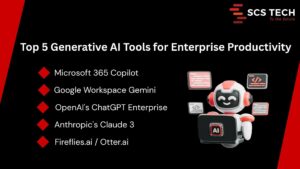
    Generative AI Tools for Enterprise Productivity

    How AI Is Transforming Key Industries in India

    AI adoption varies across industries, but the impact is widespread and growing. Below are some sectors experiencing notable transformation.

    Healthcare

    AI is revolutionizing diagnostics, patient management, and clinical decision-making in India.
    Hospitals use AI-enabled tools to analyze patient records, medical images, and vital signs, helping doctors make faster and more accurate diagnoses.

    Additionally, predictive analytics helps healthcare providers anticipate patient needs and plan treatments more effectively. Automated hospital management systems further improve patient experience and reduce administrative workload.

    Banking & Financial Services (BFSI)

    The BFSI sector depends on AI for security, customer experience, and operational efficiency.
    Banks now use AI-based systems to detect fraudulent transactions, assess creditworthiness, automate customer service, and enhance compliance.

    With the rise of digital payments and online banking, AI enables financial institutions to maintain trust while delivering seamless customer experiences.

    Manufacturing

    Manufacturers in India are integrating AI into production lines, supply chain systems, and equipment monitoring.
    AI-driven predictive maintenance significantly reduces downtime, while computer vision tools perform real-time quality checks to maintain consistency across products.

    Digital twins — virtual replicas of physical systems — allow manufacturers to test processes and optimize performance before actual deployment.

    Retail & E-Commerce

    AI helps retail companies understand customer preferences, forecast demand, manage inventory, and optimize pricing strategies.
    E-commerce platforms use AI-powered recommendation engines to deliver highly personalized shopping experiences, leading to higher conversion rates and increased customer loyalty.

    Government & Smart Cities

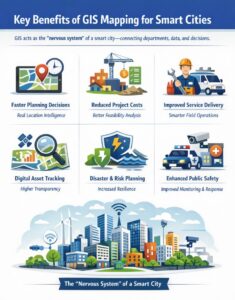
    Smart city initiatives across India use AI for traffic management, surveillance, GIS mapping, and incident response.
    Government services are becoming more citizen-friendly by automating workflows such as applications, approvals, and public queries.

    Benefits of AI & ML in Digital Transformation

    AI brings measurable improvements across multiple aspects of business operations.

    Key benefits include:

    • Faster and more accurate decision-making

    • Higher productivity through automation

    • Reduction in operational costs

    • Enhanced customer experiences

    • Stronger security and risk management

    • Increased agility and innovation

    These advantages position AI-enabled enterprises for long-term success.

    Challenges Enterprises Face While Adopting AI

    Despite its potential, AI implementation comes with challenges.

    Common barriers include:

    • Lack of AI strategy or roadmap

    • Poor data quality or fragmented data

    • Shortage of skilled AI professionals

    • High initial implementation costs

    • Integration issues with legacy systems

    • Concerns around security and ethics

    Understanding these challenges helps organizations plan better and avoid costly mistakes.

    How Enterprises Can Prepare for AI-Powered Transformation

    Organizations must take a structured approach to benefit fully from AI.

    Steps to build AI readiness:

    • Define a clear AI strategy aligned with business goals

    • Invest in strong data management and analytics systems

    • Adopt scalable cloud platforms to support AI workloads

    • Upskill internal teams in data science and automation technologies

    • Start small—test AI in pilot projects before enterprise-wide rollout

    • Partner with experienced digital transformation providers

    A guided, phased approach minimizes risks and maximizes ROI.

    Why Partner with SCS Tech India for AI-Led Digital Transformation?

    SCS Tech India is committed to helping organizations leverage AI to its fullest potential. With expertise spanning digital transformation, AI/ML engineering, cybersecurity, cloud technology, and GIS solutions, the company delivers results-driven transformation strategies.

    Organizations choose SCS Tech India because of:

    • Proven experience across enterprise sectors

    • Strong AI and ML development capabilities

    • Scalable and secure cloud and data solutions

    • Deep expertise in cybersecurity

    • Tailored transformation strategies for each client

    • A mature, outcome-focused implementation approach

    Whether an enterprise is beginning its AI journey or scaling across departments, SCS Tech India provides end-to-end guidance and execution.

    Wrapping Up!

    AI and Machine Learning are redefining what digital transformation means in 2026. These technologies are enabling organizations to move faster, work smarter, and innovate continuously. Companies that invest in AI today will lead their industries tomorrow.

    Digital transformation is no longer just about adopting new technology — it’s about building an intelligent, agile, and future-ready enterprise. With the right strategy and partners like SCS Tech India, businesses can unlock unprecedented levels of efficiency, resilience, and growth.

  • How to Audit Your Existing Tech Stack Before Starting a Digital Transformation Project

    How to Audit Your Existing Tech Stack Before Starting a Digital Transformation Project

    Before you begin any digital transformations, you need to see what you’ve got. Most teams are using dozens of tools throughout their departments, and for the most part, they are underutilized, do not connect with one another, or are not in alignment with the current objectives. 

    The tech stack audit is what helps you identify your tools, how they fit together, and where you have gaps or threats. If you haven’t done this process, even the best digital plans can wilt due to slowdowns, increased expenses, or breaches of security.

    This guide guides you step-by-step in how to do an audit of your stack properly, so your digital transformation starts from a good foundation, not with new software.

    What Is a Tech Stack Audit?

    A tech stack audit reviews all the software, platforms, and integrations being used in your business. It checks how well these components integrate, how well they execute, and how they align with your digital transformation goals.

    A fragmented or outdated stack can slow progress and increase risk. According to Struto, outdated or incompatible tools “can hinder performance, compromise security, and impede the ability to scale.”

    Poor data, redundant tools, and technical debt are common issues. Poor team morale and inefficiencies ensue, according to Brightdials, as stacks become unstructured or unmaintained.

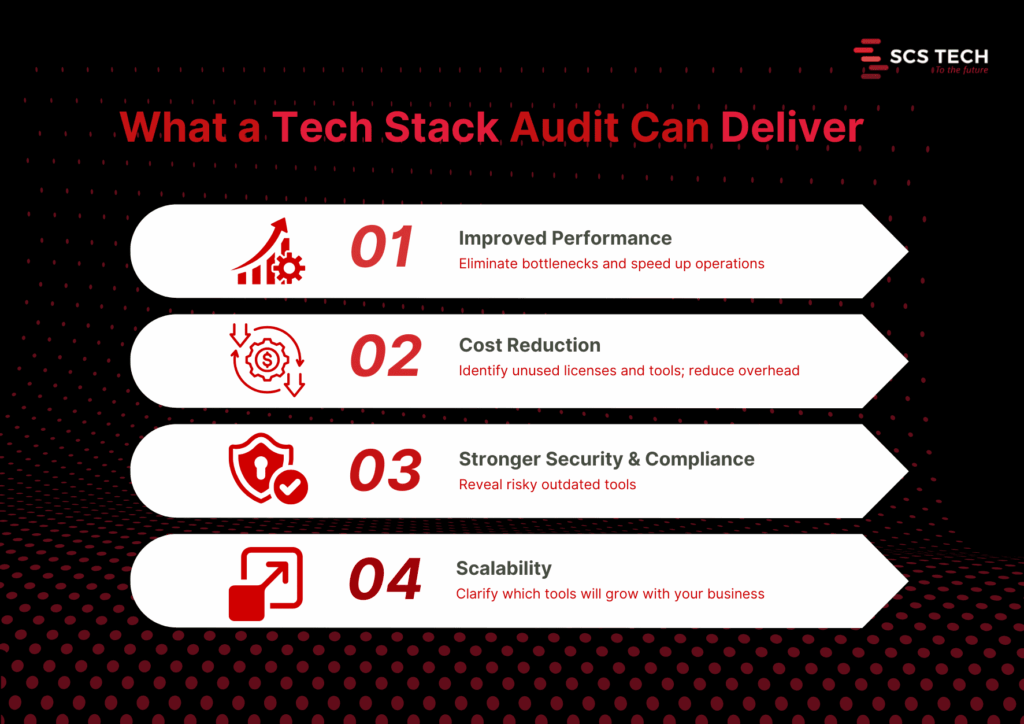
    Core benefits of a thorough audit

    1. Improved performance. Audits reveal system slowdowns and bottlenecks. Fixing them can lead to faster response times and higher user satisfaction. Streamlining outdated systems through tech digital solutions can unlock performance gains that weren’t previously possible.
    2. Cost reduction. You may discover unneeded licenses, redundant software, or shadow IT. One firm saved $20,000 annually after it discovered a few unused tools.
    3. Improved security and compliance. Auditing reveals stale or exposed pieces. It avoids compliance mistakes and reduces the attack surface.
    4. Better scalability and future-proofing. An audit shows what tools will be scalable with growth or need to be replaced before new needs drive them beyond their usefulness.

    Step-by-Step Process to Conduct a Tech Stack Audit

    It is only logical to understand what you already have and how well it is working before you begin any digital transformation program. The majority of organizations go in for new tools and platforms without checking their current systems properly. That leads to problems later on.

    A systematic tech stack review makes sense. It will inform you about what to keep, what to phase out, and what to upgrade. More importantly, it ensures your transformation isn’t based on outdated, replicated, or fragmented systems.

    The following is the step-by-step approach we suggest, in the way that we assist teams in getting ready for effective, low-risk digital transformation.

    Step 1: Create a Complete Inventory of Your Tech Stack

    Start by listing every tool, platform, and integration your organization currently uses. This includes everything from your core infrastructure (servers, databases, CRMs, ERPs) to communication tools, collaboration apps, third-party integrations, and internal utilities developed in-house.

    And it needs to be complete, not skimpy.

    Go by department or function. So:

    • Marketing may be employing an email automation tool, a customer data platform, social scheduling apps, and analytics dashboards.
    • Sales can have CRM, proposal tools, contract administration, and billing integration.
    • Operations can have inventory platforms, scheduling tools, and reporting tools.
    • IT will deal with infrastructure, security, endpoint management, identity access, and monitoring tools.

    Also account for:

    • Licensing details: Is the tool actively paid for or in trial phase?
    • Usage level: Is the team using it daily, occasionally, or not at all?
    • Ownership: Who’s responsible for managing the tool internally?
    • Integration points: Does this tool connect with other systems or stand alone?

    Be careful to include tools that are rarely talked about, like those used by one specific team, or tools procured by individual managers outside of central IT (also known as shadow IT).

    A good inventory gives you visibility. Without it, you will probably go about attempting to modernize against tools that you didn’t know were still running or lose the opportunity to consolidate where it makes sense.

    We recommend keeping this inventory in a shared spreadsheet or software auditing tool. Keep it up to date with all stakeholders before progressing to the next stage of the audit. This is often where a digital transformation consultancy can provide a clear-eyed perspective and structured direction.

    Step 2: Evaluate Usage, Cost, and ROI of Each Tool

    Having now made a list of all tools, the next thing is to evaluate if each one is worth retaining. This involves evaluating three things: how much it is being used, its cost, and what real value it provides.

    Start with usage. Talk to the teams who are using each one. Is it part of their regular workflow? Do they use one specific feature or the whole thing? If adoption is low or spotty, it’s a flag to go deeper. Teams tend to stick with a tool just because they know it, more than because it’s the best option.

    Then consider the price. That is the direct cost, such as subscription, license, and renewal. But don’t leave it at that. Add concealed costs: support, training, and the time wasted on troubleshooting. Two resources might have equal initial costs, but the resource that delays or requires constant aid has a higher cost.

    Last but not least, emphasize ROI. This is usually the neglected section. A tool might be used extensively and cheaply, yet it does not automatically mean it performs well. Ask:

    • Does it help your team accomplish objectives faster?
    • Has efficiency or manual labor improved?
    • Has an impact been made that can be measured, e.g., faster onboarding, better customer response time, or cleaner data?

    You don’t need complex math for this—just simple answers. If a tool is costing more than it returns or if a better alternative exists, it must be tagged for replacement, consolidation, or elimination.

    A digital transformation consultant can help you assess ROI with fresh objectivity and prevent emotional attachment from skewing decisions. This ensures that your transformation starts with tools that make progress and not just occupy budget space.

    Step 3: Map Data Flow and System Integrations

    Start by charting how data moves through your systems. How does it begin? Where does it go next? What devices send or receive data, and in what format? This is to pull out the form behind your operations, customer journey, reporting, collaboration, automation, etc.

    Break it up by function:

    • Is your CRM feeding back to your email system?
    • Is your ERP pumping data into inventory or logistics software?
    • How is data from customer support synced with billing or account teams?

    Map these flows visually or in a shared document. List each tool, the data it shares, where it goes, and how (manual export, API, middleware, webhook, etc.).

    While doing this, ask the following:

    • Are there any manual handoffs that slow things down or increase errors?
    • Do any of your tools depend on redundant data entry?
    • Are there any places where data needs to flow but does not?
    • Are your APIs solid, or are they perpetually patch-pending to keep working?

    This step tends to reveal some underlying problems. For instance, a tool might seem valuable when viewed in a vacuum but fails to integrate properly with the remainder of your stack, slowing teams down or building data silos.

    You’ll also likely find tools doing similar jobs in parallel, but not communicating. In those cases, either consolidate them or build better integration paths.

    The point here isn’t merely to view your tech stack; it’s to view how integrated it is. Uncluttered, reliable data flows are one of the best indications that your company is transformation-ready.

    Step 4: Identify Redundancies, Risks, and Outdated Systems

    With your tools and data flow mapped out, look at what is stopping you.

    • Start with redundancies. Do you have more than one tool to fix the same problem? If two systems are processing customer data or reporting, check to see if both are needed or if it is just a relic of an old process.
    • Scan for threats second. Tools that are outdated or tools that are no longer supported by their vendors can leave vulnerabilities. So can systems that use manual operations to function. When a tool fails and there is no defined failover, it’s a threat.
    • Then, assess for outdated systems. These are platforms that don’t integrate well, slow down teams, or can’t scale with your growth plans. Sometimes, you’ll find legacy tools still in use just because they haven’t been replaced, yet they cost more time and money to maintain.

    All of these duplicative, risky, or outdated, demands a decision: sunset it, replace it, or redefine its use. It is done now to avoid complexity in future transformation.

    Step 5: Prioritize Tools to Keep, Replace, or Retire

    With your results from the audit in front of you, sort each tool into three boxes:

    • Keep: In current use, fits well, aids current and future goals.
    • Misaligned, too narrow in scope, or outrun by better alternatives.
    • Retire: Redundant, unused, or imposes unnecessary cost or risk.

    Make decisions based on usage, ROI, integration, and team input. The simplicity of this method will allow you to build a lean, focused stack to power digital transformation without bringing legacy baggage into the future. Choosing the right tech digital solutions ensures your modernization plan aligns with both technical capability and long-term growth.

    Step 6: Build an Action Plan for Tech Stack Modernization

    Use your audit findings to give clear direction. Enumerate what must be implemented, replaced, or phased out with responsibility, timeline, and cost.

    Split it into short- and long-term considerations.

    • Short-term: purge unused tools, eliminate security vulnerabilities, and build useful integrations.
    • Long-term: timeline for new platforms, large migrations, or re-architected markets.

    This is often the phase where a digital transformation consultant can clarify priorities and keep execution grounded in ROI.

    Make sure all stakeholders are aligned by sharing the plan, assigning the work, and tracking progress. This step will turn your audit into a real upgrade roadmap ready to drive your digital transformation.

    Step 7: Set Up a Recurring Tech Stack Audit Process

    An initial audit is useful, but it’s not enough. Your tools will change. Your needs will too.

    Creating a recurring schedule to examine your stack every 6 or 12 months is suitable for most teams. Use the same checklist: usage, cost, integration, performance, and alignment with business goals.

    Make someone in charge of it. Whether it is IT, operations, or a cross-functional lead, consistency is the key.

    This allows you to catch issues sooner, and waste less, while always being prepared for future change, even if it’s not the change you’re currently designing for.

    Conclusion

    A digital transformation project can’t succeed if it’s built on top of disconnected, outdated, or unnecessary systems. That’s why a tech stack audit isn’t a nice-to-have; it’s the starting point. It helps you see what’s working, what’s getting in the way, and what needs to change before you move forward.

    Many companies turn to digital transformation consultancy at this stage to validate their findings and guide the next steps.

    By following a structured audit process, inventorying tools, evaluating usage, mapping data flows, and identifying gaps, you give your team a clear foundation for smarter decisions and smoother execution.

    If you need help assessing your current stack, a digital transformation consultant from SCSTech can guide you through a modernization plan. We work with companies to align technology with real business needs, so tools don’t just sit in your stack; they deliver measurable value. With SCSTech’s expertise in tech digital solutions, your systems evolve into assets that drive efficiency, not just cost.

  • Why AI/ML Models Are Failing in Business Forecasting—And How to Fix It

    Why AI/ML Models Are Failing in Business Forecasting—And How to Fix It

    You’re planning the next quarter. Your marketing spend is mapped. Hiring discussions are underway. You’re in talks with vendors for inventory.

    Every one of these moves depends on a forecast. Whether it’s revenue, demand, or churn—the numbers you trust are shaping how your business behaves.

    And in many organizations today, those forecasts are being generated—or influenced—by artificial intelligence and machine learning models.

    But here’s the reality most teams uncover too late: 80% of AI-based forecasting projects stall before they deliver meaningful value. The models look sophisticated. They generate charts, confidence intervals, and performance scores. But when tested in the real world—they fall short.

    And when they fail, you’re not just facing technical errors. You’re working with broken assumptions—leading to misaligned budgets, inaccurate demand planning, delayed pivots, and campaigns that miss their moment.

    In this article, we’ll walk you through why most AI/ML forecasting models underdeliver, what mistakes are being made under the hood, and how SCS Tech helps businesses fix this with practical, grounded AI strategies.

    Reasons AI/ML Forecasting Models Fail in Business Environments

    Let’s start where most vendors won’t—with the reasons these models go wrong. It’s not technology. It’s the foundation, the framing, and the way they’re deployed.

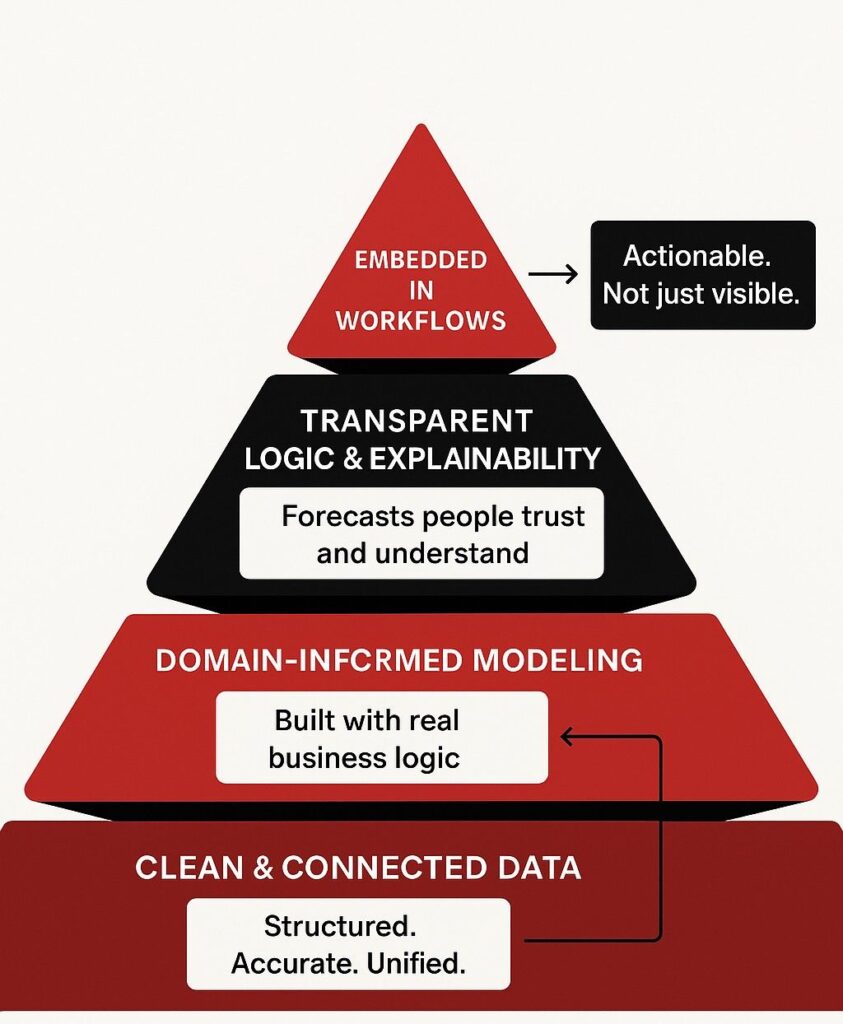
    1. Bad Data = Bad Predictions

    Most businesses don’t have AI problems. They have data hygiene problems.

    If your training data is outdated, inconsistent, or missing key variables, no model—no matter how complex—can produce reliable forecasts.

    Look out for these reasons: 

    • Mixing structured and unstructured data without normalization
    • Historical records that are biased, incomplete, or stored in silos
    • Using marketing or sales data that hasn’t been cleaned for seasonality or anomalies

    The result? Your AI isn’t predicting the future. It’s just amplifying your past mistakes.

    2. No Domain Intelligence in the Loop

    A model trained in isolation—without inputs from someone who knows the business context—won’t perform. It might technically be accurate, but operationally useless.

    If your forecast doesn’t consider how regulatory shifts affect your cash flow, or how a supplier issue impacts inventory, it’s just an academic model—not a business tool.

    At SCS Tech, we often inherit models built by external data teams. What’s usually missing? Someone who understands both the business cycle and how AI/ML models work. That bridge is what makes predictions usable.

    3. Overfitting on History, Underreacting to Reality

    Many forecasting engines over-rely on historical data. They assume what happened last year will happen again.

    But real markets are fluid:

    • Consumer behavior shifts post-crisis
    • Policy changes overnight
    • One viral campaign can change your sales trajectory in weeks
    • AI trained only on the past becomes blind to disruption.

    A healthy forecasting model should weigh historical trends alongside real-time indicators—like sales velocity, support tickets, sentiment data, macroeconomic signals, and more.

    4. Black Box Models Break Trust

    If your leadership can’t understand how a forecast was generated, they won’t trust it—no matter how accurate it is.

    Explainability isn’t optional. Especially in finance, operations, or healthcare—where decisions have regulatory or high-cost implications—“the model said so” is not a strategy.

    SCS Tech builds AI/ML services with transparent forecasting logic. You should be able to trace the input factors, know what weighted the prediction, and adjust based on what’s changing in your business.

    5. The Model Works—But No One Uses It

    Even technically sound models can fail because they’re not embedded into the way people work.

    If the forecast lives in a dashboard that no one checks before a pricing decision or reorder call, it’s dead weight.

    True forecasting solutions must:

    • Plug into your systems (CRM, ERP, inventory planning tools)
    • Push recommendations at the right time—not just pull reports
    • Allow for human overrides and inputs—because real-world intuition still matters

    How to Improve AI/ML Forecasting Accuracy in Real Business Conditions

    Let’s shift from diagnosis to solution. Based on our experience building, fixing, and operationalizing AI/ML forecasting for real businesses, here’s what actually works.


    How to Improve AI/ML Forecasting Accuracy

    Focus on Clean, Connected Data First

    Before training a model, get your data streams in order. Standardize formats. Fill the gaps. Identify the outliers. Merge your CRM, ERP, and demand data.

    You don’t need “big” data. You need usable data.

    Pair Data Science with Business Knowledge

    We’ve seen the difference it makes when forecasting teams work side by side with sales heads, finance leads, and ops managers.

    It’s not about guessing what metrics matter. It’s about modeling what actually drives margin, retention, or burn rate—because the people closest to the numbers shape better logic.

    Mix Real-Time Signals with Historical Trends

    Seasonality is useful—but only when paired with present conditions.

    Good forecasting blends:

    • Historical performance
    • Current customer behavior
    • Supply chain signals
    • Marketing campaign performance
    • External economic triggers

    This is how SCS Tech builds forecasting engines—as dynamic systems, not static reports.

    Design for Interpretability

    It’s not just about accuracy. It’s about trust.

    A business leader should be able to look at a forecast and understand:

    • What changed since last quarter
    • Why the forecast shifted
    • Which levers (price, channel, region) are influencing results

    Transparency builds adoption. And adoption builds ROI.

    Embed the Forecast Into the Flow of Work

    If the prediction doesn’t reach the person making the decision—fast—it’s wasted.

    Forecasts should show up inside:

    • Reordering systems
    • Revenue planning dashboards
    • Marketing spend allocation tools

    Don’t ask users to visit your model. Bring the model to where they make decisions.

    How SCS Tech Builds Reliable, Business-Ready AI/ML Forecasting Solutions

    SCS Tech doesn’t sell AI dashboards. We build decision systems. That means:

    • Clean data pipelines
    • Models trained with domain logic
    • Forecasts that update in real time
    • Interfaces that let your people use them—without guessing

    You don’t need a data science team to make this work. You need a partner who understands your operation—and who’s done this before. That’s us.

    Final Thoughts

    If your forecasts feel disconnected from your actual outcomes, you’re not alone. The truth is, most AI/ML models fail in business contexts because they weren’t built for them in the first place.

    You don’t need more complexity. You need clarity, usability, and integration.

    And if you’re ready to rethink how forecasting actually supports business growth, we’re ready to help. Talk to SCS Tech. Let’s start with one recurring decision in your business. We’ll show you how to turn it from a guess into a prediction you can trust.

    FAQs

    1. Can we use AI/ML forecasting without completely changing our current tools or tech stack?

    Absolutely. We never recommend tearing down what’s already working. Our models are designed to integrate with your existing systems—whether it’s ERP, CRM, or custom dashboards.

    We focus on embedding forecasting into your workflow, not creating a separate one. That’s what keeps adoption high and disruption low.

    1. How do I explain the value of AI/ML forecasting to my leadership or board?

    You explain it in terms they care about: risk reduction, speed of decision-making, and resource efficiency.

    Instead of making decisions based on assumptions or outdated reports, forecasting systems give your team early signals to act smarter:

    • Shift budgets before a drop in conversion
    • Adjust production before an oversupply
    • Flag customer churn before it hits revenue

    We help you build a business case backed by numbers, so leadership sees AI not as a cost center, but as a decision accelerator.

    1. How long does it take before we start seeing results from a new forecasting system?

    It depends on your use case and data readiness. But in most client scenarios, we’ve delivered meaningful improvements in decision-making within the first 6–10 weeks.

    We typically begin with one focused use case—like sales forecasting or procurement planning—and show early wins. Once the model proves its value, scaling across departments becomes faster and more strategic.

  • How Digital Twins Transform Asset & Infrastructure Management in Oil and Gas Technology Solutions

    How Digital Twins Transform Asset & Infrastructure Management in Oil and Gas Technology Solutions

    What if breakdowns could be predicted before they become expensive shutdowns? In an age where reliability is everything, avoiding failures before they occur can prevent millions of dollars in losses. With real-time visibility, digital twin technology can make it happen to guarantee seamless operations even in the most demanding environments.

    Based on industry reports, organizations that utilize digital twins have seen their equipment downtime decrease by as much as 20% and overall equipment effectiveness increase by as much as 15%. In cost terms, that translates to more than millions annually. These kinds of figures are what make the application of digital twins today a strategic imperative.

    In this blog, let us understand how digital twins redefine bare operational spaces in oil and gas technology solutions: predictive maintenance, asset performance, and sustainability.

    How Digital Twins Improve Asset and Infrastructure Management in Oil and Gas Technology Solutions?

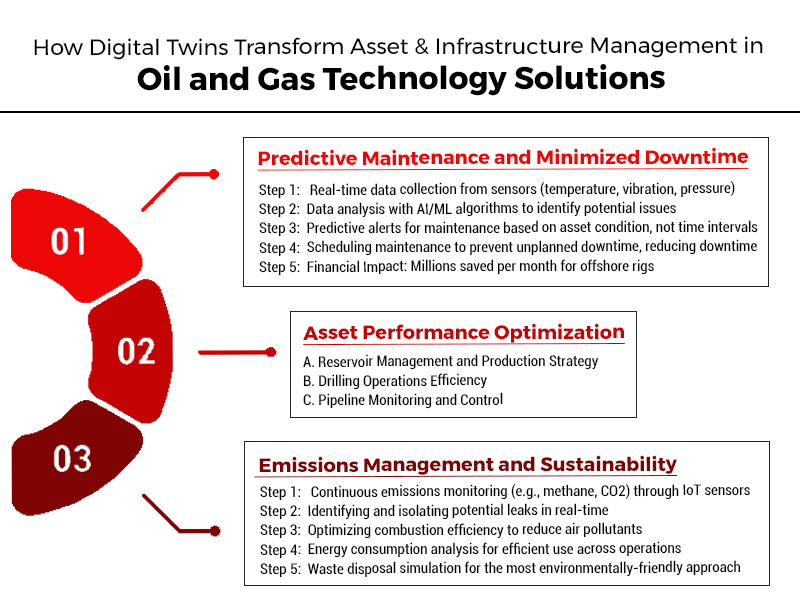
    1. Predictive Maintenance and Minimized Downtime

    Digital twins ensure intelligent maintenance by transitioning from time-based to condition-based maintenance, using real-time analysis to foretell equipment issues before they are severe.

    • Real-Time Health Monitoring: Digital twins also gather real-time data from sensors installed on pumps, compressors, turbines, and drilling equipment. Among the parameters constantly monitored are the vibration rates, pressure waves, and thermal trends, which may be used in monitoring for indicators of wear and impending failure.
    • Predictive Failure Detection: With machine learning and past failure patterns, digital twins can identify slight deviations that can lead to component failures. This enables teams to correct the problem before the problem leads to system-scale disruption.
    • Optimized Maintenance Scheduling: Rather than depending on strict maintenance schedules, digital twins suggest maintenance based on the actual condition of the assets. This avoids unnecessary work, minimizes labour costs, and maintains only when necessary, saving maintenance expenses.
    • Financial Impact: The cost savings in operations are directly obtained from the decrease in unplanned downtime. Predictive maintenance with digital twins can save millions per month for a single offshore rig alone.

    how Digital Twins enable Predictive Maintenance

    2. Asset Performance Optimization

    Asset performance optimization is not so much about getting the assets up and running as it is about getting every possible value from each asset at each stage in its operational lifecycle. Digital twins are key to this:

    A. Reservoir Management and Production Strategy

    Digital twins simulate oil reservoir behaviour by integrating geologic models with real-time operating data. This enables engineers to simulate different extraction methods—like water flooding or injecting gas—and select the one that will maximize recovery rates with the minimum amount of environmental damage.

    Operators receive insight into reservoir pressure, fluid contents, and temperature behaviour. Such data-driven insight assists in determining where and when to drill, optimize field development strategy, and maximize long-term asset use.

    B. Drilling Operations Efficiency

    Digital twin real-time modelling helps adapt quickly to altering conditions underground during drilling. Integrating drilling rig information, seismic information, and historical performance metrics, operators can select optimal drilling paths, skip danger areas, and ensure wellbore stability.

    Workflow simulations also minimize uncertainty and inefficiencies during planning, minimising well construction time. This enhances safety, minimizes non-productive time (NPT), and minimizes total drilling cost.

    C. Pipeline Monitoring and Control

    Digital twins are also applied in midstream operations, such as pipelines. They track internal pressure, flow rate, and corrosion data. By tracking anomalies such as imputed leaks or pipeline fatigue in real time, operators can perform preventive measures to ensure system integrity.

    Predictive pressure control and flow optimization also enhance energy efficiency by lowering the load on pump equipment, which results in operational efficiencies and environmental performance.

    3. Emissions Management and Sustainability

    Sustainability and environmental compliance are central to the technology solutions for oil and gas today. Digital twins offer the data infrastructure for tracking, managing, and optimizing environmental performance throughout operations.

    • Continuous Emission Monitoring: Digital twins are connected to IoT sensors deployed across production units and refineries to track emissions continuously. The systems monitor methane levels, flaring efficiency, and air quality in general. Preleak detection ensures immediate action to contain noxious emissions. On-site real-time combustion analysis can also help ensure maximum efficiency for processes by keeping pollutant production during flaring or burning down to the least.
    • Energy Use Insights: Plant operators use digital twins to point out inefficiency in energy usage in specific areas. With instantaneous comparisons between the input energy and the output from processes, operators recognize energy loss patterns and propose changes for lesser usage—greener and more efficient operation.
    • Simulation for Waste Handling: Digital twins model and analyze a variety of waste disposal plans in a bid to ascertain the most cost-effective and environmentally friendly approach. Whether dealing with drilling waste or refinery residues, operators are made transparent to minimize, reuse, or dispose of waste as per legislation.
    • Carbon Capture Optimization: As carbon capture and storage (CCS) emerges as a hot topic in the energy industry, digital twins help maximize these systems to their best. They mimic the behaviour of injected CO₂ in subsurface reservoirs, detect leakage risks, and maximize injection strategy for enhanced storage reliability. This helps companies achieve corporate sustainability objectives and aids global decarbonization goals.

    What is the Strategic Role of Digital Twins in Oil and Gas Technology Solutions?

    Digital twins are no longer pilot technologies—they are starting to become the basis for the digital transformation of oil and gas production. From upstream to downstream, they deliver unique visibility, responsiveness, and management of physical assets.

    Their capacity to integrate real-time operational data with sophisticated analytics enables companies to:

    • Improve equipment reliability and lower failures
    • Enhance decision-making on complicated operations
    • Reduce operating expenses with predictive models
    • Comply with environmental regulations and sustainability goals

    With oil and gas operators under mounting pressure to extract margins, keep humans safe, and show environmental responsibility, digital twins provide a measurable and scalable solution.

    Conclusion

    Digital twins are transforming asset and infrastructure management throughout the oil and gas value chain. They influence predictive maintenance, asset optimization, and sustainability—the three pillars of operational excellence in today’s energy sector.

    By enabling data-informed decision-making, reducing risk, and maximizing asset value, digital twins are a stunning leap in oil and gas technology solutions. Companies implementing this technology with support from SCS Tech will be better poised to run efficiently, meet regulatory demands, and dominate a globally competitive market.

  • What Role Does Blockchain Play in Streamlining Identity Verification for eGovernance Solutions?

    What Role Does Blockchain Play in Streamlining Identity Verification for eGovernance Solutions?

    What if identity verification didn’t mean endless waits, repeated paperwork, and constant data theft risks? These problems are the setbacks of outdated systems, slowing down public services and putting sensitive information at risk. Blockchain solves these issues by streamlining identity verification in eGovernance solutions. It reduces paperwork, speeds up validation, and ensures transparency and security in the process used by governments to verify citizens.

    Blockchain provides a real-time auditable record because of its unique, decentralized, and tamperproof architecture. By this, blockchains ensure clarity between citizens as well as governmental institutions.

    But how exactly does blockchain revolutionize identity verification in eGovernance? In this blog we will first look into its impact before taking a more detailed look at the key flaws of traditional identity systems and why an upgrade is long overdue.

    The Problems of Traditional Identity Verification in eGovernance

    1. Centralized Databases Are Easy Prey for Cyberattacks

    Most government identity verification systems rely on central databases, representing an attractive target for attackers. The recent OPM hack in the U.S. demonstrated this risk. Once hacked, sensitive citizen data is instantly available on the dark web.

    1. Data Silos and Repetitive Verification Processes

    Government agencies are not interlinked; each agency maintains a separate database of identities. This has created the need for citizens to continuously furnish the same information for services like health, social security, and driving licenses.

    1. Lack of Transparency and Trust

    Citizens do not know where and how their identity data is stored and accessed. An auditable system cannot be available; identity misuse and unauthorized access become widespread. The lack of public trust in the eGovernance solution prevails.

    1. High Costs and Inefficiencies

    Complex identity verification systems, fraud fighting and manual checking of documents impose a burden on government resources. Inefficiencies in service delivery and increased operational costs result.

    What Role Does Blockchain Play in Streamlining Identity Verification for eGovernance Solutions?

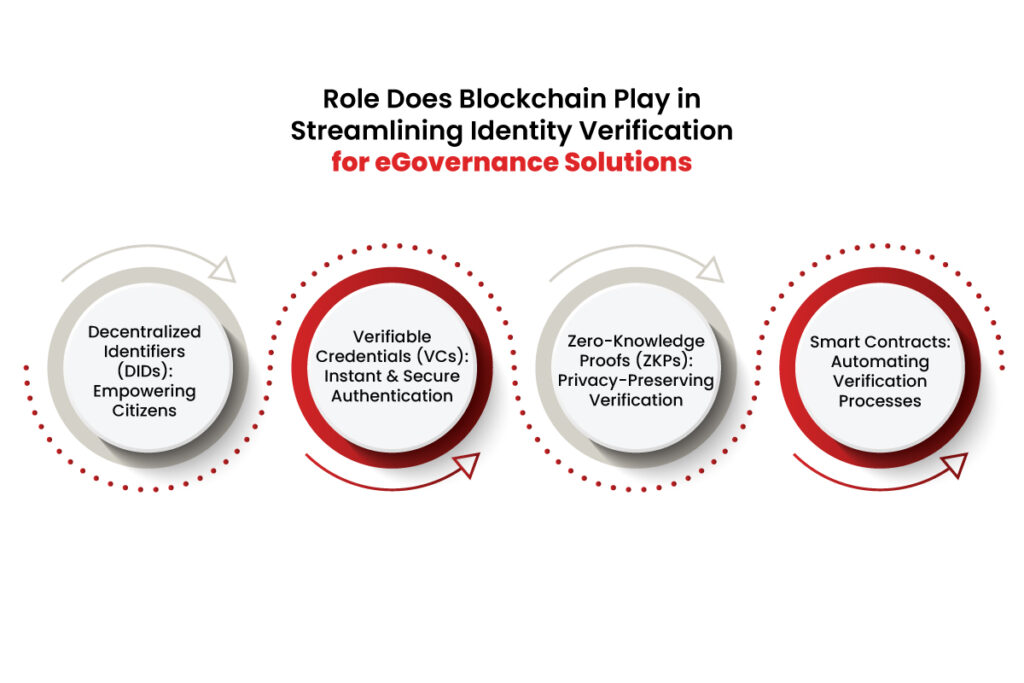
    Blockchain redefines the entire landscape of verification through identities. Let’s break it down as to how it solves the above issues:

    • Decentralized Identifiers (DIDs): Empowering Citizens

    DIDs allow people to be in control of their digital identity. Instead of government-issued IDs stored in centralized databases, users store their credentials on a blockchain. Citizens selectively disclose only the necessary information, which enhances privacy.

    • Verifiable Credentials (VCs): Instant and Secure Authentication

    VCs are cryptographically signed digital documents demonstrating identity attributes like age, citizenship, or educational qualifications. Governments can issue VCs to citizens and use them to access public services without excessive disclosure of personal data.

    • Zero-Knowledge Proofs (ZKPs): Privacy-Preserving Verification

    With ZKPs, a person may prove identity and conceal all details. For instance, one citizen can prove they are above 18 years old without revealing their birth date. This minimizes the data exposure and theft of one’s identity.

    • Smart Contracts: Automating Verification Processes

    Smart contracts enforce pre-defined verification rules without any human intervention. For example, a smart contract can immediately approve or reject citizen’s applications for government benefits based on the eligibility criteria by checking the VC.

    Role of Blockchain in Streamlining Identity Verification for eGovernance Solutions

    Real-Time eGovernance Blockchain Solutions

    1. Safe Digital Voting

    Blockchain ensures secure voting and increases the integrity of elections. Citizens get registered with a DID, receive a VC from an electoral commission, and vote anonymously on a tamper-proof ledger. ZKPs verify whether a voter is eligible to vote without disclosing their identity.

    1. Digital Identity Wallet for Social Welfare Programs

    Governments can provide VCs that prove their entitlement to welfare schemes. These are kept in digital purses, and the citizen will withdraw his benefit without requiring documents each time.

    1. Cross-Border Identity Verification

    The immigrants possess blockchain-verified credentials for identity, educational qualifications, and work experience. Immigration departments use smart contracts that authenticate credentials to help avoid tedious delays and paperwork over the authenticity of the same.

    Solution of Blockchain’s Issues in eGovernance

    Even though blockchain comes with many advantages, its significant concerns that need to be addressed are scalability, interoperability, and governance. Here’s how they are being addressed:

    1. Scalability Solutions

    Rollups and sidechains are some of the layer-2 scaling solutions that make it possible to achieve high transaction throughput and reduce congestion on the blockchain to increase efficiency.

    1. Interoperability Across Platforms

    Cross-chain bridges and atomic swaps protocols facilitate identity verification across multiple blockchain networks and jurisdictions to be integrated with existing eGovernance frameworks seamlessly.

    1. Privacy and Compliance

    Homomorphic encryption and secure multi-party computation further enhance data privacy while maintaining compliance with GDPR. The governance framework should be well-defined by governments to govern blockchain-based identity systems.

    1. Quantum-Resistant Cryptography

    With the evolution of quantum computing, blockchain networks have been moving towards quantum-resistant cryptographic algorithms for long-term security.

    Future of Blockchain Identity in eGovernance

    The adoption of blockchain for identity verification is just beginning. Future advancements will include:

    • Self-Sovereign Identity (SSI): Citizens will fully own and control their digital identities without intermediaries.
    • AI-Powered Identity Verification: AI will detect fraud, improve security, and enhance user experience.
    • Decentralized Autonomous Organizations (DAOs): It is the management of digital identities in a transparent, autonomous manner and decentralized one.
    • Metaverse Identities: Blockchain can facilitate secure identities maintained virtually in virtual worlds and digital transactions.

    Conclusion

    Blockchain for identity verification is revolutionizing eGovernance solutions. It eliminates centralized vulnerabilities, reduces verification costs, and enhances trust in blockchain-based identity solutions, opening avenues for efficient, transparent, and secure public services.

    The future digital identity will be decentralized, user-centric, and fraud-resistant for governments and institutions embracing this technology.

    SCS Tech is committed to create this future to help businesses and governments navigate this ever-changing digital landscape. Blockchain identity solutions aren’t just the future—they are the present.

  • All you should know about Smart Spaces and its future impact

    All you should know about Smart Spaces and its future impact

    What are Smart Spaces?   

    Smart spaces are facilities or public areas outfitted with sensors to collect data that can be used to generate insights about its environmental conditions, the services it provides, and how occupants interact with their environment. These smart spaces insights can be captured in real-time and from historical data, and then used in improving safety, operations, and the experiences of the people using the space.

    When enabled by technologies like IoT and 5G wireless, which are now capable of monitoring municipal operations using real-time data to bring a level of service to citizens with uncharacteristic efficiency, smart space paradigms are also shared across regions, extending over cities.

    Use of Technology in creating smart spaces

    We can classify smart enabling technologies according to their purpose using this multi-layered approach to smart space environments (virtual, physical, and human levels).

    Virtual Computing Environment — This layer gives smart devices access to private network services or the internet, which enables them to connect to other components of the distributed systems that run the smart space environment.

    Physical Environment – The most diverse layer of smart spaces is the physical environment layer, which contains the embedded sensors, microprocessors, tracking tags, and other tangible components of the smart space.

    Human Environment — This layer is made up of gadgets that people use in conjunction with their environment, such as pacemakers, wearable smart devices, and smartphones. This means that humans can develop smart space environments using cell towers, cell networks, and smartphones to create a virtual, physical, and human environment that can be thought of as a large area smart space, similar to how route-planning apps can be used to create smart spaces.

    Benefits of Smart Spaces

    The deep integration of these technologies into our daily lives demonstrates how successfully they have achieved their general goals of enhancing efficiency, security, and safety.

    Any measurable aspect of efficiency is improved by smart space technology. Smart technology often focuses on lowering overall operational expenses of buildings by avoiding resource and utility waste. Meters for electricity or water may readily be equipped with sensors, making them prime candidates for smart monitoring.

    In places where there are risks of danger or accidents, smart spaces promote safety and risk mitigation. Smart technology, such as the use of intelligent robots in industrial applications, can replace human workers performing dangerous activities. By replacing humans with these robots in numerous tedious and repetitive jobs like moving inventory palettes, productivity has grown.

    Smart environments improve user experience by automating many of our daily “clerical” duties, including checking the lighting, that were previously performed by humans. Using smart space technology is now driven by the desire to enhance the experience of occupants within a space for business purposes. These buildings are becoming more collaborative, informative, and effective thanks to smart office technologies that can connect remote workers, smart conference rooms, scheduling systems, and sensors covering every component of the facility. Several manufacturers advertise a sizable central wall display that serves as a focal point for business activities and shows real-time information. For example, a hospital could use this display to show which doctors are present, which operations are planned, or which rooms are filled.

    Common technologies used in these are:

    • Artificial Intelligence and Machine Learning
    • Computer Vision
    • Speech Recognition
    • Blockchain
    • Cloud computing / Distributed systems
    • Wireless Connectivity
    • Motion and proximity sensors
    • Climate sensors (temperature, humidity, pressure)
    • Accelerometers and gyroscopic sensors
    • Optical and thermal sensors
    • Gas and level sensors
    • RFID tagging
    • Microprocessors
    • Smartphones, tablets, watches
    • Closed-loop insulin delivery systems
    • Ingestible sensors
    • Smart inhalers
    • Smart pacemakers


  • A complete guide on Cloud Computing

    A complete guide on Cloud Computing

    One of the technologies influencing how we work and play is cloud computing. The cloud helps businesses eliminate IT problems and promotes security, productivity, and efficiency. It also enables small enterprises to utilize cutting-edge computing technologies at a significantly lesser cost. Here is what you need to know about the cloud and how it can benefit your company.

    On-Demand Computing

    The term “cloud” describes online-accessible servers and software that anyone can use. You are spared from hosting and managing your hardware and software as a result. Additionally, it implies that you can use these systems from any location where you have internet access.

    Every day, you encounter cloud computing. You are accessing data that is kept on a server somewhere in the world whenever you check your Gmail inbox, look at a photo on your Dropbox account, or watch your favorite shows on Netflix. Even though the emails, videos, or other files you require are not physically present on your computer, you may quickly, simply, and affordably access them owing to contemporary cloud computing technology.

    Public, Private, and Hybrid Cloud

    Private, public, and hybrid deployment strategies are the three main types of cloud computing. In the end, all three models will give customers access to their business-critical documents and software from any location, at any time. It all depends on how they approach the task. The kind of cloud you should use for your company depends on several variables, including the purposes for which you intend to use it, applicable laws on data storage and transmission, and other aspects.

    Private Cloud

    A single entity is served via private clouds. While some companies construct and manage their ecosystems, others rely on service providers to do so. In either case, private clouds are expensive and hostile to the cloud’s advantages for the economy and IT labor productivity. Private clouds, however, are their sole choice because certain organizations are subject to greater data privacy and regulatory constraints than others.

    Public Cloud

    Distributed across the open internet, public clouds are hosted by cloud service providers. Customers can avoid having to buy, operate, and maintain their own IT infrastructure by using the most widely used and least-priced public clouds.

    Hybrid Cloud

    A hybrid cloud combines one or more public clouds with private clouds. Imagine you operate in a sector where data privacy laws are extremely rigorous. While you don’t want to host legally required data in the cloud, you do want to be able to access it there. To access data saved in your private cloud, you also want to deploy your CRM in the cloud. Using a hybrid cloud is the most sensible choice under these circumstances.

    Everything as a Service

    The cloud “stack” is made up of numerous levels. The collection of frameworks, tools and other elements that make up the infrastructure supporting cloud computing is referred to as a stack. Software as a Service (SaaS), Platform as a Service (PaaS), and Infrastructure as a Service (IaaS) components are included in this. Customers that use these services have varied degrees of control and accountability over their cloud environment.


    Infrastructure as a Service

    The customer oversees managing everything with IaaS, including the OS, middle-ware, data, and applications. Other duties, including virtualization, servers, storage, and networking obligations, are handled by the service provider. Customers are charged by how many resources, including CPU cycles, memory, bandwidth, and others, they consume. Microsoft Azure and Amazon Web Services are two examples of IaaS products.

    Platform as a Service

    Customers can create, test, and host their applications using PaaS solutions. The consumer oversees managing their software and data; otherwise, the service provider takes care of everything. You don’t have to be concerned about operating systems, software upgrades, or storage requirements if you use PaaS solutions. Customers of PaaS pay for any computing resources they use. Google App Engine and SAP Cloud are a couple of examples of PaaS technologies.

    Software as a Service

    Customers acquire licenses to utilize an application hosted by the provider under the SaaS model. Customers often buy annual or monthly subscriptions per user instead of how much of a certain computer resource they consumed, unlike IaaS and PaaS models. Microsoft 365, Dropbox, and DocuSign are a few popular SaaS products. Small firms that lack the capital or IT resources to implement the most cutting-edge technologies would benefit greatly from SaaS solutions.

    Benefits of the Cloud

    Reduced IT costs: By using cloud computing services, recurrent costs for monitoring and maintaining an IT infrastructure can be greatly decreased.

    Scalability: When necessary, developers can increase storage and processing capability by using cloud services. Additionally, development teams do not have to spend time or money upgrading cloud computing services.

    Collaboration efficiency: For the agile technology sector, cooperation has always been a need. Professionals from all around the world may work and collaborate using current cloud services. With these functionalities, teams may communicate with clients or other teams online while collaborating in real-time and sharing resources.

    Flexibility: Cloud computing can provide a great deal of flexibility in addition to helping to lower operational costs. Developers and other key stakeholders now have easier access to crucial data metrics at any time and from any location.

    Automatic updates: Teams may use the most recent resources available while managing and meeting IT standards thanks to automatic updates. Cloud computing is a popular technology because it allows users to access the newest tools and resources without having to spend a fortune.


  • Digitization – the future of energy generation

    Digitization – the future of energy generation

    The world is going through a massive shift in the ways things used to be done. Now accomplishing set goals is not only a man’s job but is integrated with a fair amount of technology. Digital transformation in every industry is quite evident and can be seen in the power sector as well. From power plant management to consumer services, basically, now every step in the process utilizes digital resources.

    Post-Covid, power production is currently embracing digitization in its work process which includes production, dissemination, and consumption of energy. Some of the promising tech tools helping this sector are:

    MACHINE LEARNING

    Digital technology is establishing its roots right from the start of the process. In power plants, nowadays, management has become automated in terms of turbines, ranches, windmills, solar parks, and even in old hydroelectric systems. Here, sensors are installed which makes it feasible to gather data from a turbine, dam, or line continuously and send it to a unified control room. Here the utilization of imaginative programming empowers administrators to recognize odd information and this analysis helps in distinguishing threats, differences, and performance. This is known as predictive maintenance.

    This data-driven approach not only engages a particular plant but the other power-producing resources along with it and the client’s power system if involved in the business. These machine learning algorithms and advanced software rely on big data coming from all the sources put to compassion which results in better management of the system and efficient production.

    ARTIFICIAL INTELLIGENCE

    A possibility is the most valuable gift technology gave to mankind. AI has been a promising contributor which continuously works on the sighting of likely anomalies and shortcomings that, while not compromising the working of a plant, can decrease its efficiency. Therefore, actions can be advised to improve and handle the plant’s performance thus, fulfilling every short-term and long-term project goal.

    In field operations, instruments like robots and drones can establish assessments, decrease the required time, and expand precision and productivity while disposing of the dangers to individuals, who used to carry out these tasks themselves. Using digital simulations, technicians can receive comparable training which will enable them to tackle field situations with more tools made available to them.

    SMART GRIDS

    The most evident change and effect of digital transformation are seen on the grids which are utilized to distribute power. Electronic meters enable smart grids, which makes it possible to manage and balance the electricity system efficiently. Power circulation networks are open, adaptable, and comprehensive playing an important part in energy efficacy. In addition, a savvy board of the organization helps effectiveness and decreases wastage, and benefits the environment.

    The energy transition is a phenomenon that goes beyond the simple generation of clean electricity. Digitization, involves everyone, producers and consumers. A completely digitized power plant will focus on upgrading execution progressively and working in a protected and stable way — upheld via automated reporting, guided issue resolution, and digitized control strolls. Top-notch dependability can be kept up with while diminishing arranged blackout time and support costs. Data analytics and digital-process support are the actual keys.

    ROBOTICS PROCESS AUTOMATION

    RPA adoption lies at the center of many enterprises’ digital transformation efforts. Today, RPA is driving new efficiencies and freeing people from repetitive tedium across a broad swath of industries and processes. It streamlines workflows, which makes organizations more profitable, flexible, and responsive. It also increases employee satisfaction, engagement, and productivity by removing mundane tasks from their workdays. Even though there is still a skeptical opinion about digitization and automation in the Energy and Utility industry, automation front-runners and leading companies see the benefits of implementing RPA just in a few months and are expecting more promising results.

  • Key Role of Internet of Things Technology in Digital Transformation

    Key Role of Internet of Things Technology in Digital Transformation

    IoT solutions have already started to act as a game player in modern enterprises. Every year, more entrepreneurs tend to jump on the IoT bandwagon to leverage the benefits of this rapidly evolving technology.

    As per reports, there will be 75.44 billion connected devices globally by the year 2025. In such a scenario, it is interesting to see how IoT plays a role in accelerating enterprise digital transformation.

    In this article, we are going to see the impact of IoT on digital transformation. But, before moving forward, let’s understand the significance of enterprise digital transformation for your business.

    Importance of Digital Transformation in Modern Enterprise

    The State of Digital Transformation research has revealed that market pressure is one of the major factors for implementing digital transformation as market leaders also compete with technologically advanced and agile businesses.

    There is no exaggeration in mentioning that digital transformation is the best way to make your enterprise ready for the future while keeping it ready to face technological disruption.

    As customer requirements and expectations keep on changing rapidly, it is imperative for enterprises to change their traditional business processes with the help of advancements in emerging technologies.

    Be it handling internal processes or offering personalized customer experience, enterprise digital transformation has remained highly useful. Here are the top business benefits of digital transformation.

    Key Benefits of Enterprise Digital Transformation

    As mentioned above, digital transformation can assist entrepreneurs to improve their services and enhance customer experience significantly.

    Improved Customer Experience

    Today, tech-savvy customers want advanced and real-time assistance to resolve their queries. They always remain in search of advanced tools that make their lives more comfortable. As a result, enterprises need to come up with digital solutions based on updated technologies that can give their customers a better experience.

    Enhanced Efficiency

    Inventive tools and technologies can automate various processes in the company and as a result, you can improve efficiency over the period. Digital transformation solutions also bring cost savings and reduction in manual effort in the business over the period.

    Higher Security

    As compared to traditional processes, digital processes are more secure and robust. Organizations can secure their confidential and valuable data more effectively and securely using digital transformation solutions. It can help them keep the data safe and gain the customer’s trust over the period.

    Better Decision-making

    Digital transformation is designed to bring actionable insights to make informed decisions. In this data-driven age, all tools and techniques related to data analysis can assist companies to track performance metrics and better insights. It further assists in providing a better result.

    All digital transformation initiatives need a combination of emerging technologies including IoT, AI, and AR. Out of them, IoT plays a crucial role in making digital transformation solutions highly useful and user-friendly. Let’s go through the impact of IoT in digital transformation.

    Five Ways IoT Impacts Enterprise Digital Transformation Solution

    We can mention many benefits of IoT in modern enterprises. Numerous startups have built their entire business model around IoT technology. You can transform processes digitally using IoT solutions. Here are some of the major business benefits of IoT in digital transformation.

    Meaningful Customer Experience

    When it comes to improving customer experience based on their interests and expectations, connected devices can remain handy for enterprises. Thanks to IoT solutions, organizations can get deep insights into their customers’ behavior and shopping pattern.

    Entrepreneurs can customize customer experiences based on this data. In a way, enterprises can transform their processes digitally while keeping customers in the focus.

    More Efficiency in Business

    An IoT app development company can enable modern enterprises to merge rich data experiences using autonomous sensors. IoT-powered apps can improve productivity by bringing automation to various business processes. These apps can share useful data with AI or ML-based systems for effective and accurate analysis.

    Enterprises can streamline various processes including logistic and supply chain management, security, energy management, and stock management with the help of a proper data analysis.

    Reduced Operational Costs

    Process automation can eventually reduce operational costs while enabling entrepreneurs to use resources in a wise manner. IoT in digital transformation aims at improving utility consumption, waste disposal, and other ways to reduce various costs in modern enterprises.

    Optimized use of water and other natural resources also contribute to saving big for companies. Such reduction in operational costs can eventually increase ROI for your enterprise.

    Improved Employee Productivity

    A reputed mobile app development company integrates various features based on futuristic technologies. Talking about IoT technology, it can assist your company to keep your staff engaged while offering better experiences. It also makes the system available for employees in real-time from anywhere.

    Smart sensors can keep employees connected with one another all time and they can easily convey their experiences instantly. All such aspects can improve the employee’s productivity.

    Scope for Innovation

    IoT devices can fetch the user’s data including user behavior. This data can assist enterprises to understand the requirements, interests, preferences, and expectations of their customers more effectively. As a result, they can come up with innovative products over the period to cater to a huge customer base.

    Another key characteristic of IoT technology is it can readily combine with advancements of AI, AR, and Blockchain. Altogether, this technology opens the doors of creativity and innovation for enterprises. All you need to consult a reputed and reliable IoT app development company to come up with innovative app solutions.

    All these and several other benefits of IoT technology drive digital transformation in enterprises and increase the demand for IoT app development globally.

    Concluding Lines

    Simply put, the Internet of Things concept has a significant impact on digital transformation. On one hand, IoT solutions can enhance the customer’s purchasing experiences and on the other hand, they can enable businesses to remain connected to customers and employees on a 24/7 basis. We can certainly expect that IoT will enhance digital transformation in the coming years.

    Scs Tech is a leading enterprise mobility solutions that integrates features based on technological advancements in enterprise-level apps. We assist our global corporate clientele to make the most of digital transformation by developing robust and advanced solutions.