
Tag: #finance

  • How Can Custom Cybersecurity Solutions Protect Finance from Fraud and Cybercrime?

    How Can Custom Cybersecurity Solutions Protect Finance from Fraud and Cybercrime?

    It was recently reported that the financial sector faced a staggering 3,348 reported cyber attacks in 2023—a sharp 83% increase from the 1,829 attacks in 2022. This alarming trend highlights the growing vulnerability of financial institutions to sophisticated cyber threats. As these attacks become more relentless, it’s evident that traditional security systems are no longer sufficient, underscoring the urgent need for advanced computer security services to safeguard critical financial data and infrastructure.

    To counter these rising threats, the financial industry must join hands with cybersecurity solutions group that offer a stronger, more adaptive defence. The question is no longer if but how quickly organizations can upgrade their security frameworks to safeguard their digital assets.

    Custom cybersecurity solutions specific to the finance sector provide advanced threat detection, real-time monitoring, and incident response strategies designed to protect finance from these frauds and cybercrimes in the constantly changing threat landscape. Read on further to understand how custom cybersecurity solutions protect finance from cybercrimes.

    Why do Custom Cybersecurity Solutions Matter to Financial Institutions?

    High-value targets for cybercriminals are financial institutions because of the sensitivity of their data and the volumes of money involved. Cybersecurity breaches can cause enormous financial fallout, damage to customer trust, and penalties due to regulatory noncompliance.

    Custom cybersecurity solutions provide tailored protection based on the unique vulnerabilities prevailing in financial operations. These solutions cater to specific needs and requirements toward regulatory compliance, operational challenges, and information security, which the institution faces.

    Another critical benefit custom solutions provide is the ability to keep up with emerging threats. As cyberattacks become even more complex, banks and financial organizations demand defences that grow just as intense. By integrating proactive risk management, threat detection, and incident response planning, custom solutions arm financial organizations with the capabilities to mitigate risks before they climax into costly incidents.

    How Custom Cybersecurity Solutions Help Protect Finance from Fraud and Cybercrime?

    Custom cybersecurity solutions are crucial because they involve dealing with very high-risk and sensitive information and transactions. Some areas that make the solutions effective in the finance sector include:
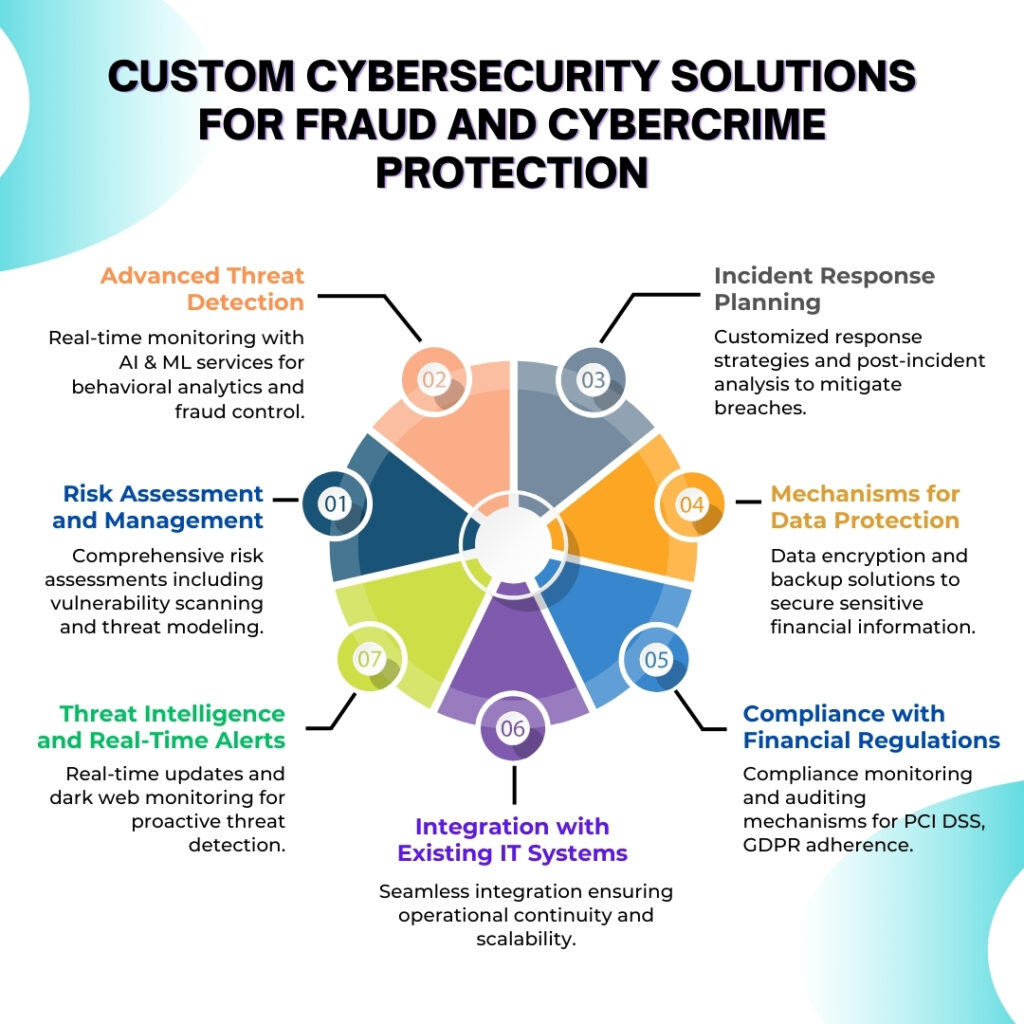
    Custom Cybersecurity Solutions for Fraud and Cybercrime Protection

    1. Risk Assessment and Management

    In this case, the risk types refer to phishing attacks, ransomware, and insider threats, among others. Custom cybersecurity solutions imply starting with a comprehensive risk assessment.

    • Vulnerability scanning: To identify weaknesses in IT infrastructure that might be attacked.
    • Threat modelling: To predict threats that are unique to financial operations so the institution can prepare and defend itself.

    Effective risk management is the basis for preventing costly breaches and fraud, helping financial institutions receive a ranked list of their most critical vulnerabilities.

    2. Advanced Threat Detection

    Due to the volume of transactions and complexity, institutions must detect threats in real time. Advanced threat detection tools utilize:

    • Real-Time Monitoring: For networks and systems to capture suspicious activities as soon as they occur. A minute’s delay in financial institutions translates into losses at unprecedented levels.
    • AI and ML Services: The services and algorithms are used in behavioural and pattern analytics to detect possible intrusion as soon as possible before damage takes place. They draw anomalies, which otherwise might go unnoticed by traditional systems, with this controlling fraud and other kinds of breaches.

    3. Incident Response Planning

    A well-coordinated response to security breaches minimizes damage and restores normal operations promptly. Incident response planning incorporates:

    • Customised Response Strategies: Ensure that detail specific measures taken during a breach, such as isolating affected systems and protecting transactions.
    • Post-Incident Analysis: For what went wrong, how to improve future responses, and how to strengthen overall security.

    4. Mechanisms for Data Protection

    The protection of sensitive financial data is the prime focus. Two fundamental mechanisms are:

    • Encrypt: For encrypting data in rest and transit modes so that any sensitive information, including customer details and transaction records, remains secure.
    • Protect Data Backup Solutions: To help bring back critical financial data in case of a cyberattack or system crash and, therefore, help reduce downtime.

    5. Compliance with Financial Regulations

    All financial institutions should adhere to data protection and transaction regulations such as PCI DSS and GDPR. The custom-made cybersecurity solution ensures that adherence is followed.

    • Compliance monitoring and reporting: These tools are used to generate all documents required by the regulatory bodies.
    • Auditing mechanisms: Custom cybersecurity solutions can help identify and rectify compliance deficiencies before the imposition of penalties.

    6. Integration with Existing IT Systems

    Cybersecurity solutions should be built to fit into a financial institution’s infrastructure seamlessly, ensuring that operations run smoothly for the organization. Such integration will result in:

    • Least Disruption to Operations: Such measures should allow the routine activities of the day.
    • Scalability: Scale with growth or introduce new services like mobile banking without compromising on effectiveness in terms of security and without sacrificing performance.

    7. Threat Intelligence and Real-Time Alerts.

    Financial institutions can remain competitive through threat intelligence platforms which are present in custom cybersecurity solutions, which give:

    • Real-time updates: Custom cybersecurity solutions send updates on new vulnerabilities and cybercriminal tactics
    • Proactive monitoring of external sources: Scanning of external sources like dark web forums to catch threats when they happen.

    Few Methodologies for Efficient Cybersecurity in Finance

    Custom security solutions for financial institutions employ a variety of methodologies to guarantee complete security. Such methodologies are essential factors while dealing with the dynamic threat environment:

    1. Proactive Security Measures

    Cyber threats should be prevented before they occur. Key proactive measures include:

    • Penetration Testing: This emulates real-world attacks to find vulnerabilities in the system. This would make the defences of an institution strong ahead of any attack.
    • Continuous Threat Intelligence: Helps in gathering, and monitoring dark web forums for compromised credentials or other indicators of compromise, thus providing early intervention before breaches happen.

    2. Multi-Layered Defense Strategies

    Multi-layered defence provides extensive coverage across different types of cyber threats, including:

    • Layered Security Controls: This should be present across different levels of IT infrastructure to ensure that if one layer is breached, others will continue to protect the network.
    • Targeted Protection Solutions: This encompasses solutions that address identified emerging threats, such as phishing, ransomware, and insider threats, in a way that avoids a single point of failure.

    3. Compatibility with Current Systems

    To be most effective, custom cybersecurity solutions need to integrate with an institution’s current infrastructure, which means:

    • Seamless Implementation: Installations should be as smooth as possible not to disrupt continuing operations. Security deployment will in no way interfere with the daily running of the institution, nor affect customer service.
    • Interoperability: Custom cybersecurity solutions have to be compatible with current security tools and technologies. This compatibility enhances a harmonious ecosystem, which is centered on strengthening security posture as well as monitoring and response capabilities.

    Key Takeaways

    The rise of cyber-attacks like supply chain attacks, zero-day exploits, and credential stuffing makes custom cybersecurity solutions vital for financial institutions to protect their digital assets and operations. SCS Tech addresses these challenges by offering comprehensive services, including risk assessments, advanced threat detection, incident response planning, and compliance support.

    By implementing these solutions, financial institutions can protect their sensitive data, maintain client trust, and ensure the continuity of their operations. With SCS Tech, financial organizations can stay ahead of evolving cyber threats, paving the way for secure digital transformation.
  • What Are the Key Challenges And Opportunities of Digital Transformation in Finance?

    What Are the Key Challenges And Opportunities of Digital Transformation in Finance?

    In an industry where precision and trust are paramount, finance is undergoing a seismic shift driven by digital transformation. The pressure to innovate and adapt is reshaping the very core of banking and financial services, forcing institutions to rethink how they operate, serve clients, and comply with ever-evolving regulations.

    It’s no longer just about adopting technology—it’s about harnessing it to create value, enhance customer experiences, and stay ahead in a fiercely competitive landscape. Yet, with transformation comes complexity.

    Cyber security threats, data management & integration, legal hindrances, and more stand in the way of progress. In this blog, we’ll explore these challenges and how financial institutions can leverage digital tools to overcome them, turning potential roadblocks into opportunities for long-term success.

    Key Challenges of Digital Transformation in Finance

    • Cybersecurity Threats: With the increase in digitization in the financial sector, the risk for increased data breaches like phishing attacks, ransomware attacks, and sensitive data targeting is the key challenge to look for, along with understanding the complexity of security measures.
    • Data Management and Integration: The key 3 issues in terms of data management and integration are scalability, complex integration, and data silos. The 3 subheads are explained below:
        • Data Silos: As the data is stored in different departments, it results in fragmented data storage, lack of unified view, and makes it difficult to share data. With data silos, the data governance gets complicated.
        • Scalability Issues: With growing data information, managing and scaling data infrastructure becomes complex, which also results in performance degradation.
        • Complex Integration: Data integration becomes complex due to diverse data sources, resulting in various technical challenges like data format discrepancies, inconsistent data quality, etc.
    • Legal System Integration: The integration faces various challenges, like compatibility challenges due to outdated technology, protocol and data format differences, etc. It also results in operational disruption as service delivery might get impacted, leading to dissatisfaction among customers. Upgrading or replacing legacy systems results in high costs, as the money is involved in training and development, and implementation of the system, which incurs costs like consulting fees, system customization, etc.
    • Managing Regulatory and Compliance Challenges: Evolving regulations can be challenging as they require extensive regulatory data requirements and demand a high level of accuracy. Efficient regulatory compliance requires investments in compliance management systems and data analytics tools with regular audits that can increase expenses.

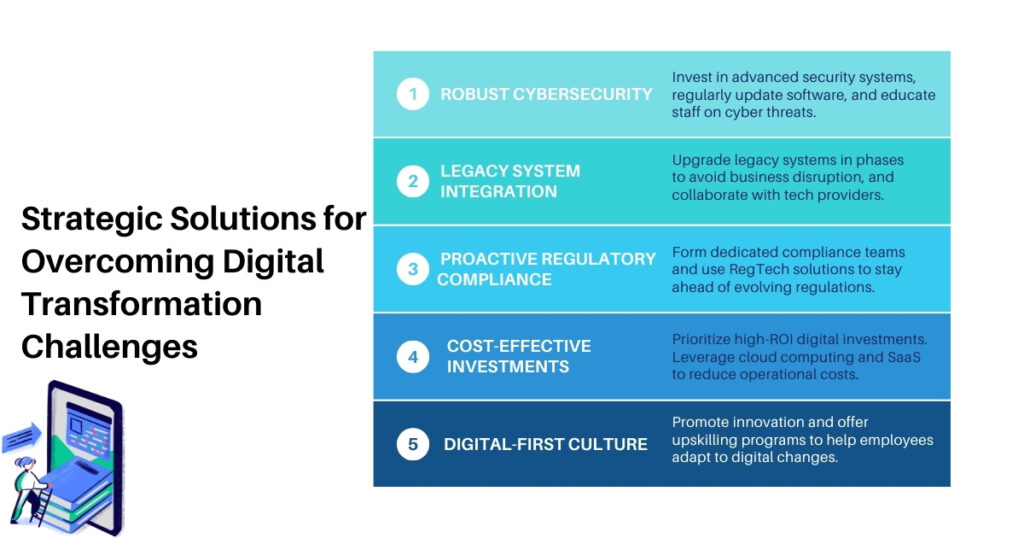
    Solutions to Overcome Digital Transformation Challenges in Finance

    Opportunities of Digital Transformation in Finance

    • Enhanced Risk Management: Digital transformation services like predictive analytics, real-time analytics solutions, fraud detection systems, Regtech solutions, compliance management platforms, etc., help in improving risk management related to finance aspects like fraud detection, refining credit score models, automating compliance tracking, and more.
    • Improved Operational Efficiency: In the finance field, digital transformation services help in operational efficiency through process automation, system integration, and cost reduction. Listed below explained are 3 key factors:
        • Process Automation: Digital transformation services like RPA tools for automated routine tasks like task automation, robotic process automation, and workflow automation help improve overall productivity through compliance checks, report generation, invoice processing, etc.
        • System Integration: Financial system integration with ERP helps in improved financial reporting, forecasting, etc. Other integrations, like APIs and data integration, help in real-time data exchange that improves decision-making.
        • Cost Reduction: Cloud computing and cost management tool integration help in cost management and efficient resource allocation.
    • Data-Driven Insights: Digital transformation services and technologies like big data analytics, behavioral analytics, data visualization, etc., help in offering tailored recommendations to customers and help in setting dynamic pricing. Do you know, as per the Infosys report, that approximately 76% of financial service executives say that customer experience is now the most integral part of digital transformation?

    For enhanced forecasting, various tools can be used for trend analysis and scenario analysis for mitigating risks.

    • Ability for Agility and Innovation by Leveraging Continuous Development in Financial Products and Services: Enterprises can focus on rapid development by implementing agile development practices like Jira or Trello for the gradual development of financial products. Along with agile practices, launching MVPs enables financial enterprises to test new ideas and features with real users rapidly. Other integrations, like modular banking platforms, microservices frameworks, and cloud computing, help give flexibility to operations.

    What is the Future of Digital Finance?

    Fintech plays a key role in transforming the future of digital finance with continuous implementation of technology to elevate the seamless outcome for both enterprises and customers. The fintech sector is projected to grow at a CAGR of 16.5% from 2024 to 2032. Listed below are some digital key integrations to look forward to in the field of finance:

    • Alternative Lending Platforms
    • Quantum Computing
    • Wealth Management Solutions
    • Collaboration with Traditional Banks
    • Open Banking and API Integration for Customer Control Over Data, Improved Competition, and Innovation
    • Sustainability and Green Finance
    • Rise of Decentralized Finance (DeFi)
    • Artificial Intelligence (AI) in Predictive Finance

    Conclusion

    The finance industry stands at a critical juncture where embracing digital transformation is no longer optional but imperative for future growth. Successfully tackling the complexities of cost management, cybersecurity, and regulatory compliance requires more than just technological adoption—it calls for a strategic, forward-thinking approach. By addressing these key challenges head-on, financial institutions can unlock new opportunities to enhance customer experiences, harness data for smarter decision-making, and drive sustainable innovation.

    At SCS Tech India, we recognize the need for integration of digital transformation services/technologies like IoT applications, AI-driven solutions, advanced cybersecurity services, etc., in navigating these complexities and challenges to drive innovation in enterprises. By partnering with SCS Tech India, organizations in the financial sector can build a resilient framework that improves agility and efficiency, helping them to capitalize on digital transformation opportunities and have a competitive edge in the dynamic financial landscape.

    FAQ

    • What is the key role of fintech in digital transformation?

    Fintech helps in digital transformation by offering real-time services, helping in cost efficiency, personalized financial advice, a focus on financial inclusion through micro-lending and digital wallets, collaboration with traditional institutions, etc., that helps in remaining competitive.

    • How do cloud-native architectures help in digital transformation in finance?

    Cloud-native architectures focus on scalability, agility, and innovation; disaster recovery and continuity; security; and compliance through inbuilt features like encryption, access controls, etc.

    • How does decentralized finance (DeFi) help in digital transformation in finance?

    Decentralized finance (DeFi) helps eliminate the need for traditional intermediaries. Transactions are recorded in the public blockchain, thereby ensuring transparency, giving access to financial services, and global accessibility.

    • What are a few challenges in AI-driven personalization in financial services?

    Challenges in AI-driven personalization in financial services include data privacy and security, biases of algorithms, customer trust, cost incurred in implementation, data integration complexity, evolving customer expectations, etc.

    (more…)

  • Transforming Today’s Business Landscape: The Impact of Blockchain Technology

    Transforming Today’s Business Landscape: The Impact of Blockchain Technology

    In the new digital era, businesses seek essential new technologies for their survival. Digital transformation enables strategic decision-making, streamlining of business processes, and the adoption of new business models through the use of disruptive technologies in the market.

    Blockchain stands out as a pivotal technology driving business evolution. While blockchain has gained significant traction in the market in connection with cryptocurrencies like Bitcoin, there is still confusion surrounding the terminology. Many individuals mistakenly view blockchain as synonymous with Bitcoin and use the terms interchangeably.

    This confusion leads to the misconception that blockchain for business solely revolves around cryptocurrencies. However, blockchain for business is established on a permissioned distributed ledger technology that fosters trust among partners. Operating on a peer-to-peer network, it enhances transaction transparency, data resilience, and security, while reducing operational costs.

    Ways Blockchain Can Enhance the Current Business Model

    Blockchain technology offers numerous benefits to businesses, offering fresh opportunities to transform current business models by cutting costs, reducing intermediary involvement, and fostering greater trust within an ecosystem. Here are ten ways that businesses can incorporate blockchain into their digital transformation efforts.

    • Smart contracts are self-executing contracts stored on a blockchain network, executing terms and conditions automatically. They eliminate the need for intermediaries in legal actions, promoting efficient business operations.
    • Blockchain technology simplifies payment processes by connecting parties on the same platform, allowing direct communication between healthcare facilities and insurance providers. This transparency enhances efficiency by providing immediate access to patient information and payment details, streamlining cash flow for businesses.
    • Blockchain in Supply Chain Management enables SMEs to track products/services from manufacturing to delivery, ensuring transparency, combating counterfeiting, and enhancing security. Example: Walmart uses blockchain to track pork items’ provenance and condition, ensuring transparency in its food supply chain.
    • Blockchain technology enhances hiring by preventing fake documents, saving time in verification, and prompting companies to engage with blockchain development firms for innovative business applications.
    • Blockchain technology enhances marketing campaigns by allowing real-time tracking of client information and behaviour. This empowers marketers to create effective campaigns, increase ROI, and authenticate traffic for better outcomes.
    • Blockchain technology in business offers robust security through decentralization, transparency, and lower cyber-attack risks. It enables digital identity protection and control over information access and usage for users.
    • Blockchain technology in business boosts customer engagement by empowering users, ensuring transparency, enabling quick transactions, and helping identify loyal customers.
    • Blockchain technology offers improved speed and efficiency by automating processes, reducing human errors, and enabling transactions to be completed in seconds.
    • Businesses seek cost-effective solutions and improved processes. Blockchain adoption reduces costs by eliminating third-party vendor expenses, central players, and the need for extensive transaction validation. This makes blockchain crucial for financial management.
    • Blockchain adoption allows businesses to raise capital through Initial Token Offerings (ITOs), where investors can buy tokens representing equity or revenue share. ITOs offer a viable capital-raising alternative for businesses of all sizes.

    The Future of Blockchain in the Business World

    Blockchain introduces a distributed ledger system that enhances the media supply chain and reduces copyright violations by providing security, data analysis, and control. The significance of blockchain is on the rise as various sectors such as healthcare, logistics, manufacturing, and IT are adopting this technology to address and predict real-time challenges.

    Blockchain technology holds immense promise in shaping the future of business. It has the potential to introduce new ideas, integrate existing concepts, and provide a comprehensive understanding of the market landscape. The impact of blockchain on small and large businesses hinges on how effectively we leverage its capabilities in our economic ecosystem.


  • An introduction to Blockchain Technology and its potential uses

    An introduction to Blockchain Technology and its potential uses

    Even while blockchain technology is still in its nascent stages today, it is finding increasing use in important industries outside of the realm of digital currencies. Through the upkeep of immutable distributed ledgers in thousands of nodes, blockchain is the primary technology utilised to produce the digital currency, Bitcoin. The 21st century will see a huge impact from this disruptive technology on institutional operations, company operations, education, and our daily lives.  It has the power to alter the current Internet from “The Internet of Information Sharing” to “The Internet of Value Exchange.”

    Blockchain technology is anticipated to fundamentally alter how business, industry, and education operate while also accelerating the worldwide transition to a knowledge-based economy. This ground-breaking technology has numerous potential uses because of its immutability, transparency, and integrity for all transactions carried out in a blockchain network.

    The following structure illustrates a sample blockchain transaction flow. A peer-to-peer blockchain network is used by User A to start a transaction with User B. The network uses a cryptographic proof of identification (a set of public and private keys) to specifically identify users A and B. The transaction will then be published to the blockchain network’s memory pool while awaiting transaction validation and verification. Reaching consensus is the process of getting a predetermined number of approved nodes to create a new block. Following a consensus, a brand-new “block” is created across the entire blockchain network, and each node updates its individual copy of the blockchain ledger. All of the transactions that took place during this time are contained in this block.

    Advantages of blockchain technology

    Reliability: because blockchain networks are decentralised, the databases of all transaction records have changed from being closed, centralised ledgers maintained by a small number of recognised institutions to being open, distributed ledgers maintained by tens of thousands of nodes.

    Trust: blockchain network also decentralises trust. With organised ledgers, blockchain networks serve as new trust bearers. A group of tamper-proof nodes form a network that shares these ledgers.

    Security: the one-way hash function, a mathematical operation that transforms a variable-length input text into a fixed-length binary sequence, is used by the blockchain network. There is no obvious connection between the input and the output.

    Efficiency: every piece of data is automatically put through pre-defined processes. Blockchain technology can therefore both dramatically lower labour costs and increase productivity. Blockchain technology may hasten the clearing and settlement of some financial transactions, resulting in a quicker and more effective reconciliation procedure.

    Applications using blockchain technology

    • Blockchain offers a number of advantages in the financial and banking sectors in terms of improved record-keeping, security, and transparency. It makes it the ideal option for banking needs like fraud protection, client onboarding, and anti-money laundering.
    • By 2025, the worldwide blockchain market for healthcare is expected to reach $5.61 billion. Using blockchain technology could help resolve expensive and urgent issues in the healthcare sector. Such as inconsistent records, patient data loss or theft, banking information, and test results.
    • Blockchain can be a great solution for the insurance industry and aid in the reduction of underwriting, the identification of fraud, and the enhancement of cyber insurance plans. By 2023, the global insurance blockchain industry might reach $1.39 billion.
    • Businesses that spend a lot of money protecting themselves against breaches are also concerned about cyber security, not only SMEs. Blockchain system nodes automatically compare the data and warn any information that is falsified.
    • Blockchain technology is being used in education by some colleges and institutions, and the majority of them do so to support academic degree management and assumptive evaluation for learning outcomes.
    • Supply chain management can be challenging and involves a lot of data. Data storage using blockchain-based systems would guarantee quick access and strong security because altering the data would be impossible without reporting it as a result.