Tag: #incident

  • How to Structure Tier-1 to Tier-3 Escalation Flows with Incident Software

    How to Structure Tier-1 to Tier-3 Escalation Flows with Incident Software

    When an alert hits your system, there’s a split-second decision that determines how long it lingers: Can Tier-1 handle this—or should we escalate?

    Now multiply that by hundreds of alerts a month, across teams, time zones, and shifts—and you’ve got a pattern of knee-jerk escalations, duplicated effort, and drained senior engineers stuck cleaning up tickets that shouldn’t have reached them in the first place.

    Most companies don’t lack talent—they lack escalation logic. They escalate based on panic, not process.

    Here’s how incident software can help you fix that—by structuring each tier with rules, boundaries, and built-in context, so your team knows who handles what, when, and how—without guessing.

    The Real Problem with Tiered Escalation (And It’s Not What You Think)
    Tiered Escalation
    Most escalation flows look clean—on slides. In reality? It’s a maze of sticky notes, gut decisions, and “just pass it to Tier-2” habits.

    Here’s what usually goes wrong:

    • Tier-1 holds on too long—hoping to fix it, wasting response time
    • Or escalates too soon—with barely any context
    • Tier-2 gets it, but has to re-diagnose because there’s no trace of what’s been done
    • Tier-3 ends up firefighting issues that were never filtered properly

    Why does this happen? Because escalation is treated like a transfer, not a transition. And without boundary-setting and logic, even the best software ends up becoming a digital dumping ground.

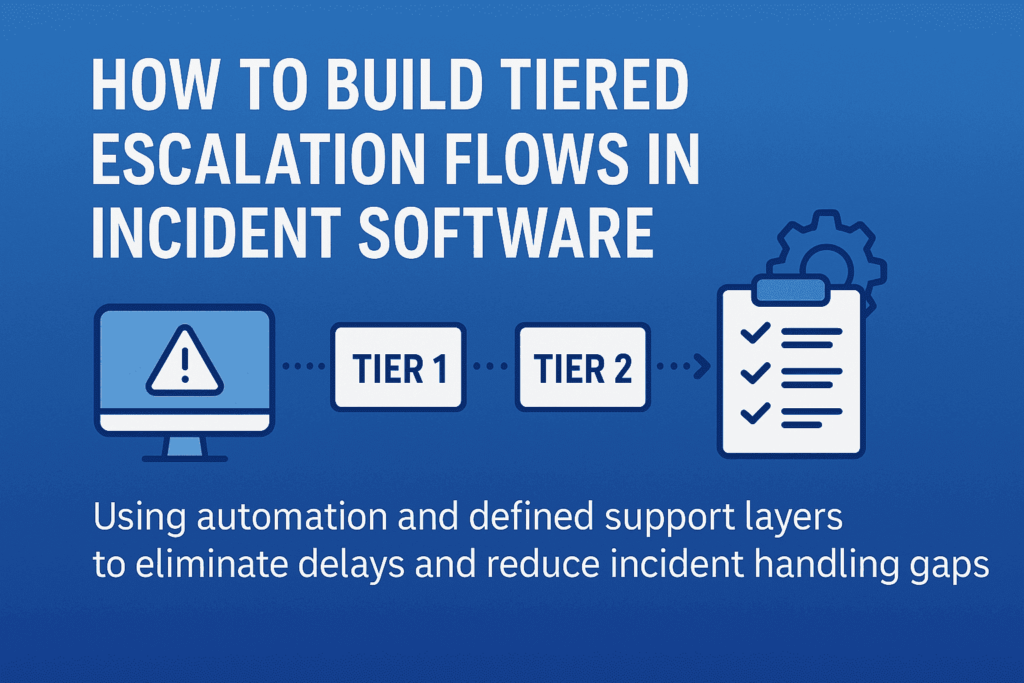
    That’s where structured escalation flows come in—not as static chains, but as decision systems. A well-designed incident management software helps implement these decision systems by aligning every tier’s scope, rules, and responsibilities. Each tier should know:

    • What they’re expected to solve
    • What criteria justifies escalation
    • What information must be attached before passing the baton

    Anything less than that—and escalation just becomes escalation theater.

    Structuring Escalation Logic: What Should Happen at Each Tier (with Boundaries)

    Escalation tiers aren’t ranks—they’re response layers with different scopes of authority, context, and tools. Here’s how to structure them so everyone acts, not just reacts.

    Tier-1: Containment and Categorization—Not Root Cause

    Tier-1 isn’t there to solve deep problems. They’re the first line of control—triaging, logging, and assigning severity. But often they’re blamed for “not solving” what they were never supposed to.

    Here’s what Tier-1 should do:

    • Acknowledge the alert within the SLA window
    • Check for known issues in a predefined knowledge base or past tickets
    • Apply initial containment steps (e.g., restart service, check logs, run diagnostics)
    • Classify and tag the incident: severity, affected system, known symptoms
    • Escalate with structured context (timestamp, steps tried, confidence level)

    Your incident management software should enforce these checkpoints—nothing escalates without it. That’s how you stop Tier-2 from becoming Tier-1 with more tools.

    Tier-2: Deep Dive, Recurrence Detection, Cross-System Insight

    This team investigates why it happened, not just what happened. They work across services, APIs, and dependencies—often comparing live and historical data.

    What should your software enable for Tier-2?

    • Access to full incident history, including diagnostic steps from Tier-1
    • Ability to cross-reference logs across services or clusters
    • Contextual linking to other open or past incidents (if this looks like déjà vu, it probably is)
    • Authority to apply temporary fixes—but flag for deeper RCA (root cause analysis) if needed

    Tier-2 should only escalate if systemic issues are detected, or if business impact requires strategic trade-offs.

    Tier-3: Permanent Fixes and Strategic Prevention

    By the time an incident reaches Tier-3, it’s no longer about restoring function—it’s about preventing it from happening again.

    They need:

    • Full access to code, configuration, and deployment pipelines
    • The authority to roll out permanent fixes (sometimes involving product or architecture changes)
    • Visibility into broader impact: Is this a one-off? A design flaw? A risk to SLAs?

    Tier-3’s involvement should trigger documentation, backlog tickets, and perhaps even blameless postmortems. Escalating to Tier-3 isn’t a failure—it’s an investment in system resilience.

    Building Escalation into Your Incident Management Software (So It’s Not Just a Ticket System)

    Most incident tools act like inboxes—they collect alerts. But to support real escalation, your software needs to behave more like a decision layer, not a passive log.

    Here’s how that looks in practice.

    1. Tier-Based Views

    When a critical alert fires, who sees it? If everyone on-call sees every ticket, it dilutes urgency. Tier-based visibility means:

    • Tier-1 sees only what’s within their response scope
    • Tier-2 gets automatically alerted when severity or affected systems cross thresholds
    • Tier-3 only gets pulled when systemic patterns emerge or human escalation occurs

    This removes alert fatigue and brings sharp clarity to ownership. No more “who’s handling this?”

    2. Escalation Triggers

    Your escalation shouldn’t rely on someone deciding when to escalate. The system should flag it:

    • If Tier-1 exceeds time to resolve
    • If the same alert repeats within X hours
    • If affected services reach a certain business threshold (e.g., customer-facing)

    These triggers can auto-create a Tier-2 task, notify SMEs, or even open an incident war room with pre-set stakeholders. Think: decision trees with automation.

    3. Context-Rich Handoffs 

    Escalation often breaks because Tier-2 or Tier-3 gets raw alerts, not narratives. Your software should automatically pull and attach:

    • Initial diagnostics
    • Steps already taken
    • System health graphs
    • Previous related incidents
    • Logs, screenshots, and even Slack threads

    This isn’t a “notes” field. It’s structured metadata that keeps context alive without relying on the person escalating.

    4. Accountability Logging

    A smooth escalation trail helps teams learn from the incident—not just survive it.

    Your incident software should:

    • Timestamp every handoff
    • Record who escalated, when, and why
    • Show what actions were taken at each tier
    • Auto-generate a timeline for RCA documentation

    This makes postmortems fast, fair, and actionable—not hours of Slack archaeology.

    When escalation logic is embedded, not documented, incident response becomes faster and repeatable—even under pressure.

    Common Pitfalls in Building Escalation Structures (And How to Avoid Them)

    While creating a smooth escalation flow sounds simple, there are a few common traps teams fall into when setting up incident management systems. Avoiding these pitfalls ensures your escalation flows work as they should when the pressure is on.

    1. Overcomplicating Escalation Triggers

    Adding too many layers or overly complex conditions for when an escalation should happen can slow down response times. Overcomplicating escalation rules can lead to delays and miscommunication.

    Keep escalation triggers simple but actionable. Aim for a few critical conditions that must be met before escalating to the next tier. This keeps teams focused on responding, not searching through layers of complexity. For example:

    • If a high-severity incident hasn’t been addressed in 15 minutes, auto-escalate.
    • If a service has reached 80% of capacity for over 5 minutes, escalate to Tier-2.

    2. Lack of Clear Ownership at Each Tier

    When there’s uncertainty about who owns a ticket, or ownership isn’t transferred clearly between teams, things slip through the cracks. This creates chaos and miscommunication when escalation happens.

    Be clear on ownership at each level. Your incident software should make this explicit. Tier-1 should know exactly what they’re accountable for, Tier-2 should know the moment a critical incident is escalated, and Tier-3 should immediately see the complete context for action.

    Set default owners for every tier, with auto-assignment based on workload. This eliminates ambiguity during time-sensitive situations.

    3. Underestimating the Importance of Context

    Escalations often fail because they happen without context. Passing a vague or incomplete incident to the next team creates bottlenecks.

    Ensure context-rich handoffs with every escalation. As mentioned earlier, integrate tools for pulling in logs, diagnostics, service health, and team notes. The team at the next tier should be able to understand the incident as if they’ve been working on it from the start. This also enables smoother collaboration when escalation happens.

    4. Ignoring the Post-Incident Learning Loop

    Once the incident is resolved, many teams close the issue and move on, forgetting to analyze what went wrong and what can be improved in the future.

    Incorporate a feedback loop into your escalation process. Your incident management software should allow teams to mark incidents as “postmortem required” with a direct link to learning resources. Encourage root-cause analysis (RCA) after every major incident, with automated templates to capture key findings from each escalation level.

    By analyzing the incident flow, you’ll uncover bottlenecks or gaps in your escalation structure and refine it over time.

    5. Failing to Test the Escalation Flow

    Thinking the system will work perfectly the first time is a mistake. Incident software can fail when escalations aren’t tested under realistic conditions, leading to inefficiencies during actual events.

    Test your escalation flows regularly. Simulate incidents with different severity levels to see how your system handles real-time escalations. Bring in Tier-1, Tier-2, and Tier-3 teams to practice. Conduct fire drills to identify weak spots in your escalation logic and ensure everyone knows their responsibilities under pressure.

    Wrapping Up

    Effective escalation flows aren’t just about ticket management—they are a strategy for ensuring that your team can respond to critical incidents swiftly and intelligently. By avoiding common pitfalls, maintaining clear ownership, integrating automation, and testing your system regularly, you can build an escalation flow that’s ready to handle any challenge, no matter how urgent. 

    At SCS Tech, we specialize in crafting tailored escalation strategies that help businesses maintain control and efficiency during high-pressure situations. Ready to streamline your escalation process and ensure faster resolutions? Contact SCS Tech today to learn how we can optimize your systems for stability and success.
  • Why Is Incident Management Software Vital for Homeland Security and Defence Operations?

    Why Is Incident Management Software Vital for Homeland Security and Defence Operations?

    Are you aware that India ranks as the world’s second most flood-affected country?

    Facing an average of 17 floods each year, these flood events annually affect about 345 million people every year. With these frequent natural disasters, along with threats like terrorism and cyberattacks, India faces constant challenges. Therefore, now more than ever it is crucial to protect people and resources.

    To tackle this, having an effective incident management software (IMS) system is very important. It helps teams coordinate effectively and plan ahead, ensuring rapid action in critical situations.

    So how exactly does incident management software support homeland security and defense operations in managing these complex crises?

    Why Is Incident Management Software Vital for Homeland Security and Defence Operations?

    why incident management software for homeland security and defence?

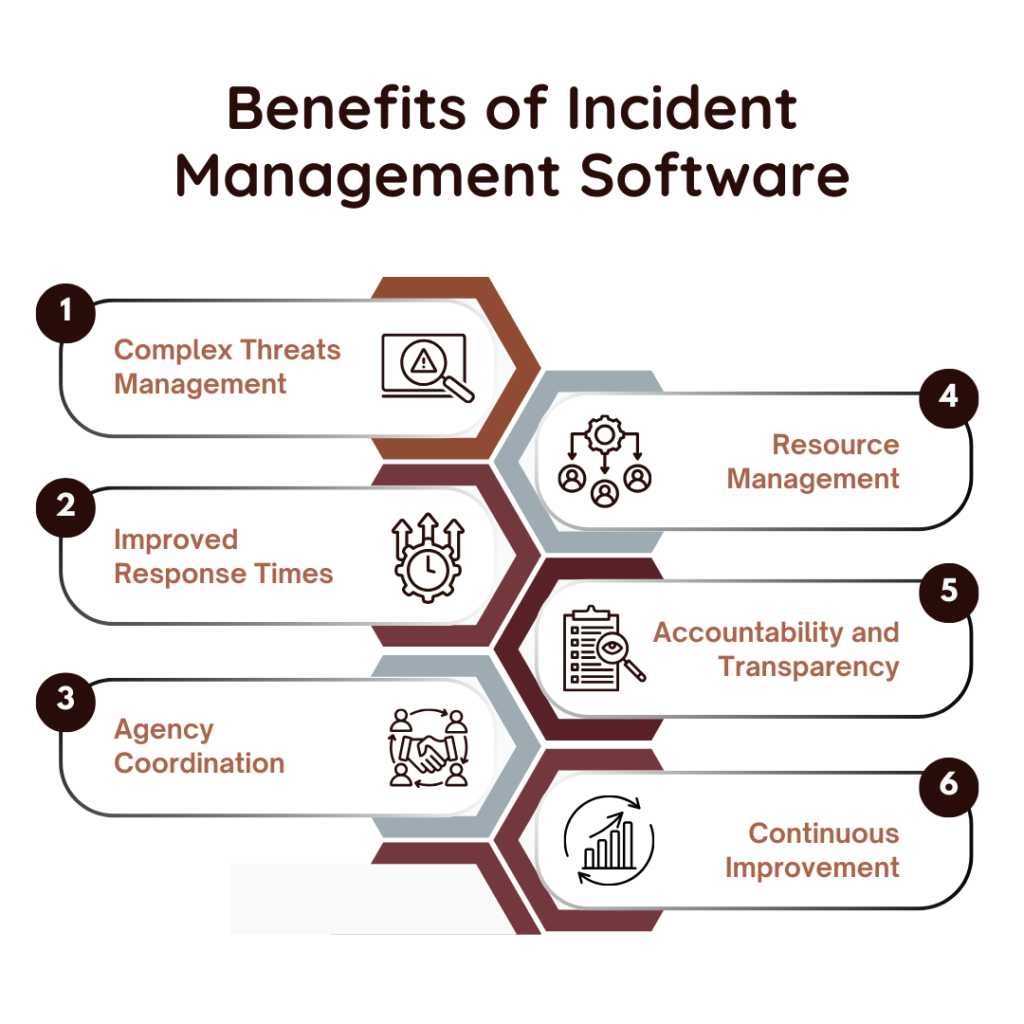
    #1. Tackling the Complexity of Security Threats

    India’s diverse threats- from natural disasters to public health emergencies- call for special and flexible response strategies. This is where incident management software makes an all-important difference.

    • Multi-Dimensional Threat Landscape: India’s threats are multi-dimensional and heterogeneous, so different agencies are called to work together. IMS centralizes the platform for police, medical teams, fire services, and defense forces to share data and communicate closely to ensure all responders are in sync.
    • Evolving Threats: The threats are diverse and cannot be predicted. Incident management software is designed to respond to unanticipated crisis changes, whereas traditional responses are often left behind. It enables on-site changes based on fresh information, creating agility in response efforts.

    #2. Response Time Improvement

    When disasters strike, every second counts. Delayed response translates to more deaths or more significant property damage. Incident management software drastically cuts down response times by standardizing procedures for critical activities.

    • Access to Information in Real Time: IMS offers decision-makers instant information about the status of incidents, resource utilization, and current operations. With rapid access to the correct information, mobilization of resources is quicker and certainly does not result in delays that may augment the crisis condition.
    • Automated Processes: Some of the core processes in an IMS are automated, such as reporting and tracking, which eliminates more human errors and lets the information flow faster. At times of high pressure, such automation is instrumental in transmitting responses fast enough for loss of life and further damage.

    #3. Coordination between Agencies

    A coordinated response involving multiple agencies is fundamental during crisis management. Incident management software helps coordinate unified action by creating a central communication hub for all the responders.

    • Unified Communication Channels: IMS presents a common communication channel to all agencies. This saves the agency from confusion and misunderstanding, which may lead to errors in response and thus present hazards to the public.
    • Standard protocols: IMS places agencies into parallel response frameworks at the national level, similar to the National Disaster Management Act. That way, they will work from the same protocols, and accountability can be easily known and understood.

    #4. Enable Resource Management

    Resources are always scarce at any given moment of a disaster. The effectiveness of response is often related to the way resources are managed. Incident management software provides an essential function in resource allocation so that it reaches precisely where and when it is needed.

    • Resource Availability Visibility: IMS provides real-time situational awareness concerning available resources, people, equipment, and supplies. Agencies can rapidly deploy resources to the point of need.
    • Dynamic Resource Allocation: The demand for resources changes sharply in more significant incidents. IMS enables the responder to promptly make dynamic resource allocations to fulfill urgent needs.

    #5. Enabling Accountability and Transparency

    Transparency and accountability are essential for any democratic country such as India. Public trust must be there, and incident management software supports this and lays the foundation for the trust of people in crisis management by the government.

    • Detailed Documentation: IMS offers an audit trail of everything done during the incident. It is crucial for accountability, with every agency responding accountable for every piece of action.
    • Public Trust: Incident management transparency will build the trust of the public. More people will feel confident and trusting that the government can be there for them if they realize there is evidence of successful crisis management. IMS helps illustrate that it is not only responsive but prepared and organized.

    #6. Enabling Continuous Improvement

    One of the greatest strengths of incident management software lies in its support for continuous improvement. Through lessons learned from past events, the agencies improve their strategies in preparation for other challenges.

    • Data-Driven Insights: IMS collects data from each incident, based on which analysis of response effectiveness is conducted to identify what areas need improvements. The insights drawn from such data guide training programs, resource planning, and policy adjustments. The system thus becomes more resilient in the face of future challenges.
    • Adaptation to New Challenges: Constant adaptation is necessary, from the emergence of cyberattacks and climate-related disasters to others yet to emerge. Through historical data analysis, the central agencies are better placed to stay ahead of rising challenges and refine their responses based on lessons learned.

    Conclusion

    Incident management software has become essential in a world where evolving security threats and natural disasters constantly challenge a nation’s resilience. This is especially true for countries like India. Companies like SCS Tech develop the most sophisticated incident management software solutions, boosting response time and coordinating and managing resources accordingly.

    Such investment is bound to be operational and goes beyond that to enhance national resilience and public trust, equipping India’s security forces to respond to emerging challenges effectively.

  • Evaluating Incident Management Software: Features and Performance Metrics

    Evaluating Incident Management Software: Features and Performance Metrics

    Downtime isn’t just a nuisance—it’s a costly affair. 

    With system downtime costing companies an average of $300,000 per hour in lost revenue, employee productivity, and maintenance charges, the financial impact is staggering. 

    For instance, an e-commerce giant facing a server outage during a major sale event can experience frustrated customers and significant revenue loss. This is one among the many situations that underscores the critical need for efficient incident management software.

    In this blog, we will delve into the essential features and performance metrics that define top-tier incident management software, helping you make informed decisions to safeguard your business operations.

    Incident Management Software: A Brief Overview

    With Incident management software, corporations can efficiently respond to and manage all kinds of incidents. The software can collaborate on resolutions, simplify the interaction with the stakeholders and track down all incidents.

    Furthermore, it can also automate various tasks like incident escalation and alerting. Besides that, the necessity of this particular software leans on the complexity and scale of your business operations and IT infrastructure.

    Small IT frameworks and SMEs with simple operations can manage all incidents without software. However, bigger and more complicated IT setups need powerful incident response systems to handle all incidents effectively.

    The Features of Incident Management Software

    Image Source:

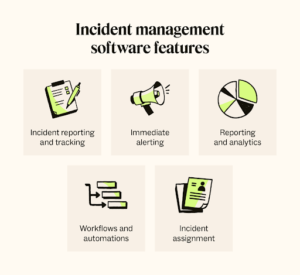
    Before you choose an ideal Incident management software for your business, it’s crucial to understand all its features. Checking out the features beforehand will certainly help you make a smart choice. The features are:

    • Customisable Workflows: The software offers workflow customisation so that you can align incident management with the company’s certain procedures.
    • Intuitive User Interface: Having a user-friendly interface will lead to instant incident resolution. Incident management software comes with a minimal learning curve and uncomplicated navigation.
    • Collaboration Tools: This type of software comes with real-time collaboration and communication features so that you can take a unified approach when it comes to handling all sorts of incidents.
    • Automated Capabilities: Having a powerful automation feature can lessen human errors and speed up response times during severe incidents.
    • Multiple Channel Alerting: This software also has the multi-channel alerting feature to make sure no incidents go unnoticed by you and your team.
    • Scalability: The software will scale the business growth and also increase the demand and the complexity along with it.
    • Comprehensive Analytics and Reporting: The powerful analytics and reporting tools can give insights into the performance and various incident trends.
    • Mobile Accessibility: Many Incident management software come with a mobile accessibility feature so that you can receive responses on time regardless of your location.
    • Integration Capabilities: This software can integrate perfectly with all your current platforms and tools. The feature can stop information silos.
    • Incident Response Tool: The incident management system comes with an outstanding incident response feature, which makes the entire platform quite powerful.
    • Security Measures and Compliance: Incident management systems meet all the compliance standards of the industry and also have robust security measures to keep all sensitive information secure.

    Value of Incident Management Software for the IT Sector

    Incident management software plays a vital part in many sectors, including Information Technology (IT). Using this software in an IT setting can help you take a systematic approach to managing all unexpected emergencies, incidents, and events. There are other reasons that prove this software is important for the IT industry. Check out the table below:

    The Pointers The Reasons
    Analysing the Root Cause Simplifies the entire analysis of various incidents to detect all the underlying issues for long-term enhancements.
    Reducing the Downtime Assist in smoothly resolving all cyber-related attacks and system failures. This helps reduce all the software disruptions.
    SLAs [Service Level Assessments] Tracks down the incident resolution times to maintain customer satisfaction and guarantee SLA compliance.

    The Performance Metrics of Incident Management Software

    The Incident management software has many performance metrics, and you will find out about the important ones in this section.

    Uptime

    This metric is known as the percentage of times a system functions correctly. Uptime is extremely straightforward as it will show you how reliable the service can be. If the uptime is close to 100%, it means your customers are happy. Based on the industry standards, an uptime of 99.9% is viewed as pretty good, but 99.99% is considered excellent. Even though perfection is not possible, try to keep this particular number higher.

    MTTR [Mean Time to Resolution]

    This metric is known as the average time taken to resolve or respond to a specific incident. Mean Time to Resolution will show you how fast your team resolves or responds to various problems that take place.

    First Touch Resolution Rate

    This is a rate at which all incidents get resolved without repeat alerts when they take place for the first time. The First Touch Resolution Rate displays how effective the management system has become over time. A first touch and high-resolution rate means the system is mature and properly configured.

    MTTA [Mean Time to Acknowledge]

    MTTA is known as the average time between the team member who acknowledges the problem and the system alert. This metric will show you how effectively and instantly your team members respond and manage the latest system alerts.

    Conclusion

    Incident management software is crucial not only for the marketing and healthcare sectors but also for the IT, power, gas, oil and various other incident-prone industries. It enables swift responses and system alerts and enhances team collaboration effectively.

    Implementing such software enables proactive incident detection and timely response to unforeseen events. For tailored incident management solutions for your business, consider consulting experts at SCS Tech India Pvt Ltd.

    SCS Tech India Pvt Ltd specializes in delivering cutting-edge IT solutions globally, including Cyber Security, Blockchain Solutions, and Enterprise Solutions. Serving diverse sectors such as Agriculture, Finance, Education, and Healthcare, they are committed to providing innovative IT-based solutions to meet varied client needs.

  • Implementing Incident Management Software for Effective Disaster Response

    Implementing Incident Management Software for Effective Disaster Response

    Incident management software is a fundamental component in coordinating incident responses across various types of events. Its role is especially crucial in today’s world, where the frequency and intensity of natural disasters have significantly increased compared to the past.

    Effective disaster management, encompassing both natural and man-made incidents, involves substantial risks. A proper response can prevent loss of life, minimize property damage, and facilitate a swift return to normalcy for affected communities.

    This blog discusses the critical importance of Incident Management Software (IMS) in disaster response, detailing its features, benefits, and implementation strategies.

    Understanding Incident Management Software

    Incident Management Software (IMS) is designed to enable organizations to handle emergencies efficiently. This system is essential for reporting, monitoring, and managing incidents across various fields. It acts as a command center for disaster management, integrating functionalities like communication, information dissemination, resource management, data interpretation, and analysis to enhance response rates.


    Understanding Incident Management Software 
    Feature Characteristics 
    Real-time Communication and Coordination Alert the senders and receivers of data and thus controllers and administrators of responses
    Resource Management  Helps to effectively allocate resources all through a given chain
    Incident Tracking and Reporting  Track and report all the specific occurrences
    Integration with other Systems  Function together with other helpful systems


    Let us identify the salient features of IMS and how an IT infrastructure solution provider can help in detail:

    • Real-time Communication & Coordination

    Disaster response management depends on positive communication hence it is important to adopt effective communication platforms. IMS founded Interactive Distance Education and e-learning tools such as messaging systems, video conferencing, and an alert system. These features alert the senders and receivers of data and thus controllers and administrators of responses coordinate timeously.

    • Resource Management

    Resource management is vital in a disaster and should be managed efficiently for the best results. IMS can be used to track and distribute work such as the distribution of human resources, machinery, facilities, and other materials. It also helps to effectively allocate resources all through a given chain, to ensure that demand for a certain resource in a certain sector is met. 

    • Incident Tracking and Reporting

    Another aspect is the efforts to track and report all the specific occurrences that may have occurred during a particular phase of the incident. IMS allows for the thorough record-keeping of details, maps and the status, which are critical in near-shore and post-impact scenarios.

    • Integration with Other Systems

    Today’s IMS solutions can function together with other helpful systems like a Geographic Information System, Meteo System, and Public Address System. It also gives a holistic approach to the occurrence of incidents when it has been integrated, hence improving the decision-making process.

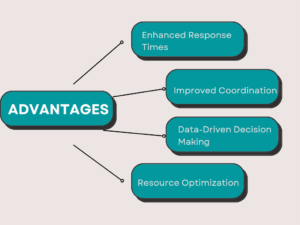
    Advantages of Incident Management Software

    A few of the advantages of incident management software are listed below:

    • Enhanced Response Times

    IMS significantly reduces the time required to respond to inquiries and emergencies. With features like real-time feeds and dispatch options, responders gain rapid situational awareness and can mobilize relevant resources quickly, thereby minimizing the disaster’s impact.

    • Improved Coordination

    Disaster response often involves multiple agencies and organizations. IMS facilitates better coordination among these entities by providing a shared platform for communication and resource management. This common ground improves the overall efficiency and effectiveness of the response.

    • Data-Driven Decision Making

    Disaster response often involves multiple agencies and organizations. IMS facilitates better coordination among these entities by providing a shared platform for communication and resource management. This common ground improves the overall efficiency and effectiveness of the response.

    • Resource Optimisation

    IMS helps organizations optimize the utilization of their resources. By keeping track of available human resources, equipment, and materials, IT solutions like IMS ensures that resources are used efficiently and effectively. This optimization minimizes resource wastage and ensures timely emergency responses.

    Implementing Incident Management Software

    By keeping in mind the following aspects, we can successfully implement incident management software:

    • Assessing Organisational Needs

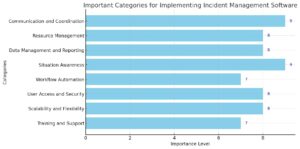
    Before one can start to implement IMS certain prerequisites need to be met. It’s about determining the kind of incidents that will be claimed, the tools to be used, and other systems that IMS will be interfacing with. The choice of the software and its features will be informed by the needs of the organisation undergoing the audit.

    • Selecting the Right Software

    In the present world market, there are numerous IMS solutions available with their advantages and disadvantages. Choosing the right software might be based on characteristics such as convenience, capacity for expansion, compatibility with other systems, and the availability of further services. 

    • Customise and Integrate the System

    If an IMS solution has been chosen, the next step is to make it compliant with your specific needs. You need to adopt the applications to meet the unique requirements of your company and its business management. Also on dependability, the ability to interface with other systems is important for the response functions.

    • Training and Drills

    IMS, from the prospect of their implementation, is not only a question of technology but rather of people as well. Make sure all users who are expected to be on the system are trained well on how to handle it. Essential frequent exercises also include drills and simulations. Both assist in evaluating the performance of the system and examining the level of awareness of the responders.

    Conclusion

    The application of Incident Management Software can be considered as a key strategy to strengthen the resilience of an organisation in the face of disaster situations. Through enhanced communication, resource dispatch and other analytical solutions, IMS enhances real-time reactions and responses to emergencies. 

    We, at SCS Tech India PVT Ltd offer leading-edge, advanced software IT infrastructure solutions for managing incidents and ensuring smooth, efficient operations. Our exceptional technologies are designed for swift and efficient responses to critical events. Our software provides real-time data, communication systems, and automated workflows to enhance emergency planning and enable quick, efficient actions by the emergency teams. 

    Contact us today to boost your organisation’s disaster management capabilities, increasing your safety and preparedness for any emergency.