Tag: IT

  • What Sets Leading Machine Learning Companies Apart in Today’s Market?

    What Sets Leading Machine Learning Companies Apart in Today’s Market?

    In today’s rapidly evolving business landscape, integrating machine learning technologies has become paramount for companies striving to stay ahead of the curve. Machine learning, a subset of artificial intelligence (AI), empowers systems to learn from data and make predictions or decisions with minimal human intervention. As businesses increasingly grasp the transformative potential of machine learning, the demand for proficient and innovative machine learning companies has surged.

    In this blog post, we’ll explore machine learning and what sets leading companies apart in today’s competitive market. From expertise and innovation to customized solutions and a commitment to quality, we’ll uncover the key factors that distinguish top-tier machine learning companies.
    AI in business

    Expertise and Innovation in Machine Learning

    Leading machine learning companies stand out due to their unparalleled expertise and commitment to innovation. With seasoned professionals skilled in algorithms, data analysis, and software development, these companies tackle complex challenges with precision.

    Innovation is a hallmark of top-tier machine learning firms. These companies invest in research, collaborate with academia, and engage in knowledge-sharing communities to pioneer new solutions. By staying abreast of trends and anticipating market needs, these companies spearhead transformative change in AI services and machine learning.

    Range of AI/ML Services Offered

    Leading machine learning companies provide various ai services tailored to meet diverse client needs. These firms provide comprehensive solutions, spanning from predictive analytics to natural language processing and computer vision. They enable businesses to glean insights, automate processes, and make data-driven decisions.

    Focusing on continuous innovation, these companies stay ahead of emerging challenges and opportunities, empowering clients to thrive in the digital age.

    Customized Solutions for Business Needs

    Leading machine learning companies excel in providing tailored solutions to meet each client’s unique requirements. These firms design solutions that drive tangible business outcomes by conducting thorough assessments and understanding specific challenges. With a focus on scalability and flexibility, they ensure their solutions adapt to evolving needs, fostering long-term success.

    Commitment to Quality and Performance

    Top-tier machine learning companies prioritize delivering high-quality solutions that exceed client expectations. They maintain rigorous standards throughout development, ensuring accuracy, reliability, and scalability.

    By leveraging robust testing methodologies and quality assurance protocols, these companies validate the performance of their solutions and identify any potential issues or optimizations. This commitment to quality ensures that clients receive reliable and efficient machine-learning solutions that meet their business objectives.

    Furthermore, leading machine learning companies are dedicated to ongoing performance optimization. They continuously monitor and analyze solution performance, identifying opportunities for improvement and innovation. By staying proactive and responsive, these companies ensure that their solutions remain at the forefront of technological advancements and deliver optimal client results.

    Client Success Stories and Testimonials

    Leading machine learning companies showcase their expertise and effectiveness through client success stories and testimonials. These stories highlight real-world applications of their solutions, demonstrating their tangible benefits to businesses across various industries.

    Top-tier machine learning companies offer prospective clients valuable insights into the effectiveness and reliability of their services by sharing success stories and testimonials.Clients’ firsthand accounts of the impact of machine learning solutions on their operations serve as compelling endorsements, instilling confidence in potential clients and reinforcing the company’s credibility.

    Furthermore, success stories and testimonials are powerful marketing tools, enabling machine learning companies to differentiate themselves from competitors and attract new clients. They demonstrate a track record of delivering results and showcase the company’s ability to address diverse challenges and deliver measurable outcomes.

    Conclusion

    In conclusion, leading machine learning companies set themselves apart in today’s market through their expertise, innovation, commitment to quality, and client-eccentric approach. These companies drive business success and foster innovation across industries by leveraging cutting-edge technologies and customized solutions.

    As businesses navigate the complexities of AI services and machine learning, partnering with a trusted and reliable machine learning company becomes essential. By focusing on factors like expertise, innovation, and dedication to quality, businesses can select a partner that aligns with their objectives and enables them to leverage the complete potential of machine learning.

    In an era increasingly defined by digitalization and data, machine-learning companies are pivotal in propelling innovation and shaping the future of business. By embracing AI services and machine learning’s capabilities, businesses can unlock new opportunities, drive efficiency, and stay competitive in today’s dynamic market landscape.

    Ready to harness the power of machine learning for your business? Explore SCS Tech India’s AI/ML services and discover how we can help you achieve your goals. Contact us today to schedule a consultation!

     

  • Top IT Trends to look out for in 2023

    Top IT Trends to look out for in 2023

    Technology is still one of the main drivers of global change. Technology advancements give businesses more opportunities to increase efficiency and develop new products. Business leaders can make better plans for the future by keeping an eye on the development of new technologies, foreseeing how businesses might use them, and comprehending the factors that influence innovation and adoption. Keep reading to know about the new tech innovation and trends which will become a critical force for change in the world.

    Artificial Intelligence  

    Artificial intelligence has long been the subject of hype. If you are a tech professional, you might not enjoy how pervasive artificial intelligence has become. For both creative and routine activities, AI has already proven its brilliance in navigation apps, cell phones, and more. The buzz surrounding AI won’t go away anytime soon. It will become more accessible because of the expanding ecosystem of as-a-service platforms and low-code or no-code AI systems.

    Synthetic content is a promising area of AI to keep an eye on. It involves using the AI’s imagination to produce brand-new, unprecedented sights, sounds, or data. We can anticipate seeing the development of AI that is useful in both business and entertainment in 2023. Precedence Research predicts that by 2030, the global AI market would be worth $1,597.1 billion. We may anticipate new opportunities in programming, development, testing, and many other sectors as AI becomes more prevalent in a variety of industries.

    Metaverse

    Metaverse can now be classified as “a more digital environment.” Within the next five years, it is anticipated that the experience of immersive online environments and next-level user experiences will develop significantly. The phrase “metaverse” is used to refer to a highly immersive 3D virtual world that is created by combining AR, VR, and MR technologies by developing a virtual environment in which users can engage in social interaction, play games, do commerce, and more. The online experience is enhanced by the metaverse platform.

    The metaverse has the potential to open doors to new artistic, social, and professional opportunities in 2023. In the next five years, the tech giant Facebook plans to add 10,000 new, highly trained jobs for the metaverse. Talented metaverse engineers, marketers, architects, and visionaries will have more opportunities as a result.

    Blockchain

    Blockchain technology has become more and more popular, and many sizable firms are headed in that direction. As a result, there is a huge need for developers in the field of blockchain technology. The network’s decentralization, security, and data privacy are among blockchain’s advantages. Applications for blockchain technology go well beyond digital currency like bitcoin. Blockchain’s worth will significantly rise, reaching $176 billion by 2025 and $3.1 trillion by 2030, as predicted by Gartner. Whether they are little businesses or established corporations, everyone wants a piece of the blockchain industry.

    Quantum Computing

    There is a contemporary competition taking place on a worldwide basis to develop quantum computing. Quantum computing, which uses subatomic particles to develop new ways to process and store data, is expected to make it possible for computers to be a trillion times faster than the fastest regular processors currently available. The concern around quantum computing is that it might make our current encryption methods obsolete.

    Therefore, any country that makes significant investments in the development of quantum computing will have the ability to decrypt the encryption used by other countries, corporations, security systems, and other entities. In 2023, keep an eye on this development as nations including the US, UK, China, and Russia invest heavily in the creation of quantum computing technology.

    Hyper-automation

    Hyper-automation enables the automatic completion of repetitive tasks without manual or human input. It modifies both new and existing gear and processes using robotic process automation (RPA), machine learning, and artificial intelligence (AI). By using digital transformation to improve cost and resource efficiency, a business can prosper in a more competitive world. To succeed in the current market, businesses must increase production, cut costs, and run more effectively. With the aid of hyper-automation services, you can advance.

    Datafication

    The transition of all the physical items in our lives into data-driven digital gadgets is known as datafication. In conclusion, it converts labor-intensive, manual processes into data-driven technologies. Data has been a part of everything for longer than we can remember, from our cell phones to our workplace software, industrial machinery, and AI-powered products.

    As a result, handling our data in a secure and safe manner has become a sought-after skill in our sector. Datafication can turn unprocessed data into knowledge if done correctly. This has already been advantageous to numerous businesses.

    Industry Cloud Platforms

    Businesses can increase the flexibility of their workload management by using industrial cloud platforms. They can expedite adjustments to data analysis, corporate operations, and compliance processes. To enhance adaptability, quicken time to value, and meet the demands of vertical industry sectors, they combine platforms, software, and infrastructure as a service.

    Sustainable Tech

    In the future, we’ll start to see a move toward sustainable technology. We all rely on technology, including computers, cell phones, and tablets, but where are the parts needed to make these devices come from? The public will be more interested in where rare earth materials come from and how we use them. Additionally, we use cloud services like Netflix and Spotify, which continue to operate in big data centers that use a lot of electricity. As consumers demand energy-efficient goods and services supported by more sustainable technologies, efforts to boost supply chain transparency will probably continue in 2023.


  • What Processes Does IT Service Management (ITSM) Foster and What Do They Do?

    What Processes Does IT Service Management (ITSM) Foster and What Do They Do?

    Editor’s note: This is a general overview of what ITSM processes are and what they can bring to a company.

    Here at SCS Tech, our ITSM consulting team believes that the less chaos in one’s IT infrastructure, the better. And this belief proves to be right with the fact that establishing stable and efficient IT operations is one of the reasons for companies from all over the world to adopt ITSM processes. But what are these ITSM processes and why else would a company want to adopt them? We will go through that in detail below, but let’s briefly clarify the difference between ITSM and ITIL first.

    ITSM is a widespread ideology – a “religion” as some of my colleagues say – of managing IT in an organization by delivering it as a service.

    ITIL is the most popular approach to ITSM, a documented set of best practices for running IT within an organization that is built around certain ITIL processes.

    ITIL processes are often dubbed “ITSM processes,” so for the sake of convenience, I’ll use the ITSM processes term throughout this article to refer to ITIL processes.

    What ITSM processes actually are

    SCS Tech team of ITILv3-certified experts applies ITSM processes in their daily work and implements them for our customers according to the following 5 stages:

    Service Strategy (SS) is the first and foremost stage. Here, you determine what exactly your IT does, explore what your users/customers need and verify whether the IT service is worth it financially. Broadly speaking, SS contributes to the overall understanding of your IT services. Some of the processes here: Service Portfolio, Financial Management, Business Relationship Management, etc.

    Service Description (SD) is the ‘helping hand’ of Service Strategy. It complements strategic findings with a detailed documented description of your services. SD ensures that your IT service delivery will meet the needed requirements, your company will have enough capacity to deliver the services, and these services will be available, secure, etc.

    Service Transition (ST) is responsible for the conversion of your services from paper into real action. Apart from that, ST maintains your services as stable and undisturbed as possible, while allowing them to be dynamic by carefully introducing changes. The processes at this stage, for instance, are Change, Release and Knowledge Management.

    Service Operation (SO) makes sure your services work, and disruptions get solved promptly. There are 5 main processes that help SO do that:

    • Event Management: Monitors how services run. In case of trouble, it notifies you and aims to resolve it.
    • Incident Management: Aims at restoring the normal flow of IT processes as soon as possible. If something isn’t working properly, IT guys implement a quick solution, for instance, a reboot.


    • Problem Management: Deals with the underlying cause of incidents. If any problem is detected, the IT team analyzes why it appeared and how it can be solved properly, so that no similar incidents occur in the future.


    • Request Fulfillment: Tries to take some load off Change Management in ST and deals with low-risk repeated and pre-defined situations. For example, when a newcomer needs a computer installed, an account created, etc.
    • Access Management: Deals with accounts and passwords. Since password resets are the most common inquiries within Access Management, this process can enable a company with, say, 600,000 annual password resets to save as much as $1,850,000 per year by automating the fulfillment of such inquiries. And such savings are not uncommon among our ITSM implementation customers.

    According to our experience of implementing and supporting ITSM solutions for our customers. Incident Management and Request Fulfillment are the most popular processes of the SO stage.

    Continual Service Improvement (CSI) is the last stage aimed at achieving the constant perfection of your services. To do that, your organization needs to monitor IT performance and react to its problem areas.

    Thinking Of Going ITSM?

    Grasping the theory behind ITSM processes is good, but now is the time for you to turn to SCS Tech and see for a fact what ITSM will bring to your organization!


    What ITSM processes bring

    Being a very structured approach to IT services, ITSM can bring lots of benefits. But the other side of the coin shouldn’t be neglected too.

    The Good

    The good side of ITSM processes is that they bring clarity and transparency to your IT structure. But is there something else behind these vague words? Yes, there is. Here is what customers cite as the most prominent outcomes of introducing ITSM in their orgs:


    • ITSM processes help IT departments stabilize IT service availability. Armed with clear what-and-how guidelines, IT teams reduce downtime (when disruptions in services occur) and increase service availability.
    • The decrease in IT teams’ reaction and resolve time, as well as the increase in overall service availability, improves user/customer satisfaction rate.
    • A more effective approach to daily operations and the automation of some of them reduce IT service management costs.
    • ITSM processes ensure that IT services are solid as a rock and at the same time aren’t resisting change. Release and Change Management help achieve ‘cautious’ IT dynamics within the enterprise.


    The Evil

    Although SCS Tech helped them in the end to find solutions to each point in the ‘dark side’ of ITSM, our customers do admit that often there was some resistance in their midst regarding the introduction of ITSM processes. Here are some of the ‘evil things’ about ITSM that caused this resistance:


    • Introducing ITSM processes was viewed as ‘too big of a change’ since it required a lot of time and effort. But most importantly, it required a change in their employees’ way of thinking. And so, learning the new workflows was met with considerable resistance. As a compulsory condition for success in such cases, we see not only the need to have the IT personnel change their approach but also the need to educate the company’s management.
    • Once our customers decided to adopt ITSM processes, they saw that the processes were actually expensive to introduce.
    • At some point, to support ITSM, a company needs to use specific software. Free tools don’t incorporate all ITSM processes and aren’t free to maintain. Mid-level platforms aren’t that expensive but still lack needed functionality. And comprehensive ITSM systems can cost a small fortune. The choice can be overwhelming, but having SCS Tech as an ITSM consultant at their side, our customers managed to easily find a fit solution.
    • A company needs to invest in organizing training for staff to teach them the core concepts of ITIL and also may have to additionally organize training for the users of the new ITSM platform.
    • Some of the ITSM processes (especially, Change Management) bring the element of ‘bureaucracy’ into the work of IT departments. It happens with practically every complex hierarchical structure and is an aftereffect of the IT process formalization.


    The Balance

    Despite all the ‘evil’ that ITSM processes can bring, SCS Tech customers are inclined to think that ITSM is on the light side of the force. Obviously, a company needs to invest in changing their IT structure while introducing ITSM processes. But the benefits (the improvement of IT service delivery and reduced IT support costs) will soon outweigh the difficulties of the implementation process.

    How SCS Tech introduces ITSM processes

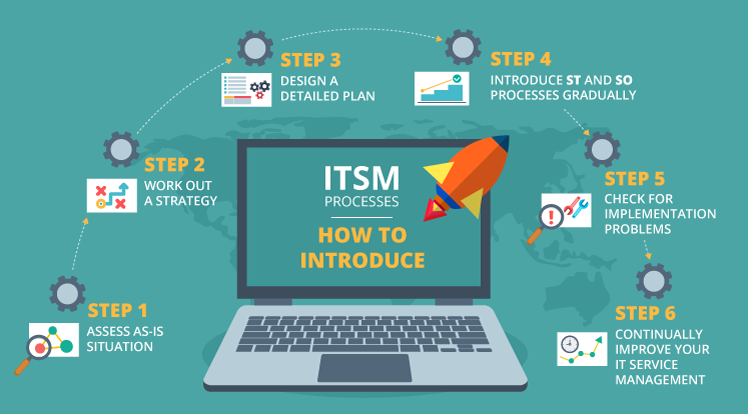
    Here is a high-level outline of how SCS Tech ITSM experts usually introduce ITSM processes in our customers’ organizations. Note that this outline does not apply to all cases of introducing ITSM and is subject to change under the specific conditions of a particular customer.

    Step 1: We assess the as-is situation.

    Step 2: We work out an ITSM introduction strategy.

    Step 3: We design a detailed plan.

    Step 4: We gradually introduce ST and SO processes (incident – problem – configuration – change – SLA).

    Step 5: We check for implementation problems (for example, set up mechanisms for controlling the usage of newly implemented processes so that all the effort isn’t in vain).

    Step 6: We continually improve IT service management and start to prepare for going to the next level of ITSM maturity when the customer is ready.

    SCS TECH ITSM PROCESS


    Our ITSM experts think that the key idea here is that no company should try to grasp it all at once. The transformation process has to happen carefully, with one step at a time, achieving specific small-scale goals (reducing operational costs or increasing first-response time). If you have trouble with that, turn to our ITSM consultants to identify your small-scale and forward-looking goals that would be a good place to start your ITSM journey.