Tag: #itinfrastructuresolutions

  • How Digital Twins Transform Asset & Infrastructure Management in Oil and Gas Technology Solutions

    How Digital Twins Transform Asset & Infrastructure Management in Oil and Gas Technology Solutions

    What if breakdowns could be predicted before they become expensive shutdowns? In an age where reliability is everything, avoiding failures before they occur can prevent millions of dollars in losses. With real-time visibility, digital twin technology can make it happen to guarantee seamless operations even in the most demanding environments.

    Based on industry reports, organizations that utilize digital twins have seen their equipment downtime decrease by as much as 20% and overall equipment effectiveness increase by as much as 15%. In cost terms, that translates to more than millions annually. These kinds of figures are what make the application of digital twins today a strategic imperative.

    In this blog, let us understand how digital twins redefine bare operational spaces in oil and gas technology solutions: predictive maintenance, asset performance, and sustainability.

    How Digital Twins Improve Asset and Infrastructure Management in Oil and Gas Technology Solutions?

    1. Predictive Maintenance and Minimized Downtime

    Digital twins ensure intelligent maintenance by transitioning from time-based to condition-based maintenance, using real-time analysis to foretell equipment issues before they are severe.

    • Real-Time Health Monitoring: Digital twins also gather real-time data from sensors installed on pumps, compressors, turbines, and drilling equipment. Among the parameters constantly monitored are the vibration rates, pressure waves, and thermal trends, which may be used in monitoring for indicators of wear and impending failure.
    • Predictive Failure Detection: With machine learning and past failure patterns, digital twins can identify slight deviations that can lead to component failures. This enables teams to correct the problem before the problem leads to system-scale disruption.
    • Optimized Maintenance Scheduling: Rather than depending on strict maintenance schedules, digital twins suggest maintenance based on the actual condition of the assets. This avoids unnecessary work, minimizes labour costs, and maintains only when necessary, saving maintenance expenses.
    • Financial Impact: The cost savings in operations are directly obtained from the decrease in unplanned downtime. Predictive maintenance with digital twins can save millions per month for a single offshore rig alone.
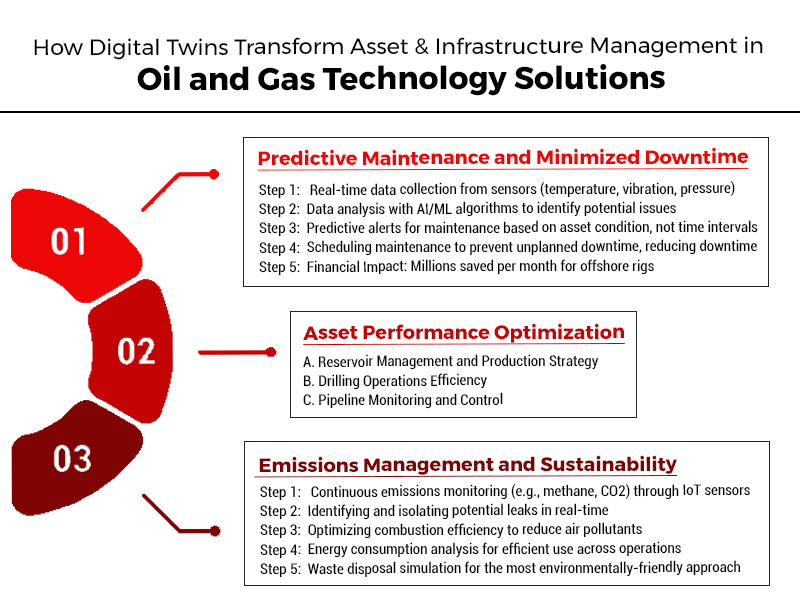
    how Digital Twins enable Predictive Maintenance

    2. Asset Performance Optimization

    Asset performance optimization is not so much about getting the assets up and running as it is about getting every possible value from each asset at each stage in its operational lifecycle. Digital twins are key to this:

    A. Reservoir Management and Production Strategy

    Digital twins simulate oil reservoir behaviour by integrating geologic models with real-time operating data. This enables engineers to simulate different extraction methods—like water flooding or injecting gas—and select the one that will maximize recovery rates with the minimum amount of environmental damage.

    Operators receive insight into reservoir pressure, fluid contents, and temperature behaviour. Such data-driven insight assists in determining where and when to drill, optimize field development strategy, and maximize long-term asset use.

    B. Drilling Operations Efficiency

    Digital twin real-time modelling helps adapt quickly to altering conditions underground during drilling. Integrating drilling rig information, seismic information, and historical performance metrics, operators can select optimal drilling paths, skip danger areas, and ensure wellbore stability.

    Workflow simulations also minimize uncertainty and inefficiencies during planning, minimising well construction time. This enhances safety, minimizes non-productive time (NPT), and minimizes total drilling cost.

    C. Pipeline Monitoring and Control

    Digital twins are also applied in midstream operations, such as pipelines. They track internal pressure, flow rate, and corrosion data. By tracking anomalies such as imputed leaks or pipeline fatigue in real time, operators can perform preventive measures to ensure system integrity.

    Predictive pressure control and flow optimization also enhance energy efficiency by lowering the load on pump equipment, which results in operational efficiencies and environmental performance.

    3. Emissions Management and Sustainability

    Sustainability and environmental compliance are central to the technology solutions for oil and gas today. Digital twins offer the data infrastructure for tracking, managing, and optimizing environmental performance throughout operations.

    • Continuous Emission Monitoring: Digital twins are connected to IoT sensors deployed across production units and refineries to track emissions continuously. The systems monitor methane levels, flaring efficiency, and air quality in general. Preleak detection ensures immediate action to contain noxious emissions. On-site real-time combustion analysis can also help ensure maximum efficiency for processes by keeping pollutant production during flaring or burning down to the least.
    • Energy Use Insights: Plant operators use digital twins to point out inefficiency in energy usage in specific areas. With instantaneous comparisons between the input energy and the output from processes, operators recognize energy loss patterns and propose changes for lesser usage—greener and more efficient operation.
    • Simulation for Waste Handling: Digital twins model and analyze a variety of waste disposal plans in a bid to ascertain the most cost-effective and environmentally friendly approach. Whether dealing with drilling waste or refinery residues, operators are made transparent to minimize, reuse, or dispose of waste as per legislation.
    • Carbon Capture Optimization: As carbon capture and storage (CCS) emerges as a hot topic in the energy industry, digital twins help maximize these systems to their best. They mimic the behaviour of injected CO₂ in subsurface reservoirs, detect leakage risks, and maximize injection strategy for enhanced storage reliability. This helps companies achieve corporate sustainability objectives and aids global decarbonization goals.

    What is the Strategic Role of Digital Twins in Oil and Gas Technology Solutions?

    Digital twins are no longer pilot technologies—they are starting to become the basis for the digital transformation of oil and gas production. From upstream to downstream, they deliver unique visibility, responsiveness, and management of physical assets.

    Their capacity to integrate real-time operational data with sophisticated analytics enables companies to:

    • Improve equipment reliability and lower failures
    • Enhance decision-making on complicated operations
    • Reduce operating expenses with predictive models
    • Comply with environmental regulations and sustainability goals

    With oil and gas operators under mounting pressure to extract margins, keep humans safe, and show environmental responsibility, digital twins provide a measurable and scalable solution.

    Conclusion

    Digital twins are transforming asset and infrastructure management throughout the oil and gas value chain. They influence predictive maintenance, asset optimization, and sustainability—the three pillars of operational excellence in today’s energy sector.

    By enabling data-informed decision-making, reducing risk, and maximizing asset value, digital twins are a stunning leap in oil and gas technology solutions. Companies implementing this technology with support from SCS Tech will be better poised to run efficiently, meet regulatory demands, and dominate a globally competitive market.

  • Embracing Hybrid Cloud IT Infrastructure Solutions as the New Norm

    Embracing Hybrid Cloud IT Infrastructure Solutions as the New Norm

    In today’s world, where data breaches are becoming alarmingly frequent, how can companies strike the right balance between ensuring robust security and maintaining the scalability required for growth?

    Well, hybrid cloud architectures might just be the answer to this! They provide a solution by enabling sensitive data to reside in secure private clouds while leveraging the expansive resources of public clouds for less critical operations.

    As hybrid cloud becomes the norm, it empowers organizations to optimize their IT infrastructure solutions, ensuring they remain competitive and agile in a continuously ever-changing digital landscape.

    This blog is about the importance of hybrid cloud solutions as the new norm in IT infrastructure solutions.

    Embracing Hybrid Cloud IT Infrastructure Solutions as the New Norm


    Hybrid cloud IT infrastructure solutions
    Hybrid cloud IT infrastructure solutions

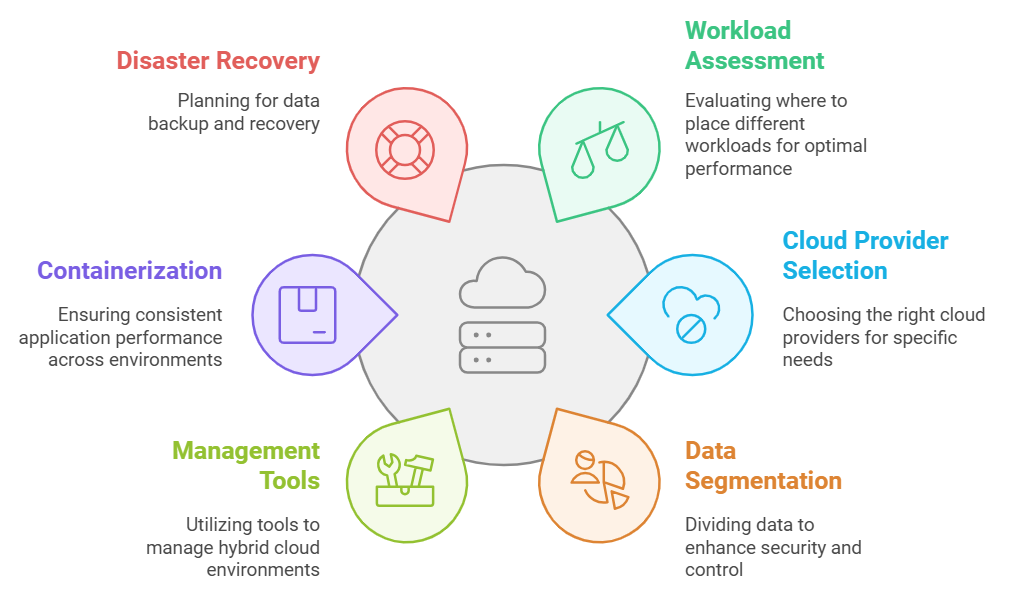
    1. Evaluating Organizational Needs and Goals

    • Assess Workloads: Determine which workloads best suit public clouds, private clouds, or on-premises environments. For example, latency-sensitive applications may remain on-premises, while scalable web applications thrive in public clouds.
    • Set Objectives: Define specific goals such as cost reduction, enhanced security, or improved scalability to effectively guide the hybrid cloud strategy.

    2. Designing a Tailored Architecture

    • Select Cloud Providers: Select public and private cloud providers based on features such as scalability, global reach, and compliance capabilities.
    • Integrate Platforms: Use orchestration tools or middleware to integrate public and private clouds with on-premises systems for smooth data flow and operations.

    3. Data Segmentation

    • Data Segmentation: Maintain sensitive data on private clouds or on-premises systems for better control.
    • Unified Security Policies: Define detailed frameworks for all environments, including encryption, firewalls, and identity management systems.
    • Continuous Monitoring: Utilize advanced monitoring tools to identify and mitigate threats in real-time.

    4. Embracing Advanced Management Tools

    • Hybrid Cloud Management Platforms: Solutions such as VMware vRealize, Microsoft Azure Arc, or Red Hat OpenShift make it easier to manage hybrid clouds.
    • AI-Driven Insights: Utilize AI & ML services to optimize resource utilization, avoid waste, and predict potential failures.

    5. Flexibility through Containerization

    • Containers: Docker and Kubernetes ensure that applications operate uniformly across different environments.
    • Microservices: Breaking an application into smaller, independent components allows for better scalability and performance optimization.

    6. Disaster Recovery and Backup Planning

    • Distribute Backups: Spread the backups across public and private clouds to prevent data loss during outages.
    • Failover Mechanisms: Configure the hybrid cloud with automatic failover systems to ensure business continuity.

    7. Audits and Updates

    • Audit Resources: Regularly assess resource utilization to remove inefficiencies and control costs.
    • Ensure Compliance: Periodically review data handling practices to comply with regulations like GDPR, HIPAA, or ISO standards.

    Emerging Trends Shaping the Future of Hybrid Cloud

    1. AI and Automation Integration

    Artificial Intelligence (AI) and automation are changing hybrid cloud environments to make them more innovative and efficient.

    • Automated Resource Allocation: AI dynamically adjusts resources according to the workload’s real-time demands for better performance. For example, AI & ML services can automatically reroute resources during traffic spikes to prevent service disruptions.
    • Predictive Analytics: Historical time series data analysis to predict potential failures to avoid faults and reduce downtime.
    • Improved monitoring: The AI-driven tools enable granular views of performance metrics, usage patterns, and cost analysis to help better make decisions.
    • AI for Security: AI detects anomalies, responds to potential threats, and strengthens hybrid environments’ security.

    2. Edge computing is on the rise

    Edging involves processing data near its sources; it combines well with hybrid cloud strategies, particularly in IoT and real-time applications.

    • Real-time Processing: Autonomous vehicles will benefit through edge computing, where sensor data is computed locally for instantaneous decisions.
    • Optimized Bandwidth: It conserves bandwidth as the critical data is processed locally, and the necessary information alone is sent to the cloud.
    • Better Resilience: With hybrid environments and edge devices, distributed workloads are more resilient when networks break.
    • Support for Emerging Tech: Hybrid systems use low-latency edge computing, especially for implementing AR and Industry 4.0 technologies.

    3. Sustainability Focus

    Hybrid cloud solutions would be crucial in aligning IT operations with and supporting environmental sustainability goals.

    • Effective utilization of resources: Hybrid could shift workloads into low-carbon environments like a public cloud provider powered by renewable sources.
    • Dynamic scaling: By scaling resources on demand through hybrid clouds, they keep energy wastage down over periods of low use
    • Green data centers: Harnessing sustainable IT infrastructure solutions by AWS and Microsoft Azure providers reduces carbon footprints.
    • Carbon Accounting: Analytics tools in hybrid platforms give accurate carbon emission measures, which allows organizations to reduce their carbon footprint.

    4. Unified Security Frameworks

    Hybrid cloud environments require consistent and robust security measures to protect distributed data.

    • Policy Enforcement: Unified frameworks apply security policies across all environments, ensuring consistency.
    • Integrated Tools: Data protection is enhanced by features like encryption, multi-factor authentication, and identity access management (IAM).
    • Threat Detection: Machine learning algorithms detect and prevent real-time threats, reducing vulnerability.
    • Compliance Simplification: Unified frameworks provide built-in auditing and reporting capabilities that simplify compliance with regulations.

    5. Hybrid Cloud and Multicloud Convergence

    Increasingly, hybrid cloud strategies are being used with multi-cloud to maximize flexibility and efficiency.

    • Diversification of vendors: Reduced dependency on one vendor can ensure resilience and help build more robust services.
    • Optimized Costs: Strategically spreading workloads across IT infrastructure solution providers can help leverage cost efficiencies and unique features.
    • Improved Interoperability: Tools such as Kubernetes ensure smooth operations across diverse cloud environments, thus enhancing flexibility and collaboration.

    Conclusion

    The future of hybrid cloud IT infrastructure solutions is shaped by transformative trends emphasizing agility, scalability, and innovation. As organizations embrace AI and automation, edge computing, sustainability, and unified security frameworks, they get better prepared to thrive in a fast-changing digital world.

    Proactively dealing with these trends can help achieve operational excellence and bring long-term growth and resilience in the age of digital transformation. SCS Tech enables businesses to navigate this evolution seamlessly, offering cutting-edge solutions tailored to modern hybrid cloud needs.

  • Why Robust IT Infrastructure Solutions Are the Backbone of Successful Enterprises?

    Why Robust IT Infrastructure Solutions Are the Backbone of Successful Enterprises?

    As per Harvard Business Review, almost forty percent of companies view IT infrastructure solutions as a leading reason for overall enterprise efficiency gain in order for businesses to stand out from one another in the marketplace.

    In the modern world of digitalization, an effective IT structure solution is no longer a luxury but a necessity for any enterprise that has to compete for its existence in the market. In this blog, we will define what it means to integrate IT infrastructure solutions into business processes, as well as strategies to develop sound IT infrastructure solutions.

    Comprehensive Insight on Benefits of IT Infrastructure Solutions for Enterprise Success

    Improved Operational Efficiency

    A robust IT infrastructure helps in improving operational efficiency by utilizing the resources optimally, reducing errors, and downtime.

    Listed below are key factors of an IT infrastructure solution that contribute to improved operational efficiency:

    • IT infrastructure solutions help streamline business processes by automating the business workflow, resulting in a reduction in manual tasks and errors.
    • A robust IT infrastructure solution enhances work collaboration through various cloud-based platforms so employees can access real-time data, share documents, and seamlessly collaborate on projects.
    • For strategic decision-making, IT infrastructure solutions offer advanced solutions for data storage via cloud storage and database management systems.
    • Integrating data analytics tools like Power BI, Google Data Studio, QlikSense, etc. for making timely decisions according to operational and market changes.

    Robust Security and Compliance

    A strong IT infrastructure not only improves operational efficiency but also makes sure the valuable assets of the organization are safeguarded from having network security solutions to data encryption solutions. Below listed are key IT infrastructure solutions that facilitate security and compliance:

    • To safeguard from potential disruption resulting from cyber-attacks or technical failures, IT infrastructure solutions offer a comprehensive recovery plan that includes data backup, testing and drills, business impact analysis, and re-establishing networking connectivity.
    • Network security solutions like virtual private networks, firewalls, intrusion detection and prevention systems (IDPS), etc., act as key solutions for enhancing data security.
    • A robust IT infrastructure solution integrates data encryption solutions through tools like BitLocker (for Windows) or FileVault (for Mac) and a public key infrastructure solution for safeguarding digital certificates and encryption keys.
    • Other key security and compliance solutions include identity and access management solutions, compliance management solutions, including data governance tools to make sure the business is securing and managing data as per regulatory compliance, endpoint security solutions, and more.

    Cost Efficiency

    Cost efficiency plays a crucial role in an enterprise’s long-term success, which can be achieved by integrating IT infrastructure solutions that can eliminate waste, streamline business operations, and allocate resources effectively.

    Below listed are the benefits offered by robust IT infrastructure solutions to achieve cost efficiency.

    • Automation of routine tasks helps enterprises utilize the skills of employees in more effective areas.
    • Helps in effective resource management by removing underutilized assets and automated scaling through tools like Microsoft Azure’s Virtual Machine Scale Sets, AWS Autoscaling, etc., so resources are allocated based on demand, resulting in reduced cost.
    • IT infrastructure management tools help in better cost visibility through 3 key aspects:
      • Energy consumption reduction by optimizing power usage
      • Storage optimization by integrating techniques like tiering, deduplication, and compression.
      • Cost savings via server consolidation, where underutilized servers can be identified and consolidated, reducing hardware costs and energy consumption.

    Improved Customer Experience

    In the evolving market, the shift towards enhancing the customer experience has become a key parameter, and enterprises can integrate the following IT infrastructure solutions to improve customer experience:

    • Streamline communication and service by adding automated response services like Chatbot or voice-enabled technology solutions.
    • Add advanced data analytics tools that can evaluate customer preferences and offer personalized customer interaction.
    • IT infrastructure solutions like CDNs (Content Delivery Networks) can be implemented to increase reliability by offering faster load time. It helps businesses in scaling as a high volume of traffic can be managed with high performance.

    Fosters Gaining Edge in Competitive Market by Constant Innovation

    Investing in IT infrastructure solutions is a backbone to drive success given market changes and the evolving landscape of technologies. Listed below are a few advantages enterprises can gain from integrating innovative approaches to IT infrastructure solutions in their business processes:

    • IT infrastructure solutions help businesses with scalable and cost-effective solutions so businesses can respond to sudden market demands and offer seamless delivery.
    • Supports cutting-edge technologies like artificial intelligence, machine learning, and the Internet of Things (IoT).
    • Improves agility and speed so businesses can rapidly deploy new services/applications and grab the right market opportunity.
    • Helps in digital transformation by integrating ERP systems like SAP, CRM software like Hubspot, and collaboration tools like Microsoft Teams.
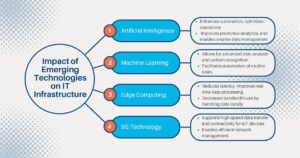
    • The digital transformation is also achieved by deploying innovative applications like AI-powered analytics (Tableau, Power BI) and IoT platforms (AWS IoT, Google Cloud IoT).Impact of emerging technologies on IT infrastructure

      Tips on Building a Robust IT Infrastructure Solutions

      • Understand business requirements and evaluate pain points to align IT infrastructure strategies.
      • Focus on scalability and flexibility through cloud-based solutions and modular design for long-term growth.
      • Improve network reliability by removing redundant systems and investing in high-speed connectivity for seamless communication.
      • Invest in advanced monitoring and management tools like SolarWinds and focus on centralized management.
      • Partner with reliable IT infrastructure solutions partner like SCS Tech India for comprehensive services like infrastructure management, cloud services, cybersecurity, etc.

      Conclusion

      Robust IT infrastructure solutions are crucial for successful enterprises, ensuring seamless operations and driving innovation. A well-structured IT structure enhances scalability and improves productivity, leading to a competitive advantage. At SCS Tech India, we understand the importance of this parameter and offer tailored services like cloud computing integration and cybersecurity to meet these needs.

      Our expertise in IoT consulting, IoT application development, wearable app development, voice-enabled technology solutions, and IT implementation and support helps enterprises build a robust IT infrastructure. Enterprises can achieve agility and efficiency by integrating these services and sustaining long-term in the market.

      FAQs

      1. What is the role of IT infrastructure in API management?

      IT infrastructure in API management focuses on seamless communication between applications and services, enabling businesses to create, manage, and track the performance of API along with detecting issues.

      1. What IT infrastructure solutions does SCS Tech India specialize in?

      SCS Tech India provides IT infrastructure solutions like network design, cloud computing, data center management, and cybersecurity services.

      1. What best practices can enterprises follow to design a robust IT infrastructure?

      Enterprises can focus on practices like scalability, assessing business needs, cloud integration, strong security measures, solid backup systems to remove redundancy, and more.

    (more…)