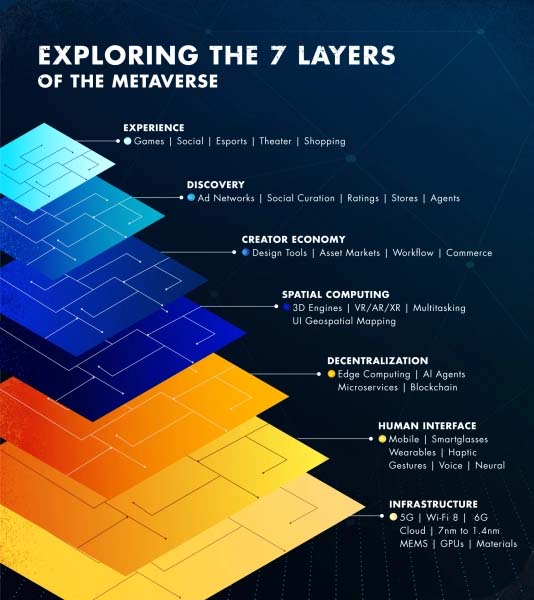
When it comes to describing the metaverse, definitions and opinions abound. And while it’s difficult to put something as vast, conceptual, and, frankly, still emerging as the metaverse into quantifiable terms, Jon Radoff, entrepreneur, author and game designer, breaks it down logically and thoroughly in Measuring the Metaverse. He moves up the value chain from infrastructure at the bottom to experience at the top, stopping at human interface, decentralization, spatial computing, creator economy, and discovery along the way.
A common framework is necessary in Radoff’s view of the metaverse. He writes, “And while there will be many proprietary (and very fun) theme parks in the metaverse, I’m even more excited by the opportunity in the Switzerlands: a metaverse powered by a robust creator-economy enabled through decentralization.”
This, of course, isn’t the first seven-layer model to lay out a critical framework. The IT world has long adhered to the seven layers of the OSI Model to organize networking functions into a universal set of rules and requirements to support interoperability among different products and software. Perhaps Radoff’s seven-layer model will become a similar conceptual framework for the metaverse.
Layer 1: Experience
Many people think of the metaverse as 3D space that will surround us. But the metaverse is not 3D or 2D, or even necessarily graphical; it is about the inexorable dematerialization of physical space, distance, and objects. It includes 3D games like Fortnite on our game consoles, Beat Saber in our virtual reality headsets, and Roblox on our computers. It also includes Alexa in our kitchen, Zoom in our virtual offices, Clubhouse on our phones, and Peloton in our home gyms.
What happens when physical space is dematerialized? Formerly scarce experiences may become abundant. Games show us the path forward: in a game, you can dream of being a rock star, a Jedi, a race car driver, or anything else you might imagine. Imagine what happens when you apply this to more familiar experiences. For example, a concert in physical space can sell only a few seats in the front row — but a virtual concert can generate a personalized plane of existence around each individual in which you always enjoy the best seat in the house.
Games will evolve to incorporate more events that are informed by live entertainment, such as the music concerts and immersive theater that have already emerged in Fortnite, Roblox, and Rec Room. Esports and online communities will be augmented by social entertainment. Meanwhile, traditional industries such as travel, education, and live performance will be reshaped around game-thinking and the virtual economy of abundance.
The live events I’ve touched upon here lead to another facet of metaverse experiences: the content-community complex. Whereas once customers were only consumers of content, they are now content-creators and content-amplifiers as well. In the past, there was the notion of “user-generated content” when referring to mundane features like blog comments or uploading a video. Now, content isn’t simply generated by people: it emerges from their interactions and feeds into the substance of the conversations within their communities. Content begets content: a virtual flywheel of content, events, and social interaction. When we talk about “immersion” in the future, we’ll be referring not only to immersion within a graphical space or a story-world, but also to the social immersion and how it sparks interaction and propels content.
Layer 2: Discovery
The discovery layer is about the push and pull that introduces people to new experiences. This is a vast ecosystem, and one of the most lucrative for many businesses — including some of the largest in the world. Broadly speaking, most discovery systems can be classified as either inbound (the person is actively seeking information about an experience) or outbound (marketing that was not specifically requested by the person, even if they opted in).
Inbound:
- Real-time presence
- Community-driven content
- N of your friends like App
- App stores (along with reviews, ratings systems, and categorization/tagging)
- Curation — via featured application listings in stores, taste-makers, and “influencers”
- Search engines
- Earned media
Outbound:
- Display advertising
- Spam (email, LinkedIn, Discord)
- Notifications
Most of the above are familiar to internet users at this point, so I’ll focus here on the aspects of discovery that will elevate in importance in the metaverse.
First, community-driven content is a far more cost-effective means of discovery than most forms of marketing. When people really care about the content or the events they are participating in, they’ll spread the word. As content itself gets easier to exchange, trade, and share within more metaverse contexts, the content itself will also become a marketing asset. An example that’s already emerged is NFTs: love them or hate them, two of their key advantages are the relative ease with which they can be supplied to decentralized exchanges and the economics that favor more direct creator-community engagement. Content marketplaces will become an alternative to application marketplaces as a means of discovery.
A specific form of community surfacing is real-time presence features. Instead of focusing on what people like, this is about what people are actually doing right now. This is highly relevant in a metaverse where so much of the value will come from interacting with friends through shared experiences.
The various walled gardens for certain games make good use of real-time presence: if you login to Steam, Battle.net, Xbox or PlayStation, you’ll see what games your friends are playing right now. Outside of games, Clubhouse shows the power of this structure: deciding which room to join is largely oriented toward your curated list of people you follow.
Just as we are dematerializing physical reality, the metaverse is also digitizing social structures. Whereas earlier stages of the Internet were defined by social media “stickiness” around a few monolithic providers, a decentralized identity ecosystem may shift the power toward the social groups themselves, allowing them to move frictionlessly across collective experiences. Clubs emerge on Clubhouse and plan a party in Rec Room; guilds move between games; a circle of friends jumps between experiences on Roblox. This is the marketing implication of the content-community complex.
Real-time presence detection that spans the multitude of activities in the metaverse is one of the greatest discovery opportunities for creators. Discord has a presence-detection SDK that works across different game environments; once that (or something like it) is adopted more pervasively and surfaced more apparently, we’ll increasingly transition from asynchronous “social networking” to real-time “social activity.” Experiences that give community leaders the tools to launch activities that people actually want to join into will lead the way.
Layer 3: Creator Economy
Not only are the experiences of the metaverse becoming increasingly immersive, social, and real-time, but the number of creators who craft them is increasing exponentially. This layer contains all of the technology that creators use on a daily basis to craft the experiences that people enjoy.
Previous creator economies developed in consistent patterns, whether in the metaverse, games, web development, or e-commerce:
Pioneer Era: The first people to create experiences for a given technology have no tools available, so they build everything from scratch. The first websites were coded directly in HTML; people implemented their own shopping carts for e-commerce sites; programmers wrote directly to the graphics hardware for games.
Engineering Era: After the early successes in a creative market, there’s an explosion of the number of people on teams. Build-from-scratch is usually too slow and expensive to support needs, and workflow grows more complex. The earliest tooling in a market tends to relieve overloaded engineers by supplying them with SDKs and middleware to save them time. For example, Ruby on Rails (along with a huge number of other application server stacks) made it easier for developers to create data-driven websites. In games, graphics libraries such as OpenGL and DirectX arrived to provide programmers with the ability to render 3D graphics without knowing much low-level coding.
Creator Era: Ultimately, designers and creators don’t want coding bottlenecks to slow them down — and coders would rather add their abilities to the unique aspects of a project. This era is defined by a dramatic and exponential rise in the number of creators. Creators gain tools, templates, and marketplaces of content that reorient development from a bottoms-up, code-centered process to a top-down, creatively centered process.
Today, you can launch an e-commerce website in Shopify in minutes without knowing a single line of code. Websites can be created and maintained in Wix or Squarespace. 3D graphics experiences can be crafted within game engines such as Unity and Unreal without ever touching the lower-level rendering APIs — using visual interfaces within their studio environments.
Experiences in the metaverse will be increasingly live, social, and continuously updated. Thus far, creator-driven experiences in the metaverse are oriented around centrally managed platforms such as Roblox, Rec Room, and Manticore — where a full suite of integrated tooling, discovery, social networking, and monetization functions has empowered an unprecedented number of people to craft experiences for others. Our vision at Beamable is to equip independent creators with the same capabilities, but in a decentralized and open manner.
Layer 4: Spatial Computing
Spatial computing proposes hybrid real/virtual computation that erodes the barriers between the physical and the ideal worlds. … Wherever possible the machine in space and space in the machine should be allowed to bleed into each other. Sometimes this means bringing space into the computer, sometime[s] this means injecting computation into objects. Mostly it means designing systems that push through the traditional boundaries of screen and keyboard without getting hung up there and melting into interface or meek simulation.
Spatial computing has exploded into a large category of technology that enables us to enter into and manipulate 3D spaces, and to augment the real world with more information and experience. I divide the software of spatial computing from the enabling hardware layer, which I detail under the Human Interface section below. For the key aspects of software, this includes:
- 3D engines to display geometry and animation (Unity and Unreal)
- Mapping and interpreting the inside and outside world — geospatial mapping (Niantic Planet-Scale AR and Cesium) and object recognition
- Voice and gesture recognition
- Data integration from devices (Internet of Things) and biometrics from people (for identification purposes as well as quantified self applications in health/fitness)
- Next-generation user interfaces to support concurrent information streams and analysis
Layer 5: Decentralization
The ideal structure of the metaverse is the opposite of the OASIS of Ready Player One, where it was controlled by a single entity. Experimentation and growth increase dramatically when options are maximized and systems are interoperable and built within competitive markets where creators are sovereign over their own data and creations.
The simplest example of decentralization is the Domain Name System (DNS), which maps individual IP addresses to names, saving you from having to enter a number each time you want to go somewhere online.
Distributed computing and microservices provide a scalable ecosystem for developers to tap into online capabilities — everything from commerce systems to specialized AI to various game systems — without needing to focus on building or integrating back-end capabilities.
Blockchain technology, which enables value-exchange between software, self-sovereign identity and new ways of unbundling and bundling content and currencies — is a large part of decentralization. This area of innovation is called Web3, which frees financial assets from centralized control and custody — and within decentralized finance (DeFi), we already see examples of connecting financial legos to form novel applications. With the advent of NFTs and blockchains optimized for the sort of microtransactions required by games and metaverse experiences, we’ll see a wave of innovation around decentralized markets and applications for game assets as well.
“Far edge” computing will push the cloud closer to our homes — even into our vehicles — to enable powerful applications at low latency, without burdening our devices with all of the work. Computing power will become more like a utility on a grid (not unlike electricity) and less like a datacenter.
Layer 6: Human Interface
Computer devices are getting closer to our bodies, transforming us into cyborgs.
Smartphones are no longer phones. They are highly portable, always-connected, and powerful computers that happen to have a phone application preinstalled. They’re only getting more powerful; and with further miniaturization, the right sensors, embedded AI technology, and low-latency access to powerful edge computing systems, they’ll absorb more and more applications and experiences from the metaverse.
The Oculus Quest is essentially a smartphone that’s been refactored into a VR device; this untethering gives us a sense of where the future is heading.
In a few years the Quest 2 ought to be reminiscent of the mobile brick-phone from decades past; soon we’ll have smartglasses that can perform all the functions of a smartphone along with AR and VR applications.
Beyond smartglasses, there is a growing industry experimenting with new ways to bring us closer to our machines:
- 3D-printed wearables integrated into fashion and clothing
- Miniaturized biosensors, some even printed on the skin
- Maybe even consumer neural interfaces?
Layer 7: Infrastructure
The infrastructure layer includes the technology that enables our devices, connects them to the network, and delivers content.
5G networks will dramatically improve bandwidth while reducing network contention and latency. 6G will increase speeds by yet another order of magnitude.
Enabling the untethered functionality, high performance, and miniaturization required by the next generation of mobile devices, smartglasses, and wearables will require increasingly powerful and tinier hardware: semiconductors that are imminently dropping to 3nm processes and beyond; microelectromechanical systems (MEMS) that enable tiny sensors; and compact, long-lasting batteries.
Internet 3.0
The metaverse is not “a” metaverse. It is the next generation of the Internet: a multiverse. The abundant adventures in this space will surround us both socially and graphically.
And while there will be many proprietary (and very fun) theme parks in the metaverse, I’m even more excited by the opportunity in the Switzerlands: a metaverse powered by a robust creator-economy enabled through decentralization.