Tag: Oil & Gas

  • How to Build a Digital Roadmap for Upstream Oil and Gas Operations

    How to Build a Digital Roadmap for Upstream Oil and Gas Operations

    Most upstream oil and gas teams already use some form of digital tools, whether it’s SCADA systems, production monitoring software, or sensor data from the field. These are all examples of oil and gas technology that play a critical role in modernizing upstream workflows.

    But in many cases, these tools don’t work well together. The result? Missed opportunities, duplicated effort, and slow decisions.

    A digital roadmap helps fix that. It gives you a clear plan to use technology in ways that actually improve drilling, production, and asset reliability, not by adding more tools, but by using the right ones in the right places.

    This article outlines the important elements for developing a viable, execution-ready plan specific to upstream operations.

    What a Digital Roadmap Looks Like in Upstream Oil and Gas

    In upstream oil and gas, a digital roadmap isn’t a general IT plan; it’s an execution-driven guide tailored for field operations across drilling, production, and asset reliability. These roadmaps prioritize production efficiency, not buzzword technology.

    A practical digital transformation in oil and gas depends on grounding innovation in field-level reality, not just boardroom strategy.

    Most upstream firms are using technologies like SCADA or reservoir software, but these often remain siloed.  A smart roadmap connects the dots, taking fragmented tools and turning them into a system that generates measurable value in the field.

    Here’s what to include:

    • Use Case Alignment – Focus on high-impact upstream areas: drilling automation, asset integrity, reservoir management, and predictive maintenance. McKinsey estimates digital tech can reduce upstream operating costs by 3–5 % and capex by up to 20 %.
    • Targeted Technology Mapping – Defining where AI/IOT or advanced analytics fit into daily operations is invaluable.  This is where next-gen oil and gas technology, such as edge computing and real-time analytics, can proactively prevent failure and improve uptime.
    • Data Infrastructure Planning – Address how real-time well data, sensor streams, and historical logs are collected and unified. McKinsey highlights that 70 % of oil firms stall in pilot phases due to fragmented data systems and a lack of integrated OT/IT infrastructure.
    • Phased Rollout Strategy – Begin with focused pilots, like real-time drilling performance tracking, then expand to multiple fields. Shell and Chevron have successfully used this playbook: validating gains at a small scale before scaling asset-wide


    Rather than a one-size-fits-all framework, a strong upstream digital roadmap is asset-specific, measurable, and built for execution, not just strategy decks. It helps upstream companies avoid digitizing for the sake of it, and instead focus on what actually moves the needle in the field.

    Building a Digital Roadmap for Upstream Oil and Gas Operations

    A digital roadmap helps upstream oil and gas teams plan how and where to use technology across their operations. It’s not just about picking new tools, it’s about making sure those tools actually improve drilling, production, and day-to-day fieldwork. 

    The following are the critical steps to creating a roadmap that supports real goals, not just upgrades to digital.

    Step 1: Define Business Priorities and Operational Pain Points

    Before looking at any technology, you need to clearly understand what problem you’re trying to solve – that’s step one to building a digital roadmap that works, not just for corporate, but also for the people who are running wells, rigs, and operations every day.

    This starts by answering one question: What are the business outcomes your upstream team needs to improve in the next 12–24 months?

    It could be:

    • Reducing non-productive time (NPT) in drilling operations
    • Improving the uptime of compressors, pumps, or separators
    • Lowering the cost per barrel in mature fields
    • Meeting environmental compliance more efficiently
    • Speeding up production reporting across locations

    These are not just IT problems; they’re business priorities that must shape your digital plan.

    For each priority, define the metric that tells you whether you’re moving in the right direction.

    Business priority  Metric to track 
    Reduce NPT in drilling  Avg. non-productive hours per rig/month 
    Improve asset reliability  Unplanned downtime hours pre-asset 
    Lower operational costs  Costs per barrel (OPEX) 
    Meet ESG reporting requirements  Time to compile and validate compliance data 


    It is simple to understand which digital use cases merit efforts once you have assigned numbers to the goals you established. This is where strategic oil and gas industry consulting adds value by turning operational pain points into measurable digital opportunities.

    Step 2: Audit Your Existing Digital Capabilities and Gaps

    Now that you have the agreed consideration for what priorities you want to strengthen in your upstream activities, the second step is to identify your existing data capabilities, tools, and systems, and assess how well they support what you want to achieve.

    It is not an inventory of software. You’re reviewing:

    • What you have
    • What you’re underutilizing
    • What’s old or difficult to scale
    • And what you’re completely lacking

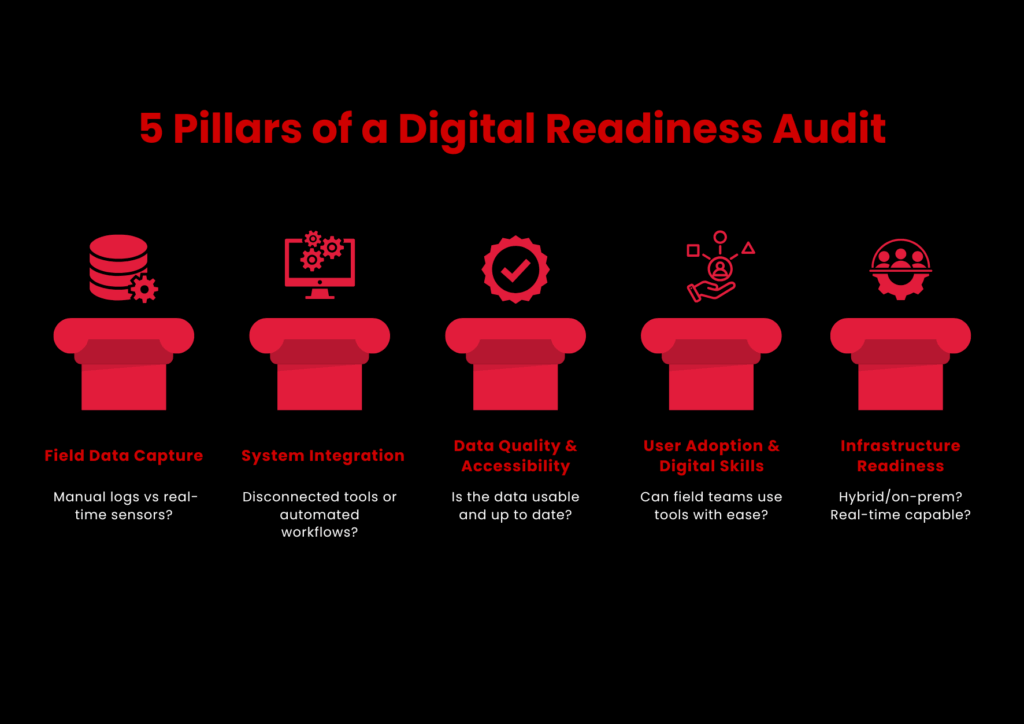
    Pillars of Digital Readiness Audit

    A successful digital transformation in oil and gas starts with a clear-eyed view of your current tools, gaps, and data flows.

    Focus Areas for a Practical Digital Audit

    Your audit should consider five priority areas:

    1. Field Data Capture
      • Do you still use manual logs or spreadsheets for day-to-day production, asset status, or safety reports?
      • Do you have sensors or edge devices? Are they available and connected?
      • Is field data captured in real-time or batched uploads?
    2. System Integration
      • Are SCADA, ERP, maintenance software, and reporting tools communicating?
      • Are workflows between systems automated or manually exported/imported?
    3. Data Quality and Accessibility
      • How up-to-date, complete, and clean is your operational data?
      • Do engineers and analysts access insights easily, or do they depend on IT every time?
    4. User Adoption and Digital Skill Levels
      • Are digital tools easy to use by field teams?
      • Is there ongoing training for digital tools besides initial rollouts?
    5. Infrastructure Readiness
      • Are you running on cloud, on-premises, or a hybrid setup?
      • Do remote sites have enough connectivity to support real-time monitoring or analytics?

    Step 3: Prioritize High-Impact Use Cases for Digitization

    A digital roadmap fails when it attempts to do too much or gets the wrong priorities. That’s why this step is about selecting the correct digital use cases to begin with.

    You don’t require a long list. You require the correct 3–5 use cases that align with your field requirements, provide early traction, and enable you to gain momentum.

    How to Select and Prioritize the Right Use Cases

    Use three filters:

    • Business Impact

    Does it materially contribute to your objectives from Step 1? Can it decrease downtime, save money, enhance safety, or accelerate reporting?

    • Feasibility

    Do you have sufficient data and infrastructure to enable it? Can you deploy it with your existing team or partners?

    • Scalability

    If it works in one site, can you expand it across other wells, rigs, or regions?

    Plot your candidates on a simple Impact vs. Effort matrix and focus first on the high-impact, low-effort quadrant.

    These examples have been validated industry-wide in both onshore and offshore environments:

    Use cases  What it solves  Why it works 
    Predictive maintenance for rotating equipment  Unexpected failures, costly unplanned downtime Can reduce maintenance costs by up to 25% and unplanned outages by 70% (GE Digital)
    Automated drilling performance tracking  Slow manual analysis of rig KPIs  Speeds up decision-making during drilling and improves safety 
    Remote monitoring of good conditions  Infrequent site visits, delayed issue detection  Supports real-time response and better resource allocation 
    AI-driven production forecasting  Inaccurate short-term forecasts, missed targets  Helps optimize lift strategies and resource planning 
    Digital permit to work systems  Paper-based HSE workflows  Improves compliance tracking and field audit readiness 


    Don’t select use cases solely on tech appeal. Even AI won’t work if there’s dirty data or your field staff can’t use it confidently.

    Step 4: Build a Phased Roadmap with Realistic Timelines

    Many digital transformation efforts in upstream oil and gas lose momentum because they try to do too much, too fast. Teams get overwhelmed, budgets stretch thin, and progress stalls. The solution? Break your roadmap into manageable phases, tied to clear business outcomes and operational maturity.

    Many upstream leaders leverage oil and gas industry consulting to design phased rollouts that reduce complexity and accelerate implementation.

    Here’s how to do it in practice.

    Consider your shortlist in Step 3. Don’t try to do it all immediately. Rather, classify each use case into one of three buckets:

    • Quick wins (low complexity and ready for piloting)
    • Mid-range initiatives (need integrations or cross-site collaboration)
    • Long-term bets (advanced analytics, AI, or full-scale automation)

    Suppose you begin with production reporting and asset monitoring:

    Phase  What happens  When 
    Test  Pilot asset condition monitoring on 3 pumps Month 1-3
    Expand  Roll out monitoring to 20+ pumps across fields Month 4-12 
    Integrate  Link monitoring with maintenance dispatch + alert automation  Month 13-24


    This strategy prevents your teams from getting tech-fatigued. Every victory wins over trust. And above all, it makes leadership visible, measurable value, nota  digital aspiration.

    Step 5: Monitor, Iterate, and Scale Across Assets

    Once your roadmap is in motion, don’t stop at rollout. You need to keep track of what’s working, fix what isn’t, and expand only what brings real results. This step is about building consistency, not complexity.

    • Regularly review KPIs to determine if targets are being achieved
    • Gather field feedback to identify adoption problems or technical holes
    • Enhance and evolve based on actual usage, not projections
    • Scale established solutions to comparable assets with aligned needs and infrastructure

    This keeps your roadmap current and expanding, rather than wasting time on tools that do not yield results.

    Conclusion

    Creating a digital roadmap for upstream oil and gas operations isn’t a matter of pursuing fads or purchasing more software. Effective use of oil and gas technology is less about adopting every new tool and more about applying the right tech in the right phase of field operations.

    It’s setting your sights on the right objectives, leveraging what you already have better, and deploying technology in a manner that your teams can realistically use and expand upon.

    This guide took you through every step:

    • How to set actual operational priorities
    • How to conduct an audit of your existing capability
    • How to select and deploy high-impact use cases
    • How to get it all done on the ground, over time

    But even the most excellent roadmap requires experience behind it, particularly when field realities, integration nuances, and production pressures are at play.

    That’s where SCSTech is.

    We’ve helped upstream teams design and implement digital strategies that don’t just look good on paper but deliver measurable value across assets, people, and workflows. From early audits to scaled deployments, our oil and gas industry consulting team knows how to align tech decisions with business outcomes.

    If you’re planning to move forward with a digital roadmap, talk to us at SCSTech. We can help you turn the right ideas into real, field-ready results.
  • The ROI of Sensor-Driven Asset Health Monitoring in Midstream Operations

    The ROI of Sensor-Driven Asset Health Monitoring in Midstream Operations

    In midstream, a single asset failure can halt operations and burn through hundreds of thousands in downtime and emergency response.

    Yet many operators still rely on time-based checks and manual inspections — methods that often catch problems too late, or not at all.

    Sensor-driven asset health monitoring flips the model. With real-time data from embedded sensors, teams can detect early signs of wear, trigger predictive maintenance, and avoid costly surprises. 

    This article unpacks how that visibility translates into real, measurable ROI. This article unpacks how that visibility translates into real, measurable ROI, especially when paired with oil and gas technology solutions designed to perform in high-risk, midstream environments.

    What Is Sensor-Driven Asset Health Monitoring in Midstream?

    In midstream operations — pipelines, storage terminals, compressor stations — asset reliability is everything. A single pressure drop, an undetected leak, or delayed maintenance can create ripple effects across the supply chain. That’s why more midstream operators are turning to sensor-driven asset health monitoring.

    At its core, this approach uses a network of IoT-enabled sensors embedded across critical assets to track their condition in real time. It’s not just about reactive alarms. These sensors continuously feed data on:

    • Pressure and flow rates
    • Temperature fluctuations
    • Vibration and acoustic signals
    • Corrosion levels and pipeline integrity
    • Valve performance and pump health

    What makes this sensor-driven model distinct is the continuous diagnostics layer it enables. Instead of relying on fixed inspection schedules or manual checks, operators gain a live feed of asset health, supported by analytics and thresholds that signal risk before failure occurs.

    In midstream, where the scale is vast and downtime is expensive, this shift from interval-based monitoring to real-time condition-based oversight isn’t just a tech upgrade — it’s a performance strategy.

    Sensor data becomes the foundation for:

    • Predictive maintenance triggers
    • Remote diagnostics
    • Failure pattern analysis
    • And most importantly, operational decisions grounded in actual equipment behavior

    The result? Fewer surprises, better safety margins, and a stronger position to quantify asset reliability — something we’ll dig into when talking ROI.

    Key Challenges in Midstream Asset Management Without Sensors

    Risk Without Sensor-Driven Monitoring

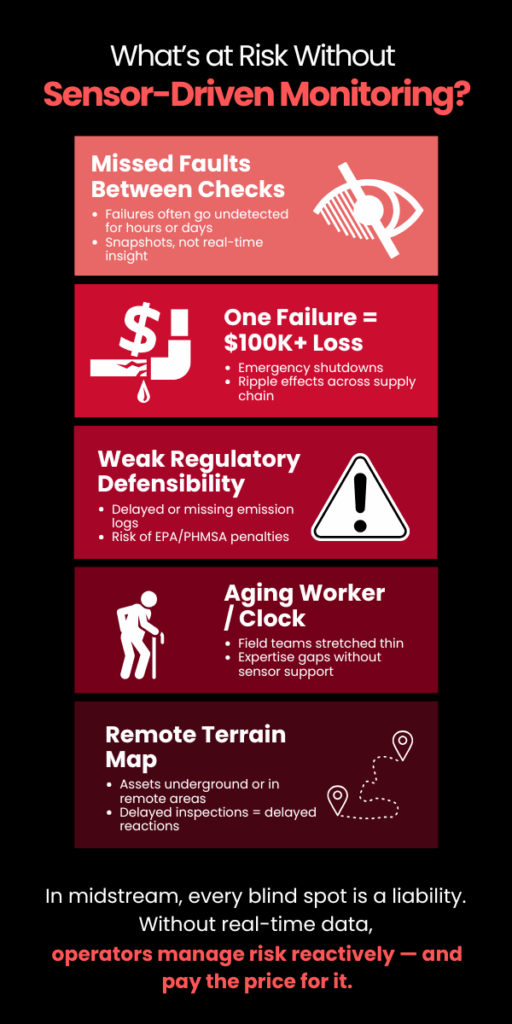
    Without sensor-driven monitoring, midstream operators are often flying blind across large, distributed, high-risk systems. Traditional asset management approaches — grounded in manual inspections, periodic maintenance, and lagging indicators — come with structural limitations that directly impact reliability, cost control, and safety.

    Here’s a breakdown of the core challenges:

    1. Delayed Fault Detection

    Without embedded sensors, operators depend on scheduled checks or human observation to identify problems.

    • Leaks, pressure drops, or abnormal vibrations can go unnoticed for hours — sometimes days — between inspections.
    • Many issues only become visible after performance degrades or equipment fails, resulting in emergency shutdowns or unplanned outages.

    2. Inability to Track Degradation Trends Over Time

    Manual inspections are episodic. They provide snapshots, not timelines.

    • A technician may detect corrosion or reduced valve responsiveness during a routine check, but there’s no continuity to know how fast the degradation is occurring or how long it’s been developing.
    • This makes it nearly impossible to predict failures or plan proactive interventions.

    3. High Cost of Unplanned Downtime

    In midstream, pipeline throughput, compression, and storage flow must stay uninterrupted.

    • An unexpected pump failure or pipe leak doesn’t just stall one site — it disrupts the supply chain across upstream and downstream operations.
    • Emergency repairs are significantly more expensive than scheduled interventions and often require rerouting or temporary shutdowns.

    A single failure event can cost hundreds of thousands in downtime, not including environmental penalties or lost product.

    4. Limited Visibility Across Remote or Hard-to-Access Assets

    Midstream infrastructure often spans hundreds of miles, with many assets located underground, underwater, or in remote terrain.

    • Manual inspections of these sites are time-intensive and subject to environmental and logistical delays.
    • Data from these assets is often sparse or outdated by the time it’s collected and reported.

    Critical assets remain unmonitored between site visits — a major vulnerability for high-risk assets.

    5. Regulatory and Reporting Gaps

    Environmental and safety regulations demand consistent documentation of asset integrity, especially around leaks, emissions, and spill risks.

    • Without sensor data, reporting is dependent on human records, often inconsistent and subject to audits.
    • Missed anomalies or delayed documentation can result in non-compliance fines or reputational damage.

    Lack of real-time data makes regulatory defensibility weak, especially during incident investigations.

    6. Labor Dependency and Expertise Gaps

    A manual-first model heavily relies on experienced field technicians to detect subtle signs of wear or failure.

    • As experienced personnel retire and talent pipelines shrink, this approach becomes unsustainable.
    • Newer technicians lack historical insight, and without sensors, there’s no system to bridge the knowledge gap.

    Reliability becomes person-dependent instead of system-dependent.

    Without system-level visibility, operators lack the actionable insights provided by modern oil and gas technology solutions, which creates a reactive, risk-heavy environment.

    This is exactly where sensor-driven monitoring begins to shift the balance, from exposure to control.

    Calculating ROI from Sensor-Driven Monitoring Systems

    For midstream operators, investing in sensor-driven asset health monitoring isn’t just a tech upgrade — it’s a measurable business case. The return on investment (ROI) stems from one core advantage: catching failures before they cascade into costs.

    Here’s how the ROI typically stacks up, based on real operational variables:

    1. Reduced Unplanned Downtime

    Let’s start with the cost of a midstream asset failure.

    • A compressor station failure can cost anywhere from $50,000 to $300,000 per day in lost throughput and emergency response.
    • With real-time vibration or pressure anomaly detection, sensor systems can flag degradation days before failure, enabling scheduled maintenance.

    If even one major outage is prevented per year, the sensor system often pays for itself multiple times over.

    2. Optimized Maintenance Scheduling

    Traditional maintenance is either time-based (replace parts every X months) or fail-based (fix it when it breaks). Both are inefficient.

    • Sensors enable condition-based maintenance (CBM) — replacing components when wear indicators show real need.
    • This avoids early replacement of healthy equipment and extends asset life.

    Lower maintenance labor hours, fewer replacement parts, and less downtime during maintenance windows.

    3. Fewer Compliance Violations and Penalties

    Sensor-driven monitoring improves documentation and reporting accuracy.

    • Leak detection systems, for example, can log time-stamped emissions data, critical for EPA and PHMSA audits.
    • Real-time alerts also reduce the window for unnoticed environmental releases.

    Avoidance of fines (which can exceed $100,000 per incident) and a stronger compliance posture during inspections.

    4. Lower Insurance and Risk Exposure

    Demonstrating that assets are continuously monitored and failures are mitigated proactively can:

    • Reduce risk premiums for asset insurance and liability coverage
    • Strengthen underwriting positions in facility risk models

    Lower annual risk-related costs and better positioning with insurers.

    5. Scalability Without Proportional Headcount

    Sensors and dashboards allow one centralized team to monitor hundreds of assets across vast geographies.

    • This reduces the need for site visits, on-foot inspections, and local diagnostic teams.
    • It also makes asset management scalable without linear increases in staffing costs.

    Bringing it together:

    Most midstream operators using sensor-based systems calculate ROI in 3–5 operational categories. Here’s a simplified example:

    ROI Area Annual Savings Estimate
    Prevented Downtime (1 event) $200,000
    Optimized Maintenance $70,000
    Compliance Penalty Avoidance $50,000
    Reduced Field Labor $30,000
    Total Annual Value $350,000
    System Cost (Year 1) $120,000
    First-Year ROI ~192%


    Over 3–5 years, ROI improves as systems become part of broader operational workflows, especially when data integration feeds into predictive analytics and enterprise decision-making.

    ROI isn’t hypothetical anymore. With real-time condition data, the economic case for sensor-driven monitoring becomes quantifiable, defensible, and scalable.

    Conclusion

    Sensor-driven monitoring isn’t just a nice-to-have — it’s a proven way for midstream operators to cut downtime, reduce maintenance waste, and stay ahead of failures. With the right data in hand, teams stop reacting and start optimizing.

    SCSTech helps you get there. Our digital oil and gas technology solutions are built for real-world midstream conditions — remote assets, high-pressure systems, and zero-margin-for-error operations.

    If you’re ready to make reliability measurable, SCSTech delivers the technical foundation to do it.

  • How Digital Twins Transform Asset & Infrastructure Management in Oil and Gas Technology Solutions

    How Digital Twins Transform Asset & Infrastructure Management in Oil and Gas Technology Solutions

    What if breakdowns could be predicted before they become expensive shutdowns? In an age where reliability is everything, avoiding failures before they occur can prevent millions of dollars in losses. With real-time visibility, digital twin technology can make it happen to guarantee seamless operations even in the most demanding environments.

    Based on industry reports, organizations that utilize digital twins have seen their equipment downtime decrease by as much as 20% and overall equipment effectiveness increase by as much as 15%. In cost terms, that translates to more than millions annually. These kinds of figures are what make the application of digital twins today a strategic imperative.

    In this blog, let us understand how digital twins redefine bare operational spaces in oil and gas technology solutions: predictive maintenance, asset performance, and sustainability.

    How Digital Twins Improve Asset and Infrastructure Management in Oil and Gas Technology Solutions?

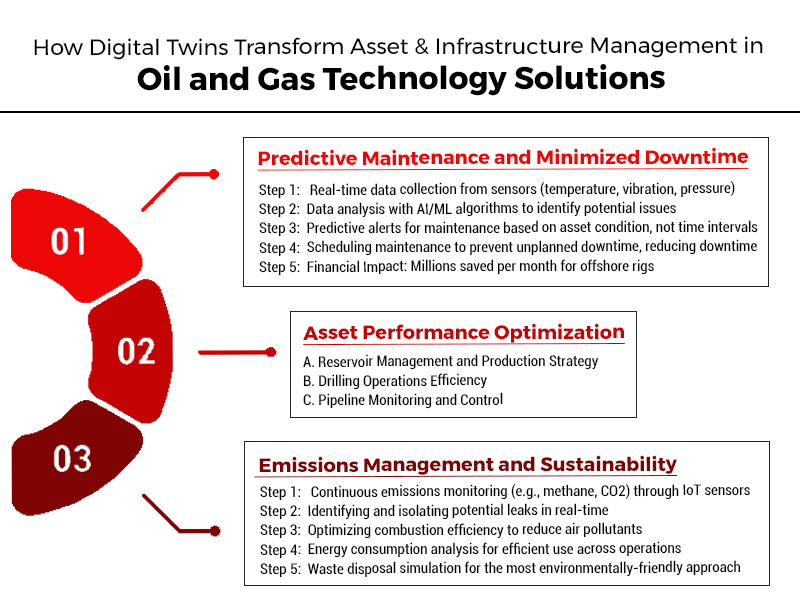
    1. Predictive Maintenance and Minimized Downtime

    Digital twins ensure intelligent maintenance by transitioning from time-based to condition-based maintenance, using real-time analysis to foretell equipment issues before they are severe.

    • Real-Time Health Monitoring: Digital twins also gather real-time data from sensors installed on pumps, compressors, turbines, and drilling equipment. Among the parameters constantly monitored are the vibration rates, pressure waves, and thermal trends, which may be used in monitoring for indicators of wear and impending failure.
    • Predictive Failure Detection: With machine learning and past failure patterns, digital twins can identify slight deviations that can lead to component failures. This enables teams to correct the problem before the problem leads to system-scale disruption.
    • Optimized Maintenance Scheduling: Rather than depending on strict maintenance schedules, digital twins suggest maintenance based on the actual condition of the assets. This avoids unnecessary work, minimizes labour costs, and maintains only when necessary, saving maintenance expenses.
    • Financial Impact: The cost savings in operations are directly obtained from the decrease in unplanned downtime. Predictive maintenance with digital twins can save millions per month for a single offshore rig alone.

    how Digital Twins enable Predictive Maintenance

    2. Asset Performance Optimization

    Asset performance optimization is not so much about getting the assets up and running as it is about getting every possible value from each asset at each stage in its operational lifecycle. Digital twins are key to this:

    A. Reservoir Management and Production Strategy

    Digital twins simulate oil reservoir behaviour by integrating geologic models with real-time operating data. This enables engineers to simulate different extraction methods—like water flooding or injecting gas—and select the one that will maximize recovery rates with the minimum amount of environmental damage.

    Operators receive insight into reservoir pressure, fluid contents, and temperature behaviour. Such data-driven insight assists in determining where and when to drill, optimize field development strategy, and maximize long-term asset use.

    B. Drilling Operations Efficiency

    Digital twin real-time modelling helps adapt quickly to altering conditions underground during drilling. Integrating drilling rig information, seismic information, and historical performance metrics, operators can select optimal drilling paths, skip danger areas, and ensure wellbore stability.

    Workflow simulations also minimize uncertainty and inefficiencies during planning, minimising well construction time. This enhances safety, minimizes non-productive time (NPT), and minimizes total drilling cost.

    C. Pipeline Monitoring and Control

    Digital twins are also applied in midstream operations, such as pipelines. They track internal pressure, flow rate, and corrosion data. By tracking anomalies such as imputed leaks or pipeline fatigue in real time, operators can perform preventive measures to ensure system integrity.

    Predictive pressure control and flow optimization also enhance energy efficiency by lowering the load on pump equipment, which results in operational efficiencies and environmental performance.

    3. Emissions Management and Sustainability

    Sustainability and environmental compliance are central to the technology solutions for oil and gas today. Digital twins offer the data infrastructure for tracking, managing, and optimizing environmental performance throughout operations.

    • Continuous Emission Monitoring: Digital twins are connected to IoT sensors deployed across production units and refineries to track emissions continuously. The systems monitor methane levels, flaring efficiency, and air quality in general. Preleak detection ensures immediate action to contain noxious emissions. On-site real-time combustion analysis can also help ensure maximum efficiency for processes by keeping pollutant production during flaring or burning down to the least.
    • Energy Use Insights: Plant operators use digital twins to point out inefficiency in energy usage in specific areas. With instantaneous comparisons between the input energy and the output from processes, operators recognize energy loss patterns and propose changes for lesser usage—greener and more efficient operation.
    • Simulation for Waste Handling: Digital twins model and analyze a variety of waste disposal plans in a bid to ascertain the most cost-effective and environmentally friendly approach. Whether dealing with drilling waste or refinery residues, operators are made transparent to minimize, reuse, or dispose of waste as per legislation.
    • Carbon Capture Optimization: As carbon capture and storage (CCS) emerges as a hot topic in the energy industry, digital twins help maximize these systems to their best. They mimic the behaviour of injected CO₂ in subsurface reservoirs, detect leakage risks, and maximize injection strategy for enhanced storage reliability. This helps companies achieve corporate sustainability objectives and aids global decarbonization goals.

    What is the Strategic Role of Digital Twins in Oil and Gas Technology Solutions?

    Digital twins are no longer pilot technologies—they are starting to become the basis for the digital transformation of oil and gas production. From upstream to downstream, they deliver unique visibility, responsiveness, and management of physical assets.

    Their capacity to integrate real-time operational data with sophisticated analytics enables companies to:

    • Improve equipment reliability and lower failures
    • Enhance decision-making on complicated operations
    • Reduce operating expenses with predictive models
    • Comply with environmental regulations and sustainability goals

    With oil and gas operators under mounting pressure to extract margins, keep humans safe, and show environmental responsibility, digital twins provide a measurable and scalable solution.

    Conclusion

    Digital twins are transforming asset and infrastructure management throughout the oil and gas value chain. They influence predictive maintenance, asset optimization, and sustainability—the three pillars of operational excellence in today’s energy sector.

    By enabling data-informed decision-making, reducing risk, and maximizing asset value, digital twins are a stunning leap in oil and gas technology solutions. Companies implementing this technology with support from SCS Tech will be better poised to run efficiently, meet regulatory demands, and dominate a globally competitive market.

  • How Can Digital Oilfields Reduce Downtime with Oil and Gas Technology Solutions?

    How Can Digital Oilfields Reduce Downtime with Oil and Gas Technology Solutions?

    Unplanned downtime costs the oil and gas industry billions each year. In fact, research shows that companies with a reactive maintenance approach spend 36% more time in downtime than those using data-driven, predictive maintenance strategies. The difference?

    A potential $34 million in annual savings. With such high stakes, it’s no longer a question of whether the oil and gas industry should adopt digital transformation in oil and gas — it’s about how to implement these innovations to maximize efficiency and reduce costly downtime.

    The answer lies in Digital Oilfields (DOFs), which seamlessly integrate advanced technologies to optimize operations, improve asset reliability, and cut costs.

    In this blog, let’s explore how Digital Oilfields revolutionize operations and reshape the future of the oil and gas industry.

    How Does Digital Oilfields Seamless Integration Revolutionize Operations?

    Digital Oilfields solutions implement Industrial IoT (IIoT) for Oil & Gas, real-time analysis, and automation to streamline operations, predict likely breakdowns, and drive peak asset efficiency. Predictive maintenance for Oil & Gas enables firms to visualize equipment in real-time, predict breakdowns in advance, and do everything possible to avoid downtime.

    Digital Oilfield transformation replaced traditional operations with man-critical and reactive modes to data-centered, AI-led decision-making. This improves the oil and gas industry’s safety, sustainability, and profitability. However, the need to understand the key causes of downtime is crucial in addressing these challenges and minimizing operational disruptions.

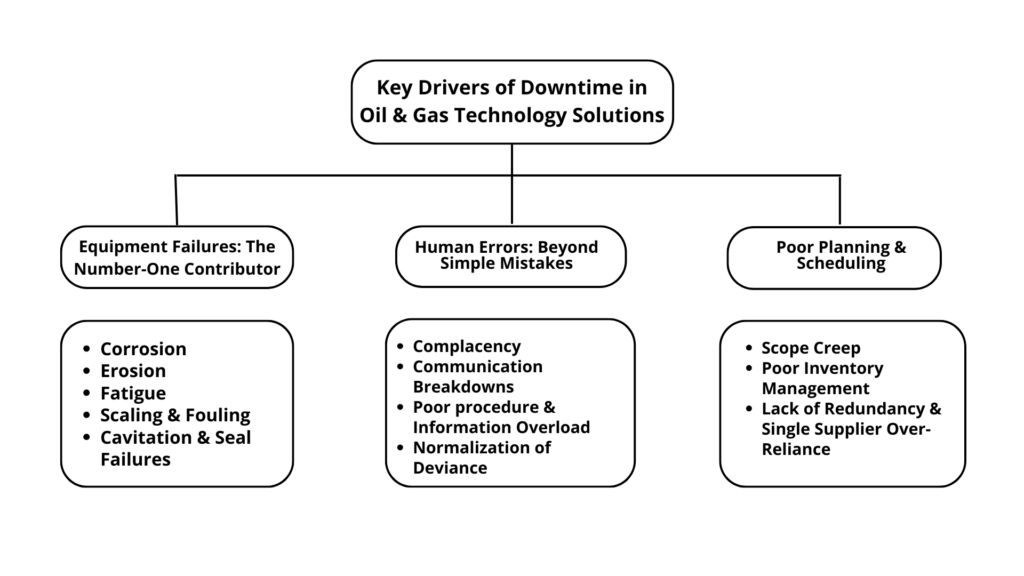
    The Key Drivers of Downtime in Oil & Gas Technology Solutions

    1. Equipment Failures: The Number-One Contributor

    Equipment breakdown is one of the significant sources of unplanned downtime. Several reasons are involved, including:

    • Corrosion: Sour crude (high sulfur) pipelines deteriorate over time by electrochemical action, especially at welds, bends, and dead legs.
    • Erosion: Sand-and-similar-abrasive-content high-speed fluids in fracking erosion erode pump impellers, chokes, and pipes.
    • Fatigue: Alternating pressure changes and vibration fatigue cause pipes to be damaged, usually at stress concentrators and threaded joints.
    • Scaling & Fouling: Mineral (such as calcium carbonate) and organic depositing in heat exchangers and pipes diminishes flow efficiency and causes shutdowns.
    • Cavitation & Seal Failures: Shock waves from collapsing vapor bubbles form when sudden pressure drops create vapor bubbles, which wear out the seals and pump impellers.

    2. Human Errors: Beyond Simple Mistakes

    Human error accounts for most of the oil and gas downtime due to the following:

    • Complacency: Routine work causes operators to overlook warning signs.
    • Communication Breakdowns: Communication breakdowns between operations, maintenance, and engineering personnel can delay problem-solving.
    • Poor Procedures & Information Overload: Inadequate procedures and excessive information overload can lead to misestimation.
    • Normalization of Deviance: Repeatedly exceeding operating limits by a small margin can lead to failures of catastrophic magnitude.

    3. Poor Planning & Scheduling

    Maintenance schedules and turnarounds, if not planned well, can cause downtime due to:

    • Scope Creep: Unplanned expansion of maintenance work that causes delay.
    • Poor Inventory Management: No spares available, resulting in prolonged downtime.
    • Lack of Redundancy & Single Supplier Over-Reliance: Supply chain interruption can bring operations to a standstill.

    With these major challenges in mind, the next logical step is understanding how Digital Oilfields tackle them.

     Key Drivers of Downtime in Oil & Gas Technology Solutions

    How Digital Oilfields Minimize Downtime?

    1. Real-Time Monitoring with Industrial IoT in Oil & Gas

    The newest IoT sensors bring critical information about equipment conditions so that proactive maintenance practices can be exercised. Some of those are:

    • Vibration Sensors: Picks up pump and compressor misalignments and bearing wear.
    • Acoustic Sensors: Picks up pipeline and pressure system leaks by detecting ultrasonic noises.
    • Corrosion Probes: Quantifies corrosion type, rate, and causative factors for effective mitigation.
    • Multiphase Flow Meters: Offers precise measurement of oil, gas, and water flow rates to prevent slugging and optimize production.

    2. Predictive Maintenance in Oil & Gas: AI-Driven Insights

    Artificial Intelligence (AI) and as well as Machine Learning (ML) based predictive analytics allow companies to predict failures before their occurrence. Some of the key applications are:

    • Failure Prediction Models: AI models consider historical failure records to predict the future failure of equipment.
    • Remaining Useful Life (RUL) Estimation: Machine learning estimates the time before a component fails, allowing for proper maintenance planning.
    • Anomaly Detection: Detects deviations in normal operating conditions, indicating future problems.
    • Prescriptive Analytics: Provides accurate recommendations for proactive actions to optimize equipment life.

    3. Automation & Remote Operations: Reduction of Human Error

    • Automated Control Systems: Allows operating conditions (e.g., temperature, flow rates, pressures) to be managed with real-time feedback.
    • Robotic Inspections: Robotic scanning of pipes and offshore rigs reduces human exposure to hazardous conditions.
    • Remote Monitoring & Control Centers: Operators remotely manage Assets from centralized facilities for enhanced productivity and savings.

    4. Digital Twins: Virtual Copies to Optimize

    Digital Twins are virtual copies of physical assets using AI to imitate real-time operations which include:

    • Real-Time Data Sync: Synchronizes with real-time sensor inputs in real-time.
    • Scenario Planning & Training: Mimics several operating scenarios to predict simulation and train operators.

    5. Advanced Digital Oilfield Technologies

    • Tank & LPG Level Monitors: Detect leaks and temperature stratification and predict evaporation/condensation rates.
    • Smart Flow Meters: Recognize multiphase flows and detect anomalies.
    • Thief Hatch Sensors: Recognize intrusions and monitor gas emissions.

    Conclusion

    The oil and gas industry is an area of convergence where industrial IoT, predictive maintenance, and automation are no longer a necessity. As digital oilfields offer more than digitization, they represent a shifting paradigm that decreases downtime, enhances safety, and delivers improved profitability.

    Therefore, businesses with digital oilfields can leverage the real potential of oil and gas technology solutions by using analytics, real-time monitoring, and AI-driven automation.

    With this technology, businesses can hence achieve operational excellence and success in the long run. SCS Tech supports oil and gas companies with cutting-edge digital solutions to re-imagine their businesses to be efficient, resilient, and industry-fit for the future.

  • How Do Digital Oilfields Improve Oil and Gas Technology Solutions?

    How Do Digital Oilfields Improve Oil and Gas Technology Solutions?

    Are you aware of the oil and gas technology that is transforming the industry? There’s an operation so bright that it reduces costs by 25%, increases production rates by 4%, and enhances recovery by 7%, all within just a few years. This is, says CERA, the actual effect of applying digital oilfield technologies. The digital oilfield applies advanced tools to transform oilfield operations’ efficiency, cost-effectiveness, and sustainability.

    Read further to understand how digital oilfields change oil and gas industry solutions.

    What Are Digital Oilfields?

    Digital oilfields are a technological revolution in oil and gas operations. Using IoT, AI, and ML, they make processes more efficient and cost-effective and provide better decision-making capabilities. From real-time data collection to advanced analytics and automation, digital oilfields integrate every operational aspect into a seamless, optimized ecosystem.

    Key Components of Digital Oilfields

    1. Data Gathering and Surveillance

    Digital oilfields start with collecting enormous volumes of real-time data:

    • IoT Sensors: Scattered across drilling locations, these sensors track pressure, temperature, flow rates, and equipment status. For instance, sudden changes in sound pressure may alert operators to take corrective actions immediately.
    • Remote Monitoring: Operators can control geographically dispersed assets from centralized control rooms or remote locations. Telemetry systems ensure smooth data transmission for quick decision-making.
    1. Advanced Analytics

    The gathered data is processed and analyzed for actionable insights:

    • Machine Learning and AI: Predictive AI analytics identifies possible equipment failures and optimizes the maintenance schedule. For example, an AI system can predict when a pump will fail so proactive maintenance can be scheduled.
    • Data Integration: Advanced analytics combines geological surveys, production logs, and market trends to give a holistic view, which is helpful in strategic decisions.
    1. Automation

    Automation minimizes human intervention in repetitive tasks:

    • Automated Workflows: Drill rigs do real-time optimizations depending on sensor feedback to improve performance and reduce errors.
    • Robotics and Remote Operations: Robotics and ROVs execute tasks like underwater surveys, which can be executed safely without losing efficiency.
    1. Collaboration Tools

    Digital Oilfield streamlines communication and Teamwork.

    • Integrated Communication Platforms: Real-time information sharing between the teams, video conferencing tools, and centralized platforms facilitate efficient collaboration.
    • Cloud-Based Solutions: Geologists, engineers, and managers can access data from anywhere, which leads to better coordination.
    1. Visualization Technologies

    Visualization tools turn data into actionable insights:

    • Dashboards: KPIs are displayed in digestible formats, which enables operators to spot and address issues quickly.
    • Digital Twins: Virtual replicas of the physical assets enable simulations, which allow operators to test scenarios and implement improvements without risking real-world operations.

    How Digital Oilfields Improve Oil and Gas Technology Solutions

    Digital oilfields utilize modern technologies to make the oil and gas technology solutions operational landscape more efficient. This results in efficiency, improved safety, cost-effectiveness, and optimized production with better sustainability. The explanation below elaborates on how digital oilfields enhance technology solutions in the oil and gas industry.

    1. Improved Operative Efficiency

    Digital oilfields improve operational efficiency through the following:

    • Real-Time Data Monitoring: IoT sensors deployed across oilfield assets such as wells, pipelines, and drilling rigs collect real-time data on various parameters (pressure, temperature, flow rates). This data is transmitted to centralized systems for immediate analysis, allowing operators to detect anomalies quickly and optimize operations accordingly.
    • Predictive Maintenance: With the help of AI and machine learning algorithms, the digital oilfield can predict equipment failures before they happen. For instance, Shell’s predictive maintenance has resulted in a timely intervention that saves the company from costly downtimes. These systems could predict when maintenance should be performed based on historical performance data and current operating conditions by extending equipment lifespan and reducing operational interruptions.
    • Workflow Automation: Technologies automate workflow and reduce people’s manual interfaces with routine items like equipment checking and data typing, which conserve time and lead to fewer possible errors. Example: an automated system for drilling optimizes the entire process as sensors provide feedback from which it sets parameters for continuous drilling in the well.

    2. Improved Reservoir Management

    Digital oilfields add to reservoir management with superior analytical techniques.

    • AI-Driven Reservoir Modeling: Digital oilfields utilize high-end AI models to analyze geology data to predict the reservoir’s behavior. These models can provide insight into subsurface conditions, enabling better decisions about the location of a well and the method of extraction for operators. Thus, it makes hydrocarbon recovery more efficient while reducing the environmental footprint.
    • Improve Recovery Techniques: With a better characterization of reservoirs, these digital oilfields are set up to implement enhanced oil recovery techniques suited for specific reservoir conditions. For instance, real-time data analytics can allow data-driven optimization techniques in water flooding or gas injection strategies to recover maximum amounts.

    3. Cost Cut

    The financial benefits of digital oilfields are tremendous:

    • Lower Capital Expenditures: Companies can avoid the high costs of maintaining on-premises data centers by using cloud computing for data storage and processing. This shift allows for scalable operations without significant upfront investment.
    • Operational Cost Savings: Digital technologies have shown a high ROI by bringing down capital and operating expenses. For instance, automating mundane activities will reduce labor costs but enhance production quantity. According to research, companies have seen an operative cost reduction of as much as 25% within the first year after deploying digital solutions.

    4. Improved Production Rates

    Digital oilfields increase production rates through:

    • Optimized Drilling Operations: Real-time analytics allow operators to adjust drilling parameters based on immediate feedback from sensors dynamically. This capability helps avoid issues such as drill bit wear or unexpected geological formations that can slow down operations.
    • Data-Driven Decision Making: With big data analytics, companies can quickly process vast volumes of operational data. These analyses underpin strategic decisions to improve production performance along the value chain from exploration through extraction.

    5. Sustainability Benefits

    Digital oilfield technologies are essential contributors to sustainability.

    • Environmental Monitoring: Modern monitoring systems can sense the leakage or emission, enabling solutions to be implemented immediately. AI-based advanced predictive analytics can identify where environmental risk has the potential to arise before it becomes a significant problem.
    • Resource Optimization: Digital oilfields optimize resource extraction processes and minimize waste; this process reduces the ecological footprint of oil production. For example, optimized energy management practices reduce energy consumption during extraction processes.

    6. Improved Safety Standards

    Safety is improved through various digital technologies:

    • Remote Operations: Digital oilfields allow for the remote monitoring and control of operations, thus allowing less personnel exposure to hazardous conditions. This enables one to reduce exposure to risks associated with drilling activities.
    • Wearable Technology: Wearable devices equipped with biosensors enable real-time monitoring of workers in the field and their health status. The wearable devices can notify the management of a potential health risk or unsafe conditions that may cause an accident.

    Conclusion

    The digital oilfield is a revolutionary innovation introduced into the oil and gas industry, combining the latest technologies to improve operational efficiency, better manage a reservoir, cut costs, enhance production rates, foster sustainability, and raise safety levels. The comprehensive implementation of IoT sensors, AI-driven analytics, automated tools, and cloud computing not only optimizes existing operations but projects an industry toward a position of success for future challenges.

    As digital transformation continues to unfold within this sector, the implications for efficiency and sustainability will grow more profoundly. SCS Tech, with its expertise in advanced oil and gas technology solutions, stands as a trusted partner in enabling this transformation and helping businesses embrace the potential of digital oilfield technologies.

  • The Importance of GIS Mapping Services in Oil & Gas Exploration and Management

    The Importance of GIS Mapping Services in Oil & Gas Exploration and Management

    In the high-stakes world of oil and gas, every decision matters—especially when it comes to exploration and infrastructure management. But how do industry leaders make the right call on where to dig, how to optimize their operations, and minimize risk? The answer lies in harnessing the power of Geographic Information Systems (GIS).

    As the GIS controller market heads towards an estimated 780 million USD by 2032, with an impressive annual growth rate of 13% from 2024 to 2032, the reliance on this cutting-edge technology is growing exponentially. Partnering with a trusted GIS company in Mumbai can provide the strategic edge needed to leverage this technology effectively. GIS isn’t just a tool; it’s a strategic advantage that turns raw data into actionable insights, helping companies boost safety, reduce costs, and make smarter, faster decisions in real time.

    GIS mapping services help them make smarter choices, increase safety, and save money by giving them highly detailed, real-time data about their operational environment. Read on for a look at how GIS boosts oil and gas exploration and management and how GIS companies in India are meeting the needs of the industry. To better understand how GIS achieves this, let’s explore its core functionalities in oil and gas exploration.

    GIS Data Integration and Visualization in Oil & Gas Exploration

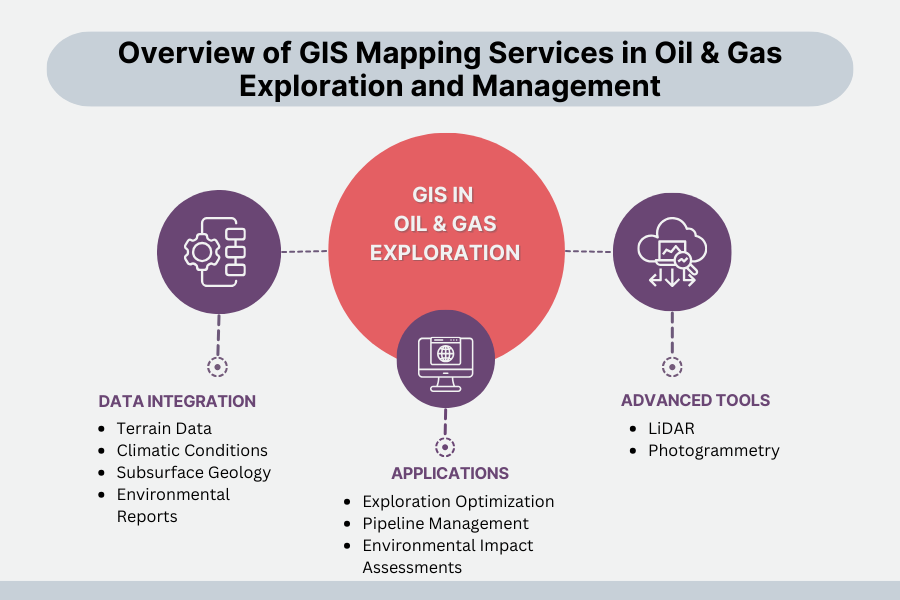
    Data Integration

    GIS integrates different information types, which come from satellites and GPS data, as well as surveys on the geology of the subsurface and environmental reports. Because of this ability to integrate data types, companies can now get a better view of the big picture.

    In the operation of oil and gas exploration, among other information, GIS can consolidate knowledge of terrain, climatic conditions, and subsurface geology. With all this data on one map, companies can be better positioned to decide where to explore, where to drill, and get a better handle on their asset management.

    Data Layering

    Another essential feature of GIS is its ability to layer different types of data on a single map. For instance, oil and gas professionals can view geological, environmental, and infrastructural data together, helping them assess how landscapes, sensitive environments, and operational challenges might impact drilling decisions. This multi-layered approach simplifies complex analysis, improving planning and decision-making.

    Advanced GIS Tools in Oil & Gas Exploration

    LiDAR and Photogrammetry

    While GIS is the core platform for data visualization and analysis, it often works in tandem with tools like LiDAR (Light Detection and Ranging) and photogrammetry, which provide detailed 2D and 3D images of the terrain. These high-technology tools generate dense data sets that can be overlaid onto GIS systems for further analysis.

    For example, LiDAR is critical in oil and gas exploration because it helps assess the stability of the land, identifying safe drilling and pipeline routes while minimizing risks associated with unstable terrain. By integrating this data into GIS, companies can make more accurate decisions on where to drill or lay pipelines.

    Real-Time Data Processing

    GIS, when integrated with real-time monitoring systems such as SCADA (Supervisory Control and Data Acquisition) and IoT devices, allows companies to visualize real-time data. While GIS is not responsible for collecting this data, it plays a crucial role in analyzing and visualizing it.

    Real-time monitoring enables companies to track their assets, including pipelines and wells, and respond quickly to any potential issues, such as leaks or environmental hazards. GIS serves as the front-end interface, where teams can visualize real-time conditions and act swiftly to prevent costly damages or disasters.

    GIS Applications in Oil & Gas Exploration and Asset Management

    Exploration Optimization

    The exploration of oil and gas tends to be both expensive and risky. Companies can mitigate these risks using GIS mapping services, which provide information on the most optimal locations to drill based on data. GIS integrates seismic data, historical exploration records, and geological information to help determine sites that may have high-potential oil and gas reserves. This helps minimize drilling into unproductive areas. Therefore, losses in terms of time and money are minimal.

    Pipeline Management

    One of the most critical challenges in the oil and gas industry is managing pipelines, especially when they traverse rugged or environmentally sensitive terrain. GIS helps by analyzing land conditions, environmental risks, and potential obstacles, ensuring the safest and most cost-effective pipeline routes.

    Moreover, by integrating real-time data from monitoring systems, GIS can track the condition of pipelines and issue alerts when there is a risk of leakage or damage. This proactive management ensures that companies can address issues before they become significant problems, reducing the likelihood of environmental disasters and costly repairs.

    Environmental Impact Assessments

    Environmental considerations are of paramount importance in oil and gas operations. GIS is an invaluable tool for conducting Environmental Impact Assessments; it shows how operations may impact ecosystems in the near vicinity. Companies may overlay environmental data with operational maps to ensure that projects conform to ecological standards while minimizing adverse impacts on the surrounding area.

    Benefits of GIS in Oil & Gas Exploration and Management

    More Informed Decisions

    GIS lets oil and gas companies map out all their critical data in one place, making more intelligent and faster decisions during the asset life cycle’s exploration, development, and operations phases. Companies can then see detailed maps with information regarding geological risks and possible environmental impacts. This will thus decide whether a specific location is suitable to drill in turn saving money.

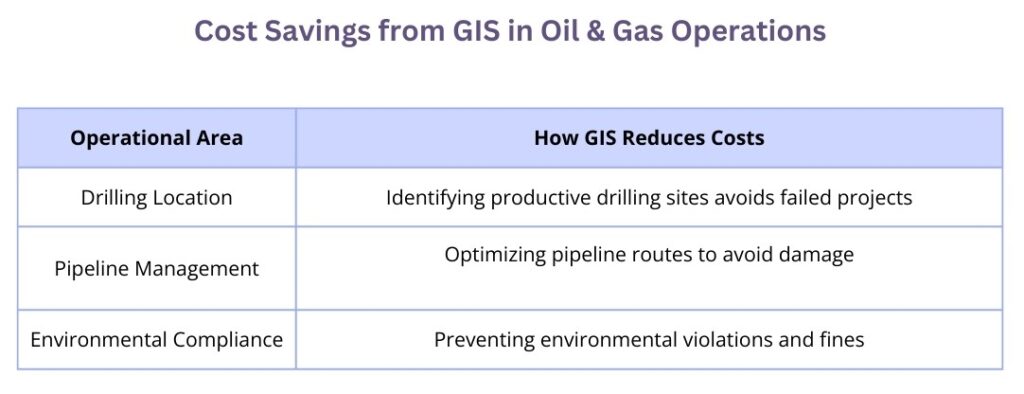
    Cost Savings

    Improving processes and increasing efficiency yields enormous savings for a company using GIS mapping services. Choosing a drilling location can save a lot of time and money since the loss of time and money through a non-productive site is avoided. More pipeline routing efficiency and current monitoring reduce more expensive repair work and avoid more downtime time. Operational expenses will be reduced.

    Cost Savings from GIS in Oil & Gas Operations

    Improved Safety

    Monitoring in real-time of hazards to safety and the environment of the oil and gas industry is essential. Even though GIS does not monitor equipment leaks or failure directly, it allows the companies to visualize and analyze data collected in real-time from other systems such as SCADA or IoT devices. In incidences, this system detects the problems, and by getting GIS images on display, the team can respond faster and stop further damage. This swift action does not only protect the workers but also helps avoid environmental disasters.

    The Future of GIS Mapping Services in Oil & Gas Industry

    The applications of GIS mapping services in oil and gas industries will have a promising future.

    • AI and Machine Learning Integration: Further AI and machine learning integration with GIS mapping services will likely spread its influence further. These technologies enable fast analysis of data and hidden patterns to help companies optimize drilling, predict equipment failures, and gain better operational efficiency.
    • Mobile GIS Applications: Mobile GIS applications are now becoming an essential aspect of field operations when mobile GIS can afford to reach far-flung areas. Realtime collection of data with instantaneous updating helps companies decide faster, communicate better, and reduce delays associated with oil and gas work activities.

    Key Takeaways

    GIS mapping services are changing the game in the oil and gas industry, where industries can make better decisions, reduce some of the costs, and become safer. GIS integrates various data, such as satellites and real-time sensor data, enabling compelling exploration, asset management, and regulatory compliance.

    GIS companies in India, such as SCS Tech India Pvt Ltd, are leading providers of GIS mapping services, which are increasingly vital to the oil and gas industry. We distinctively integrate advanced technologies with GIS applications, enhancing data accuracy and predictive capabilities for exploration, pipeline management, and environmental monitoring. Our solutions ensure precise, real-time mapping and analysis, optimizing efficiency and safety in high-risk and complex environments.

  • How GIS Mapping Services is Transforming the Oil/Gas Sector?

    How GIS Mapping Services is Transforming the Oil/Gas Sector?

    Do you know the integration of GIS across various sectors, including oil and gas, is projected to grow at a CAGR of 12.5% and reach a market size of US $26.27 billion between the periods of 2024-30? With this growth, oil and gas companies are adopting GIS mapping services. GIS helps in optimizing pipeline routes and monitoring assets in real-time. It also improves safety protocols and analyzes large amounts of spatial data. This integration streamlines operations, reduces risks, and enhances decision-making.

    To know more about how GIS technology integration helps in achieving optimal results, read the blog that covers various aspects of the GIS mapping services integration with the oil and gas technology sector.

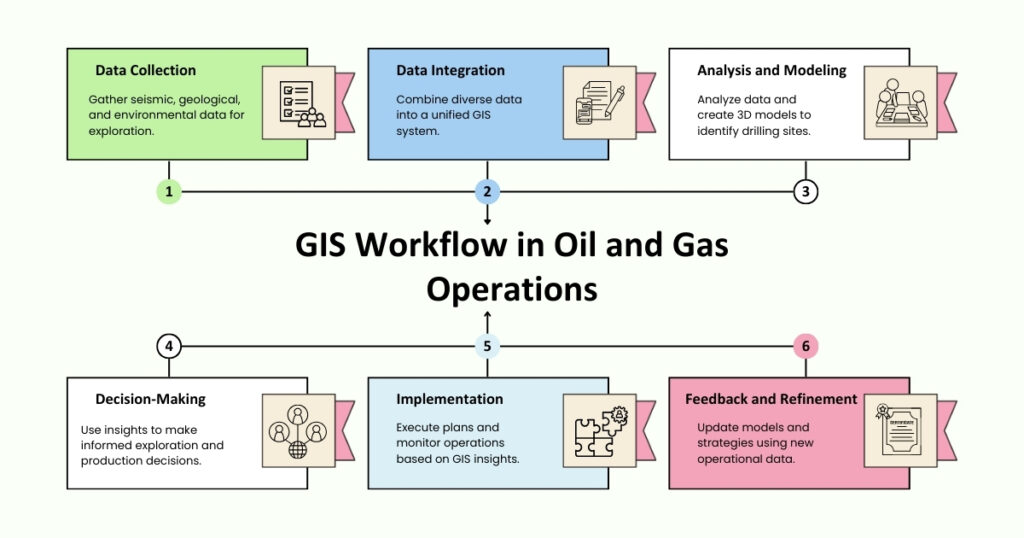
    GIS Workflow in Oil and Gas Operations

    What is the Role of GIS mapping services in the Oil and Gas Sector?

    GIS plays an important role in streamlining operations and saving costs in the oil and gas sector, we will discuss each factor in detail through the below-mentioned pointers:

    Exploration and Production (E&P)

    • This is the first stage in the oil and gas lifecycle; GIS here helps to integrate historical records, geological maps, seismic data, etc., to create effective reservoir modeling.
    • With these integrations, we identify locations for resource extraction and drilling. It helps in improving the accuracy of finding drilling locations and results in reduced exploration risks.
    • Reservoir modeling: a GIS mapping services feature helps visualize and model the size of the reservoir so accurate production estimates can be made.

    Asset Management and Infrastructure

    • Asset Management and Infrastructure in the Oil and Gas Sector with GIS is important for cost-effective infrastructure management, including storage, refineries, pipelines, rigs, etc.
    • Through spatial databases, GIS helps in asset maintenance and tracking. Operators can effectively determine on one single platform how the asset will be distributed across geographic locations, such as the exact location of pipelines, storage tanks, etc.
    • GIS technology also aids in optimized infrastructure planning by enabling optimal site selection, environmental considerations, and cost optimization. Additionally, it reduces risks through data integration from drones and satellites, allowing for in-depth inspections, particularly in offshore rigs and remote pipeline locations.

    Pipeline and Route Optimization

    • In the oil and gas sector, pipelines are the foundation for transporting crude oil, natural gas, and other petroleum products over long distances that can be challenging. Here, GIS plays a role in route optimization through planning and design, which is done by geospatial analysis of factors like terrain, land use, and environmental sensitivity. Route optimization is done for cost savings and less environmental disruption.
    • Listed below are a few important features offered by GIS for pipeline and route optimization.
      • Terrain and elevation analysis through slope stability analysis and analysis of elevation profiles
      • Integrating existing pipeline networks and faster access to maintenance facilities. Through predictive maintenance, one can perform a better assessment of temperature variations, terrain type, seismic activity, etc.
      • Enhancing risk management and safety through population density analysis, identification of high-risk zones, emergency response planning, etc.

    Field Data Collection and Remote Sensing

    • Integrating field data collection and remote sensing with GIS mapping enables remote data acquisition using satellite imagery, LiDAR, and aerial photography. This approach captures large-scale data over pipelines, refineries, and infrastructure. Additionally, UAVs equipped with GIS sensors provide in-depth data collection, enhancing overall accuracy.

    • Other key aspects include real-time field data collection through GPS integration and geotagging, environmental impact monitoring, sensitive ecosystem tracking, regulatory audits and inspections through data maps, etc.

    Seismic Data Analysis and Fault Line Mapping

    • Integrating GIS in India with seismic data analysis enhances vibrational data acquisition, and then we use geophones or hydrophone sensors to collect information on wave reflection.
    • Integration data also helps engineers analyze subsurface geological formations in 2D or 3D form.
    • GIS integrates seismic surveys, geological maps, and satellite imagery, which helps identify fault lines so that companies can make changes in drilling plans, develop stronger infrastructure, and develop safety protocols to mitigate the impact.

    Advantages of GIS mapping services in the Oil and Gas Sector

    The geographic information system helps the oil and gas sector by integrating tools that help in data management through data layering, emergency response planning, data sharing and collaboration, and more. Listed below are some key advantages:

    • Optimized Exploration and Drilling Operations
    • Supply Chain and Logistics Optimization
    • Enhanced Pipeline and Infrastructure Management
    • Sustainability through Optimized Resource Utilization
    • Reduction in Maintenance Costs
    • Enhanced Emergency Response and Incident Management
    • Enhanced Communication and Collaboration

    GIS Innovations and Trends Integrated by GIS Companies in India

    Listed below are a few upcoming GIS trends and innovations contributing to the transformation of the oil and gas industry:

    • Real-time data integration, such as satellite imagery and IoT sensors
    • AI and Machine learning for anomaly detection and optimization
    • Advanced geospatial analytics such as 3D modeling and spatial analysis
    • Blockchain for Data Security
    • Remote Sensing and UAVs through high-resolution aerial imagery and data collection
    • Enhanced reservoir modeling that helps in accurately predicting oil and gas reserves.

    Conclusion

    Integrating GIS technology in the oil and gas industry not only enhances operational efficiency but also transforms how we manage and ensure our resources and safety. By utilizing advanced spatial data analysis and innovative technologies, companies can achieve precise monitoring, proactive maintenance, and optimized resource usage. This strategic integration drives significant improvements, offering a competitive edge and unlocking new levels of operational excellence. Using these GIS capabilities could redefine your approach to industry challenges, setting the stage for future advancements and sustained success.

    If you are looking to capitalize on the benefits of GIS mapping services in the oil and gas industry solutions, then getting expert guidance from  SCS Tech India can be an optimal decision. Their solutions enhance precision, streamline management, and drive innovation, giving you a competitive edge while maximizing efficiency.


    FAQ

    • Can GIS help in predictive analytics in the oil and gas sector exploration?

    Yes, GIS technology helps in predictive analytics in the oil and gas sector exploration by integrating historical data with geospatial information, subsurface mapping, geological risk assessment, hydrocarbon movement prediction, and more.

    • Do GIS mapping services help in risk management in the oil and gas industry?

    Yes, GIS mapping services help in risk management by identifying high-risk zones, real-time monitoring of assets through drone and satellite monitoring, seismic risk prediction by spatial analysis, etc.

    • What are the innovations GIS companies in India are focusing on to transform the oil and gas sector in India?

    GIS companies in India are focusing on innovations like advanced remote sensing and satellite imagery, 3D reservoir modeling, seismic data integration, scalable cloud GIS platforms, hybrid energy systems, and more.

    • How can we use GIS technology in pipeline management in the oil and gas sector?

    GIS technology is important for pipeline management in the oil and gas sector as it helps detect leaks, corrosion, and pressure anomalies, ensure pipeline safety, reduce environmental risks, etc.

    (more…)

  • Current trends in Artificial Intelligence (AI) Application to Oil and Gas Industry

    Current trends in Artificial Intelligence (AI) Application to Oil and Gas Industry

    In recent years, artificial intelligence (AI), in its many integrated flavors from neural networks to
    genetic optimization to fuzzy logic, has made solid steps toward becoming more accepted in the mainstream of the oil and gas industry.On the basis of recent developments in the field of Oil & Gas upstream, it is becoming clear that petroleum industry has realized the immense potential offered by intelligent systems. Moreover, with the advent of new sensors that are permanently placed in the wellbore, very large amounts of data that carry important and vital information are now available.

    To make the most of these innovative hardware tools, an operator intervention is required to handle the software to process the data in real time. Intelligent systems are the only viable techniques capable of bringing real-time analysis and decision-making power to the new hardware.

    An integrated, intelligent software tool must have several important attributes, such as the ability to integrate hard (statistical) and soft (intelligent) computing and to integrate several AI
    techniques. The most used techniques in the Oil and Gas sector are:

    Genetic Algorithm (GA), inspired by the biological evolution of species in natural
    environment, consists of a stochastic algorithm in which three key parameters must be
    defined:
    1. Chromosomes, or better, vectors constituted by a fixed number of parameters
    (genes).
    2. A collection of chromosomes called genotype, which represents the individuals of
    a population.
    3. The operations of selection, mutation, and crossover to produce a population from
    one generation (parents) to the next (offspring).

    Fuzzy Logic (FL) is a mathematical tool able to covert crisp (discrete) information as
    input and to predict the correspondent crisp outlet by means of a knowledge base
    (database) and a specific reasoning mechanism. To achieve such goal, the crisp
    information is firstly converted into a continuous (fuzzy) form, secondly processed by an
    inference engine and at least re-converted to a crisp form.

    Artificial neural network (ANN) is constituted by a large number simple processing
    units, characterized by a state of activation, which communicate between them by sending
    signals of different weight. The overall interaction of the units produces, together with an external input, a processed output. The latter is also responsible of changing the state of
    activation of the units themselves.

    AI applications in Oil and Gas industry

    Exploration & Production (E&P) sector

    Most of the resources in the Oil and gas field is centered in drilling operation in which artificial
    intelligence finds natural application. Drilling success and safety are related to an accurate
    prediction of the likely performance of different factors such as:
    • Pre-drilling settings (rig, logistics and associated drilling risks)
    • Drilling equipment (casing and tubing pipes, drilling mud)
    • Downhole machinery behavior (vibrations, torque limits)

    The development of models, implemented by AI systems, permits to avoid the necessity of
    disposing of real-time data and to produce smart outcomes in order to quickly re-establish optimum operating conditions.

    Relatively to the selection of Drill bits, trained artificial neural networks (ANNs) have been used:
    they are able to suggest the best drill bit to select (roller cone, diamond insert or a hybrid) analyzing a user defined database. The latter should include information relative to the IADC bit codes correlated with specific geological data.

    Neural and network system (commonly GRNNs) gave accurate results in the prediction of mud
    the fracture gradient. As input parameters to the model, the depth of the well, the overburden
    gradient and the Poisson ratio must be provided. It is important to keep in mind that the results will strictly depend upon the range of the data set, and that extrapolations may loss in accuracy.

    In the planning stages of a well, drilling engineers are responsible for the establishment of the
    different depths at which the well must be cased to ensure an overall desired perforation depth. To avoid casing collapse, a neural network approach adopting a BPNN based spreadsheet program can be used. Back-propagating neural networks (BPNN) are constituted by a defined number of “layers”. Each layer is interconnected with the other: in particular, the input layer is connected with hidden layers which are in turn connected to the output layer. This neural net, provided of an historical well archive, is fed (input layer) with specific data of the well under consideration (i.e. location, depth, casing strength). Furthermore, the BPNN is able to estimate an “experienced”casing case probability.

    Another example of AI application is given by the real time drilling optimization in which
    artificial intelligence system are adopted to improved monitoring of downhole parameters
    optimizing the drilling operation.

    A crucial real-time operation is the Estimation of hole cleaning efficiency in terms of cutting
    concentration. During the drilling process, the wellbore is filled with many rock fragments
    (cuttings) generated by the mechanical action of the drill bit. In order to remove those cuttings
    from the well, a drilling fluid, or drilling mud, is pumped from the drill bit and exits from the
    wellhead: the cuttings are lifted and carried on the top of the well. According to this, the cutting concentration (expressed as a %) is the residual amount of rock fragments into the well after the cleaning action of the mud (Figure 5 gives a visual idea of the situation described). Inefficient removal of the drilled cuttings may lead, in some severe cases, to the loss of the well due to stuck pipe.

    For the estimation of the hole cleaning efficiency, artificial feed-forward neural network with
    back-propagation (BPNN) can be used. As input to the model all the parameters which affect the cutting concentration must be given. The latter are divided in specific parameters of the drilling (rate of penetration, inclination angle of the wellbore) or in parameters regarding the rheology conditions of the mud (viscosity, density).

    Future-proof your operations, onshore or offshore

    Whether you focus on exploration, extraction, transportation, storage, or production, at SCS Tech, we cater to all sectors of the oil and gas industry. From crude oil to natural gas and natural gas liquids, from refineries to gas treatment and petrochemical production, from pipelines to storage facilities, our service solutions and expertise give you the competitive edge. We ensure and boost the performance of the turbomachinery that lies at the heart of your value-adding process.