As per the Industry Growth Insight Report, the global emergency disaster management software market is expected to grow at a CAGR of 10.8% from 2018 to 2030. The global emergency disaster management software is divided into two segments, i.e., local deployment and cloud-based.
As per the report, the cloud-based segment is expected to grow at a faster rate during the forecast year due to increased concerns in enterprises for potential crises that may occur due to natural disasters like hurricanes, earthquakes, and cyber attacks, which can result in severe damage and business losses.
As businesses have started to understand the need to be prepared for the unexpected, the question arises: Can disaster management software predict natural disasters and shield your businesses from unanticipated catastrophes? This blog sheds light upon its various uses, advantages, disadvantages, and how disaster management software can play a significant role in safeguarding during times of crisis.
Understanding Disaster Management Software
Disaster management software is a great tool to prepare, respond, and recover from situations of crisis by emphasizing decreased levels of risks, clear communication, synchronizing emergency responses, and supervising recovery efforts efficiently. It essentially serves as a unified platform for administering all aspects of crisis management.
The key aspects of disaster management software comprise of:
- Risk Assessment: Disaster management software offers tools and techniques for risk assessment like qualitative and quantitative assessment, risk mapping, scenario analysis, failure mode and effects analysis (FEMA), SWOT analysis, and more. Listed below are crucial steps integrated into disaster management software for risk assessment:
- Threat Identification
- Vulnerability Analysis
- Risk Analysis and Score Generation
- Visualization and Risk Mapping
- Forecasting and Scenario Analysis
- Risk Mitigation Planning
- Monitoring and Alert Generation
- Reporting and Compliance
- Emergency Response Planning: This aspect focuses on creating and implementing strategies to manage the disaster effectively through customizable templates so the organization can plan out the action as per the scenario, simulation, drills, incident management software integration, plan adaptation, real-time updates, and focusing on post-incident review for identifying areas of improvement.
- Communication Tools: Disaster management software includes various communication tools like mass notification systems, GIS for disaster management based communication, incident management platforms, etc., that help mitigate the risk by sharing real-time information and coordinating effectively.
- Recovery Management: The software helps in reducing the intensity of damage and restarting the operations by adding supporting recovering management features that integrate the following solutions and tools:
- Business Continuity Planning Tools
- Resource Management Tools
- Data Recovery and Backup Solutions
- Recovery Point Objective (RPO) Tracking
- Recovery Time Objective (RTO)
Benefits of Disaster Management Software
Disaster management software extends various advantages that are vital in maintaining the continuity of business operations, which are discussed below:
- Efficient Response and Recovery: Disaster management software helps simplify the response and recovery phase by utilizing pre-defined response plans and related resources to subjugate any crisis successfully.
- Compliance and Reporting: Several industries demand compliance with certain regulations concerning the management and reporting of crises. Disaster management software acts as an aid in the fulfillment of these requirements in reporting, documentation, and auditing.
- Enhanced Communication: Disaster management software provides the necessary communication tools to ensure clear and consistent communication, which eliminates the risk of delayed response, thus resulting in a unified and collectively coordinated response.
- Proactive Risk Management: This involves the engagement of advanced analytics and data visualization tools to recognize potential risks involved before they develop into a major crisis. This approach promotes the advanced implementation of risk alleviation strategies.
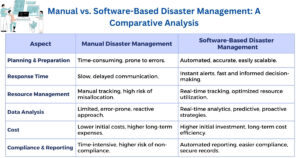
Challenges And Limitations Of Disaster Management Software
Let us understand the limitations of disaster management software that have a significant impact on the business’s decision-making ability and its implementation:
- Human Factor: Human errors such as wrong data entry, misinterpreted information, etc. are a major risk in diminishing the efficacy of disaster management software. Therefore, businesses must ensure timely and appropriate training to employees to ensure a smoother resolution of the crisis involved.
- Initial Costs and Implementation: The initial execution of this software can be costly for enterprises with budget constraints. These costs include integration, customization, and regular maintenance of the software.
- Complexity and Training: Disaster management software emphasizes proper training of their employees to harness their true potential to the advantage of the organization. However, the complexity of this software often results in employees sticking to the old traditional ways to resolve crises.
- Dependence on Technology: Technology is a powerful tool, but it can lead to various risks. Heavily relying on disaster management software can be concerning if all the software gets jeopardized. To avoid such difficult scenarios, businesses must have detailed backup plans to ensure smooth functioning.
Future of Disaster Management Software
Artificial intelligence (AI) and the Internet of Things (IoT) are becoming a crucial part of the evolving landscape of disaster management software due to the unique features they offer.
AI helps in improving risk assessment by easy dissemination of large sets of data, which helps in predicting and preventing potential crises that may occur shortly. On the other hand, IoT devices offer the collection of real-time data which promotes quick and accurate responses.
Businesses can expect to increase their potential manifold through the successful integration of these latest technologies into disaster management software.
Conclusion
Any enterprise can struggle with unexpected crises that can negatively impact its business operations. Disaster management software acts as a savior in navigating through such crises successfully by providing the necessary resources and solutions to safeguard assets and ensure the continuity of business operations, along with quick and informed decision-making.
Partnering with a technology provider like SCS Tech India can significantly amplify your benefits of disaster management software while ensuring that the organizations are provided with innovative solutions and required tools to handle any unforeseen emergencies successfully, whilst focusing on speedy recovery and business continuity.
FAQs
Is disaster management software suitable for small businesses?
Yes, disaster management software is suitable for businesses of all sizes, including small businesses.
Does GIS help in natural disaster management?
Yes, GIS in disaster management as it helps in giving real-time data, so efficient resource allocation can be done by mapping out the prone areas, predicting the impact level, and creating a recovery plan.
How does disaster management software integrate with other systems?
It is integrated into businesses through human resources, information technology, and communication platforms.