Tag: #security

  • How Custom Cybersecurity Solutions Protect Cloud, Mobile, and On-Site Systems?

    How Custom Cybersecurity Solutions Protect Cloud, Mobile, and On-Site Systems?

    Just 39 seconds—that’s all it takes for a cyberattack to strike, faster than you can reply to your emails.

    This alarming frequency indicates the urgent need for cybersecurity solutions. With every company relying on cloud computing, mobile devices, and on-site infrastructure, the demand for robust protection has never been greater. While each environment has its own unique vulnerabilities, cyber security consulting services help organizations identify and address these gaps effectively. General security measures may cover major threats, but expert consulting ensures even the less obvious vulnerabilities are not overlooked.

    That is where custom cybersecurity solutions come in for each system, which are different, specified according to their needs, and used to counter specific threats.

    Let’s discuss, in detail, each of the challenges presented by cloud, mobile, and on-site systems. Understand how custom cybersecurity solutions overcome those challenges, and improve security in each.

    Security of Cloud Systems: Overcoming Unique Security Challenges

    With the advent of cloud computing, tremendous flexibility and scalability emerged for businesses, but they differ through unique risks. With various users sharing cloud environments and being managed by third parties, they pose unique security issues that vary from traditional systems.

    What Are the Challenges in Cloud Security?

    • Data Breach: When sensitive information is stored in the cloud, it is most vulnerable to unauthorized access, especially if it has weak credentials or is not configured correctly.
    • Account Hijacking: Compromise from phishing leads to allowing attackers access to valuable information.
    • Insecure API: An insecure API control can be equated to an open door for an attacker with services in the cloud.
    • Compliance Complexities: These are the complexities of the compliance cloud configurations that must be put into strict regulatory standards like GDPR or HIPAA. This is challenging to implement effectively.

    How Do Custom Cybersecurity Solutions Enhance Cloud Security?
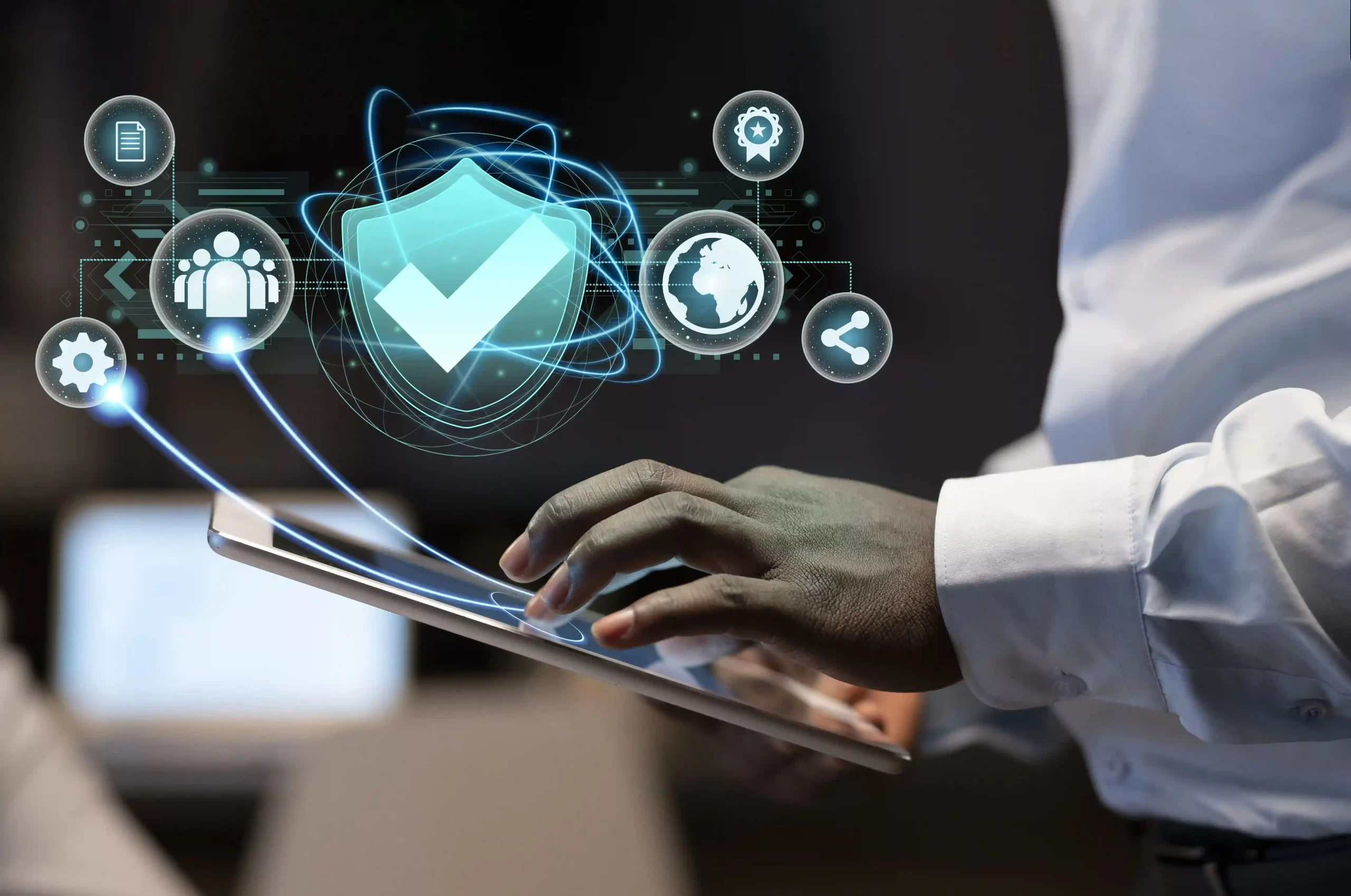
    Discover how custom cybersecurity solutions provide tailored protection for secure cloud environments

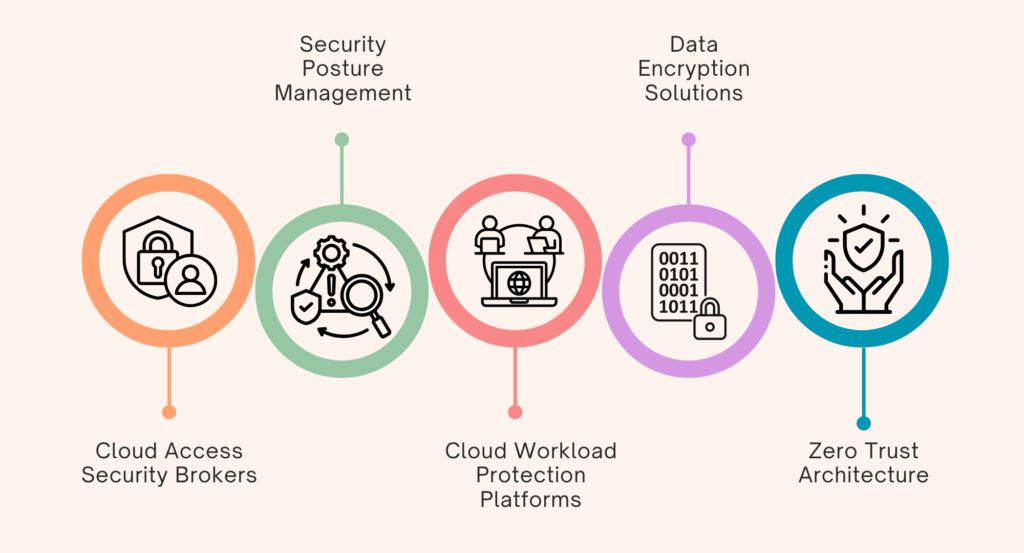
    1. Cloud Access Security Brokers (CASBs): CASBs serve as security layers between the cloud provider and the user base. It provides
      1. Data Protection: CASBs enforce data-loss-prevention policies through enforcing DLP policies by monitoring how data is transferred and blocking unauthorized access to sensitive information.
      2. Threat Detection: They use behavioral analytics to detect anomalies in user behavior that might suggest a breach.
      3. Compliance Management: CASBs help keep organizations compliant with all the appropriate industry regulations based on audit trails and reporting.
    2. Security Posture Management (SPM): SPM tools continuously watch for identifying vulnerabilities and misconfigurations in the cloud environments. This is done through:
      1. Vulnerability Scanning: Scanner tools that scan for all misconfigurations and known vulnerabilities in cloud resources.
      2. Compliance Audits: Periodic audits that the configurations adhere to best security practices and the appropriate regulations from the mandate.
    3. Cloud Workload Protection Platforms (CWPP): They protect the applications running in the cloud by analyzing activity in real-time and blocking unauthorized access attempts.
      1. Runtime Protection: The CWPP can detect real-time threats by protecting applications against malicious activity.
      2. Intrusion Prevention: The CWPP prevents any unauthorized access attempt and reduces the attack’s impact on workloads.
    4. Data Encryption Solutions: Encryption at rest, associated with the storage of data, and in motion, associated with the transfer of data utilise strong algorithms such as Advanced Encryption Standard (AES) coupled with Rivest-Shamir-Adleman (RSA) ensuring the integrity of data as it flows through all its stages of the life cycle.
      1. Encryption at Rest: With strong encryption algorithms such as AES-256, data is encrypted to secure those at rest in the cloud.
      2. Encryption in Transit: Encryption protocols, such as TLS/SSL, consist of specific ones that encrypt data between users and cloud services.
    5. Zero Trust Architecture: Zero Trust continuously verifies users and devices, limits network access, and controls lateral movement. This architectural model is designed so that not a single user or device should be trusted by default, regardless of whether they are inside or outside the network perimeter.
      1. Identity Verification: MFA ensures only the proper users can access cloud resources.
      2. Micro-Segmentation: This involves limiting lateral movement as the workload is segmented so multiple attack vectors remain inaccessible to the hackers if one resource is compromised.

    Mobile Systems: Unique Risks and Custom Solutions for Security

    The increasing use of mobile devices in the workplace has become a meaningful way to access company information. Still, they also pose vulnerabilities due to their portability and high connectivity. Among mobile security threats are malware attacks, phishing scams, and accidental data leaks in cases where information is mishandled.

    What Are the Issues in Mobile Security?

    • Threats of Malware: The mobile phone is highly vulnerable to malware that can steal away information or compromise system operations.
    • Phishing Attacks: Mobile phishing attacks target mobile users with fake messages that compel the victims to unveil sensitive information.
    • Leakage of Data: The leakage of data is facilitated by mishandling and storing some applications without appropriate security, thereby making them vulnerable.

    How Do Custom Cybersecurity Solutions Improve Mobile Security?
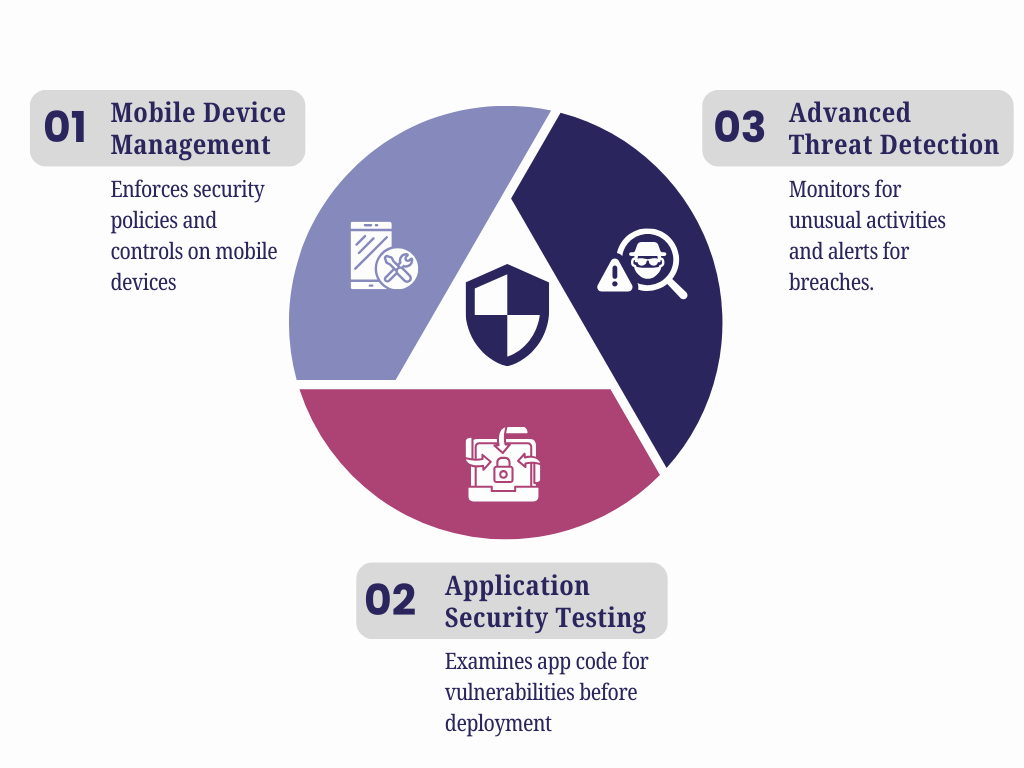
    How to Improve Mobile Security with Custom Cybersecurity Solutions

    1. Mobile Device Management (MDM): MDM will help enforce security policies across mobile devices and controls preventing the installation of unauthorized applications. This is done by:
      1. Wipe Remotely Ability: IT administrators can remotely wipe the data off lost or stolen devices so sensitive information cannot be accessed.
      2. Application Control: MDM enables organizations to mark applications as white lists or black lists depending on security policies to prevent malicious applications from being installed.
    2. Application Security Testing: This examines the code of a mobile application for potential vulnerabilities while simulating attacks to determine hidden weaknesses before deploying the app.
      1. Static Application Security Testing (SAST): It scans for possible weaknesses in the source code that may occur when executed.
      2. Dynamic Application Security Testing (DAST): Running applications are tested for vulnerability through simulated attacks that could reveal the exploits.
    3. Advanced Threat Detection: Behavioral analytics monitor mobile devices for unusual activities and enable an immediate response to potential breaches.
      1. Behavioral Analytics: These systems monitor patterns in the user behavior that signify a potential compromise.
      2. Real-Time Alerts: Instant alerting of suspicious events to allow for prompt investigation and action.

    On-Site Systems: Controlling Internal and Physical Threats through Custom Cybersecurity Solutions

    As businesses continue their digital transformation, on-site systems form the backbone of most organizations, since they provide a direct source of access to data coupled with control.

    They are always vulnerable to internal threats and intrusion by physical persons. Insiders and unauthorized physical intrusion are the main risks to on-site systems.

    What Are the Security Problems in On-Site Systems?

    • Insider Threat: The insiders compromised the security since those authorized to privilege access may misuse their rights.
    • Physical Violations: Unauthorized physical entities entering critical areas directly result in hardware or data exposure.

    How Do Custom Cybersecurity Solutions Improve On-Site Security?
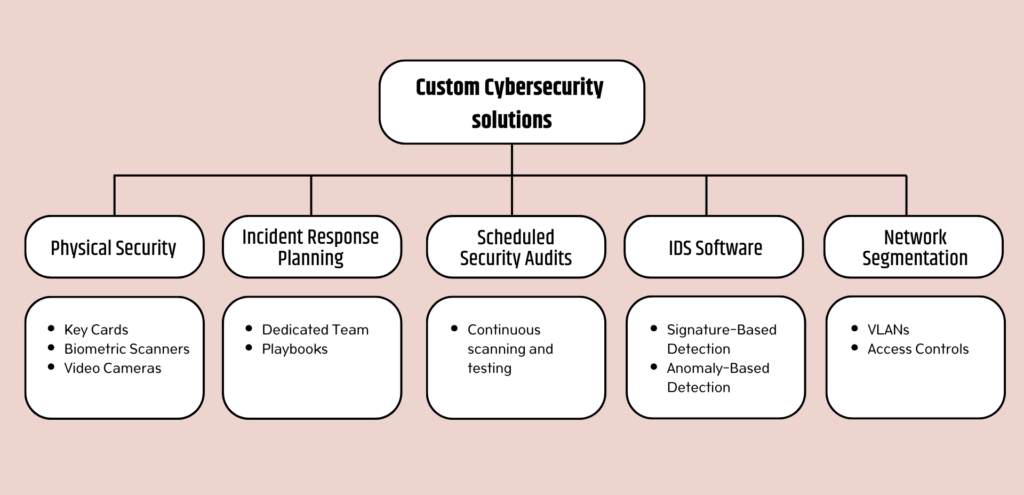
    Learn how custom cybersecurity solutions enhance on-site security by addressing unique vulnerabilities.

    1. Network Segmentation: Division of the network into sub-divisions. Segmentation limits the movement of attackers and restricts access to sensitive data. This format helps isolate breaches, thus protecting the rest of the network.
      1. Virtual Local Area Networks (VLANs): Separation of the different network-level departments reduces the likelihood of lateral movement by an attacker.
      2. Access Controls Between Segments: Strict access controls make sure that only authorized persons gain access to the sensitive segments.
    2. IDS Software: Intrusion Detection Systems (IDS) software keeps track of network traffic by detecting signatures and anomalies, which will notify of a threat in real-time.
      1. Signature-Based Detection: Predefined signatures of known threats are recognized and provide immediate responses to familiar attacks.
      2. Anomaly-Based Detection: This form of detection involves scanning for patterns that don’t fall under the usual traffic profile within the network. The method finds new threats that do not match existing signatures.
    3. Scheduled Security Audit: Periodic scanning for weaknesses and penetration testing will discover and remove all the possible vulnerabilities within the system before hackers take advantage of them.
    4. Incident Response Planning: A dedicated incident response team and a few playbooks for common scenarios ensure that breaches are fast and efficient and the eventual damage is reduced.
    5. Physical Security: Restrict access to building parts using key cards, biometric scanners, and video cameras.

    Conclusion

    Present-day generic solutions fail when unique challenges exist in cloud, mobile, and on-site systems. SCS Tech, a trusted name among the cybersecurity solutions group, provides targeted protection needed to keep data and operations safe.

    Whether planning a new security strategy or seeking to build upon and enhance the existing one, investing in custom cybersecurity solutions is paramount in these times of constant global changes and cyber threats.
     

  • What Are the Best Cybersecurity Practices for Small and Medium Enterprises (SMEs)?

    What Are the Best Cybersecurity Practices for Small and Medium Enterprises (SMEs)?

    With the threat of cyberattacks looming larger than ever, if you think that your small and medium-sized businesses are safe, think again. Alarmingly, a recent report published by The CyberPeace Foundation stated that approximately 43% of data breaches occurred in small businesses and startups. With cybercriminals increasingly targeting smaller businesses, SMEs must recognize the critical importance of fortifying their defenses.

    In this blog, we explore essential strategies to help SMEs thrive in an ever-evolving digital landscape.

    Essential  Cybersecurity Practices Every SMEs Must Implement

    SMEs must focus on building their Cybersecurity Service walls, as they are vulnerable to cyberattacks due to their limited resources. Let us discuss the various practices that small and medium enterprises must implement as security measures to safeguard their sensitive data and mitigate risks:

    • Updated Systems and Software: Managing updates of systems and software on a timely basis ensures the elimination of any security breaches, which further mitigates any chance of exploitation by attackers. It also promotes enhanced performance and compliance with all standards to eliminate any possibility of security compromises.
    • Limit Access to Sensitive Data: This practice gives role-based data access control, which helps safeguard data against unauthorized activities and potential threats. This further enhances data safety and privacy.
    • Secure Wi-Fi Networks: Transmission of sensitive data over wi-fi networks should be performed with complete security. This practice plays a crucial role in shielding data and maintaining network integrity. By using methods like strong encryption, timely updating of default settings, and solid passwords, we can substantially mitigate the risk of unwanted access and data breaches.
    • Data Encryption and Regular Backups: Systematic backups of data regularly ensure protection against loss of data in case of any cyberattacks. On the other hand, implementation methods of strong encryption safeguard data against any unauthorized access, even if it is stolen or intercepted.
    • Strong Password Policies and Multi-Factor Authentication: A solid password combined with multi-factor authentication (MFA), which involves more than one verification method to obtain access, guarantees an additional layer of security, which prevents any unauthorized access data in case of compromised passwords.
    • Performing Regular Risk Assessments: Supervising regular risk assessments promotes the identification and management of potential pitfalls and susceptibilities. It also helps businesses to have an edge over evolving threats, assuring that the security needs are synchronized with the present risk environment and business demands.
    • Firewalls and Antivirus Software: The implementation of proper firewalls acts as a shield between established internal networks and suspicious external networks and potential malware threats. On the other hand, antivirus software locates, defends, and eliminates any malicious content from systems and software.
    • Employee Training on Cybersecurity Awareness: Organizations must focus on building a security-conscious environment that educates employees to recognize and respond to cyber threats because they are the first line of defense. By cultivating an environment of shared responsibility amongst the employees for cybersecurity service, SMEs can remarkably refine their safeguards against advancing cyber risks.
    • Engaging with Third-Party Vendors: Working with trusted third-party vendors promotes the protection of sensitive data and reduces potential cyber risks through third-party systems. Organizations must ensure that these vendors work with stringent security protocols to prevent any data or security breaches.
    • Build an Incident Response Plan: Creating an effective incident response plan is extremely crucial for handling cybersecurity breaches or attacks. It is a standardized approach that ensures quick and adequate response to cyber threats by organizations while mitigating potential risks, reducing recovery time, and eliminating future cyber attacks. It also prevents any reputational damage by focusing on timely compliance with necessary protocols, which further builds customer trust.

    Emerging Cybersecurity Trends and Technologies for SMEs

    Emerging cybersecurity trends and technologies have started to pave the way for small and medium enterprises to engage in innovative methods to protect themselves from potential cyber risks. Let us explore these latest trends that SMEs should deploy to strengthen their cybersecurity structure:

    #1 Artificial Intelligence (AI) and Machine Learning (ML) in cybersecurity

    AI and ML services offer transformative benefits to SMEs by scrutinizing vast sets of data in no time while simultaneously analyzing the data for any security threats and early warnings.

    #2 Endpoint detection and response (EDR)

    With the rising demand for remote work, protection of endpoints ( laptops, mobiles, etc.) has become extremely important. EDR focuses on finding and scrutinizing any malicious activities on these endpoints and isolating the same to prevent further damage.

    #3 Zero Trust Architecture

    With hybrid work environments in trend, conventional defenses are not enough to strengthen the cybersecurity of SMEs. Zero trust engages the concept of not trusting anybody in the internal or external networks.

    #4 Security automation and orchestration (SOAR)

    SOAR is a boon for organizations with a finite IT staff as it uses automation of repetitive tasks which helps in detecting, evaluating, and responding to cyber threats by amalgamating different security tools.

    #5 Phishing awareness and training programs

    SMEs employees often lack the training and knowledge to adequately fight against phishing and other cyber attacks. Building awareness against phishing attacks can enhance employee retaliation to real threats.


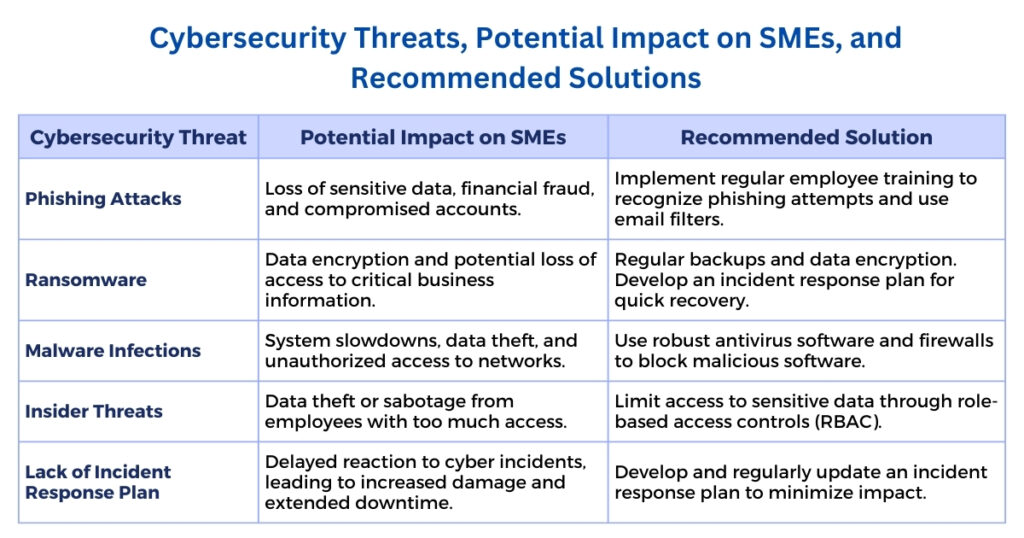
    Cybersecurity Threats, their potential impact on SMEs and solutions

    Conclusion 

    As cyber threats continue to rise, SMEs can no longer afford to remain complacent—especially with 46% of SMEs in India unaware of how to mitigate these risks. To safeguard sensitive and operational data while preserving customer trust, it’s crucial for organizations to adopt robust cybersecurity practices.

    Collaborating with custom cybersecurity solutions providers like SCS Tech can enhance protection by integrating advanced technology into their systems while promoting business growth and minimizing risks.

    FAQs

    • Do SMEs have the resources to implement solid cybersecurity protocols?

    Yes, SMEs can implement strong, cost-effective, and flexible cybersecurity measures with limited resources.

    • How does the principle of least privilege work in SMEs?

    The principle of least privilege involves allowing the user with minimum access rights to do their jobs to mitigate insider attacks and threats.

    • In what ways can SMEs protect their staff against phishing attacks?

    SMEs must ensure that employees have the knowledge to recognize suspicious emails, use spam filters, and encourage employees to report any phishing attempts.

    (more…)

  • Can Disaster Management Software Protect Your Business from Unexpected Crises?

    Can Disaster Management Software Protect Your Business from Unexpected Crises?

    As per the Industry Growth Insight Report, the global emergency disaster management software market is expected to grow at a CAGR of 10.8% from 2018 to 2030. The global emergency disaster management software is divided into two segments, i.e., local deployment and cloud-based.

    As per the report, the cloud-based segment is expected to grow at a faster rate during the forecast year due to increased concerns in enterprises for potential crises that may occur due to natural disasters like hurricanes, earthquakes, and cyber attacks, which can result in severe damage and business losses.

    As businesses have started to understand the need to be prepared for the unexpected, the question arises: Can disaster management software predict natural disasters and shield your businesses from unanticipated catastrophes? This blog sheds light upon its various uses, advantages, disadvantages, and how disaster management software can play a significant role in safeguarding during times of crisis.

    Understanding Disaster Management Software 

    Disaster management software is a great tool to prepare, respond, and recover from situations of crisis by emphasizing decreased levels of risks, clear communication, synchronizing emergency responses, and supervising recovery efforts efficiently. It essentially serves as a unified platform for administering all aspects of crisis management.

    The key aspects of disaster management software comprise of:

    • Risk Assessment: Disaster management software offers tools and techniques for risk assessment like qualitative and quantitative assessment, risk mapping, scenario analysis, failure mode and effects analysis (FEMA), SWOT analysis, and more. Listed below are crucial steps integrated into disaster management software for risk assessment:
    • Threat Identification
    • Vulnerability Analysis
    • Risk Analysis and Score Generation
    • Visualization and Risk Mapping
    • Forecasting and Scenario Analysis
    • Risk Mitigation Planning
    • Monitoring and Alert Generation
    • Reporting and Compliance
    • Emergency Response Planning: This aspect focuses on creating and implementing strategies to manage the disaster effectively through customizable templates so the organization can plan out the action as per the scenario, simulation, drills, incident management software integration, plan adaptation, real-time updates, and focusing on post-incident review for identifying areas of improvement.
    • Communication Tools: Disaster management software includes various communication tools like mass notification systems, GIS for disaster management based communication, incident management platforms, etc., that help mitigate the risk by sharing real-time information and coordinating effectively.
    • Recovery Management: The software helps in reducing the intensity of damage and restarting the operations by adding supporting recovering management features that integrate the following solutions and tools:
    • Business Continuity Planning Tools
    • Resource Management Tools
    • Data Recovery and Backup Solutions
    • Recovery Point Objective (RPO) Tracking
    • Recovery Time Objective (RTO)

    Benefits of Disaster Management Software

    Disaster management software extends various advantages that are vital in maintaining the continuity of business operations, which are discussed below:

    • Efficient Response and Recovery: Disaster management software helps simplify the response and recovery phase by utilizing pre-defined response plans and related resources to subjugate any crisis successfully.
    • Compliance and Reporting: Several industries demand compliance with certain regulations concerning the management and reporting of crises. Disaster management software acts as an aid in the fulfillment of these requirements in reporting, documentation, and auditing.
    • Enhanced Communication: Disaster management software provides the necessary communication tools to ensure clear and consistent communication, which eliminates the risk of delayed response, thus resulting in a unified and collectively coordinated response.
    • Proactive Risk Management: This involves the engagement of advanced analytics and data visualization tools to recognize potential risks involved before they develop into a major crisis.  This approach promotes the advanced implementation of risk alleviation strategies.

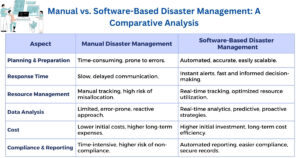
     Comparison of Manual vs. Software based disaster management

    Challenges And Limitations Of Disaster Management Software

    Let us understand the limitations of disaster management software that have a significant impact on the business’s decision-making ability and its implementation:

    • Human Factor: Human errors such as wrong data entry, misinterpreted information, etc. are a major risk in diminishing the efficacy of disaster management software. Therefore, businesses must ensure timely and appropriate training to employees to ensure a smoother resolution of the crisis involved.
    • Initial Costs and Implementation: The initial execution of this software can be costly for enterprises with budget constraints. These costs include integration, customization, and regular maintenance of the software.
    • Complexity and Training: Disaster management software emphasizes proper training of their employees to harness their true potential to the advantage of the organization. However, the complexity of this software often results in employees sticking to the old traditional ways to resolve crises.
    • Dependence on Technology: Technology is a powerful tool, but it can lead to various risks. Heavily relying on disaster management software can be concerning if all the software gets jeopardized. To avoid such difficult scenarios, businesses must have detailed backup plans to ensure smooth functioning.

    Future of Disaster Management Software

    Artificial intelligence (AI) and the Internet of Things (IoT) are becoming a crucial part of the evolving landscape of disaster management software due to the unique features they offer.

    AI helps in improving risk assessment by easy dissemination of large sets of data, which helps in predicting and preventing potential crises that may occur shortly. On the other hand, IoT devices offer the collection of real-time data which promotes quick and accurate responses.

    Businesses can expect to increase their potential manifold through the successful integration of these latest technologies into disaster management software.

    Conclusion

    Any enterprise can struggle with unexpected crises that can negatively impact its business operations. Disaster management software acts as a savior in navigating through such crises successfully by providing the necessary resources and solutions to safeguard assets and ensure the continuity of business operations, along with quick and informed decision-making.

    Partnering with a technology provider like SCS Tech India can significantly amplify your benefits of disaster management software while ensuring that the organizations are provided with innovative solutions and required tools to handle any unforeseen emergencies successfully, whilst focusing on speedy recovery and business continuity.

    FAQs

    Is disaster management software suitable for small businesses?
    Yes, disaster management software is suitable for businesses of all sizes, including small businesses.

    Does GIS help in natural disaster management?
    Yes, GIS in disaster management as it helps in giving real-time data, so efficient resource allocation can be done by mapping out the prone areas, predicting the impact level, and creating a recovery plan.

    How does disaster management software integrate with other systems?
    It is integrated into businesses through human resources, information technology, and communication platforms.

    (more…)