Tag: Technology

  • GIS Mapping: 9 Use Cases That Are Powering Smart Cities & Infrastructure

    GIS Mapping: 9 Use Cases That Are Powering Smart Cities & Infrastructure

    Smart cities are no longer futuristic ideas as they are actively being designed, funded, and built across India. With rapid urban growth, rising infrastructure demand, and increasing pressure on resources, city planners and government agencies need smarter ways to manage land, water, transport, public services, and emergency response. This is where GIS mapping (Geographic Information Systems) has become a game-changer.

    GIS mapping is more than just digital maps. It enables decision-makers to visualize real-world data geographically, analyze patterns, forecast risks, and plan smarter infrastructure development. Whether a city is planning new roads, managing flood-prone zones, tracking public assets, or improving traffic flow, GIS provides a single, powerful layer of intelligence that connects everything.

    In this blog, we’ll explore what GIS mapping is, why it’s essential for smart cities, and the most high-impact GIS use cases that are transforming infrastructure and urban planning in 2026.

    What Is GIS Mapping and Why Does It Matter Today?

    GIS mapping is a technology that collects, stores, analyzes, and visualizes geographical or location-based data. It combines traditional mapping with modern data analytics, enabling organizations to answer key questions like:

    Where are the problems occurring?

    Why are they happening in specific locations?

    What areas are most vulnerable in the future?

    How can we optimize infrastructure planning and public service delivery?

    In simple terms: GIS turns location data into actionable intelligence.

    For smart cities, GIS is essential because every urban system—roads, water pipelines, electricity networks, traffic signals, public safety, waste management—exists in a geographic space. GIS helps connect these systems and manage them more efficiently.

    How GIS Mapping Powers Smart City Development

    GIS mapping serves as the technological backbone of smart city development by synthesizing diverse, real-time data into a unified, actionable framework. By integrating layers such as transportation networks, land usage, and population distribution with critical utility infrastructure and environmental metrics, GIS allows urban planners to move beyond departmental silos.

    This multidimensional approach—further enriched by satellite and drone imagery—transforms the city into a visible, dynamic ecosystem where the relationship between streetlights, air quality, and traffic flow can be analyzed simultaneously. Ultimately, this geographic intelligence empowers leaders to make precise, data-driven decisions that improve efficiency and quality of life across the entire urban landscape.

    Top 9 GIS Mapping Use Cases Powering Smart Cities & Infrastructure

    Let’s look at the most impactful and practical GIS applications being used in smart cities and infrastructure projects today.

    1. Urban Planning and Land Use Management

    Urban development requires structured planning—where to build, what to build, and how to ensure long-term sustainability. GIS helps planners identify growth patterns, land availability, and development constraints.

    GIS enables:

    • Zoning and land-use planning

    • Master planning for city expansion

    • Identifying suitable land parcels for public projects

    • Mapping unauthorized constructions and encroachments

    • Impact analysis of new infrastructure projects

    Instead of relying on static reports, smart city planners can visualize development scenarios using interactive GIS dashboards.

    2. Smart Transportation and Traffic Management

    Traffic congestion is one of the biggest challenges in urban India. Smart mobility depends on analyzing traffic flow, identifying bottlenecks, and optimizing routes for both private and public transport.

    With GIS mapping, authorities can:

    • Monitor congestion hotspots

    • Analyze accident-prone zones

    • Optimize traffic signals and junction layouts

    • Plan alternate routes and bypass corridors

    • Improve public transport route planning

    Over time, GIS can also support long-term initiatives such as integrated metro, bus, and multimodal transport networks by improving planning accuracy.

    3. Asset Management for Public Infrastructure

    Smart cities run on public assets: streetlights, water valves, power transformers, CCTV cameras, roads, bridges, signboards, and more. Managing these assets manually is costly and inefficient.

    GIS-based asset mapping helps governments and civic bodies:

    • Create an accurate inventory of city assets

    • Track asset condition and maintenance schedules

    • Identify asset gaps across regions

    • Reduce service downtime through faster repairs

    • Improve accountability through geo-tagged records

    This is one of the most practical and high-ROI uses of GIS, especially for municipal bodies focused on service delivery improvements.

    4. Water Supply and Pipeline Network Monitoring

    Water is one of the most critical—and stressed—resources for growing cities. Leakage, illegal connections, and poor monitoring can lead to heavy losses and supply disruption.

    GIS helps utilities manage water networks by enabling:

    • Mapping of pipeline networks and distribution zones

    • Leak detection and hotspot identification

    • Monitoring pressure zones and flow rates

    • Planning new water lines based on demand mapping

    • Visualizing real-time supply status across regions

    When integrated with IoT sensors, GIS becomes even more powerful, enabling real-time alerts and predictive maintenance.

    5. Disaster Management and Emergency Response

    Whether it’s floods, landslides, fires, earthquakes, or industrial incidents, emergency response depends on speed and accurate situational awareness. GIS enables authorities to respond faster and allocate resources efficiently.

    GIS can support:

    • Flood risk mapping and drainage analysis

    • Identifying evacuation routes and shelter locations

    • Real-time incident mapping and resource allocation

    • Tracking emergency vehicles and field teams

    • Monitoring disaster impact zones using satellite imagery

    This makes GIS an essential tool not only for smart cities but also for climate resilience planning.

    6. Solid Waste Management and Sanitation Planning

    Solid waste management is a major operational challenge in cities. Routes must be optimized, bins must be tracked, and collection schedules need to be managed efficiently.

    GIS helps by enabling:

    • Geo-tagging of bins and collection points

    • Route optimization for waste collection vehicles

    • Identifying missed pickups or underserved areas

    • Planning landfill sites and waste transfer stations

    • Monitoring sanitation performance across zones

    This use case supports cleaner cities while reducing fuel consumption and operational costs.

    7. Smart Street Lighting and Energy Optimization

    Street lighting is one of the biggest municipal electricity expenses. Smart street lighting projects are powered by GIS through mapping and monitoring of lighting infrastructure.

    GIS supports:

    • Mapping existing streetlight points

    • Identifying high-need areas (dark spots)

    • Monitoring faults and maintenance schedules

    • Optimizing energy usage through smart controls

    This results in improved public safety while keeping energy spending under control.

    8. Environmental Monitoring and Sustainability Projects

    Smart cities must also be sustainable cities. GIS plays a vital role in monitoring environmental conditions and planning eco-friendly interventions.

    Common GIS applications include:

    • Air quality mapping and pollution hotspot tracking

    • Mapping green spaces and urban forest projects

    • Heat map analysis for urban heat islands

    • Water body monitoring and restoration planning

    • Noise pollution and waste dumping monitoring

    These insights help cities plan long-term environmental action instead of reactive measures.

    9. Smart Governance and Citizen Service Delivery

    Citizens expect fast, transparent, and efficient service delivery. GIS enables governance teams to manage issues geographically and improve response times.

    With GIS-enabled citizen service models, authorities can:

    • Map citizen complaints by ward/zone

    • Prioritize areas with high service gaps

    • Allocate field teams efficiently

    • Track service completion with geo-tagged proof

    • Improve accountability with data-based monitoring

    This leads to better citizen satisfaction and measurable improvements in municipal services.

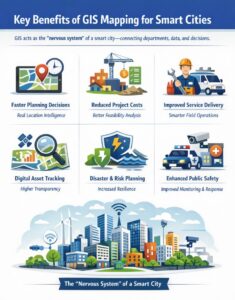
    Key Benefits of GIS Mapping for Smart Cities

    GIS brings value across planning, operations, and governance. Some of the most powerful benefits include:

    Key benefits of GIS mapping for smart cities including planning, cost reduction, resilience and public safety

    Wrapping Up!

    GIS mapping is no longer just a support tool—it has become a foundational technology driving smart city development and modern infrastructure planning. In 2026, cities that adopt GIS effectively gain a major advantage: they can plan smarter, respond faster, allocate resources efficiently, and deliver better public services.

    From transport and water management to disaster response and sustainability initiatives, GIS is empowering governments and enterprises to transform how cities function—making them more connected, resilient, and future-ready.

    For organizations working on smart city projects, partnering with a technology provider like SCS Tech India that understands GIS implementation at scale can make all the difference. With the right strategy, data systems, and deployment approach, GIS can become one of the highest-impact investments for infrastructure modernization.

  • How to Audit Your Existing Tech Stack Before Starting a Digital Transformation Project

    How to Audit Your Existing Tech Stack Before Starting a Digital Transformation Project

    Before you begin any digital transformations, you need to see what you’ve got. Most teams are using dozens of tools throughout their departments, and for the most part, they are underutilized, do not connect with one another, or are not in alignment with the current objectives. 

    The tech stack audit is what helps you identify your tools, how they fit together, and where you have gaps or threats. If you haven’t done this process, even the best digital plans can wilt due to slowdowns, increased expenses, or breaches of security.

    This guide guides you step-by-step in how to do an audit of your stack properly, so your digital transformation starts from a good foundation, not with new software.

    What Is a Tech Stack Audit?

    A tech stack audit reviews all the software, platforms, and integrations being used in your business. It checks how well these components integrate, how well they execute, and how they align with your digital transformation goals.

    A fragmented or outdated stack can slow progress and increase risk. According to Struto, outdated or incompatible tools “can hinder performance, compromise security, and impede the ability to scale.”

    Poor data, redundant tools, and technical debt are common issues. Poor team morale and inefficiencies ensue, according to Brightdials, as stacks become unstructured or unmaintained.

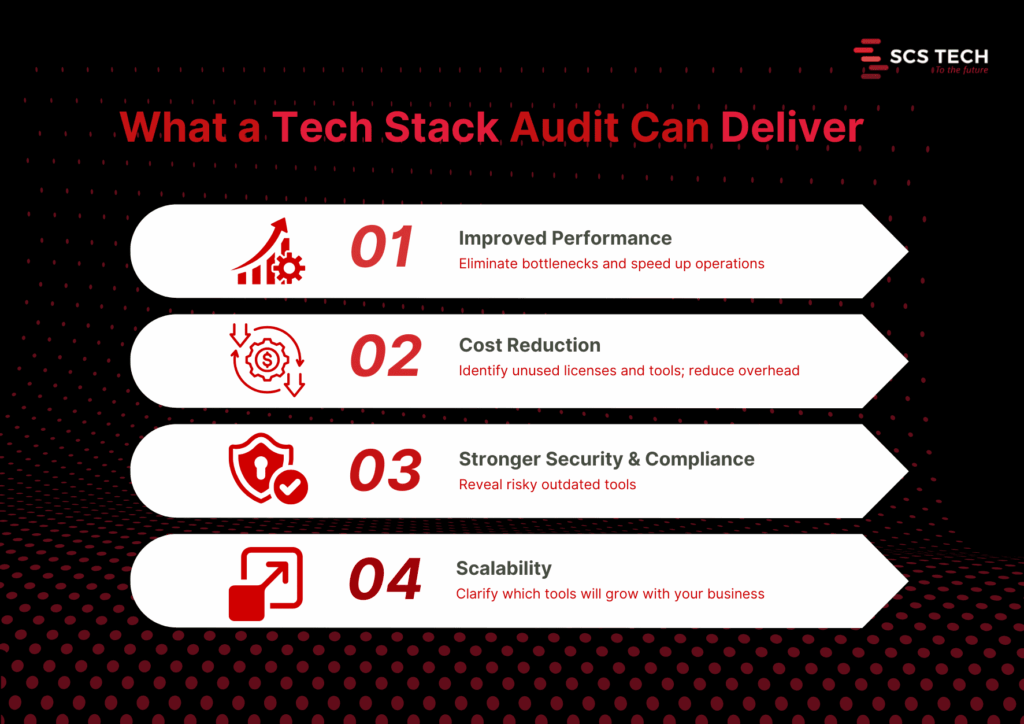
    Core benefits of a thorough audit

    1. Improved performance. Audits reveal system slowdowns and bottlenecks. Fixing them can lead to faster response times and higher user satisfaction. Streamlining outdated systems through tech digital solutions can unlock performance gains that weren’t previously possible.
    2. Cost reduction. You may discover unneeded licenses, redundant software, or shadow IT. One firm saved $20,000 annually after it discovered a few unused tools.
    3. Improved security and compliance. Auditing reveals stale or exposed pieces. It avoids compliance mistakes and reduces the attack surface.
    4. Better scalability and future-proofing. An audit shows what tools will be scalable with growth or need to be replaced before new needs drive them beyond their usefulness.

    Step-by-Step Process to Conduct a Tech Stack Audit

    It is only logical to understand what you already have and how well it is working before you begin any digital transformation program. The majority of organizations go in for new tools and platforms without checking their current systems properly. That leads to problems later on.

    A systematic tech stack review makes sense. It will inform you about what to keep, what to phase out, and what to upgrade. More importantly, it ensures your transformation isn’t based on outdated, replicated, or fragmented systems.

    The following is the step-by-step approach we suggest, in the way that we assist teams in getting ready for effective, low-risk digital transformation.

    Step 1: Create a Complete Inventory of Your Tech Stack

    Start by listing every tool, platform, and integration your organization currently uses. This includes everything from your core infrastructure (servers, databases, CRMs, ERPs) to communication tools, collaboration apps, third-party integrations, and internal utilities developed in-house.

    And it needs to be complete, not skimpy.

    Go by department or function. So:

    • Marketing may be employing an email automation tool, a customer data platform, social scheduling apps, and analytics dashboards.
    • Sales can have CRM, proposal tools, contract administration, and billing integration.
    • Operations can have inventory platforms, scheduling tools, and reporting tools.
    • IT will deal with infrastructure, security, endpoint management, identity access, and monitoring tools.

    Also account for:

    • Licensing details: Is the tool actively paid for or in trial phase?
    • Usage level: Is the team using it daily, occasionally, or not at all?
    • Ownership: Who’s responsible for managing the tool internally?
    • Integration points: Does this tool connect with other systems or stand alone?

    Be careful to include tools that are rarely talked about, like those used by one specific team, or tools procured by individual managers outside of central IT (also known as shadow IT).

    A good inventory gives you visibility. Without it, you will probably go about attempting to modernize against tools that you didn’t know were still running or lose the opportunity to consolidate where it makes sense.

    We recommend keeping this inventory in a shared spreadsheet or software auditing tool. Keep it up to date with all stakeholders before progressing to the next stage of the audit. This is often where a digital transformation consultancy can provide a clear-eyed perspective and structured direction.

    Step 2: Evaluate Usage, Cost, and ROI of Each Tool

    Having now made a list of all tools, the next thing is to evaluate if each one is worth retaining. This involves evaluating three things: how much it is being used, its cost, and what real value it provides.

    Start with usage. Talk to the teams who are using each one. Is it part of their regular workflow? Do they use one specific feature or the whole thing? If adoption is low or spotty, it’s a flag to go deeper. Teams tend to stick with a tool just because they know it, more than because it’s the best option.

    Then consider the price. That is the direct cost, such as subscription, license, and renewal. But don’t leave it at that. Add concealed costs: support, training, and the time wasted on troubleshooting. Two resources might have equal initial costs, but the resource that delays or requires constant aid has a higher cost.

    Last but not least, emphasize ROI. This is usually the neglected section. A tool might be used extensively and cheaply, yet it does not automatically mean it performs well. Ask:

    • Does it help your team accomplish objectives faster?
    • Has efficiency or manual labor improved?
    • Has an impact been made that can be measured, e.g., faster onboarding, better customer response time, or cleaner data?

    You don’t need complex math for this—just simple answers. If a tool is costing more than it returns or if a better alternative exists, it must be tagged for replacement, consolidation, or elimination.

    A digital transformation consultant can help you assess ROI with fresh objectivity and prevent emotional attachment from skewing decisions. This ensures that your transformation starts with tools that make progress and not just occupy budget space.

    Step 3: Map Data Flow and System Integrations

    Start by charting how data moves through your systems. How does it begin? Where does it go next? What devices send or receive data, and in what format? This is to pull out the form behind your operations, customer journey, reporting, collaboration, automation, etc.

    Break it up by function:

    • Is your CRM feeding back to your email system?
    • Is your ERP pumping data into inventory or logistics software?
    • How is data from customer support synced with billing or account teams?

    Map these flows visually or in a shared document. List each tool, the data it shares, where it goes, and how (manual export, API, middleware, webhook, etc.).

    While doing this, ask the following:

    • Are there any manual handoffs that slow things down or increase errors?
    • Do any of your tools depend on redundant data entry?
    • Are there any places where data needs to flow but does not?
    • Are your APIs solid, or are they perpetually patch-pending to keep working?

    This step tends to reveal some underlying problems. For instance, a tool might seem valuable when viewed in a vacuum but fails to integrate properly with the remainder of your stack, slowing teams down or building data silos.

    You’ll also likely find tools doing similar jobs in parallel, but not communicating. In those cases, either consolidate them or build better integration paths.

    The point here isn’t merely to view your tech stack; it’s to view how integrated it is. Uncluttered, reliable data flows are one of the best indications that your company is transformation-ready.

    Step 4: Identify Redundancies, Risks, and Outdated Systems

    With your tools and data flow mapped out, look at what is stopping you.

    • Start with redundancies. Do you have more than one tool to fix the same problem? If two systems are processing customer data or reporting, check to see if both are needed or if it is just a relic of an old process.
    • Scan for threats second. Tools that are outdated or tools that are no longer supported by their vendors can leave vulnerabilities. So can systems that use manual operations to function. When a tool fails and there is no defined failover, it’s a threat.
    • Then, assess for outdated systems. These are platforms that don’t integrate well, slow down teams, or can’t scale with your growth plans. Sometimes, you’ll find legacy tools still in use just because they haven’t been replaced, yet they cost more time and money to maintain.

    All of these duplicative, risky, or outdated, demands a decision: sunset it, replace it, or redefine its use. It is done now to avoid complexity in future transformation.

    Step 5: Prioritize Tools to Keep, Replace, or Retire

    With your results from the audit in front of you, sort each tool into three boxes:

    • Keep: In current use, fits well, aids current and future goals.
    • Misaligned, too narrow in scope, or outrun by better alternatives.
    • Retire: Redundant, unused, or imposes unnecessary cost or risk.

    Make decisions based on usage, ROI, integration, and team input. The simplicity of this method will allow you to build a lean, focused stack to power digital transformation without bringing legacy baggage into the future. Choosing the right tech digital solutions ensures your modernization plan aligns with both technical capability and long-term growth.

    Step 6: Build an Action Plan for Tech Stack Modernization

    Use your audit findings to give clear direction. Enumerate what must be implemented, replaced, or phased out with responsibility, timeline, and cost.

    Split it into short- and long-term considerations.

    • Short-term: purge unused tools, eliminate security vulnerabilities, and build useful integrations.
    • Long-term: timeline for new platforms, large migrations, or re-architected markets.

    This is often the phase where a digital transformation consultant can clarify priorities and keep execution grounded in ROI.

    Make sure all stakeholders are aligned by sharing the plan, assigning the work, and tracking progress. This step will turn your audit into a real upgrade roadmap ready to drive your digital transformation.

    Step 7: Set Up a Recurring Tech Stack Audit Process

    An initial audit is useful, but it’s not enough. Your tools will change. Your needs will too.

    Creating a recurring schedule to examine your stack every 6 or 12 months is suitable for most teams. Use the same checklist: usage, cost, integration, performance, and alignment with business goals.

    Make someone in charge of it. Whether it is IT, operations, or a cross-functional lead, consistency is the key.

    This allows you to catch issues sooner, and waste less, while always being prepared for future change, even if it’s not the change you’re currently designing for.

    Conclusion

    A digital transformation project can’t succeed if it’s built on top of disconnected, outdated, or unnecessary systems. That’s why a tech stack audit isn’t a nice-to-have; it’s the starting point. It helps you see what’s working, what’s getting in the way, and what needs to change before you move forward.

    Many companies turn to digital transformation consultancy at this stage to validate their findings and guide the next steps.

    By following a structured audit process, inventorying tools, evaluating usage, mapping data flows, and identifying gaps, you give your team a clear foundation for smarter decisions and smoother execution.

    If you need help assessing your current stack, a digital transformation consultant from SCSTech can guide you through a modernization plan. We work with companies to align technology with real business needs, so tools don’t just sit in your stack; they deliver measurable value. With SCSTech’s expertise in tech digital solutions, your systems evolve into assets that drive efficiency, not just cost.

  • How Do Blockchain-Powered eGovernance Solutions Improve Public Service Delivery?

    How Do Blockchain-Powered eGovernance Solutions Improve Public Service Delivery?

    Do you hope for governments to be able to deliver faster, more transparent, and more efficient services in this digital world? Blockchain-powered eGovernance solutions are likely to help with this and become the foundational technology for 30% of the world’s customer base, from simple, everyday devices to commercial activities, by 2030. It will signal a fundamental shift in how public service delivery takes place and make governance smarter, safer, and more accessible.

    In this blog, we’ll explore how blockchain-powered eGovernance solutions improve public services. These advancements are reshaping how governments serve their citizens, from automating workflows to enhancing transparency.

    1. Decentralization: Building Resilient Systems

    Distributed Systems for Reliable Services

    Traditional systems are primarily based on centralized databases, prone to cyberattacks, downtime, and data breaches. With the power of Distributed Ledger Technology (DLT), blockchain changes this by distributing data across multiple nodes. This decentralization ensures that the system functions seamlessly if one part of the network fails. Governments can enhance service reliability and eliminate the risks associated with single points of failure.

    Faster and More Efficient Processes

    Centralized systems can create a bottleneck because they function off one control point. Blockchain removes the bottleneck because multiple departments can access and share real-time information. For example, processing permits or verifying applications becomes quicker if multiple agencies can update and access the record simultaneously. Such gives citizens less waiting time in government offices and more efficiency in their governments.

    2. Effectiveness Through Smart Contracts

    Automation Made Easy

    Imagine filing a tax return and processing the refund instantly without human intervention. Blockchain makes this possible through smart contracts—self-executing agreements coded to perform actions when certain conditions are met. These contracts automate fund disbursements, application approvals, or service verifications, significantly reducing delays and manual errors.

    Streamlining Government Workflows

    Governments would handle repetitive jobs, such as checking documents or issuing licenses. Through the rule and procedure codification in a smart contract, these jobs are automated, reducing errors and making them consistent. This saves time and allows employees to focus on more important things, increasing productivity and citizen satisfaction.

    3. Transparency: The Basis of Trust

    Open Access to Transactions

    Blockchain records every transaction on a public ledger accessible to all stakeholders. Citizens can see how public funds are allocated, ensuring accountability. For example, in infrastructure projects, blockchain can show how funds are spent at each stage, reducing doubts and fostering trust in government actions.

    Immutable Records for Audits

    This ensures that once recorded, data is immutable, hence unchangeable unless the network has agreed to its alteration. It makes auditing very simple and tamper-proof. The governments will be able to maintain records that are easy to verify but hard to alter, reducing further corruption and assuring ethical administration.

    4. Building Citizen Trust

    Reliable and Transparent Systems

    Blockchain’s design inherently fosters trust. Citizens know their data is secure, and their interactions with government entities are recorded transparently and immutable. For example, once a land ownership record is stored on the blockchain, it cannot be changed without alerting the entire network, ensuring property rights remain secure.

    Empowering Citizens through Accountability

    For example, transparency in the governance process allows citizens to hold officials responsible. If funds allocated to education or health are visible in a blockchain, citizens can check the discrepancies in the ledger and thus strengthen their trust in such public institutions; at the same time, these institutions will forge a collaborative relationship with citizens.

    5. Secure Digital Identities

    Self-Sovereign Identity for Privacy

    Blockchain facilitates self-sovereign identity (SSI). It gives individuals complete control of their personal information. Unlike systems that store secret information in centralized databases, blockchain stores information in blockchains. It puts citizens in the best position to decide who shall access their data and for what purpose. There is a reduced likelihood of identity theft, and personal privacy is amplified.

    Simplification of Accessibility to Services

    Using blockchain-powered eGovernance solutions, citizens will have secure digital IDs that facilitate verification faster. Rather than sending the same set of documents repeatedly for various services from the government, they will use a blockchain-based ID to check their eligibility on the go. This would reduce the access time to public services and enhance the convenience level with data safety.

    6. Cost Saving: A Wise Use of Resources

    Reducing Administrative Costs

    This kind of paper trail and manual procedure costs governments massive amounts. With blockchain, such paper trails do not exist. Records are digitalized, and workflows are automated. For example, property registration or certificate issuing on blockchain automatically reduces administrative overhead.

    Fraud Prevention and Elimination of Mistakes

    Fraudulent actions and human mistakes can be costly for governments. Blockchain’s openness and immutable ledger reduce these risks because it leaves a transparent and tamper-proof history of the transactions. Not only does it save money in investigations, but it also ensures accurate delivery of services with no rework or additional costs incurred.

    7. Improved Data Security

    Encryption for Stronger Safeguards

    Blockchain uses advanced cryptographic techniques to secure data. Each block is linked to the one before it, creating a nearly impossible chain to alter without detection. Sensitive information, such as health records or tax data, is protected from unauthorized access, ensuring citizen data remains secure.

    Defense Against Cyberattacks

    In traditional systems, hackers will always target centralized databases. With blockchain, data is spread across different nodes, meaning that cybercriminals will find it much more challenging to access large volumes of information or manipulate the same. Therefore, public services will remain accessible and trustworthy, even in cyber attacks.

    Conclusion

    It’s not just an upgrade in technology but rather the need for governance in modern society. Blockchain can solve all inefficiencies presented by traditional public administrations by decentralizing systems, automating workflows, facilitating transparent processes, and improving cost efficiency. The improvement in this technology develops citizens’ participation, engenders trust, and makes governance in a fast-to-be-digitized world robust.

    Companies like SCS Tech are leading the way by offering innovative blockchain-powered eGovernance solutions that help governments modernize their systems effectively. As governments worldwide continue exploring blockchain, the positive effects will stretch beyond improving service delivery. They will ensure they have developed transparent, efficient, and secure governance structures, hence meeting the demands of tech-savvy citizens today.

  • Technology and Innovation – an update to encapsulate 2023

    Technology and Innovation – an update to encapsulate 2023

    Looking forward is never easy, but the New Year is a great time to revaluate your strategy and determine where to concentrate your efforts, particularly in technology. However, there are many regulatory incentives that could drive innovation and expansion in the coming years. In order to survive and prosper, tech businesses must recommit to enhancing their supply operations, upgrading infrastructure, and capitalizing on opportunities for growth.

    Embracing Technological Advancements: a response to global instability
    In the face of pandemics, inflation, geopolitical turmoil, supply problems, blockades, and other global uncertainties, it’s crucial to adapt the way we conduct business. This challenging landscape provides an opportunity to adopt new technology solutions that can help companies overcome these obstacles and transform them into a competitive edge. To stay ahead of the curve, let’s take a closer look at the technological advancements that have revolutionized the business landscape in 2023.

    Establishing a robust competitive position to ensure future success

    The pandemic has not only affected the world as a whole but also accelerated digital transformation and transformed work models, which has proven beneficial to the technology industry. However, in 2023, the tech industry is projected to face challenges concerning supply chains, workforce, and innovation, which are now compounded by significant macroeconomic and global uncertainties.

    In 2020-21, tech stocks performed exceptionally well during the pandemic. However, in 2022, the sector faced significant stock market declines. Now, the focus for tech companies will be to manage a potential economic slowdown by cutting costs, improving efficiency, and boosting revenue. Simultaneously, they will likely be searching for ways to remain innovative and establish a solid competitive footing for the future.

    Major Themes of 2023 and beyond-

    • Leading in Times of Macroeconomic Uncertainty

    In the face of economic challenges such as softening consumer spending, lower product demand, and falling market capitalizations, technology companies are pressured to improve margins and expand revenues.

    Here are some approaches that companies can take to address these challenges:

    • Streamlining business processes to improve efficiency
    • Increasing reliance on intelligent automation
    • Modernizing legacy architectures
    • Considering strategic mergers and acquisitions (M&A)

    These solutions can help overcome economic hurdles and ensure business continuity.

    • Strategies for Confronting Global Uncertainties in Technology Companies

    To reduce risks and improve system resilience, tech companies must navigate existing global challenges. Leaders should make strategic decisions regarding their choice of partners, location, and production methods.

    • The Tech Industry’s Impact on Other Sectors

    The technology sector is collaborating with other industries to identify new revenue streams and support innovation. By leveraging digital advancements, tech companies are striving to enhance efficiency and encourage innovation in sectors such as manufacturing, real estate, and retail, which are prime for transformation.

    • The Impact of New Regulations on Tech Companies

    As technology continues to evolve, our lives become increasingly intertwined with emerging tech trends. The Metaverse and AI have the potential to transform the world, much like the internet did, providing unparalleled opportunities for nimble businesses to gain an edge. Sustainable technology, AI, wireless engineering, cloud platforms, and other technologies have been at the forefront of technological innovation this year. The focus in the time ahead lies in tech innovation. It will be paramount that more immersive and experiential tech trends will be shaping the future.

  • A complete guide on Cloud Computing

    A complete guide on Cloud Computing

    One of the technologies influencing how we work and play is cloud computing. The cloud helps businesses eliminate IT problems and promotes security, productivity, and efficiency. It also enables small enterprises to utilize cutting-edge computing technologies at a significantly lesser cost. Here is what you need to know about the cloud and how it can benefit your company.

    On-Demand Computing

    The term “cloud” describes online-accessible servers and software that anyone can use. You are spared from hosting and managing your hardware and software as a result. Additionally, it implies that you can use these systems from any location where you have internet access.

    Every day, you encounter cloud computing. You are accessing data that is kept on a server somewhere in the world whenever you check your Gmail inbox, look at a photo on your Dropbox account, or watch your favorite shows on Netflix. Even though the emails, videos, or other files you require are not physically present on your computer, you may quickly, simply, and affordably access them owing to contemporary cloud computing technology.

    Public, Private, and Hybrid Cloud

    Private, public, and hybrid deployment strategies are the three main types of cloud computing. In the end, all three models will give customers access to their business-critical documents and software from any location, at any time. It all depends on how they approach the task. The kind of cloud you should use for your company depends on several variables, including the purposes for which you intend to use it, applicable laws on data storage and transmission, and other aspects.

    Private Cloud

    A single entity is served via private clouds. While some companies construct and manage their ecosystems, others rely on service providers to do so. In either case, private clouds are expensive and hostile to the cloud’s advantages for the economy and IT labor productivity. Private clouds, however, are their sole choice because certain organizations are subject to greater data privacy and regulatory constraints than others.

    Public Cloud

    Distributed across the open internet, public clouds are hosted by cloud service providers. Customers can avoid having to buy, operate, and maintain their own IT infrastructure by using the most widely used and least-priced public clouds.

    Hybrid Cloud

    A hybrid cloud combines one or more public clouds with private clouds. Imagine you operate in a sector where data privacy laws are extremely rigorous. While you don’t want to host legally required data in the cloud, you do want to be able to access it there. To access data saved in your private cloud, you also want to deploy your CRM in the cloud. Using a hybrid cloud is the most sensible choice under these circumstances.

    Everything as a Service

    The cloud “stack” is made up of numerous levels. The collection of frameworks, tools and other elements that make up the infrastructure supporting cloud computing is referred to as a stack. Software as a Service (SaaS), Platform as a Service (PaaS), and Infrastructure as a Service (IaaS) components are included in this. Customers that use these services have varied degrees of control and accountability over their cloud environment.


    Infrastructure as a Service

    The customer oversees managing everything with IaaS, including the OS, middle-ware, data, and applications. Other duties, including virtualization, servers, storage, and networking obligations, are handled by the service provider. Customers are charged by how many resources, including CPU cycles, memory, bandwidth, and others, they consume. Microsoft Azure and Amazon Web Services are two examples of IaaS products.

    Platform as a Service

    Customers can create, test, and host their applications using PaaS solutions. The consumer oversees managing their software and data; otherwise, the service provider takes care of everything. You don’t have to be concerned about operating systems, software upgrades, or storage requirements if you use PaaS solutions. Customers of PaaS pay for any computing resources they use. Google App Engine and SAP Cloud are a couple of examples of PaaS technologies.

    Software as a Service

    Customers acquire licenses to utilize an application hosted by the provider under the SaaS model. Customers often buy annual or monthly subscriptions per user instead of how much of a certain computer resource they consumed, unlike IaaS and PaaS models. Microsoft 365, Dropbox, and DocuSign are a few popular SaaS products. Small firms that lack the capital or IT resources to implement the most cutting-edge technologies would benefit greatly from SaaS solutions.

    Benefits of the Cloud

    Reduced IT costs: By using cloud computing services, recurrent costs for monitoring and maintaining an IT infrastructure can be greatly decreased.

    Scalability: When necessary, developers can increase storage and processing capability by using cloud services. Additionally, development teams do not have to spend time or money upgrading cloud computing services.

    Collaboration efficiency: For the agile technology sector, cooperation has always been a need. Professionals from all around the world may work and collaborate using current cloud services. With these functionalities, teams may communicate with clients or other teams online while collaborating in real-time and sharing resources.

    Flexibility: Cloud computing can provide a great deal of flexibility in addition to helping to lower operational costs. Developers and other key stakeholders now have easier access to crucial data metrics at any time and from any location.

    Automatic updates: Teams may use the most recent resources available while managing and meeting IT standards thanks to automatic updates. Cloud computing is a popular technology because it allows users to access the newest tools and resources without having to spend a fortune.


  • Top IT Trends to look out for in 2023

    Top IT Trends to look out for in 2023

    Technology is still one of the main drivers of global change. Technology advancements give businesses more opportunities to increase efficiency and develop new products. Business leaders can make better plans for the future by keeping an eye on the development of new technologies, foreseeing how businesses might use them, and comprehending the factors that influence innovation and adoption. Keep reading to know about the new tech innovation and trends which will become a critical force for change in the world.

    Artificial Intelligence  

    Artificial intelligence has long been the subject of hype. If you are a tech professional, you might not enjoy how pervasive artificial intelligence has become. For both creative and routine activities, AI has already proven its brilliance in navigation apps, cell phones, and more. The buzz surrounding AI won’t go away anytime soon. It will become more accessible because of the expanding ecosystem of as-a-service platforms and low-code or no-code AI systems.

    Synthetic content is a promising area of AI to keep an eye on. It involves using the AI’s imagination to produce brand-new, unprecedented sights, sounds, or data. We can anticipate seeing the development of AI that is useful in both business and entertainment in 2023. Precedence Research predicts that by 2030, the global AI market would be worth $1,597.1 billion. We may anticipate new opportunities in programming, development, testing, and many other sectors as AI becomes more prevalent in a variety of industries.

    Metaverse

    Metaverse can now be classified as “a more digital environment.” Within the next five years, it is anticipated that the experience of immersive online environments and next-level user experiences will develop significantly. The phrase “metaverse” is used to refer to a highly immersive 3D virtual world that is created by combining AR, VR, and MR technologies by developing a virtual environment in which users can engage in social interaction, play games, do commerce, and more. The online experience is enhanced by the metaverse platform.

    The metaverse has the potential to open doors to new artistic, social, and professional opportunities in 2023. In the next five years, the tech giant Facebook plans to add 10,000 new, highly trained jobs for the metaverse. Talented metaverse engineers, marketers, architects, and visionaries will have more opportunities as a result.

    Blockchain

    Blockchain technology has become more and more popular, and many sizable firms are headed in that direction. As a result, there is a huge need for developers in the field of blockchain technology. The network’s decentralization, security, and data privacy are among blockchain’s advantages. Applications for blockchain technology go well beyond digital currency like bitcoin. Blockchain’s worth will significantly rise, reaching $176 billion by 2025 and $3.1 trillion by 2030, as predicted by Gartner. Whether they are little businesses or established corporations, everyone wants a piece of the blockchain industry.

    Quantum Computing

    There is a contemporary competition taking place on a worldwide basis to develop quantum computing. Quantum computing, which uses subatomic particles to develop new ways to process and store data, is expected to make it possible for computers to be a trillion times faster than the fastest regular processors currently available. The concern around quantum computing is that it might make our current encryption methods obsolete.

    Therefore, any country that makes significant investments in the development of quantum computing will have the ability to decrypt the encryption used by other countries, corporations, security systems, and other entities. In 2023, keep an eye on this development as nations including the US, UK, China, and Russia invest heavily in the creation of quantum computing technology.

    Hyper-automation

    Hyper-automation enables the automatic completion of repetitive tasks without manual or human input. It modifies both new and existing gear and processes using robotic process automation (RPA), machine learning, and artificial intelligence (AI). By using digital transformation to improve cost and resource efficiency, a business can prosper in a more competitive world. To succeed in the current market, businesses must increase production, cut costs, and run more effectively. With the aid of hyper-automation services, you can advance.

    Datafication

    The transition of all the physical items in our lives into data-driven digital gadgets is known as datafication. In conclusion, it converts labor-intensive, manual processes into data-driven technologies. Data has been a part of everything for longer than we can remember, from our cell phones to our workplace software, industrial machinery, and AI-powered products.

    As a result, handling our data in a secure and safe manner has become a sought-after skill in our sector. Datafication can turn unprocessed data into knowledge if done correctly. This has already been advantageous to numerous businesses.

    Industry Cloud Platforms

    Businesses can increase the flexibility of their workload management by using industrial cloud platforms. They can expedite adjustments to data analysis, corporate operations, and compliance processes. To enhance adaptability, quicken time to value, and meet the demands of vertical industry sectors, they combine platforms, software, and infrastructure as a service.

    Sustainable Tech

    In the future, we’ll start to see a move toward sustainable technology. We all rely on technology, including computers, cell phones, and tablets, but where are the parts needed to make these devices come from? The public will be more interested in where rare earth materials come from and how we use them. Additionally, we use cloud services like Netflix and Spotify, which continue to operate in big data centers that use a lot of electricity. As consumers demand energy-efficient goods and services supported by more sustainable technologies, efforts to boost supply chain transparency will probably continue in 2023.


  • Digitization – the future of energy generation

    Digitization – the future of energy generation

    The world is going through a massive shift in the ways things used to be done. Now accomplishing set goals is not only a man’s job but is integrated with a fair amount of technology. Digital transformation in every industry is quite evident and can be seen in the power sector as well. From power plant management to consumer services, basically, now every step in the process utilizes digital resources.

    Post-Covid, power production is currently embracing digitization in its work process which includes production, dissemination, and consumption of energy. Some of the promising tech tools helping this sector are:

    MACHINE LEARNING

    Digital technology is establishing its roots right from the start of the process. In power plants, nowadays, management has become automated in terms of turbines, ranches, windmills, solar parks, and even in old hydroelectric systems. Here, sensors are installed which makes it feasible to gather data from a turbine, dam, or line continuously and send it to a unified control room. Here the utilization of imaginative programming empowers administrators to recognize odd information and this analysis helps in distinguishing threats, differences, and performance. This is known as predictive maintenance.

    This data-driven approach not only engages a particular plant but the other power-producing resources along with it and the client’s power system if involved in the business. These machine learning algorithms and advanced software rely on big data coming from all the sources put to compassion which results in better management of the system and efficient production.

    ARTIFICIAL INTELLIGENCE

    A possibility is the most valuable gift technology gave to mankind. AI has been a promising contributor which continuously works on the sighting of likely anomalies and shortcomings that, while not compromising the working of a plant, can decrease its efficiency. Therefore, actions can be advised to improve and handle the plant’s performance thus, fulfilling every short-term and long-term project goal.

    In field operations, instruments like robots and drones can establish assessments, decrease the required time, and expand precision and productivity while disposing of the dangers to individuals, who used to carry out these tasks themselves. Using digital simulations, technicians can receive comparable training which will enable them to tackle field situations with more tools made available to them.

    SMART GRIDS

    The most evident change and effect of digital transformation are seen on the grids which are utilized to distribute power. Electronic meters enable smart grids, which makes it possible to manage and balance the electricity system efficiently. Power circulation networks are open, adaptable, and comprehensive playing an important part in energy efficacy. In addition, a savvy board of the organization helps effectiveness and decreases wastage, and benefits the environment.

    The energy transition is a phenomenon that goes beyond the simple generation of clean electricity. Digitization, involves everyone, producers and consumers. A completely digitized power plant will focus on upgrading execution progressively and working in a protected and stable way — upheld via automated reporting, guided issue resolution, and digitized control strolls. Top-notch dependability can be kept up with while diminishing arranged blackout time and support costs. Data analytics and digital-process support are the actual keys.

    ROBOTICS PROCESS AUTOMATION

    RPA adoption lies at the center of many enterprises’ digital transformation efforts. Today, RPA is driving new efficiencies and freeing people from repetitive tedium across a broad swath of industries and processes. It streamlines workflows, which makes organizations more profitable, flexible, and responsive. It also increases employee satisfaction, engagement, and productivity by removing mundane tasks from their workdays. Even though there is still a skeptical opinion about digitization and automation in the Energy and Utility industry, automation front-runners and leading companies see the benefits of implementing RPA just in a few months and are expecting more promising results.

  • Key Role of Internet of Things Technology in Digital Transformation

    Key Role of Internet of Things Technology in Digital Transformation

    IoT solutions have already started to act as a game player in modern enterprises. Every year, more entrepreneurs tend to jump on the IoT bandwagon to leverage the benefits of this rapidly evolving technology.

    As per reports, there will be 75.44 billion connected devices globally by the year 2025. In such a scenario, it is interesting to see how IoT plays a role in accelerating enterprise digital transformation.

    In this article, we are going to see the impact of IoT on digital transformation. But, before moving forward, let’s understand the significance of enterprise digital transformation for your business.

    Importance of Digital Transformation in Modern Enterprise

    The State of Digital Transformation research has revealed that market pressure is one of the major factors for implementing digital transformation as market leaders also compete with technologically advanced and agile businesses.

    There is no exaggeration in mentioning that digital transformation is the best way to make your enterprise ready for the future while keeping it ready to face technological disruption.

    As customer requirements and expectations keep on changing rapidly, it is imperative for enterprises to change their traditional business processes with the help of advancements in emerging technologies.

    Be it handling internal processes or offering personalized customer experience, enterprise digital transformation has remained highly useful. Here are the top business benefits of digital transformation.

    Key Benefits of Enterprise Digital Transformation

    As mentioned above, digital transformation can assist entrepreneurs to improve their services and enhance customer experience significantly.

    Improved Customer Experience

    Today, tech-savvy customers want advanced and real-time assistance to resolve their queries. They always remain in search of advanced tools that make their lives more comfortable. As a result, enterprises need to come up with digital solutions based on updated technologies that can give their customers a better experience.

    Enhanced Efficiency

    Inventive tools and technologies can automate various processes in the company and as a result, you can improve efficiency over the period. Digital transformation solutions also bring cost savings and reduction in manual effort in the business over the period.

    Higher Security

    As compared to traditional processes, digital processes are more secure and robust. Organizations can secure their confidential and valuable data more effectively and securely using digital transformation solutions. It can help them keep the data safe and gain the customer’s trust over the period.

    Better Decision-making

    Digital transformation is designed to bring actionable insights to make informed decisions. In this data-driven age, all tools and techniques related to data analysis can assist companies to track performance metrics and better insights. It further assists in providing a better result.

    All digital transformation initiatives need a combination of emerging technologies including IoT, AI, and AR. Out of them, IoT plays a crucial role in making digital transformation solutions highly useful and user-friendly. Let’s go through the impact of IoT in digital transformation.

    Five Ways IoT Impacts Enterprise Digital Transformation Solution

    We can mention many benefits of IoT in modern enterprises. Numerous startups have built their entire business model around IoT technology. You can transform processes digitally using IoT solutions. Here are some of the major business benefits of IoT in digital transformation.

    Meaningful Customer Experience

    When it comes to improving customer experience based on their interests and expectations, connected devices can remain handy for enterprises. Thanks to IoT solutions, organizations can get deep insights into their customers’ behavior and shopping pattern.

    Entrepreneurs can customize customer experiences based on this data. In a way, enterprises can transform their processes digitally while keeping customers in the focus.

    More Efficiency in Business

    An IoT app development company can enable modern enterprises to merge rich data experiences using autonomous sensors. IoT-powered apps can improve productivity by bringing automation to various business processes. These apps can share useful data with AI or ML-based systems for effective and accurate analysis.

    Enterprises can streamline various processes including logistic and supply chain management, security, energy management, and stock management with the help of a proper data analysis.

    Reduced Operational Costs

    Process automation can eventually reduce operational costs while enabling entrepreneurs to use resources in a wise manner. IoT in digital transformation aims at improving utility consumption, waste disposal, and other ways to reduce various costs in modern enterprises.

    Optimized use of water and other natural resources also contribute to saving big for companies. Such reduction in operational costs can eventually increase ROI for your enterprise.

    Improved Employee Productivity

    A reputed mobile app development company integrates various features based on futuristic technologies. Talking about IoT technology, it can assist your company to keep your staff engaged while offering better experiences. It also makes the system available for employees in real-time from anywhere.

    Smart sensors can keep employees connected with one another all time and they can easily convey their experiences instantly. All such aspects can improve the employee’s productivity.

    Scope for Innovation

    IoT devices can fetch the user’s data including user behavior. This data can assist enterprises to understand the requirements, interests, preferences, and expectations of their customers more effectively. As a result, they can come up with innovative products over the period to cater to a huge customer base.

    Another key characteristic of IoT technology is it can readily combine with advancements of AI, AR, and Blockchain. Altogether, this technology opens the doors of creativity and innovation for enterprises. All you need to consult a reputed and reliable IoT app development company to come up with innovative app solutions.

    All these and several other benefits of IoT technology drive digital transformation in enterprises and increase the demand for IoT app development globally.

    Concluding Lines

    Simply put, the Internet of Things concept has a significant impact on digital transformation. On one hand, IoT solutions can enhance the customer’s purchasing experiences and on the other hand, they can enable businesses to remain connected to customers and employees on a 24/7 basis. We can certainly expect that IoT will enhance digital transformation in the coming years.

    Scs Tech is a leading enterprise mobility solutions that integrates features based on technological advancements in enterprise-level apps. We assist our global corporate clientele to make the most of digital transformation by developing robust and advanced solutions.

  • Smart Building Technology: Concept, Features, and Application

    Smart Building Technology: Concept, Features, and Application

    In the digital era, it is no longer enough for buildings to provide space, keep occupants warm, and please the eye. New demands require the digital market to offer advanced complex solutions like smart buildings.

    A smart building is a structure based on IoT technology that uses hardware, software, and connectivity to manage HVAC, lighting, security, etc., and create a comfortable and safe environment for occupants. The above elements interlinked form a complex solution that collects and analyzes building operation data in real time and improves building upkeep and maintenance as well as the experience of its occupants.

    Why Opt for Smart Building

    • Comfort for occupants due to controlling lighting, temperature, humidity, and other parameters and allowing for personalized comfort settings.
    • Automated control of a building’s HVAC, electrical, lighting, shading, access, and security systems based on collecting and analyzing data on environmental conditions, occupant behavior, and more.
    • Cost optimization due to analyzing building usage patterns and making adjustments to improve a building’s upkeep, optimize HVAC operation, match occupancy patterns to energy use, enhance space utilization efficiency, and more.
    • Reduced environmental impact due to analyzing indoor and outdoor environment conditions, occupants’ behavior, and other data to optimize energy and water consumption patterns and reduce emissions.
    • Integration capabilities due to which there is no need to construct or move to a new building to benefit from the smart technology. Modern smart building solutions can be embedded into older structures.
    • Preventive maintenance due to analyzing real-time and historical equipment data and detecting patterns leading to a potential failure.
    • Enhanced health and well-being due to supporting physical distancing efforts through space optimization and access control systems and improving indoor air quality through efficient HVAC operation, and more.


    Use Cases of Smart Building Technology

    Smart offices like the Edge in Amsterdam, Netherlands, or Capital Tower in Singapore use smart building technology to adjust building operations to workers’ needs and enhance employee satisfaction and productivity. Occupants of these buildings can book available office spaces, have seamless access to location information and personalized comfort settings. Building managers can handle maintenance and sanitization requests and get space and energy efficiency optimized.

    For example, with the help of a special app, the Edge knows the routine of each of its occupants: it books workplaces based on their business schedules, knows which cars they drive and takes care of parking arrangements accordingly, remembers each occupant’s lighting and temperature preferences. Every aspect of building operation from energy use to coffee machines is monitored via its central dashboards, which helps optimize building resources and cut upkeep costs whenever possible.

    Smart offices are also capable of addressing global challenges like air purification or fighting extreme temperatures. For example, with its five air purification systems, Glumac’s Shanghai office, China, ensures the best indoor air quality in Shanghai. And Hindmarsh Shire Council Corporate Center in Melbourne, Australia, has a series of underground thermal chambers and a ventilation system to maintain a comfortable indoor climate.

    Smart hospitals can bring better treatment outcomes, enhanced staff productivity, and cost-effectiveness, as proven by the Ankara City Hospital, Turkey, or the Sint-Maarten Hospital in Mechelen, Belgium. These hospitals are intelligent ecosystems with a central building management platform that controls the subsystems. Smart building hardware and software are used to lower infection risks, optimize the use and maintenance of medical equipment, facilitate patient and visitor registration, provide individual comfort settings for patients, improve energy use, and more.

    Smart data centers prioritize uptime, energy efficiency, physical security, and fire safety. They use smart building solutions that operate 24/7/365 as in NxtGen Data Center in Bangalore, India, or Interxion Data Center in Vienna, Austria. They leverage smart power supply systems that provide power independently from the public power grid, smoke detectors that identify incipient fires and activate response measures, and security management systems that ensure perimeter protection, intrusion detection, and visitor management.

    Smart life science facilities face unique challenges like biosafety hazards or intellectual property loss and use specialized smart solutions for cleanrooms, laboratories, and critical storage facilities to address them. For example, Ferring Pharmaceuticals and Develco Pharma use tailored smart building technologies in their production buildings in Saint-Prex, Switzerland, and Schopfheim, Germany. The solutions they use provide security monitoring via smart surveillance systems, control airflows, detect and protect the buildings from fire, and share building operation analytics through real-time dashboards.

  • What Processes Does IT Service Management (ITSM) Foster and What Do They Do?

    What Processes Does IT Service Management (ITSM) Foster and What Do They Do?

    Editor’s note: This is a general overview of what ITSM processes are and what they can bring to a company.

    Here at SCS Tech, our ITSM consulting team believes that the less chaos in one’s IT infrastructure, the better. And this belief proves to be right with the fact that establishing stable and efficient IT operations is one of the reasons for companies from all over the world to adopt ITSM processes. But what are these ITSM processes and why else would a company want to adopt them? We will go through that in detail below, but let’s briefly clarify the difference between ITSM and ITIL first.

    ITSM is a widespread ideology – a “religion” as some of my colleagues say – of managing IT in an organization by delivering it as a service.

    ITIL is the most popular approach to ITSM, a documented set of best practices for running IT within an organization that is built around certain ITIL processes.

    ITIL processes are often dubbed “ITSM processes,” so for the sake of convenience, I’ll use the ITSM processes term throughout this article to refer to ITIL processes.

    What ITSM processes actually are

    SCS Tech team of ITILv3-certified experts applies ITSM processes in their daily work and implements them for our customers according to the following 5 stages:

    Service Strategy (SS) is the first and foremost stage. Here, you determine what exactly your IT does, explore what your users/customers need and verify whether the IT service is worth it financially. Broadly speaking, SS contributes to the overall understanding of your IT services. Some of the processes here: Service Portfolio, Financial Management, Business Relationship Management, etc.

    Service Description (SD) is the ‘helping hand’ of Service Strategy. It complements strategic findings with a detailed documented description of your services. SD ensures that your IT service delivery will meet the needed requirements, your company will have enough capacity to deliver the services, and these services will be available, secure, etc.

    Service Transition (ST) is responsible for the conversion of your services from paper into real action. Apart from that, ST maintains your services as stable and undisturbed as possible, while allowing them to be dynamic by carefully introducing changes. The processes at this stage, for instance, are Change, Release and Knowledge Management.

    Service Operation (SO) makes sure your services work, and disruptions get solved promptly. There are 5 main processes that help SO do that:

    • Event Management: Monitors how services run. In case of trouble, it notifies you and aims to resolve it.
    • Incident Management: Aims at restoring the normal flow of IT processes as soon as possible. If something isn’t working properly, IT guys implement a quick solution, for instance, a reboot.


    • Problem Management: Deals with the underlying cause of incidents. If any problem is detected, the IT team analyzes why it appeared and how it can be solved properly, so that no similar incidents occur in the future.


    • Request Fulfillment: Tries to take some load off Change Management in ST and deals with low-risk repeated and pre-defined situations. For example, when a newcomer needs a computer installed, an account created, etc.
    • Access Management: Deals with accounts and passwords. Since password resets are the most common inquiries within Access Management, this process can enable a company with, say, 600,000 annual password resets to save as much as $1,850,000 per year by automating the fulfillment of such inquiries. And such savings are not uncommon among our ITSM implementation customers.

    According to our experience of implementing and supporting ITSM solutions for our customers. Incident Management and Request Fulfillment are the most popular processes of the SO stage.

    Continual Service Improvement (CSI) is the last stage aimed at achieving the constant perfection of your services. To do that, your organization needs to monitor IT performance and react to its problem areas.

    Thinking Of Going ITSM?

    Grasping the theory behind ITSM processes is good, but now is the time for you to turn to SCS Tech and see for a fact what ITSM will bring to your organization!


    What ITSM processes bring

    Being a very structured approach to IT services, ITSM can bring lots of benefits. But the other side of the coin shouldn’t be neglected too.

    The Good

    The good side of ITSM processes is that they bring clarity and transparency to your IT structure. But is there something else behind these vague words? Yes, there is. Here is what customers cite as the most prominent outcomes of introducing ITSM in their orgs:


    • ITSM processes help IT departments stabilize IT service availability. Armed with clear what-and-how guidelines, IT teams reduce downtime (when disruptions in services occur) and increase service availability.
    • The decrease in IT teams’ reaction and resolve time, as well as the increase in overall service availability, improves user/customer satisfaction rate.
    • A more effective approach to daily operations and the automation of some of them reduce IT service management costs.
    • ITSM processes ensure that IT services are solid as a rock and at the same time aren’t resisting change. Release and Change Management help achieve ‘cautious’ IT dynamics within the enterprise.


    The Evil

    Although SCS Tech helped them in the end to find solutions to each point in the ‘dark side’ of ITSM, our customers do admit that often there was some resistance in their midst regarding the introduction of ITSM processes. Here are some of the ‘evil things’ about ITSM that caused this resistance:


    • Introducing ITSM processes was viewed as ‘too big of a change’ since it required a lot of time and effort. But most importantly, it required a change in their employees’ way of thinking. And so, learning the new workflows was met with considerable resistance. As a compulsory condition for success in such cases, we see not only the need to have the IT personnel change their approach but also the need to educate the company’s management.
    • Once our customers decided to adopt ITSM processes, they saw that the processes were actually expensive to introduce.
    • At some point, to support ITSM, a company needs to use specific software. Free tools don’t incorporate all ITSM processes and aren’t free to maintain. Mid-level platforms aren’t that expensive but still lack needed functionality. And comprehensive ITSM systems can cost a small fortune. The choice can be overwhelming, but having SCS Tech as an ITSM consultant at their side, our customers managed to easily find a fit solution.
    • A company needs to invest in organizing training for staff to teach them the core concepts of ITIL and also may have to additionally organize training for the users of the new ITSM platform.
    • Some of the ITSM processes (especially, Change Management) bring the element of ‘bureaucracy’ into the work of IT departments. It happens with practically every complex hierarchical structure and is an aftereffect of the IT process formalization.


    The Balance

    Despite all the ‘evil’ that ITSM processes can bring, SCS Tech customers are inclined to think that ITSM is on the light side of the force. Obviously, a company needs to invest in changing their IT structure while introducing ITSM processes. But the benefits (the improvement of IT service delivery and reduced IT support costs) will soon outweigh the difficulties of the implementation process.

    How SCS Tech introduces ITSM processes

    Here is a high-level outline of how SCS Tech ITSM experts usually introduce ITSM processes in our customers’ organizations. Note that this outline does not apply to all cases of introducing ITSM and is subject to change under the specific conditions of a particular customer.

    Step 1: We assess the as-is situation.

    Step 2: We work out an ITSM introduction strategy.

    Step 3: We design a detailed plan.

    Step 4: We gradually introduce ST and SO processes (incident – problem – configuration – change – SLA).

    Step 5: We check for implementation problems (for example, set up mechanisms for controlling the usage of newly implemented processes so that all the effort isn’t in vain).

    Step 6: We continually improve IT service management and start to prepare for going to the next level of ITSM maturity when the customer is ready.

    SCS TECH ITSM PROCESS


    Our ITSM experts think that the key idea here is that no company should try to grasp it all at once. The transformation process has to happen carefully, with one step at a time, achieving specific small-scale goals (reducing operational costs or increasing first-response time). If you have trouble with that, turn to our ITSM consultants to identify your small-scale and forward-looking goals that would be a good place to start your ITSM journey.