

You’re planning the next quarter. Your marketing spend is mapped. Hiring discussions are underway. You’re in talks with vendors for inventory.
Every one of these moves depends on a forecast. Whether it’s revenue, demand, or churn—the numbers you trust are shaping how your business behaves.
And in many organizations today, those forecasts are being generated—or influenced—by artificial intelligence and machine learning models.
But here’s the reality most teams uncover too late: 80% of AI-based forecasting projects stall before they deliver meaningful value. The models look sophisticated. They generate charts, confidence intervals, and performance scores. But when tested in the real world—they fall short.
And when they fail, you’re not just facing technical errors. You’re working with broken assumptions—leading to misaligned budgets, inaccurate demand planning, delayed pivots, and campaigns that miss their moment.
In this article, we’ll walk you through why most AI/ML forecasting models underdeliver, what mistakes are being made under the hood, and how SCS Tech helps businesses fix this with practical, grounded AI strategies.
Reasons AI/ML Forecasting Models Fail in Business Environments
Let’s start where most vendors won’t—with the reasons these models go wrong. It’s not technology. It’s the foundation, the framing, and the way they’re deployed.
1. Bad Data = Bad Predictions
Most businesses don’t have AI problems. They have data hygiene problems.
If your training data is outdated, inconsistent, or missing key variables, no model—no matter how complex—can produce reliable forecasts.
Look out for these reasons:
- Mixing structured and unstructured data without normalization
- Historical records that are biased, incomplete, or stored in silos
- Using marketing or sales data that hasn’t been cleaned for seasonality or anomalies
The result? Your AI isn’t predicting the future. It’s just amplifying your past mistakes.
2. No Domain Intelligence in the Loop
A model trained in isolation—without inputs from someone who knows the business context—won’t perform. It might technically be accurate, but operationally useless.
If your forecast doesn’t consider how regulatory shifts affect your cash flow, or how a supplier issue impacts inventory, it’s just an academic model—not a business tool.
At SCS Tech, we often inherit models built by external data teams. What’s usually missing? Someone who understands both the business cycle and how AI/ML models work. That bridge is what makes predictions usable.
3. Overfitting on History, Underreacting to Reality
Many forecasting engines over-rely on historical data. They assume what happened last year will happen again.
But real markets are fluid:
- Consumer behavior shifts post-crisis
- Policy changes overnight
- One viral campaign can change your sales trajectory in weeks
- AI trained only on the past becomes blind to disruption.
A healthy forecasting model should weigh historical trends alongside real-time indicators—like sales velocity, support tickets, sentiment data, macroeconomic signals, and more.
4. Black Box Models Break Trust
If your leadership can’t understand how a forecast was generated, they won’t trust it—no matter how accurate it is.
Explainability isn’t optional. Especially in finance, operations, or healthcare—where decisions have regulatory or high-cost implications—“the model said so” is not a strategy.
SCS Tech builds AI/ML services with transparent forecasting logic. You should be able to trace the input factors, know what weighted the prediction, and adjust based on what’s changing in your business.
5. The Model Works—But No One Uses It
Even technically sound models can fail because they’re not embedded into the way people work.
If the forecast lives in a dashboard that no one checks before a pricing decision or reorder call, it’s dead weight.
True forecasting solutions must:
- Plug into your systems (CRM, ERP, inventory planning tools)
- Push recommendations at the right time—not just pull reports
- Allow for human overrides and inputs—because real-world intuition still matters
How to Improve AI/ML Forecasting Accuracy in Real Business Conditions
Let’s shift from diagnosis to solution. Based on our experience building, fixing, and operationalizing AI/ML forecasting for real businesses, here’s what actually works.
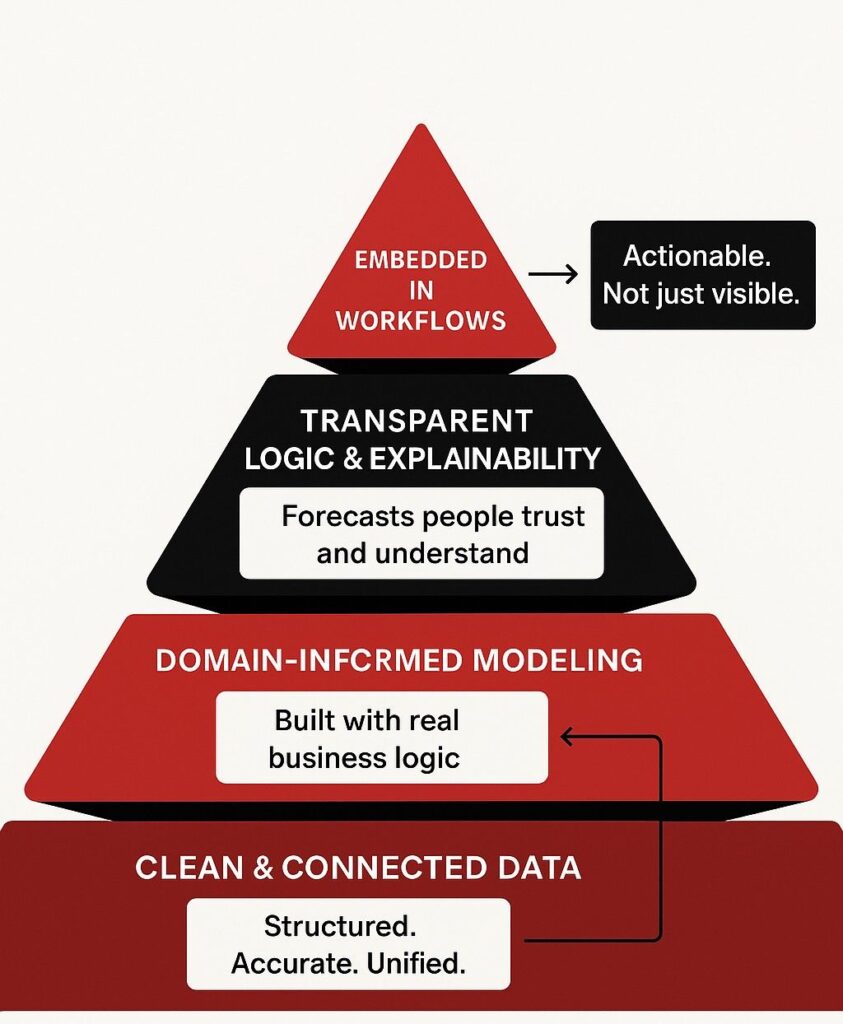
Focus on Clean, Connected Data First
Before training a model, get your data streams in order. Standardize formats. Fill the gaps. Identify the outliers. Merge your CRM, ERP, and demand data.
You don’t need “big” data. You need usable data.
Pair Data Science with Business Knowledge
We’ve seen the difference it makes when forecasting teams work side by side with sales heads, finance leads, and ops managers.
It’s not about guessing what metrics matter. It’s about modeling what actually drives margin, retention, or burn rate—because the people closest to the numbers shape better logic.
Mix Real-Time Signals with Historical Trends
Seasonality is useful—but only when paired with present conditions.
Good forecasting blends:
- Historical performance
- Current customer behavior
- Supply chain signals
- Marketing campaign performance
- External economic triggers
This is how SCS Tech builds forecasting engines—as dynamic systems, not static reports.
Design for Interpretability
It’s not just about accuracy. It’s about trust.
A business leader should be able to look at a forecast and understand:
- What changed since last quarter
- Why the forecast shifted
- Which levers (price, channel, region) are influencing results
Transparency builds adoption. And adoption builds ROI.
Embed the Forecast Into the Flow of Work
If the prediction doesn’t reach the person making the decision—fast—it’s wasted.
Forecasts should show up inside:
- Reordering systems
- Revenue planning dashboards
- Marketing spend allocation tools
Don’t ask users to visit your model. Bring the model to where they make decisions.
How SCS Tech Builds Reliable, Business-Ready AI/ML Forecasting Solutions
SCS Tech doesn’t sell AI dashboards. We build decision systems. That means:
- Clean data pipelines
- Models trained with domain logic
- Forecasts that update in real time
- Interfaces that let your people use them—without guessing
You don’t need a data science team to make this work. You need a partner who understands your operation—and who’s done this before. That’s us.
Final Thoughts
If your forecasts feel disconnected from your actual outcomes, you’re not alone. The truth is, most AI/ML models fail in business contexts because they weren’t built for them in the first place.
You don’t need more complexity. You need clarity, usability, and integration.
And if you’re ready to rethink how forecasting actually supports business growth, we’re ready to help. Talk to SCS Tech. Let’s start with one recurring decision in your business. We’ll show you how to turn it from a guess into a prediction you can trust.
FAQs
-
Can we use AI/ML forecasting without completely changing our current tools or tech stack?
Absolutely. We never recommend tearing down what’s already working. Our models are designed to integrate with your existing systems—whether it’s ERP, CRM, or custom dashboards.
We focus on embedding forecasting into your workflow, not creating a separate one. That’s what keeps adoption high and disruption low.
-
How do I explain the value of AI/ML forecasting to my leadership or board?
You explain it in terms they care about: risk reduction, speed of decision-making, and resource efficiency.
Instead of making decisions based on assumptions or outdated reports, forecasting systems give your team early signals to act smarter:
- Shift budgets before a drop in conversion
- Adjust production before an oversupply
- Flag customer churn before it hits revenue
We help you build a business case backed by numbers, so leadership sees AI not as a cost center, but as a decision accelerator.
-
How long does it take before we start seeing results from a new forecasting system?
It depends on your use case and data readiness. But in most client scenarios, we’ve delivered meaningful improvements in decision-making within the first 6–10 weeks.
We typically begin with one focused use case—like sales forecasting or procurement planning—and show early wins. Once the model proves its value, scaling across departments becomes faster and more strategic.