Category: operation efficiency

  • What IT Infrastructure Solutions Do Businesses Need to Support Edge Computing Expansion?

    What IT Infrastructure Solutions Do Businesses Need to Support Edge Computing Expansion?

    Did you know that by 2025, global data volumes are expected to reach an astonishing 175 zettabytes? This will create huge challenges for businesses trying to manage the growing amount of data. So how do businesses manage such vast amounts of data instantly without relying entirely on cloud servers?

    What happens when your data grows faster than your IT infrastructure can handle? As businesses generate more data than ever before, the pressure to process, analyze, and act on that data in real time continues to rise. Traditional cloud setups can’t always keep pace, especially when speed, low latency, and instant insights are critical to business success.

    That’s where edge computing addresses such limitations. By bringing computation closer to where data is generated, it eliminates delays, reduces bandwidth use, and enhances security.

    Therefore, with local processing, and reducing reliance on cloud infrastructure, organizations are allowed to make faster decisions, improve efficiency, and stay competitive in an increasingly data-driven world.

    Read further to understand why edge computing matters and how IT infrastructure solutions help support the same.

    Why do Business Organizations need Edge Computing?

    Regarding business benefits, edge computing is a strategic benefit, not merely a technical upgrade. While edge computing allows organizations to attain better operational efficiencies through reduced latency and improve real-time decision-making to deliver continuous, seamless experiences for customers, mission-critical applications involve processing data on time to enhance reliability and safety – financial services, smart cities.

    As the Internet of Things expands its reach, scaling and decentralized infrastructure solutions become necessary for competing in an aggressively data-driven and rapidly evolving new world. Edge computing has many savings, enabling any company to stretch resources to great lengths and scale costs across operations and edge computing services into a new reality.

    What Types of IT Infrastructure Solutions Does Your Business Need?

    1. Edge Hardware

    Hardware is the core of any IT infrastructure solutions. For a business to benefit from the advantages of edge computing, the following are needed:

    Edge Servers & Gateways

    Edge servers compute the data at the location, thus avoiding communication back and forth between the centralized data centers. Gateways act as an interface middle layer aggregating and filtering IoT device data before forwarding it to the cloud or edge servers.

    IoT Devices & Sensors

    These are the primary data collectors in an edge computing architecture. Cameras, motion sensors, and environmental monitors collect and process data at the edge to support real-time analytics and instant response.

    Networking Equipment

    A network infrastructure is very important for a seamless communication system. High-speed routers and switches enable fast data transfer between the edge devices and cloud or on-premise servers.

    2. Edge Software

    The core requirement to make data processing effective is that a business must install edge computing feature-supporting software.

    Edge Management Platforms

    Controlling various edge nodes spread over different locations becomes quite complex. Platforms such as Digi Remote Manager enable the remote configuration, deployment, and monitoring of edge devices.

    Lightweight Operating Systems

    Standard OSs consume many resources. Businesses must install OS solutions designed especially for edge devices to utilize available resources effectively.

    Data Processing & Analytics Tools

    Real-time decision-making is imperative at the edge. AI-driven tools allow immediate analysis of data coming in and reduce reliance on cloud processing to enhance operational efficiency.

    Security Software

    Data on the edge is highly susceptible to cyber threats. Security measures like firewalls, encryption, and intrusion detection keep the edge computing environment safe.

    3. Cloud Integration

    While edge computing advises processing near data sources, it does not do away with cloud dependency for extensive storage and analytical functions.

    Hybrid Cloud Deployment

    Business enterprises must accept hybrid clouds, combining seamless integration with the edge and the cloud platform. Services in AWS, Azure, and Google Cloud enable proper data synchronization that an option for a central control panel can replicate.

    Edge-to-Cloud Connection

    Reliable and safe communication between edge devices and cloud data centres is fundamental. 5G, fiber-optic networking, and software-defined networking offer low-latency networking.

    4. Network Infrastructure

    Edge computing involves a robust network delivering low-latency, high-speed data transfer.

    Low Latency Networks

    The technologies, including 5G, provide for lower latency real-time communication. Those organizations that depend on edge computing will require high-speed networking solutions optimized for all their operations. SD-WAN stands for Software-Defined Wide Area Network.

    SD-WAN optimizes the network performance while ensuring data routes remain efficient and secure, even in highly distributed edge environments.

    5. Security Solutions

    Security is one of the biggest concerns with edge computing, as distributed data processing introduces more potential attack points.

    Identity & Access Management (IAM)

    The IAM solutions ensure that only authorized personnel access sensitive edge data. MFA and role-based access controls can be used to reduce security risks.

    Threat Detection & Prevention

    Businesses must deploy real-time intrusion detection and endpoint security at the edge. Cisco Edge Computing Solutions advocates trust-based security models to prevent cyberattacks and unauthorized access.

    6. Services & Support

    Deploying and managing edge infrastructure requires ongoing support and expertise.

    Consulting Services

    Businesses should seek guidance from edge computing experts to design customized solutions that align with industry needs.

    Managed Services

    Managed services for businesses lacking in-house expertise provide end-to-end support for edge computing deployments.

    Training & Support

    Ensuring IT teams understand edge management, security protocols, and troubleshooting is crucial for operational success.
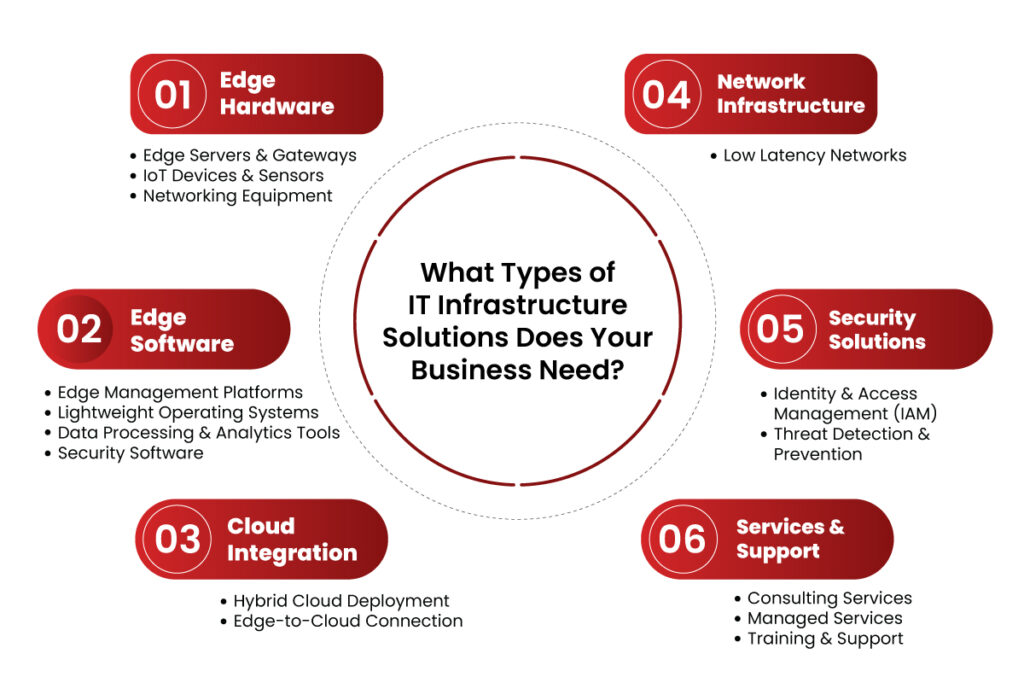
    What Types of IT Infrastructure Solutions Does Your Business Need?

    Conclusion

    As businesses embrace edge computing, they must invest in scalable, secure, and efficient IT infrastructure solutions. The right combination of hardware, software, cloud integration, and security solutions ensures organizations can leverage edge computing benefits for operational efficiency and business growth.

    With infrastructure investment aligned to meet business needs, companies will come out with the best of opportunities in a very competitive, evolving digital landscape. That’s where SCS Tech comes in as an IT infrastructure solution provider, helping businesses with cutting-edge solutions that seamlessly integrate edge computing into their operations. This ensures they stay ahead in the future of computing—right at the edge.

  • How Robotic Process Automation Services Achieve Hyperautomation?

    How Robotic Process Automation Services Achieve Hyperautomation?

    Do you know that the global hyper-automation market is growing at a 12.5% CAGR? The change is fast and represents a transformational period wherein enterprises can no longer settle for automating single tasks. They need to optimize entire workflows for superior efficiency.

    But how does a company move from task automation to full-scale hyperautomation? It all starts with Robotic Process Automation services in india (RPA), the foundational technology that allows organizations to scale beyond the automation of simple tasks and into intelligent, end-to-end workflow optimization.

    Continue reading to see how robotic process automation services in india services powers hyperautomation for businesses, automating workflows to improve speed, accuracy, and digital transformation.

    What is Hyperautomation?

    Hyperautomation, more than just the automation of repetitive tasks, is reaching for an interconnected automation ecosystem that makes processes, data, and decisions flow smoothly. It’s the strategic approach for enterprises to quickly identify, vet, and automate as many business and IT processes as possible and to extend traditional automation to create an impact across the entire organization. RPA, at its core, represents this revolution, which can automate structured rule-based tasks at speed, consistency, and precision.

    However, pure hyper-automation extends beyond RPA and integrates with more technologies like AI, ML, process mining, and intelligent document processing that incorporate to get the entire workflow automated. These technologies enhance decision-making ability, eliminate inefficiencies, and optimize workflows across the enterprise.

    What is the Role of RPA in Hyperautomation?

    1. RPA as the “Hands” of Hyperautomation

    RPA shines with the automation of structured and rule-based work as the execution engine of hyper-automation. RPA bots can execute pre-defined workflows and interact with different systems to perform repetitive duties. For example, during invoice processing, RPA bots can extract data from PDFs and automatically update accounting software, which can be efficient and accurate.

    1. RPA as a Bridge for Legacy Systems

    Many organizations have problems integrating with old infrastructure. RPA solves the problem by simulating human interaction with legacy systems that do not have APIs. This way, automation can work with these systems by simulating user actions. For instance, a bank may use RPA bots to move data from a mainframe to a new reporting tool without needing expensive and complicated API integrations.

    1. RPA for Data Aggregation and Consolidation

    RPA helps automatically collect and aggregate business data. With the support of RPA, businesses can gain a better single view through a consolidated fragmented source of data. For instance, RPA-based sales data collected from different e-commerce channels can provide a performance overview.

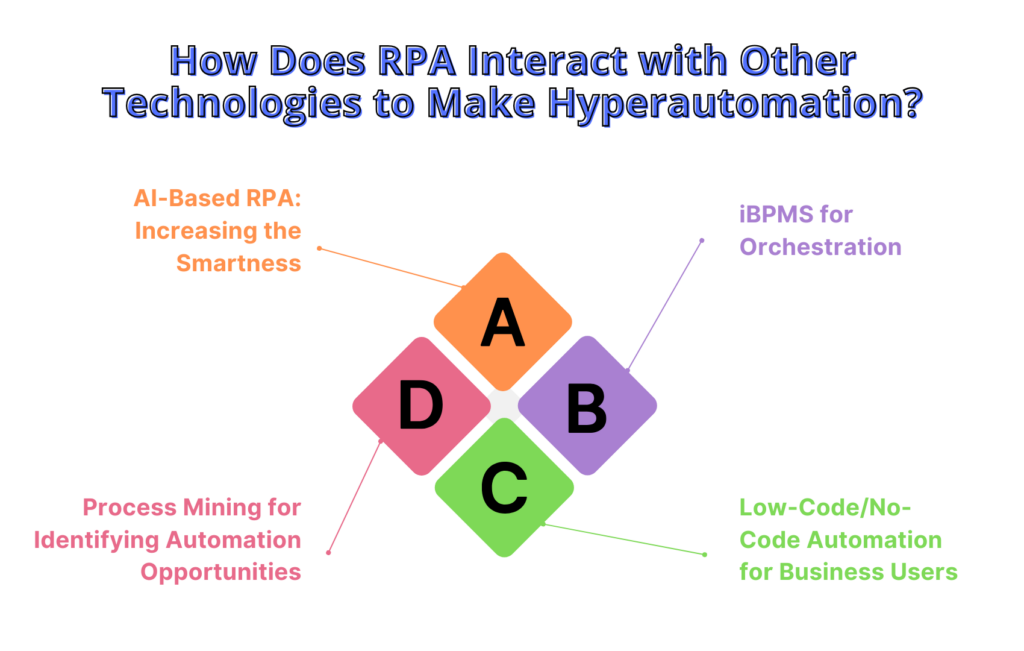
    How Does RPA Interact with Other Technologies to Make Hyperautomation?

    1. AI-Based RPA: Increasing the Smartness

    RPA becomes intelligent by associating with other AI-based technologies.

    • Natural Language Processing (NLP): This facilitates using unstructured emails and chat logs to enable the intelligent routing of communications
    • Machine Learning (ML): These bots increase their performance over time because of the data they draw from the previous records. Hence, it maximizes accuracy and efficiency.
    • Computer Vision: This is an advancement of RPA since it enables one to interface with applications that may or may not contain structured interfaces with no screen present.

    For instance, AI-based RPA can be used in intelligent claims processing in insurance, where it can automatically extract, validate, and route data.

    1. Process Mining for Identifying Automation Opportunities

    Process mining tools assess the workflow and then identify the points of inefficiency by pointing to where automating is likely. The bottleneck found can be automated using RPA, streamlining the processes involved. An example would be if a hospital optimized admission using process mining to automate entry and verification through RPA.

    1. iBPMS for Orchestration

    iBPMS provides governance and real-time automation monitoring; therefore, it executes processes efficiently and effectively. RPA automates some tasks within an extensive process framework managed by iBPMS. For example, order fulfillment in e-commerce involves using RPA to update inventory and ship orders.

    1. Low-Code/No-Code Automation for Business Users

    Low-code/no-code platforms enable nontechnical employees to develop RPA workflows, thus democratizing automation and speeding up hyper-automation adoption. For example, a marketing team can use a low-code tool to automate lead management, freeing time for more strategic activities while improving efficiency.

    RPA's Interaction with Other Technologies to Make Hyperautomation

    What is the Impact Of RPA on Hyperautomation in Terms of Business?

    1. Unleash Full Potential

    Hyperautomation unlocks the true potential of RPA, which is rich in AI, process mining, and intelligent decision-making. The RPA performs mundane tasks, while AI-driven tools optimize workflows and improve decision-making and accuracy.

    For example, RPA bots can process invoice data extraction. AI enhances document classification and validation to ensure everything is automated.

    1. Flexibility and Agility in Operations

    RPA enables businesses to integrate multiple automation tools under one umbrella while still being able to change immediately according to fluctuating market and business situations. This cannot be achieved through static automation, but it provides more scalable and flexible ways of automating workflows with real-time optimization using RPA-based hyperautomation.

    1. Increasing Workforce Productivity

    With the automation of mundane, time-consuming tasks, RPA allows others to apply more of their expertise in strategic thinking, innovation, and customer interaction, thereby improving workforce productivity and further driving the business.

    1. Seamless Interoperability Of Systems

    RPA makes the data exchange and execution of workflows between business units, digital workers or bots, and IT systems invisible. This gives organizations the benefit of faster decisions and effective operations.

    Hyperautomation using RPA provides for efficiency, reduced operational cost, and ROI. Therefore, business benefits range from real-time data processing to automatic compliance checks with easy scalability to stay sustainable and profitable over long periods.

    Conclusion

    Hyperautomation is more than just RPA services—it’s about integrating technologies like AI, process mining, and low-code platforms to drive real transformation.

    Hyperautomation is not just about adding technology to your processes — it’s about rethinking how work flows across your organization. By combining technology intelligently, businesses can automate smarter, work faster, and make decisions with greater accuracy.]

    This powerful digital strategy, driven by RPA services, can not only boost efficiency but also help your organization become more agile, resilient, and future-ready.

    As a leader in the automation solutions firm, SCS Tech supports initiating this digital strategy in organizations to help them move beyond tactical automation to a strategic enabler of that same transformation.

  • How Can Digital Oilfields Reduce Downtime with Oil and Gas Technology Solutions?

    How Can Digital Oilfields Reduce Downtime with Oil and Gas Technology Solutions?

    Unplanned downtime costs the oil and gas industry billions each year. In fact, research shows that companies with a reactive maintenance approach spend 36% more time in downtime than those using data-driven, predictive maintenance strategies. The difference?

    A potential $34 million in annual savings. With such high stakes, it’s no longer a question of whether the oil and gas industry should adopt digital transformation in oil and gas — it’s about how to implement these innovations to maximize efficiency and reduce costly downtime.

    The answer lies in Digital Oilfields (DOFs), which seamlessly integrate advanced technologies to optimize operations, improve asset reliability, and cut costs.

    In this blog, let’s explore how Digital Oilfields revolutionize operations and reshape the future of the oil and gas industry.

    How Does Digital Oilfields Seamless Integration Revolutionize Operations?

    Digital Oilfields solutions implement Industrial IoT (IIoT) for Oil & Gas, real-time analysis, and automation to streamline operations, predict likely breakdowns, and drive peak asset efficiency. Predictive maintenance for Oil & Gas enables firms to visualize equipment in real-time, predict breakdowns in advance, and do everything possible to avoid downtime.

    Digital Oilfield transformation replaced traditional operations with man-critical and reactive modes to data-centered, AI-led decision-making. This improves the oil and gas industry’s safety, sustainability, and profitability. However, the need to understand the key causes of downtime is crucial in addressing these challenges and minimizing operational disruptions.

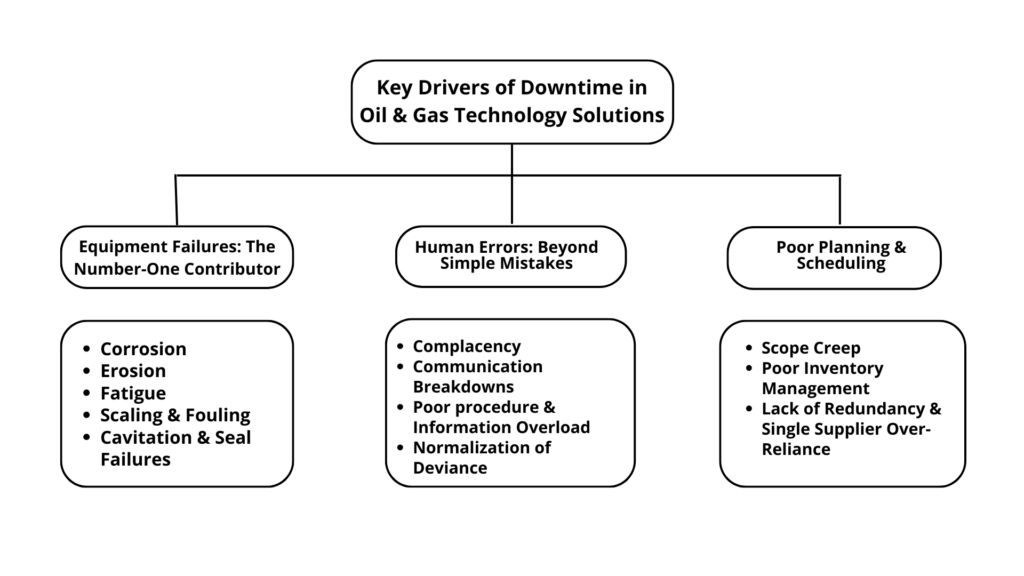
    The Key Drivers of Downtime in Oil & Gas Technology Solutions

    1. Equipment Failures: The Number-One Contributor

    Equipment breakdown is one of the significant sources of unplanned downtime. Several reasons are involved, including:

    • Corrosion: Sour crude (high sulfur) pipelines deteriorate over time by electrochemical action, especially at welds, bends, and dead legs.
    • Erosion: Sand-and-similar-abrasive-content high-speed fluids in fracking erosion erode pump impellers, chokes, and pipes.
    • Fatigue: Alternating pressure changes and vibration fatigue cause pipes to be damaged, usually at stress concentrators and threaded joints.
    • Scaling & Fouling: Mineral (such as calcium carbonate) and organic depositing in heat exchangers and pipes diminishes flow efficiency and causes shutdowns.
    • Cavitation & Seal Failures: Shock waves from collapsing vapor bubbles form when sudden pressure drops create vapor bubbles, which wear out the seals and pump impellers.

    2. Human Errors: Beyond Simple Mistakes

    Human error accounts for most of the oil and gas downtime due to the following:

    • Complacency: Routine work causes operators to overlook warning signs.
    • Communication Breakdowns: Communication breakdowns between operations, maintenance, and engineering personnel can delay problem-solving.
    • Poor Procedures & Information Overload: Inadequate procedures and excessive information overload can lead to misestimation.
    • Normalization of Deviance: Repeatedly exceeding operating limits by a small margin can lead to failures of catastrophic magnitude.

    3. Poor Planning & Scheduling

    Maintenance schedules and turnarounds, if not planned well, can cause downtime due to:

    • Scope Creep: Unplanned expansion of maintenance work that causes delay.
    • Poor Inventory Management: No spares available, resulting in prolonged downtime.
    • Lack of Redundancy & Single Supplier Over-Reliance: Supply chain interruption can bring operations to a standstill.

    With these major challenges in mind, the next logical step is understanding how Digital Oilfields tackle them.

     Key Drivers of Downtime in Oil & Gas Technology Solutions

    How Digital Oilfields Minimize Downtime?

    1. Real-Time Monitoring with Industrial IoT in Oil & Gas

    The newest IoT sensors bring critical information about equipment conditions so that proactive maintenance practices can be exercised. Some of those are:

    • Vibration Sensors: Picks up pump and compressor misalignments and bearing wear.
    • Acoustic Sensors: Picks up pipeline and pressure system leaks by detecting ultrasonic noises.
    • Corrosion Probes: Quantifies corrosion type, rate, and causative factors for effective mitigation.
    • Multiphase Flow Meters: Offers precise measurement of oil, gas, and water flow rates to prevent slugging and optimize production.

    2. Predictive Maintenance in Oil & Gas: AI-Driven Insights

    Artificial Intelligence (AI) and as well as Machine Learning (ML) based predictive analytics allow companies to predict failures before their occurrence. Some of the key applications are:

    • Failure Prediction Models: AI models consider historical failure records to predict the future failure of equipment.
    • Remaining Useful Life (RUL) Estimation: Machine learning estimates the time before a component fails, allowing for proper maintenance planning.
    • Anomaly Detection: Detects deviations in normal operating conditions, indicating future problems.
    • Prescriptive Analytics: Provides accurate recommendations for proactive actions to optimize equipment life.

    3. Automation & Remote Operations: Reduction of Human Error

    • Automated Control Systems: Allows operating conditions (e.g., temperature, flow rates, pressures) to be managed with real-time feedback.
    • Robotic Inspections: Robotic scanning of pipes and offshore rigs reduces human exposure to hazardous conditions.
    • Remote Monitoring & Control Centers: Operators remotely manage Assets from centralized facilities for enhanced productivity and savings.

    4. Digital Twins: Virtual Copies to Optimize

    Digital Twins are virtual copies of physical assets using AI to imitate real-time operations which include:

    • Real-Time Data Sync: Synchronizes with real-time sensor inputs in real-time.
    • Scenario Planning & Training: Mimics several operating scenarios to predict simulation and train operators.

    5. Advanced Digital Oilfield Technologies

    • Tank & LPG Level Monitors: Detect leaks and temperature stratification and predict evaporation/condensation rates.
    • Smart Flow Meters: Recognize multiphase flows and detect anomalies.
    • Thief Hatch Sensors: Recognize intrusions and monitor gas emissions.

    Conclusion

    The oil and gas industry is an area of convergence where industrial IoT, predictive maintenance, and automation are no longer a necessity. As digital oilfields offer more than digitization, they represent a shifting paradigm that decreases downtime, enhances safety, and delivers improved profitability.

    Therefore, businesses with digital oilfields can leverage the real potential of oil and gas technology solutions by using analytics, real-time monitoring, and AI-driven automation.

    With this technology, businesses can hence achieve operational excellence and success in the long run. SCS Tech supports oil and gas companies with cutting-edge digital solutions to re-imagine their businesses to be efficient, resilient, and industry-fit for the future.

  • Why Are Governments Using Blockchain in eGovernance Solutions for Land Records?

    Why Are Governments Using Blockchain in eGovernance Solutions for Land Records?

    What if you couldn’t prove the land you live on is actually yours? Sounds scary, right? That’s the reality for many people due to outdated land records. In India, only 69% of land has been mapped digitally under the Digital Land Record Management Program, leaving large gaps. This highlights the urgent need for a system in eGovernance solutions that is secure, transparent, and tamper-proof.

    This is where blockchain comes in. Its unparalleled ability to serve transparency, security, and efficiency puts it at the core of modern eGovernance solutions for land records. In this blog, let’s understand why blockchain is changing the face of this significant aspect of governance. But before let’s dive into the challenges that we faced due to traditional land record systems.

    Challenges in Traditional Land Record Systems

    The present system regarding the management of land records has significant flaws. Let’s take a closer look at them:

    Vulnerability to Fraud

    Traditional systems have fake documents, duplicate registrations, and unauthorized changes. Such issues bring legal disputes and make property transactions risky. Think of buying a property only to discover it had already been sold to another person based on forged papers. Blockchain can remove such risks because records are tamper-proof.

    Lack of Transparency

    Traditional systems often store records in centralized databases. Accessing these records is a bureaucratic maze, leading to confusion and mistrust. Blockchain’s open ledgers make records visible to all stakeholders, reducing disputes.

    Inefficiency and Bureaucracy

    Traditional processes are slow and costly, from waiting in long queues to paying multiple intermediaries. This inefficiency discourages investment and delays transactions. By streamlining processes, blockchain makes land transactions faster and more affordable.

    Data Integrity Issues

    Centralized systems are prone to natural disasters, cyberattacks, or human error. Blockchain’s decentralized nature ensures that data remains secure and accessible, no matter what.

    Why Are Governments Using Blockchain in eGovernance Solutions for Land Records?

    Governments are increasingly adopting blockchain technology to improve eGovernance solutions, particularly in managing land records. This transition is motivated by several critical factors:

    1. Immutable Ledger

    A significant need is reliable, tamper-proof records of land. More often, traditional systems are prone to fraud, such as forgery and unauthorized amendments. This kind of ledger ensures that records entered cannot be deleted or modified without consensus, thus increasing trust in the integrity of ownership documentation over land.

    Blockchain technology has a decentralized ledger where all the transactions concerning land ownership are permanently recorded. Each transaction is enclosed in a block that connects subsequent blocks, thus offering security regarding the chain of custody. This structure ensures that any kind of attempt to alter the record would require all the following blocks to be changed, making such attempts impracticable.

    2. Increased Transparency

    Transparency is essential in developing trust among all stakeholders involved in real estate transactions. Centralized databases can hide information, leading to confusion and disputes about property ownership in traditional systems. Governments can minimize misunderstandings and increase public confidence by providing transparent access to land records.


    Blockchain enables all parties involved, such as government agencies, property owners, and potential buyers, to access the same information about land ownership and transaction history in a shared ledger. Real-time access means all parties have up-to-date data, allowing them to verify ownership claims without intermediaries independently.

    3. Enhanced Security

    This is because land record management involves very sensitive information on property ownership, and therefore, security is a significant concern. With traditional systems, unauthorized access and data breaches can compromise the integrity of the land records.

    Blockchain allows all stakeholders including government agencies, property owners as well as potential buyers to view an agreed-to version of truth regarding land ownership and transactional history in a shared ledger. Real-time access will provide immediate data for all parties, and that’s how they will authenticate claims of ownership independently, without anyone’s interference.

    4. Simplified Process via Smart Contract

    The bureaucratic nature of traditional land registration processes often results in delays and increased costs for property transactions. Reducing reliance on intermediaries can expedite these processes and lower administrative burdens on government agencies.

    Smart contracts are self-executing contracts with all of the terms written directly into code. They automate many aspects of land transactions. For instance, they can automatically verify ownership during sales or transfers, eliminating the need for notaries or registrars. This automation accelerates transactions and improves operational efficiency within government agencies responsible for land registration.

    5. Decentralization

    Centralized control over land records poses risks such as data loss or manipulation due to individual malfeasance or systemic failures. Decentralization mitigates these risks by distributing data across multiple nodes.

    Blockchain runs on a decentralized network, storing data in multiple nodes instead of in a central database kept by a single entity. It minimizes the probability of losing or altering data and increases resistance against cyberattacks so that land records do not become inaccessible if some nodes go offline.

    Landmark Initiative for Land Records Modernization in Bihar

    The Bihar government is undertaking its first-ever state-wide land survey to modernize records. The project was launched in August 2023 and aimed at modifying the ownership records of around 44,000 villages by making them more transparent and reduced in terms of dispute.

    The exercise has been divided into two phases, one to be carried out on around 5,000 villages and the remaining in the next phase. However, due to complexities such as untransferred ownership and incomplete mutation processes, the deadline has been extended to July 2026. Landowners now have until March 2025 to submit claims online through a simplified self-declaration process.

    This initiative also includes plans for urban land surveys, with a pilot project proposed for six urban local bodies. Digitizing land records is the goal of the Bihar government in streamlining governance, making land ownership more transparent, and empowering citizens.

    These efforts are part of a broader vision of ensuring efficient land administration and reducing the potential conflicts that arise from ambiguous records. Once completed, this project is expected to transform land governance in the state, fostering trust and accountability among citizens while enabling smoother economic and legal transactions involving land.

    Conclusion

    In essence, blockchain in eGovernance solutions enhances transparency, security, and efficiency in transactions about the properties. Most significantly, the main challenges posed by traditional systems- fraud, inefficiency, and mistrust-could now be addressed and placed within a more substantial framework that enables better land administration.

    For successful adoption, governments must establish regulatory frameworks that validate blockchain records as official property documentation, ensure compatibility with existing systems, and promote public awareness of its advantages. Companies like SCS Tech are enabling these advancements by offering tailored blockchain solutions. By implementing blockchain effectively, governments can create more trustworthy governance structures, protect citizens’ property rights, and transform land record management into a secure and transparent process.

  • How Do Blockchain-Powered eGovernance Solutions Improve Public Service Delivery?

    How Do Blockchain-Powered eGovernance Solutions Improve Public Service Delivery?

    Do you hope for governments to be able to deliver faster, more transparent, and more efficient services in this digital world? Blockchain-powered eGovernance solutions are likely to help with this and become the foundational technology for 30% of the world’s customer base, from simple, everyday devices to commercial activities, by 2030. It will signal a fundamental shift in how public service delivery takes place and make governance smarter, safer, and more accessible.

    In this blog, we’ll explore how blockchain-powered eGovernance solutions improve public services. These advancements are reshaping how governments serve their citizens, from automating workflows to enhancing transparency.

    1. Decentralization: Building Resilient Systems

    Distributed Systems for Reliable Services

    Traditional systems are primarily based on centralized databases, prone to cyberattacks, downtime, and data breaches. With the power of Distributed Ledger Technology (DLT), blockchain changes this by distributing data across multiple nodes. This decentralization ensures that the system functions seamlessly if one part of the network fails. Governments can enhance service reliability and eliminate the risks associated with single points of failure.

    Faster and More Efficient Processes

    Centralized systems can create a bottleneck because they function off one control point. Blockchain removes the bottleneck because multiple departments can access and share real-time information. For example, processing permits or verifying applications becomes quicker if multiple agencies can update and access the record simultaneously. Such gives citizens less waiting time in government offices and more efficiency in their governments.

    2. Effectiveness Through Smart Contracts

    Automation Made Easy

    Imagine filing a tax return and processing the refund instantly without human intervention. Blockchain makes this possible through smart contracts—self-executing agreements coded to perform actions when certain conditions are met. These contracts automate fund disbursements, application approvals, or service verifications, significantly reducing delays and manual errors.

    Streamlining Government Workflows

    Governments would handle repetitive jobs, such as checking documents or issuing licenses. Through the rule and procedure codification in a smart contract, these jobs are automated, reducing errors and making them consistent. This saves time and allows employees to focus on more important things, increasing productivity and citizen satisfaction.

    3. Transparency: The Basis of Trust

    Open Access to Transactions

    Blockchain records every transaction on a public ledger accessible to all stakeholders. Citizens can see how public funds are allocated, ensuring accountability. For example, in infrastructure projects, blockchain can show how funds are spent at each stage, reducing doubts and fostering trust in government actions.

    Immutable Records for Audits

    This ensures that once recorded, data is immutable, hence unchangeable unless the network has agreed to its alteration. It makes auditing very simple and tamper-proof. The governments will be able to maintain records that are easy to verify but hard to alter, reducing further corruption and assuring ethical administration.

    4. Building Citizen Trust

    Reliable and Transparent Systems

    Blockchain’s design inherently fosters trust. Citizens know their data is secure, and their interactions with government entities are recorded transparently and immutable. For example, once a land ownership record is stored on the blockchain, it cannot be changed without alerting the entire network, ensuring property rights remain secure.

    Empowering Citizens through Accountability

    For example, transparency in the governance process allows citizens to hold officials responsible. If funds allocated to education or health are visible in a blockchain, citizens can check the discrepancies in the ledger and thus strengthen their trust in such public institutions; at the same time, these institutions will forge a collaborative relationship with citizens.

    5. Secure Digital Identities

    Self-Sovereign Identity for Privacy

    Blockchain facilitates self-sovereign identity (SSI). It gives individuals complete control of their personal information. Unlike systems that store secret information in centralized databases, blockchain stores information in blockchains. It puts citizens in the best position to decide who shall access their data and for what purpose. There is a reduced likelihood of identity theft, and personal privacy is amplified.

    Simplification of Accessibility to Services

    Using blockchain-powered eGovernance solutions, citizens will have secure digital IDs that facilitate verification faster. Rather than sending the same set of documents repeatedly for various services from the government, they will use a blockchain-based ID to check their eligibility on the go. This would reduce the access time to public services and enhance the convenience level with data safety.

    6. Cost Saving: A Wise Use of Resources

    Reducing Administrative Costs

    This kind of paper trail and manual procedure costs governments massive amounts. With blockchain, such paper trails do not exist. Records are digitalized, and workflows are automated. For example, property registration or certificate issuing on blockchain automatically reduces administrative overhead.

    Fraud Prevention and Elimination of Mistakes

    Fraudulent actions and human mistakes can be costly for governments. Blockchain’s openness and immutable ledger reduce these risks because it leaves a transparent and tamper-proof history of the transactions. Not only does it save money in investigations, but it also ensures accurate delivery of services with no rework or additional costs incurred.

    7. Improved Data Security

    Encryption for Stronger Safeguards

    Blockchain uses advanced cryptographic techniques to secure data. Each block is linked to the one before it, creating a nearly impossible chain to alter without detection. Sensitive information, such as health records or tax data, is protected from unauthorized access, ensuring citizen data remains secure.

    Defense Against Cyberattacks

    In traditional systems, hackers will always target centralized databases. With blockchain, data is spread across different nodes, meaning that cybercriminals will find it much more challenging to access large volumes of information or manipulate the same. Therefore, public services will remain accessible and trustworthy, even in cyber attacks.

    Conclusion

    It’s not just an upgrade in technology but rather the need for governance in modern society. Blockchain can solve all inefficiencies presented by traditional public administrations by decentralizing systems, automating workflows, facilitating transparent processes, and improving cost efficiency. The improvement in this technology develops citizens’ participation, engenders trust, and makes governance in a fast-to-be-digitized world robust.

    Companies like SCS Tech are leading the way by offering innovative blockchain-powered eGovernance solutions that help governments modernize their systems effectively. As governments worldwide continue exploring blockchain, the positive effects will stretch beyond improving service delivery. They will ensure they have developed transparent, efficient, and secure governance structures, hence meeting the demands of tech-savvy citizens today.

  • How Do Digital Oilfields Improve Oil and Gas Technology Solutions?

    How Do Digital Oilfields Improve Oil and Gas Technology Solutions?

    Are you aware of the oil and gas technology that is transforming the industry? There’s an operation so bright that it reduces costs by 25%, increases production rates by 4%, and enhances recovery by 7%, all within just a few years. This is, says CERA, the actual effect of applying digital oilfield technologies. The digital oilfield applies advanced tools to transform oilfield operations’ efficiency, cost-effectiveness, and sustainability.

    Read further to understand how digital oilfields change oil and gas industry solutions.

    What Are Digital Oilfields?

    Digital oilfields are a technological revolution in oil and gas operations. Using IoT, AI, and ML, they make processes more efficient and cost-effective and provide better decision-making capabilities. From real-time data collection to advanced analytics and automation, digital oilfields integrate every operational aspect into a seamless, optimized ecosystem.

    Key Components of Digital Oilfields

    1. Data Gathering and Surveillance

    Digital oilfields start with collecting enormous volumes of real-time data:

    • IoT Sensors: Scattered across drilling locations, these sensors track pressure, temperature, flow rates, and equipment status. For instance, sudden changes in sound pressure may alert operators to take corrective actions immediately.
    • Remote Monitoring: Operators can control geographically dispersed assets from centralized control rooms or remote locations. Telemetry systems ensure smooth data transmission for quick decision-making.
    1. Advanced Analytics

    The gathered data is processed and analyzed for actionable insights:

    • Machine Learning and AI: Predictive AI analytics identifies possible equipment failures and optimizes the maintenance schedule. For example, an AI system can predict when a pump will fail so proactive maintenance can be scheduled.
    • Data Integration: Advanced analytics combines geological surveys, production logs, and market trends to give a holistic view, which is helpful in strategic decisions.
    1. Automation

    Automation minimizes human intervention in repetitive tasks:

    • Automated Workflows: Drill rigs do real-time optimizations depending on sensor feedback to improve performance and reduce errors.
    • Robotics and Remote Operations: Robotics and ROVs execute tasks like underwater surveys, which can be executed safely without losing efficiency.
    1. Collaboration Tools

    Digital Oilfield streamlines communication and Teamwork.

    • Integrated Communication Platforms: Real-time information sharing between the teams, video conferencing tools, and centralized platforms facilitate efficient collaboration.
    • Cloud-Based Solutions: Geologists, engineers, and managers can access data from anywhere, which leads to better coordination.
    1. Visualization Technologies

    Visualization tools turn data into actionable insights:

    • Dashboards: KPIs are displayed in digestible formats, which enables operators to spot and address issues quickly.
    • Digital Twins: Virtual replicas of the physical assets enable simulations, which allow operators to test scenarios and implement improvements without risking real-world operations.

    How Digital Oilfields Improve Oil and Gas Technology Solutions

    Digital oilfields utilize modern technologies to make the oil and gas technology solutions operational landscape more efficient. This results in efficiency, improved safety, cost-effectiveness, and optimized production with better sustainability. The explanation below elaborates on how digital oilfields enhance technology solutions in the oil and gas industry.

    1. Improved Operative Efficiency

    Digital oilfields improve operational efficiency through the following:

    • Real-Time Data Monitoring: IoT sensors deployed across oilfield assets such as wells, pipelines, and drilling rigs collect real-time data on various parameters (pressure, temperature, flow rates). This data is transmitted to centralized systems for immediate analysis, allowing operators to detect anomalies quickly and optimize operations accordingly.
    • Predictive Maintenance: With the help of AI and machine learning algorithms, the digital oilfield can predict equipment failures before they happen. For instance, Shell’s predictive maintenance has resulted in a timely intervention that saves the company from costly downtimes. These systems could predict when maintenance should be performed based on historical performance data and current operating conditions by extending equipment lifespan and reducing operational interruptions.
    • Workflow Automation: Technologies automate workflow and reduce people’s manual interfaces with routine items like equipment checking and data typing, which conserve time and lead to fewer possible errors. Example: an automated system for drilling optimizes the entire process as sensors provide feedback from which it sets parameters for continuous drilling in the well.

    2. Improved Reservoir Management

    Digital oilfields add to reservoir management with superior analytical techniques.

    • AI-Driven Reservoir Modeling: Digital oilfields utilize high-end AI models to analyze geology data to predict the reservoir’s behavior. These models can provide insight into subsurface conditions, enabling better decisions about the location of a well and the method of extraction for operators. Thus, it makes hydrocarbon recovery more efficient while reducing the environmental footprint.
    • Improve Recovery Techniques: With a better characterization of reservoirs, these digital oilfields are set up to implement enhanced oil recovery techniques suited for specific reservoir conditions. For instance, real-time data analytics can allow data-driven optimization techniques in water flooding or gas injection strategies to recover maximum amounts.

    3. Cost Cut

    The financial benefits of digital oilfields are tremendous:

    • Lower Capital Expenditures: Companies can avoid the high costs of maintaining on-premises data centers by using cloud computing for data storage and processing. This shift allows for scalable operations without significant upfront investment.
    • Operational Cost Savings: Digital technologies have shown a high ROI by bringing down capital and operating expenses. For instance, automating mundane activities will reduce labor costs but enhance production quantity. According to research, companies have seen an operative cost reduction of as much as 25% within the first year after deploying digital solutions.

    4. Improved Production Rates

    Digital oilfields increase production rates through:

    • Optimized Drilling Operations: Real-time analytics allow operators to adjust drilling parameters based on immediate feedback from sensors dynamically. This capability helps avoid issues such as drill bit wear or unexpected geological formations that can slow down operations.
    • Data-Driven Decision Making: With big data analytics, companies can quickly process vast volumes of operational data. These analyses underpin strategic decisions to improve production performance along the value chain from exploration through extraction.

    5. Sustainability Benefits

    Digital oilfield technologies are essential contributors to sustainability.

    • Environmental Monitoring: Modern monitoring systems can sense the leakage or emission, enabling solutions to be implemented immediately. AI-based advanced predictive analytics can identify where environmental risk has the potential to arise before it becomes a significant problem.
    • Resource Optimization: Digital oilfields optimize resource extraction processes and minimize waste; this process reduces the ecological footprint of oil production. For example, optimized energy management practices reduce energy consumption during extraction processes.

    6. Improved Safety Standards

    Safety is improved through various digital technologies:

    • Remote Operations: Digital oilfields allow for the remote monitoring and control of operations, thus allowing less personnel exposure to hazardous conditions. This enables one to reduce exposure to risks associated with drilling activities.
    • Wearable Technology: Wearable devices equipped with biosensors enable real-time monitoring of workers in the field and their health status. The wearable devices can notify the management of a potential health risk or unsafe conditions that may cause an accident.

    Conclusion

    The digital oilfield is a revolutionary innovation introduced into the oil and gas industry, combining the latest technologies to improve operational efficiency, better manage a reservoir, cut costs, enhance production rates, foster sustainability, and raise safety levels. The comprehensive implementation of IoT sensors, AI-driven analytics, automated tools, and cloud computing not only optimizes existing operations but projects an industry toward a position of success for future challenges.

    As digital transformation continues to unfold within this sector, the implications for efficiency and sustainability will grow more profoundly. SCS Tech, with its expertise in advanced oil and gas technology solutions, stands as a trusted partner in enabling this transformation and helping businesses embrace the potential of digital oilfield technologies.

  • Embracing Hybrid Cloud IT Infrastructure Solutions as the New Norm

    Embracing Hybrid Cloud IT Infrastructure Solutions as the New Norm

    In today’s world, where data breaches are becoming alarmingly frequent, how can companies strike the right balance between ensuring robust security and maintaining the scalability required for growth?

    Well, hybrid cloud architectures might just be the answer to this! They provide a solution by enabling sensitive data to reside in secure private clouds while leveraging the expansive resources of public clouds for less critical operations.

    As hybrid cloud becomes the norm, it empowers organizations to optimize their IT infrastructure solutions, ensuring they remain competitive and agile in a continuously ever-changing digital landscape.

    This blog is about the importance of hybrid cloud solutions as the new norm in IT infrastructure solutions.

    Embracing Hybrid Cloud IT Infrastructure Solutions as the New Norm


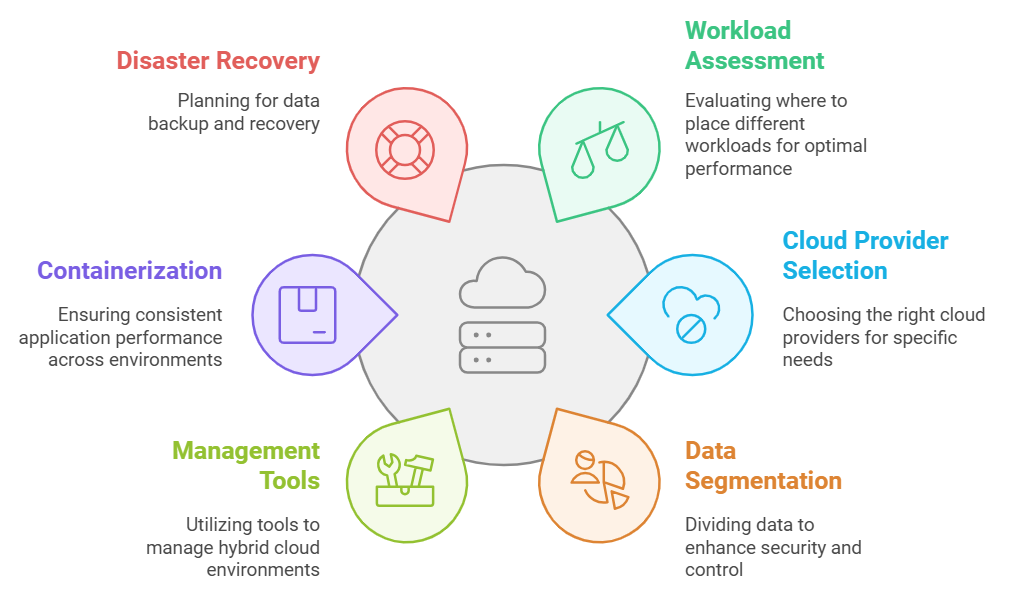
    Hybrid cloud IT infrastructure solutions
    Hybrid cloud IT infrastructure solutions

    1. Evaluating Organizational Needs and Goals

    • Assess Workloads: Determine which workloads best suit public clouds, private clouds, or on-premises environments. For example, latency-sensitive applications may remain on-premises, while scalable web applications thrive in public clouds.
    • Set Objectives: Define specific goals such as cost reduction, enhanced security, or improved scalability to effectively guide the hybrid cloud strategy.

    2. Designing a Tailored Architecture

    • Select Cloud Providers: Select public and private cloud providers based on features such as scalability, global reach, and compliance capabilities.
    • Integrate Platforms: Use orchestration tools or middleware to integrate public and private clouds with on-premises systems for smooth data flow and operations.

    3. Data Segmentation

    • Data Segmentation: Maintain sensitive data on private clouds or on-premises systems for better control.
    • Unified Security Policies: Define detailed frameworks for all environments, including encryption, firewalls, and identity management systems.
    • Continuous Monitoring: Utilize advanced monitoring tools to identify and mitigate threats in real-time.

    4. Embracing Advanced Management Tools

    • Hybrid Cloud Management Platforms: Solutions such as VMware vRealize, Microsoft Azure Arc, or Red Hat OpenShift make it easier to manage hybrid clouds.
    • AI-Driven Insights: Utilize AI & ML services to optimize resource utilization, avoid waste, and predict potential failures.

    5. Flexibility through Containerization

    • Containers: Docker and Kubernetes ensure that applications operate uniformly across different environments.
    • Microservices: Breaking an application into smaller, independent components allows for better scalability and performance optimization.

    6. Disaster Recovery and Backup Planning

    • Distribute Backups: Spread the backups across public and private clouds to prevent data loss during outages.
    • Failover Mechanisms: Configure the hybrid cloud with automatic failover systems to ensure business continuity.

    7. Audits and Updates

    • Audit Resources: Regularly assess resource utilization to remove inefficiencies and control costs.
    • Ensure Compliance: Periodically review data handling practices to comply with regulations like GDPR, HIPAA, or ISO standards.

    Emerging Trends Shaping the Future of Hybrid Cloud

    1. AI and Automation Integration

    Artificial Intelligence (AI) and automation are changing hybrid cloud environments to make them more innovative and efficient.

    • Automated Resource Allocation: AI dynamically adjusts resources according to the workload’s real-time demands for better performance. For example, AI & ML services can automatically reroute resources during traffic spikes to prevent service disruptions.
    • Predictive Analytics: Historical time series data analysis to predict potential failures to avoid faults and reduce downtime.
    • Improved monitoring: The AI-driven tools enable granular views of performance metrics, usage patterns, and cost analysis to help better make decisions.
    • AI for Security: AI detects anomalies, responds to potential threats, and strengthens hybrid environments’ security.

    2. Edge computing is on the rise

    Edging involves processing data near its sources; it combines well with hybrid cloud strategies, particularly in IoT and real-time applications.

    • Real-time Processing: Autonomous vehicles will benefit through edge computing, where sensor data is computed locally for instantaneous decisions.
    • Optimized Bandwidth: It conserves bandwidth as the critical data is processed locally, and the necessary information alone is sent to the cloud.
    • Better Resilience: With hybrid environments and edge devices, distributed workloads are more resilient when networks break.
    • Support for Emerging Tech: Hybrid systems use low-latency edge computing, especially for implementing AR and Industry 4.0 technologies.

    3. Sustainability Focus

    Hybrid cloud solutions would be crucial in aligning IT operations with and supporting environmental sustainability goals.

    • Effective utilization of resources: Hybrid could shift workloads into low-carbon environments like a public cloud provider powered by renewable sources.
    • Dynamic scaling: By scaling resources on demand through hybrid clouds, they keep energy wastage down over periods of low use
    • Green data centers: Harnessing sustainable IT infrastructure solutions by AWS and Microsoft Azure providers reduces carbon footprints.
    • Carbon Accounting: Analytics tools in hybrid platforms give accurate carbon emission measures, which allows organizations to reduce their carbon footprint.

    4. Unified Security Frameworks

    Hybrid cloud environments require consistent and robust security measures to protect distributed data.

    • Policy Enforcement: Unified frameworks apply security policies across all environments, ensuring consistency.
    • Integrated Tools: Data protection is enhanced by features like encryption, multi-factor authentication, and identity access management (IAM).
    • Threat Detection: Machine learning algorithms detect and prevent real-time threats, reducing vulnerability.
    • Compliance Simplification: Unified frameworks provide built-in auditing and reporting capabilities that simplify compliance with regulations.

    5. Hybrid Cloud and Multicloud Convergence

    Increasingly, hybrid cloud strategies are being used with multi-cloud to maximize flexibility and efficiency.

    • Diversification of vendors: Reduced dependency on one vendor can ensure resilience and help build more robust services.
    • Optimized Costs: Strategically spreading workloads across IT infrastructure solution providers can help leverage cost efficiencies and unique features.
    • Improved Interoperability: Tools such as Kubernetes ensure smooth operations across diverse cloud environments, thus enhancing flexibility and collaboration.

    Conclusion

    The future of hybrid cloud IT infrastructure solutions is shaped by transformative trends emphasizing agility, scalability, and innovation. As organizations embrace AI and automation, edge computing, sustainability, and unified security frameworks, they get better prepared to thrive in a fast-changing digital world.

    Proactively dealing with these trends can help achieve operational excellence and bring long-term growth and resilience in the age of digital transformation. SCS Tech enables businesses to navigate this evolution seamlessly, offering cutting-edge solutions tailored to modern hybrid cloud needs.

  • How do AI and ML Services Improve Defence Operations?

    How do AI and ML Services Improve Defence Operations?

    According to Polaris Research, the global AI in the military market is predicted to grow at a compound annual growth rate (CAGR) of 11.8% from 2023 to 2032, reaching approximately USD 21.56 billion by 2032. This uptrend mirrors the significant paradigm shift in how defense sectors worldwide are using AI/ML to enhance situational awareness, automate processes, and facilitate predictive capabilities. As this demand grows, providers of machine learning solutions in India are emerging as key contributors to advancing defense technologies globally.

    Read ahead to know how AI and ML services are changing the game for defense operations.

    What Is the Role of AI and ML in Defence?

    The concept of AI and ML was once a hallucination in the world of defense systems, but that is no longer the case now. It is now transforming military strategies as we speak. AI’s sense of processing millions of datasets in a matter of seconds and making decisions in real-time with the ML sense that learns from experience and improvements across times have made them very important to various applications within modern militaries. These technologies not only accelerate the speed and accuracy associated with operations but also tend to reduce human intervention, thus allowing defense personnel to focus on more critical decision-making under pressure.

    How Autonomous Systems in Warfare Use AI and ML Services

    One of the most visible applications of AI and ML services in warfare is autonomous systems, ranging from drones to uncrewed vehicles. They use sophisticated algorithms in AI to perform tasks that are too dangerous, repetitive, or time-consuming for a human.

    • Reconnaissance and Surveillance: AI drones with autonomous navigation in hostile environments allow for gathering real-time intelligence without putting human lives at risk. Using machine learning algorithms enables drones to adapt to changing environmental factors, recognize patterns, and identify actual threats more accurately.
    • Combat Engagement: AI-controlled autonomous weapons systems can engage targets based on predefined rules and thus improve operational speed and reduce soldiers’ exposure to risks. There are autonomous drones, the swarms whereby multiple autonomous drones are coordinated to work together for efficient assessment and attack targets with minimal human intervention. These swarms communicate with each other to ensure more coordinated and effective strikes.

    Despite the ongoing discussion on ethical concerns, autonomous systems are still very sure of their safety, efficiency, and operational reach.

    The Enhancing Strategic Decisions With AI and ML Services

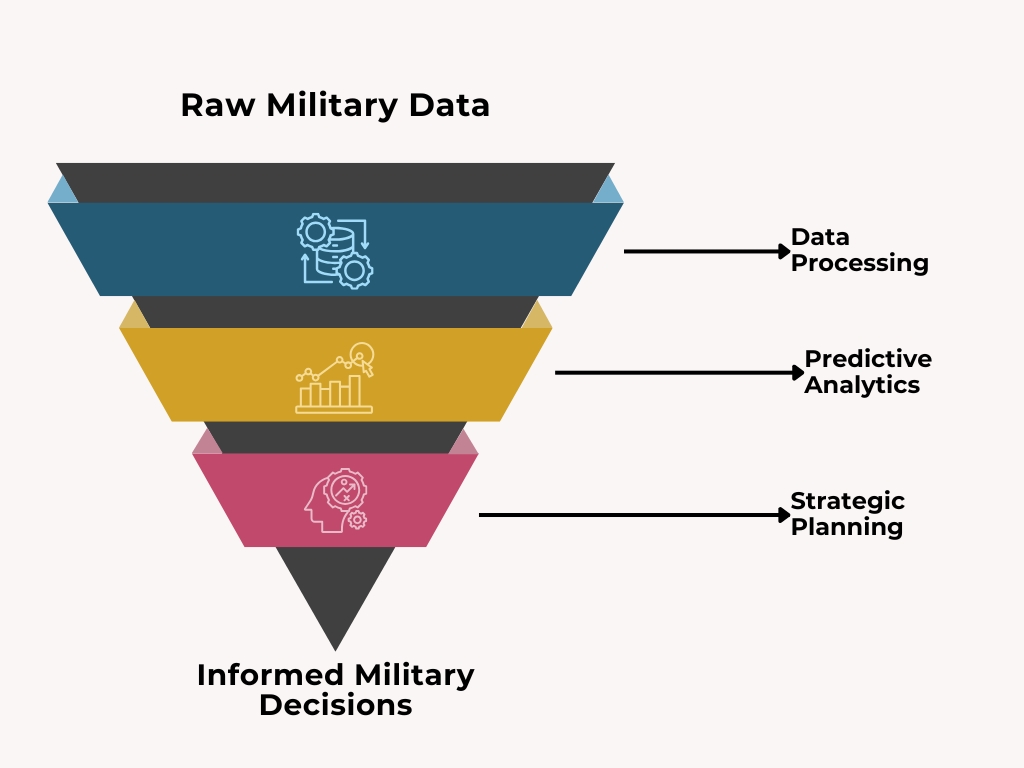
    The advent of artificial intelligence heralded a change agent in military decision-making processes. The only way to make choices in high-pressure situations is to do so promptly, based on factual data. AI technology companies systems can process volumes of information from satellites, drones, and intelligence reports to give commanders actionable insights.

    • Data Processing: AI scans such massive datasets to spot any patterns, correlations, and deviations that may occur and which a human analyst may fail to identify. Such predictive ability is essential for forecasting an enemy’s movements, understanding the battle’s dynamics, and forecasting possibilities of success in a mission.
    • Simulations and Predictive Analytics: AI and ML services can simulate multiple scenarios in millions of ways, predict the possible result, and evaluate the outcome. This enables military strategists to feel more confident about planning and executing operations. Generative AI models can even provide strategic suggestions based on past data with maximum precision and make decisions faster.

    It can make military leaders better informed, faster, and safer in decision-making, especially in dynamic battle situations.

    AI and ML-based Cybersecurity for Defence Operations

    Cyber threats are on an upsurge in this present age. Defense systems are the main field where AI and ML services are indispensable for safeguarding all military information and defense infrastructure. Military systems, which have become easy targets for state and non-state actors, require strengthened cybersecurity to be safe.

    • Real-Time Threat Detection: AI algorithms monitor traffic in real time, detecting patterns of attacks or unusual activity more effectively than traditional systems. In addition, ML learns from previous attacks and continuously enhances detection capabilities.
    • Automated Response: Once a threat has been identified, AI can activate automated countermeasures such as isolating affected systems or blocking suspicious activity, thus minimizing the period to conduct a response action and minimizing the damage that can be caused.

    With rising cyber warfare, military reliance on AI and ML-based cybersecurity will only grow, thus covering more critical infrastructure and secret information from malicious attacks.

    Future Training Simulations through AI and ML Services

    AI and ML change how military training is conducted into real-time, adaptive, and budget-friendly simulations. Traditional training methods are expensive and sometimes risky because they rely on physical assets and live exercises. AI-driven simulations are cost-effective, safety-wise.

    • Customized training programs: AI tracks the soldier’s performance during the exercise, detects the weak spots, and develops modules to improve soldier skills. In this way, soldiers will be prepared to face challenges in life as applied in combat.
    • Realistic Combat Simulations: AI can emulate dynamic battlefield scenarios in training soldiers in decision-making, coordination, and various tactics in a controlled environment. The simulations change dynamically based on participants’ actions to become more realistic and engaging.

    AI integration into military training will enhance readiness by significantly reducing operational, financial, and risk-based costs compared to traditional training exercises.

    Predictive Maintenance and Logistics with AI and ML Services

    Predictive maintenance and logistics are two of the most subtle and impactful applications of AI and ML services in defense. Military operations consume equipment and machinery from aircraft and tanks to vehicles and systems of weapons, many of which are hard to replace in the short term. The ability to keep equipment at optimal operation affects mission success.

    • Predictive Maintenance: These systems, based on AI, monitor performance in real time, recognize signs of wear and tear beforehand, and provide the appropriate maintenance time. This ensures that critical failures do not occur and equipment failures do not cause expensive downtime during critical operations.
    • Efficient Logistics: AI enables the study of terrain and weather, among other things, to optimize supply chains. Autonomous vehicles powered by AI technology companies can transport supplies to the most remote and dangerous locations, avoiding risks to human personnel and resources when available to troops.

    AI in military logistics utilizes the efficiencies of enhancement in efficiency, reduction in operating costs, and ensuring that such mission-critical assets remain combat-ready.

    Improving Command and Control through AI and ML Services

    AI and ML services are transforming command and control systems to make decisions better and communicate and coordinate among military forces.

    • Real-Time Data Processing: AI gathers data from different sources in real time, thus giving commanders a fuller view of the battlefield to make judgments even more judiciously.
    • Improved Coordination: AI-based C2 systems enhance communication between the military branches, thus allowing for effective collaboration and coordination in operations.

    The real-time data used to evaluate the outcomes of action options relieves the cognitive burden and enables more rapid and accurate responses to pressures. AI in C2 systems can enhance situational awareness and operational effectiveness for military leaders in highly dynamic environments to make timely decisions.

    Key Takeaways

    With the ever-increasing evolution of AI and ML services, impacts on defense operations will surely increase. These technologies, from IT infrastructure solution providers, right from autonomous systems and strategic decision-making to cybersecurity, training simulations, logistics, and command and control, fundamentally change how military operations are conducted.

    SCS Tech, a leader in AI and ML services, is at the forefront of this transformation, providing advanced solutions that enhance military efficiency, improve decision-making, and support predictive capabilities in complex environments.

  • The Importance of GIS Mapping Services in Oil & Gas Exploration and Management

    The Importance of GIS Mapping Services in Oil & Gas Exploration and Management

    In the high-stakes world of oil and gas, every decision matters—especially when it comes to exploration and infrastructure management. But how do industry leaders make the right call on where to dig, how to optimize their operations, and minimize risk? The answer lies in harnessing the power of Geographic Information Systems (GIS).

    As the GIS controller market heads towards an estimated 780 million USD by 2032, with an impressive annual growth rate of 13% from 2024 to 2032, the reliance on this cutting-edge technology is growing exponentially. Partnering with a trusted GIS company in Mumbai can provide the strategic edge needed to leverage this technology effectively. GIS isn’t just a tool; it’s a strategic advantage that turns raw data into actionable insights, helping companies boost safety, reduce costs, and make smarter, faster decisions in real time.

    GIS mapping services help them make smarter choices, increase safety, and save money by giving them highly detailed, real-time data about their operational environment. Read on for a look at how GIS boosts oil and gas exploration and management and how GIS companies in India are meeting the needs of the industry. To better understand how GIS achieves this, let’s explore its core functionalities in oil and gas exploration.

    GIS Data Integration and Visualization in Oil & Gas Exploration

    Data Integration

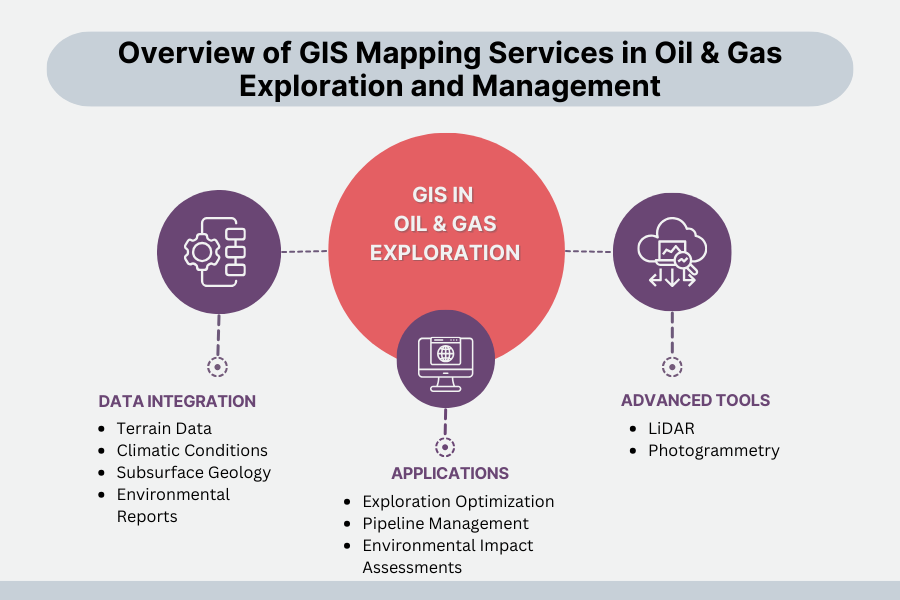
    GIS integrates different information types, which come from satellites and GPS data, as well as surveys on the geology of the subsurface and environmental reports. Because of this ability to integrate data types, companies can now get a better view of the big picture.

    In the operation of oil and gas exploration, among other information, GIS can consolidate knowledge of terrain, climatic conditions, and subsurface geology. With all this data on one map, companies can be better positioned to decide where to explore, where to drill, and get a better handle on their asset management.

    Data Layering

    Another essential feature of GIS is its ability to layer different types of data on a single map. For instance, oil and gas professionals can view geological, environmental, and infrastructural data together, helping them assess how landscapes, sensitive environments, and operational challenges might impact drilling decisions. This multi-layered approach simplifies complex analysis, improving planning and decision-making.

    Advanced GIS Tools in Oil & Gas Exploration

    LiDAR and Photogrammetry

    While GIS is the core platform for data visualization and analysis, it often works in tandem with tools like LiDAR (Light Detection and Ranging) and photogrammetry, which provide detailed 2D and 3D images of the terrain. These high-technology tools generate dense data sets that can be overlaid onto GIS systems for further analysis.

    For example, LiDAR is critical in oil and gas exploration because it helps assess the stability of the land, identifying safe drilling and pipeline routes while minimizing risks associated with unstable terrain. By integrating this data into GIS, companies can make more accurate decisions on where to drill or lay pipelines.

    Real-Time Data Processing

    GIS, when integrated with real-time monitoring systems such as SCADA (Supervisory Control and Data Acquisition) and IoT devices, allows companies to visualize real-time data. While GIS is not responsible for collecting this data, it plays a crucial role in analyzing and visualizing it.

    Real-time monitoring enables companies to track their assets, including pipelines and wells, and respond quickly to any potential issues, such as leaks or environmental hazards. GIS serves as the front-end interface, where teams can visualize real-time conditions and act swiftly to prevent costly damages or disasters.

    GIS Applications in Oil & Gas Exploration and Asset Management

    Exploration Optimization

    The exploration of oil and gas tends to be both expensive and risky. Companies can mitigate these risks using GIS mapping services, which provide information on the most optimal locations to drill based on data. GIS integrates seismic data, historical exploration records, and geological information to help determine sites that may have high-potential oil and gas reserves. This helps minimize drilling into unproductive areas. Therefore, losses in terms of time and money are minimal.

    Pipeline Management

    One of the most critical challenges in the oil and gas industry is managing pipelines, especially when they traverse rugged or environmentally sensitive terrain. GIS helps by analyzing land conditions, environmental risks, and potential obstacles, ensuring the safest and most cost-effective pipeline routes.

    Moreover, by integrating real-time data from monitoring systems, GIS can track the condition of pipelines and issue alerts when there is a risk of leakage or damage. This proactive management ensures that companies can address issues before they become significant problems, reducing the likelihood of environmental disasters and costly repairs.

    Environmental Impact Assessments

    Environmental considerations are of paramount importance in oil and gas operations. GIS is an invaluable tool for conducting Environmental Impact Assessments; it shows how operations may impact ecosystems in the near vicinity. Companies may overlay environmental data with operational maps to ensure that projects conform to ecological standards while minimizing adverse impacts on the surrounding area.

    Benefits of GIS in Oil & Gas Exploration and Management

    More Informed Decisions

    GIS lets oil and gas companies map out all their critical data in one place, making more intelligent and faster decisions during the asset life cycle’s exploration, development, and operations phases. Companies can then see detailed maps with information regarding geological risks and possible environmental impacts. This will thus decide whether a specific location is suitable to drill in turn saving money.

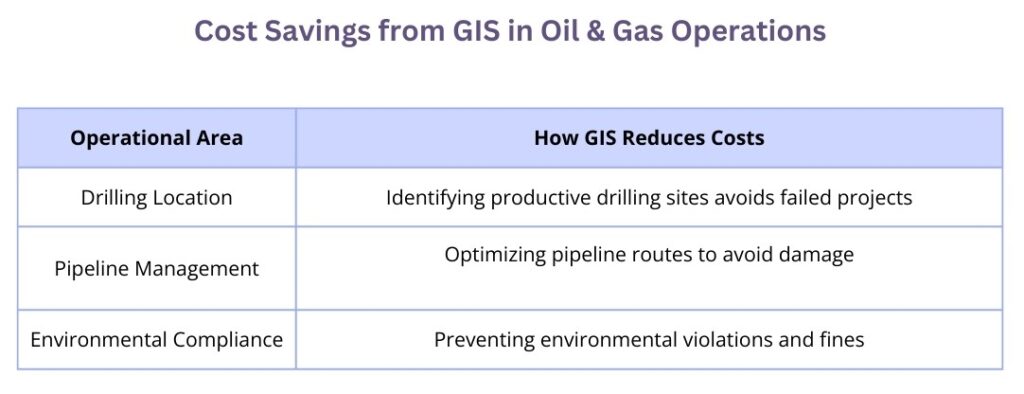
    Cost Savings

    Improving processes and increasing efficiency yields enormous savings for a company using GIS mapping services. Choosing a drilling location can save a lot of time and money since the loss of time and money through a non-productive site is avoided. More pipeline routing efficiency and current monitoring reduce more expensive repair work and avoid more downtime time. Operational expenses will be reduced.

    Cost Savings from GIS in Oil & Gas Operations

    Improved Safety

    Monitoring in real-time of hazards to safety and the environment of the oil and gas industry is essential. Even though GIS does not monitor equipment leaks or failure directly, it allows the companies to visualize and analyze data collected in real-time from other systems such as SCADA or IoT devices. In incidences, this system detects the problems, and by getting GIS images on display, the team can respond faster and stop further damage. This swift action does not only protect the workers but also helps avoid environmental disasters.

    The Future of GIS Mapping Services in Oil & Gas Industry

    The applications of GIS mapping services in oil and gas industries will have a promising future.

    • AI and Machine Learning Integration: Further AI and machine learning integration with GIS mapping services will likely spread its influence further. These technologies enable fast analysis of data and hidden patterns to help companies optimize drilling, predict equipment failures, and gain better operational efficiency.
    • Mobile GIS Applications: Mobile GIS applications are now becoming an essential aspect of field operations when mobile GIS can afford to reach far-flung areas. Realtime collection of data with instantaneous updating helps companies decide faster, communicate better, and reduce delays associated with oil and gas work activities.

    Key Takeaways

    GIS mapping services are changing the game in the oil and gas industry, where industries can make better decisions, reduce some of the costs, and become safer. GIS integrates various data, such as satellites and real-time sensor data, enabling compelling exploration, asset management, and regulatory compliance.

    GIS companies in India, such as SCS Tech India Pvt Ltd, are leading providers of GIS mapping services, which are increasingly vital to the oil and gas industry. We distinctively integrate advanced technologies with GIS applications, enhancing data accuracy and predictive capabilities for exploration, pipeline management, and environmental monitoring. Our solutions ensure precise, real-time mapping and analysis, optimizing efficiency and safety in high-risk and complex environments.

  • What Are the Key Challenges And Opportunities of Digital Transformation in Finance?

    What Are the Key Challenges And Opportunities of Digital Transformation in Finance?

    In an industry where precision and trust are paramount, finance is undergoing a seismic shift driven by digital transformation. The pressure to innovate and adapt is reshaping the very core of banking and financial services, forcing institutions to rethink how they operate, serve clients, and comply with ever-evolving regulations.

    It’s no longer just about adopting technology—it’s about harnessing it to create value, enhance customer experiences, and stay ahead in a fiercely competitive landscape. Yet, with transformation comes complexity.

    Cyber security threats, data management & integration, legal hindrances, and more stand in the way of progress. In this blog, we’ll explore these challenges and how financial institutions can leverage digital tools to overcome them, turning potential roadblocks into opportunities for long-term success.

    Key Challenges of Digital Transformation in Finance

    • Cybersecurity Threats: With the increase in digitization in the financial sector, the risk for increased data breaches like phishing attacks, ransomware attacks, and sensitive data targeting is the key challenge to look for, along with understanding the complexity of security measures.
    • Data Management and Integration: The key 3 issues in terms of data management and integration are scalability, complex integration, and data silos. The 3 subheads are explained below:
        • Data Silos: As the data is stored in different departments, it results in fragmented data storage, lack of unified view, and makes it difficult to share data. With data silos, the data governance gets complicated.
        • Scalability Issues: With growing data information, managing and scaling data infrastructure becomes complex, which also results in performance degradation.
        • Complex Integration: Data integration becomes complex due to diverse data sources, resulting in various technical challenges like data format discrepancies, inconsistent data quality, etc.
    • Legal System Integration: The integration faces various challenges, like compatibility challenges due to outdated technology, protocol and data format differences, etc. It also results in operational disruption as service delivery might get impacted, leading to dissatisfaction among customers. Upgrading or replacing legacy systems results in high costs, as the money is involved in training and development, and implementation of the system, which incurs costs like consulting fees, system customization, etc.
    • Managing Regulatory and Compliance Challenges: Evolving regulations can be challenging as they require extensive regulatory data requirements and demand a high level of accuracy. Efficient regulatory compliance requires investments in compliance management systems and data analytics tools with regular audits that can increase expenses.

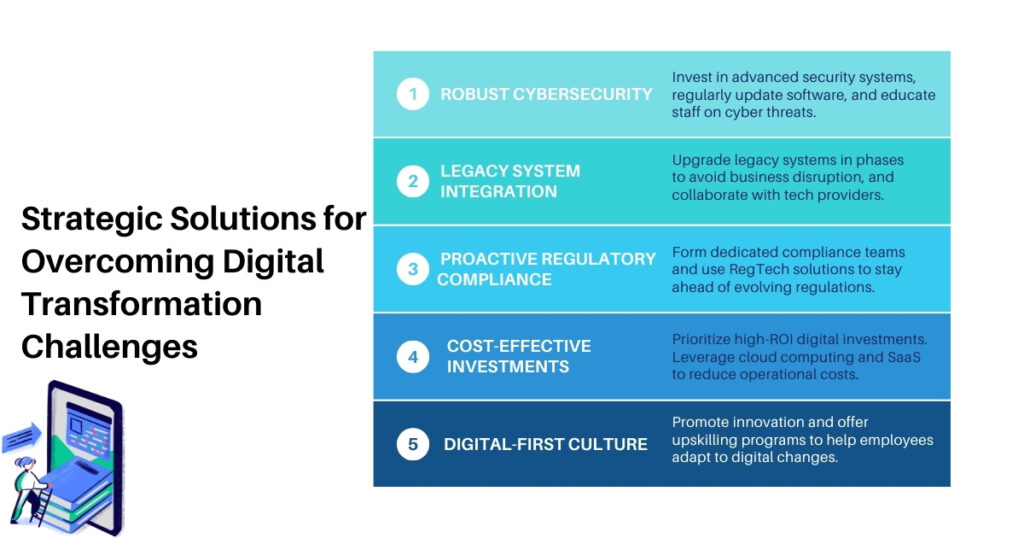
    Solutions to Overcome Digital Transformation Challenges in Finance

    Opportunities of Digital Transformation in Finance

    • Enhanced Risk Management: Digital transformation services like predictive analytics, real-time analytics solutions, fraud detection systems, Regtech solutions, compliance management platforms, etc., help in improving risk management related to finance aspects like fraud detection, refining credit score models, automating compliance tracking, and more.
    • Improved Operational Efficiency: In the finance field, digital transformation services help in operational efficiency through process automation, system integration, and cost reduction. Listed below explained are 3 key factors:
        • Process Automation: Digital transformation services like RPA tools for automated routine tasks like task automation, robotic process automation, and workflow automation help improve overall productivity through compliance checks, report generation, invoice processing, etc.
        • System Integration: Financial system integration with ERP helps in improved financial reporting, forecasting, etc. Other integrations, like APIs and data integration, help in real-time data exchange that improves decision-making.
        • Cost Reduction: Cloud computing and cost management tool integration help in cost management and efficient resource allocation.
    • Data-Driven Insights: Digital transformation services and technologies like big data analytics, behavioral analytics, data visualization, etc., help in offering tailored recommendations to customers and help in setting dynamic pricing. Do you know, as per the Infosys report, that approximately 76% of financial service executives say that customer experience is now the most integral part of digital transformation?

    For enhanced forecasting, various tools can be used for trend analysis and scenario analysis for mitigating risks.

    • Ability for Agility and Innovation by Leveraging Continuous Development in Financial Products and Services: Enterprises can focus on rapid development by implementing agile development practices like Jira or Trello for the gradual development of financial products. Along with agile practices, launching MVPs enables financial enterprises to test new ideas and features with real users rapidly. Other integrations, like modular banking platforms, microservices frameworks, and cloud computing, help give flexibility to operations.

    What is the Future of Digital Finance?

    Fintech plays a key role in transforming the future of digital finance with continuous implementation of technology to elevate the seamless outcome for both enterprises and customers. The fintech sector is projected to grow at a CAGR of 16.5% from 2024 to 2032. Listed below are some digital key integrations to look forward to in the field of finance:

    • Alternative Lending Platforms
    • Quantum Computing
    • Wealth Management Solutions
    • Collaboration with Traditional Banks
    • Open Banking and API Integration for Customer Control Over Data, Improved Competition, and Innovation
    • Sustainability and Green Finance
    • Rise of Decentralized Finance (DeFi)
    • Artificial Intelligence (AI) in Predictive Finance

    Conclusion

    The finance industry stands at a critical juncture where embracing digital transformation is no longer optional but imperative for future growth. Successfully tackling the complexities of cost management, cybersecurity, and regulatory compliance requires more than just technological adoption—it calls for a strategic, forward-thinking approach. By addressing these key challenges head-on, financial institutions can unlock new opportunities to enhance customer experiences, harness data for smarter decision-making, and drive sustainable innovation.

    At SCS Tech India, we recognize the need for integration of digital transformation services/technologies like IoT applications, AI-driven solutions, advanced cybersecurity services, etc., in navigating these complexities and challenges to drive innovation in enterprises. By partnering with SCS Tech India, organizations in the financial sector can build a resilient framework that improves agility and efficiency, helping them to capitalize on digital transformation opportunities and have a competitive edge in the dynamic financial landscape.

    FAQ

    • What is the key role of fintech in digital transformation?

    Fintech helps in digital transformation by offering real-time services, helping in cost efficiency, personalized financial advice, a focus on financial inclusion through micro-lending and digital wallets, collaboration with traditional institutions, etc., that helps in remaining competitive.

    • How do cloud-native architectures help in digital transformation in finance?

    Cloud-native architectures focus on scalability, agility, and innovation; disaster recovery and continuity; security; and compliance through inbuilt features like encryption, access controls, etc.

    • How does decentralized finance (DeFi) help in digital transformation in finance?

    Decentralized finance (DeFi) helps eliminate the need for traditional intermediaries. Transactions are recorded in the public blockchain, thereby ensuring transparency, giving access to financial services, and global accessibility.

    • What are a few challenges in AI-driven personalization in financial services?

    Challenges in AI-driven personalization in financial services include data privacy and security, biases of algorithms, customer trust, cost incurred in implementation, data integration complexity, evolving customer expectations, etc.

    (more…)