
Category: operation efficiency

  • How GIS Mapping Services is Transforming the Oil/Gas Sector?

    How GIS Mapping Services is Transforming the Oil/Gas Sector?

    Do you know the integration of GIS across various sectors, including oil and gas, is projected to grow at a CAGR of 12.5% and reach a market size of US $26.27 billion between the periods of 2024-30? With this growth, oil and gas companies are adopting GIS mapping services. GIS helps in optimizing pipeline routes and monitoring assets in real-time. It also improves safety protocols and analyzes large amounts of spatial data. This integration streamlines operations, reduces risks, and enhances decision-making.

    To know more about how GIS technology integration helps in achieving optimal results, read the blog that covers various aspects of the GIS mapping services integration with the oil and gas technology sector.
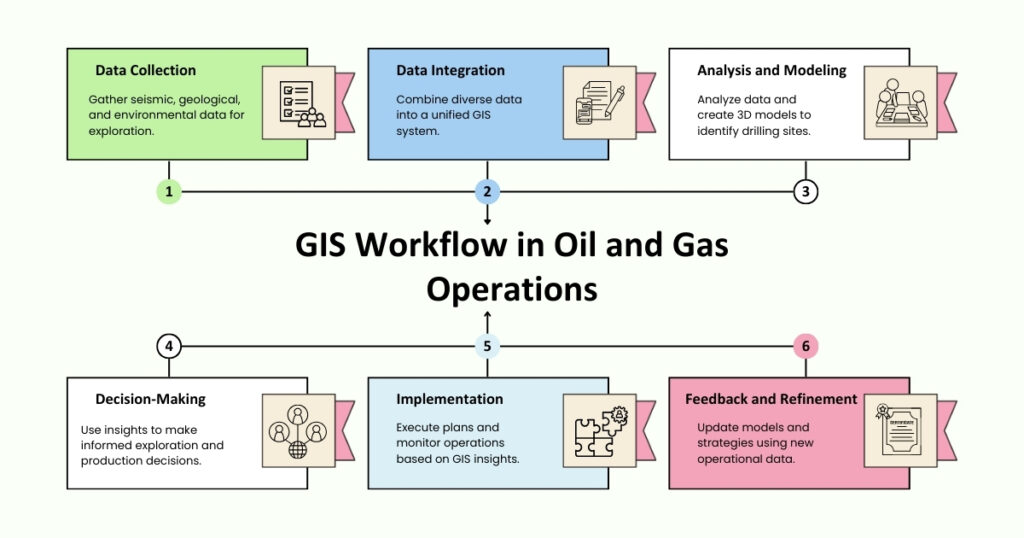
    GIS Workflow in Oil and Gas Operations

    What is the Role of GIS mapping services in the Oil and Gas Sector?

    GIS plays an important role in streamlining operations and saving costs in the oil and gas sector, we will discuss each factor in detail through the below-mentioned pointers:

    Exploration and Production (E&P)

    • This is the first stage in the oil and gas lifecycle; GIS here helps to integrate historical records, geological maps, seismic data, etc., to create effective reservoir modeling.
    • With these integrations, we identify locations for resource extraction and drilling. It helps in improving the accuracy of finding drilling locations and results in reduced exploration risks.
    • Reservoir modeling: a GIS mapping services feature helps visualize and model the size of the reservoir so accurate production estimates can be made.

    Asset Management and Infrastructure

    • Asset Management and Infrastructure in the Oil and Gas Sector with GIS is important for cost-effective infrastructure management, including storage, refineries, pipelines, rigs, etc.
    • Through spatial databases, GIS helps in asset maintenance and tracking. Operators can effectively determine on one single platform how the asset will be distributed across geographic locations, such as the exact location of pipelines, storage tanks, etc.
    • GIS technology also aids in optimized infrastructure planning by enabling optimal site selection, environmental considerations, and cost optimization. Additionally, it reduces risks through data integration from drones and satellites, allowing for in-depth inspections, particularly in offshore rigs and remote pipeline locations.

    Pipeline and Route Optimization

    • In the oil and gas sector, pipelines are the foundation for transporting crude oil, natural gas, and other petroleum products over long distances that can be challenging. Here, GIS plays a role in route optimization through planning and design, which is done by geospatial analysis of factors like terrain, land use, and environmental sensitivity. Route optimization is done for cost savings and less environmental disruption.
    • Listed below are a few important features offered by GIS for pipeline and route optimization.
      • Terrain and elevation analysis through slope stability analysis and analysis of elevation profiles
      • Integrating existing pipeline networks and faster access to maintenance facilities. Through predictive maintenance, one can perform a better assessment of temperature variations, terrain type, seismic activity, etc.
      • Enhancing risk management and safety through population density analysis, identification of high-risk zones, emergency response planning, etc.

    Field Data Collection and Remote Sensing

    • Integrating field data collection and remote sensing with GIS mapping enables remote data acquisition using satellite imagery, LiDAR, and aerial photography. This approach captures large-scale data over pipelines, refineries, and infrastructure. Additionally, UAVs equipped with GIS sensors provide in-depth data collection, enhancing overall accuracy.

    • Other key aspects include real-time field data collection through GPS integration and geotagging, environmental impact monitoring, sensitive ecosystem tracking, regulatory audits and inspections through data maps, etc.

    Seismic Data Analysis and Fault Line Mapping

    • Integrating GIS in India with seismic data analysis enhances vibrational data acquisition, and then we use geophones or hydrophone sensors to collect information on wave reflection.
    • Integration data also helps engineers analyze subsurface geological formations in 2D or 3D form.
    • GIS integrates seismic surveys, geological maps, and satellite imagery, which helps identify fault lines so that companies can make changes in drilling plans, develop stronger infrastructure, and develop safety protocols to mitigate the impact.

    Advantages of GIS mapping services in the Oil and Gas Sector

    The geographic information system helps the oil and gas sector by integrating tools that help in data management through data layering, emergency response planning, data sharing and collaboration, and more. Listed below are some key advantages:

    • Optimized Exploration and Drilling Operations
    • Supply Chain and Logistics Optimization
    • Enhanced Pipeline and Infrastructure Management
    • Sustainability through Optimized Resource Utilization
    • Reduction in Maintenance Costs
    • Enhanced Emergency Response and Incident Management
    • Enhanced Communication and Collaboration

    GIS Innovations and Trends Integrated by GIS Companies in India

    Listed below are a few upcoming GIS trends and innovations contributing to the transformation of the oil and gas industry:

    • Real-time data integration, such as satellite imagery and IoT sensors
    • AI and Machine learning for anomaly detection and optimization
    • Advanced geospatial analytics such as 3D modeling and spatial analysis
    • Blockchain for Data Security
    • Remote Sensing and UAVs through high-resolution aerial imagery and data collection
    • Enhanced reservoir modeling that helps in accurately predicting oil and gas reserves.

    Conclusion

    Integrating GIS technology in the oil and gas industry not only enhances operational efficiency but also transforms how we manage and ensure our resources and safety. By utilizing advanced spatial data analysis and innovative technologies, companies can achieve precise monitoring, proactive maintenance, and optimized resource usage. This strategic integration drives significant improvements, offering a competitive edge and unlocking new levels of operational excellence. Using these GIS capabilities could redefine your approach to industry challenges, setting the stage for future advancements and sustained success.

    If you are looking to capitalize on the benefits of GIS mapping services in the oil and gas industry solutions, then getting expert guidance from  SCS Tech India can be an optimal decision. Their solutions enhance precision, streamline management, and drive innovation, giving you a competitive edge while maximizing efficiency.


    FAQ

    • Can GIS help in predictive analytics in the oil and gas sector exploration?

    Yes, GIS technology helps in predictive analytics in the oil and gas sector exploration by integrating historical data with geospatial information, subsurface mapping, geological risk assessment, hydrocarbon movement prediction, and more.

    • Do GIS mapping services help in risk management in the oil and gas industry?

    Yes, GIS mapping services help in risk management by identifying high-risk zones, real-time monitoring of assets through drone and satellite monitoring, seismic risk prediction by spatial analysis, etc.

    • What are the innovations GIS companies in India are focusing on to transform the oil and gas sector in India?

    GIS companies in India are focusing on innovations like advanced remote sensing and satellite imagery, 3D reservoir modeling, seismic data integration, scalable cloud GIS platforms, hybrid energy systems, and more.

    • How can we use GIS technology in pipeline management in the oil and gas sector?

    GIS technology is important for pipeline management in the oil and gas sector as it helps detect leaks, corrosion, and pressure anomalies, ensure pipeline safety, reduce environmental risks, etc.

    (more…)

  • Why Robust IT Infrastructure Solutions Are the Backbone of Successful Enterprises?

    Why Robust IT Infrastructure Solutions Are the Backbone of Successful Enterprises?

    As per Harvard Business Review, almost forty percent of companies view IT infrastructure solutions as a leading reason for overall enterprise efficiency gain in order for businesses to stand out from one another in the marketplace.

    In the modern world of digitalization, an effective IT structure solution is no longer a luxury but a necessity for any enterprise that has to compete for its existence in the market. In this blog, we will define what it means to integrate IT infrastructure solutions into business processes, as well as strategies to develop sound IT infrastructure solutions.

    Comprehensive Insight on Benefits of IT Infrastructure Solutions for Enterprise Success

    Improved Operational Efficiency

    A robust IT infrastructure helps in improving operational efficiency by utilizing the resources optimally, reducing errors, and downtime.

    Listed below are key factors of an IT infrastructure solution that contribute to improved operational efficiency:

    • IT infrastructure solutions help streamline business processes by automating the business workflow, resulting in a reduction in manual tasks and errors.
    • A robust IT infrastructure solution enhances work collaboration through various cloud-based platforms so employees can access real-time data, share documents, and seamlessly collaborate on projects.
    • For strategic decision-making, IT infrastructure solutions offer advanced solutions for data storage via cloud storage and database management systems.
    • Integrating data analytics tools like Power BI, Google Data Studio, QlikSense, etc. for making timely decisions according to operational and market changes.

    Robust Security and Compliance

    A strong IT infrastructure not only improves operational efficiency but also makes sure the valuable assets of the organization are safeguarded from having network security solutions to data encryption solutions. Below listed are key IT infrastructure solutions that facilitate security and compliance:

    • To safeguard from potential disruption resulting from cyber-attacks or technical failures, IT infrastructure solutions offer a comprehensive recovery plan that includes data backup, testing and drills, business impact analysis, and re-establishing networking connectivity.
    • Network security solutions like virtual private networks, firewalls, intrusion detection and prevention systems (IDPS), etc., act as key solutions for enhancing data security.
    • A robust IT infrastructure solution integrates data encryption solutions through tools like BitLocker (for Windows) or FileVault (for Mac) and a public key infrastructure solution for safeguarding digital certificates and encryption keys.
    • Other key security and compliance solutions include identity and access management solutions, compliance management solutions, including data governance tools to make sure the business is securing and managing data as per regulatory compliance, endpoint security solutions, and more.

    Cost Efficiency

    Cost efficiency plays a crucial role in an enterprise’s long-term success, which can be achieved by integrating IT infrastructure solutions that can eliminate waste, streamline business operations, and allocate resources effectively.

    Below listed are the benefits offered by robust IT infrastructure solutions to achieve cost efficiency.

    • Automation of routine tasks helps enterprises utilize the skills of employees in more effective areas.
    • Helps in effective resource management by removing underutilized assets and automated scaling through tools like Microsoft Azure’s Virtual Machine Scale Sets, AWS Autoscaling, etc., so resources are allocated based on demand, resulting in reduced cost.
    • IT infrastructure management tools help in better cost visibility through 3 key aspects:
      • Energy consumption reduction by optimizing power usage
      • Storage optimization by integrating techniques like tiering, deduplication, and compression.
      • Cost savings via server consolidation, where underutilized servers can be identified and consolidated, reducing hardware costs and energy consumption.

    Improved Customer Experience

    In the evolving market, the shift towards enhancing the customer experience has become a key parameter, and enterprises can integrate the following IT infrastructure solutions to improve customer experience:

    • Streamline communication and service by adding automated response services like Chatbot or voice-enabled technology solutions.
    • Add advanced data analytics tools that can evaluate customer preferences and offer personalized customer interaction.
    • IT infrastructure solutions like CDNs (Content Delivery Networks) can be implemented to increase reliability by offering faster load time. It helps businesses in scaling as a high volume of traffic can be managed with high performance.

    Fosters Gaining Edge in Competitive Market by Constant Innovation

    Investing in IT infrastructure solutions is a backbone to drive success given market changes and the evolving landscape of technologies. Listed below are a few advantages enterprises can gain from integrating innovative approaches to IT infrastructure solutions in their business processes:

    • IT infrastructure solutions help businesses with scalable and cost-effective solutions so businesses can respond to sudden market demands and offer seamless delivery.
    • Supports cutting-edge technologies like artificial intelligence, machine learning, and the Internet of Things (IoT).
    • Improves agility and speed so businesses can rapidly deploy new services/applications and grab the right market opportunity.
    • Helps in digital transformation by integrating ERP systems like SAP, CRM software like Hubspot, and collaboration tools like Microsoft Teams.
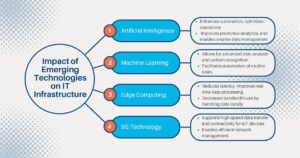
    • The digital transformation is also achieved by deploying innovative applications like AI-powered analytics (Tableau, Power BI) and IoT platforms (AWS IoT, Google Cloud IoT).Impact of emerging technologies on IT infrastructure

      Tips on Building a Robust IT Infrastructure Solutions

      • Understand business requirements and evaluate pain points to align IT infrastructure strategies.
      • Focus on scalability and flexibility through cloud-based solutions and modular design for long-term growth.
      • Improve network reliability by removing redundant systems and investing in high-speed connectivity for seamless communication.
      • Invest in advanced monitoring and management tools like SolarWinds and focus on centralized management.
      • Partner with reliable IT infrastructure solutions partner like SCS Tech India for comprehensive services like infrastructure management, cloud services, cybersecurity, etc.

      Conclusion

      Robust IT infrastructure solutions are crucial for successful enterprises, ensuring seamless operations and driving innovation. A well-structured IT structure enhances scalability and improves productivity, leading to a competitive advantage. At SCS Tech India, we understand the importance of this parameter and offer tailored services like cloud computing integration and cybersecurity to meet these needs.

      Our expertise in IoT consulting, IoT application development, wearable app development, voice-enabled technology solutions, and IT implementation and support helps enterprises build a robust IT infrastructure. Enterprises can achieve agility and efficiency by integrating these services and sustaining long-term in the market.

      FAQs

      1. What is the role of IT infrastructure in API management?

      IT infrastructure in API management focuses on seamless communication between applications and services, enabling businesses to create, manage, and track the performance of API along with detecting issues.

      1. What IT infrastructure solutions does SCS Tech India specialize in?

      SCS Tech India provides IT infrastructure solutions like network design, cloud computing, data center management, and cybersecurity services.

      1. What best practices can enterprises follow to design a robust IT infrastructure?

      Enterprises can focus on practices like scalability, assessing business needs, cloud integration, strong security measures, solid backup systems to remove redundancy, and more.

    (more…)