

Smart cities are no longer futuristic ideas as they are actively being designed, funded, and built across India. With rapid urban growth, rising infrastructure demand, and increasing pressure on resources, city planners and government agencies need smarter ways to manage land, water, transport, public services, and emergency response. This is where GIS mapping (Geographic Information Systems) has become a game-changer.
GIS mapping is more than just digital maps. It enables decision-makers to visualize real-world data geographically, analyze patterns, forecast risks, and plan smarter infrastructure development. Whether a city is planning new roads, managing flood-prone zones, tracking public assets, or improving traffic flow, GIS provides a single, powerful layer of intelligence that connects everything.
In this blog, we’ll explore what GIS mapping is, why it’s essential for smart cities, and the most high-impact GIS use cases that are transforming infrastructure and urban planning in 2026.
What Is GIS Mapping and Why Does It Matter Today?
GIS mapping is a technology that collects, stores, analyzes, and visualizes geographical or location-based data. It combines traditional mapping with modern data analytics, enabling organizations to answer key questions like:
Where are the problems occurring?
Why are they happening in specific locations?
What areas are most vulnerable in the future?
How can we optimize infrastructure planning and public service delivery?
In simple terms: GIS turns location data into actionable intelligence.
For smart cities, GIS is essential because every urban system—roads, water pipelines, electricity networks, traffic signals, public safety, waste management—exists in a geographic space. GIS helps connect these systems and manage them more efficiently.
How GIS Mapping Powers Smart City Development
GIS mapping serves as the technological backbone of smart city development by synthesizing diverse, real-time data into a unified, actionable framework. By integrating layers such as transportation networks, land usage, and population distribution with critical utility infrastructure and environmental metrics, GIS allows urban planners to move beyond departmental silos.
This multidimensional approach—further enriched by satellite and drone imagery—transforms the city into a visible, dynamic ecosystem where the relationship between streetlights, air quality, and traffic flow can be analyzed simultaneously. Ultimately, this geographic intelligence empowers leaders to make precise, data-driven decisions that improve efficiency and quality of life across the entire urban landscape.
Top 9 GIS Mapping Use Cases Powering Smart Cities & Infrastructure
Let’s look at the most impactful and practical GIS applications being used in smart cities and infrastructure projects today.
1. Urban Planning and Land Use Management
Urban development requires structured planning—where to build, what to build, and how to ensure long-term sustainability. GIS helps planners identify growth patterns, land availability, and development constraints.
GIS enables:
-
Zoning and land-use planning
-
Master planning for city expansion
-
Identifying suitable land parcels for public projects
-
Mapping unauthorized constructions and encroachments
-
Impact analysis of new infrastructure projects
Instead of relying on static reports, smart city planners can visualize development scenarios using interactive GIS dashboards.
2. Smart Transportation and Traffic Management
Traffic congestion is one of the biggest challenges in urban India. Smart mobility depends on analyzing traffic flow, identifying bottlenecks, and optimizing routes for both private and public transport.
With GIS mapping, authorities can:
-
Monitor congestion hotspots
-
Analyze accident-prone zones
-
Optimize traffic signals and junction layouts
-
Plan alternate routes and bypass corridors
-
Improve public transport route planning
Over time, GIS can also support long-term initiatives such as integrated metro, bus, and multimodal transport networks by improving planning accuracy.
3. Asset Management for Public Infrastructure
Smart cities run on public assets: streetlights, water valves, power transformers, CCTV cameras, roads, bridges, signboards, and more. Managing these assets manually is costly and inefficient.
GIS-based asset mapping helps governments and civic bodies:
-
Create an accurate inventory of city assets
-
Track asset condition and maintenance schedules
-
Identify asset gaps across regions
-
Reduce service downtime through faster repairs
-
Improve accountability through geo-tagged records
This is one of the most practical and high-ROI uses of GIS, especially for municipal bodies focused on service delivery improvements.
4. Water Supply and Pipeline Network Monitoring
Water is one of the most critical—and stressed—resources for growing cities. Leakage, illegal connections, and poor monitoring can lead to heavy losses and supply disruption.
GIS helps utilities manage water networks by enabling:
-
Mapping of pipeline networks and distribution zones
-
Leak detection and hotspot identification
-
Monitoring pressure zones and flow rates
-
Planning new water lines based on demand mapping
-
Visualizing real-time supply status across regions
When integrated with IoT sensors, GIS becomes even more powerful, enabling real-time alerts and predictive maintenance.
5. Disaster Management and Emergency Response
Whether it’s floods, landslides, fires, earthquakes, or industrial incidents, emergency response depends on speed and accurate situational awareness. GIS enables authorities to respond faster and allocate resources efficiently.
GIS can support:
-
Flood risk mapping and drainage analysis
-
Identifying evacuation routes and shelter locations
-
Real-time incident mapping and resource allocation
-
Tracking emergency vehicles and field teams
-
Monitoring disaster impact zones using satellite imagery
This makes GIS an essential tool not only for smart cities but also for climate resilience planning.
6. Solid Waste Management and Sanitation Planning
Solid waste management is a major operational challenge in cities. Routes must be optimized, bins must be tracked, and collection schedules need to be managed efficiently.
GIS helps by enabling:
-
Geo-tagging of bins and collection points
-
Route optimization for waste collection vehicles
-
Identifying missed pickups or underserved areas
-
Planning landfill sites and waste transfer stations
-
Monitoring sanitation performance across zones
This use case supports cleaner cities while reducing fuel consumption and operational costs.
7. Smart Street Lighting and Energy Optimization
Street lighting is one of the biggest municipal electricity expenses. Smart street lighting projects are powered by GIS through mapping and monitoring of lighting infrastructure.
GIS supports:
-
Mapping existing streetlight points
-
Identifying high-need areas (dark spots)
-
Monitoring faults and maintenance schedules
-
Optimizing energy usage through smart controls
This results in improved public safety while keeping energy spending under control.
8. Environmental Monitoring and Sustainability Projects
Smart cities must also be sustainable cities. GIS plays a vital role in monitoring environmental conditions and planning eco-friendly interventions.
Common GIS applications include:
-
Air quality mapping and pollution hotspot tracking
-
Mapping green spaces and urban forest projects
-
Heat map analysis for urban heat islands
-
Water body monitoring and restoration planning
-
Noise pollution and waste dumping monitoring
These insights help cities plan long-term environmental action instead of reactive measures.
9. Smart Governance and Citizen Service Delivery
Citizens expect fast, transparent, and efficient service delivery. GIS enables governance teams to manage issues geographically and improve response times.
With GIS-enabled citizen service models, authorities can:
-
Map citizen complaints by ward/zone
-
Prioritize areas with high service gaps
-
Allocate field teams efficiently
-
Track service completion with geo-tagged proof
-
Improve accountability with data-based monitoring
This leads to better citizen satisfaction and measurable improvements in municipal services.
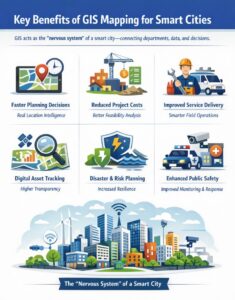
Key Benefits of GIS Mapping for Smart Cities
GIS brings value across planning, operations, and governance. Some of the most powerful benefits include:
Wrapping Up!
GIS mapping is no longer just a support tool—it has become a foundational technology driving smart city development and modern infrastructure planning. In 2026, cities that adopt GIS effectively gain a major advantage: they can plan smarter, respond faster, allocate resources efficiently, and deliver better public services.
From transport and water management to disaster response and sustainability initiatives, GIS is empowering governments and enterprises to transform how cities function—making them more connected, resilient, and future-ready.
For organizations working on smart city projects, partnering with a technology provider like SCS Tech India that understands GIS implementation at scale can make all the difference. With the right strategy, data systems, and deployment approach, GIS can become one of the highest-impact investments for infrastructure modernization.