Blog

  • The 7-Step Process to Migrate Legacy Systems Without Disrupting Operations

    The 7-Step Process to Migrate Legacy Systems Without Disrupting Operations

    Are your legacy systems holding your business back? Outdated applications, slow performance, cybersecurity vulnerabilities, and complex integrations can silently drain productivity and increase operational risks. In fact, only 46 % of data migration projects finish on schedule—and just 36 % remain within budget, highlighting how easily such transitions derail.

    Migrating to modern platforms promises efficiency, scalability, and security, but the process can feel daunting.

    The good news is, with a structured approach, you don’t have to gamble with downtime or data loss. In this guide, we’ll walk you through a 7-step process to migrate your legacy systems safely and effectively, helping you maintain business continuity while upgrading your IT environment.

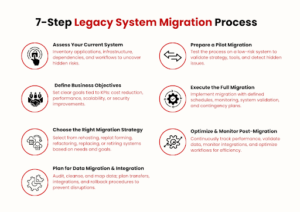
    Step 1 – Assess Your Current System

    Before you even think about migration, you need a complete understanding of your current IT environment. This means going beyond a surface check. Start by identifying:

    • Applications in use – Which ones are business-critical, and which can be retired or replaced?
    • Infrastructure setup – Servers, databases, integrations, and how they connect.
    • Dependencies and workflows – How different systems rely on each other, including third-party tools.

    A clear system assessment helps you uncover hidden risks. For example, you may find that an old payroll module depends on a database that isn’t compatible with modern cloud platforms. If you skip this stage, such issues can cause downtime later.

    To keep this manageable, create an inventory report that maps out all systems, users, and dependencies. This document becomes your baseline reference for planning the rest of the migration.

    Step 2 – Define Business Objectives for Migration

    Once you know what you’re working with, the next step is to define why you’re migrating in the first place. Without clear objectives, even the best technical plan can go off-track.

    Start by asking:

    1. What outcomes do we want? – Is the goal to cut infrastructure costs, improve system performance, enable scalability, or strengthen security?
    2. Which processes need improvement? – For example, faster reporting for finance, better uptime for customer-facing apps, or smoother integrations for supply chain systems.
    3. What risks must we minimize? – Think compliance, downtime, and data loss.

    Document these goals and tie them directly to business KPIs. For instance, if your objective is to reduce operational costs, you might target a 25% drop in IT spend over the next two years. If it’s about performance, you may aim for response times under one second for customer transactions. For example, organizations pursuing modernization commonly realize cost savings of 13 % to 18 % as inefficiencies, architectural debt, and maintenance overhead are reduced.

    This clarity ensures that every decision, from choosing the migration strategy to monitoring post-migration performance, is aligned with measurable business value.

    Step 3 – Choose the Right Migration Strategy

    With your current system assessed and objectives defined, it’s time to select the migration strategy that best fits your business. There’s no one-size-fits-all approach, the right choice depends on your legacy setup, budget, and long-term goals.

    The most common strategies include:

    1. Rehosting (“Lift and Shift”) – Move applications as they are, with minimal changes. This is often the fastest route but may not unlock the full benefits of modernization.
    2. Replatforming – Make limited adjustments (like moving databases to managed services) without a full rewrite. This balances speed and optimization.
    3. Refactoring/Re-architecting – Redesign applications to fully leverage cloud-native capabilities. This option is resource-heavy but future-proofs your system.
    4. Replacing – Retire outdated applications and replace them with new SaaS or off-the-shelf solutions.
    5. Retiring – Eliminate redundant systems that no longer add value.

    To decide, weigh factors such as:

    • Compatibility with existing workflows
    • Projected costs vs. long-term savings
    • Security and compliance needs
    • User adoption and training requirements

    By matching the strategy to your business objectives, you avoid unnecessary complexity and ensure the migration delivers real value, not just a technical upgrade.

    Step 4 – Plan for Data Migration and Integration

    Data is at the core of any legacy system, and moving it safely is often the most challenging part of migration. If you don’t plan this step carefully, you risk losing critical information or facing inconsistencies that disrupt business operations.

    Start with a data audit. Identify what data is relevant, what can be archived, and what needs cleansing before migration. Outdated, duplicated, or corrupted records only add complexity; cleaning them now prevents issues later.

    Next, map out data dependencies. For example, if your HR system pulls employee data from a central database that also serves payroll, both need to move in sync. Skipping this detail can break processes that employees rely on daily.

    For integration, establish how your new environment will interact with:

    • Existing applications that won’t migrate immediately
    • Third-party tools used by different teams
    • APIs and middleware that handle real-time transactions

    Finally, decide on a migration method:

    • Big Bang – Move all data in one go, usually over a planned downtime window.
    • Phased – Transfer data in stages to minimize disruption.

    Whichever you choose, always back it up with a rollback plan. If something goes wrong, you need a reliable way to restore systems without losing business continuity.

    Step 5 – Prepare a Pilot Migration

    Jumping straight into a full migration is risky. A pilot migration helps you test your approach in a controlled environment before scaling it across the entire organization.

    Here’s how to structure it:

    1. Select a low-risk system or module – Choose something non-critical but still representative of your larger environment. For example, a reporting tool or internal dashboard.
    2. Replicate the migration process – Apply the same steps you plan for the full migration, including data transfer, integration, and security checks.
    3. Measure outcomes against your objectives – Look at performance benchmarks, system compatibility, user experience, and downtime. Did the pilot meet the KPIs you defined in Step 2?
    4. Identify issues early – This stage is where hidden dependencies, data integrity gaps, or integration failures usually show up. Catching them now avoids major disruptions later.

    A pilot isn’t just a “test run”, it’s a validation exercise. It gives your team the confidence that the chosen strategy, tools, and processes will scale effectively when it’s time for the real migration.

    Step 6 – Execute the Full Migration

    With lessons learned from the pilot, you’re ready to carry out the full migration. This step requires tight coordination between IT teams, business units, and external partners to ensure minimal disruption.

    A strong execution plan should cover:

    1. Timeline and scheduling – Define clear migration windows, ideally during off-peak hours, to reduce impact on daily operations.
    2. Communication plan – Keep stakeholders and end-users informed about expected downtime, system changes, and fallback options.
    3. Data transfer process – Use the validated method (big bang or phased) from Step 4, ensuring continuous monitoring for errors or mismatches.
    4. System validation – Run functional and performance tests immediately after each migration batch. Confirm that applications, integrations, and security policies work as expected.
    5. Contingency measures – Have a rollback procedure and dedicated support team on standby in case critical issues arise.

    Remember, success here isn’t just about “moving everything over.” It’s about doing it with zero data loss, minimal downtime, and full business continuity. If executed properly, users should notice improvements rather than disruptions.

    Step 7 – Optimize and Monitor Post-Migration

    The migration itself is only half the journey. Once your systems live in the new environment, continuous monitoring and optimization are crucial to realize the full benefits.

    Start by:

    1. Tracking performance metrics – Measure application response times, system uptime, transaction success rates, and other KPIs defined in Step 2.
    2. Validating data integrity – Ensure all records migrated correctly, with no missing or corrupted entries.
    3. Monitoring integrations – Confirm that workflows across connected systems operate seamlessly.
    4. Collecting user feedback – Users often spot issues that automated monitoring misses. Document their experience to identify friction points.

    After initial validation, focus on optimization:

    • Fine-tune configurations to improve performance.
    • Automate routine tasks where possible.
    • Plan periodic audits to maintain compliance and security.

    Continuous monitoring helps you proactively address issues before they escalate, ensuring your migrated systems are not just functional, but efficient, reliable, and scalable for future business needs.

    Conclusion

    As companies increasingly modernize, 76 % of organizations are now actively engaged in legacy system modernization initiatives, underlining how mainstream this challenge has become.

    With the right digital transformation solutions, from assessing your current environment to optimizing post-migration performance, each stage ensures your systems stay reliable while unlocking efficiency, scalability, and security.

    At SCSTech, we specialize in guiding businesses through complex migrations with minimal risk. Our experts can help you choose the right strategy, manage data integrity, and monitor performance so you get measurable results. Contact our team today to discuss a migration plan tailored to your business objectives.

  • Cybersecurity Measures for Smart Grid Infrastructure with Custom Cybersecurity Solutions

    Cybersecurity Measures for Smart Grid Infrastructure with Custom Cybersecurity Solutions

    Smart grids are no longer future tech. They’re already running in many cities, silently balancing demand, managing renewable inputs, and automating fault recovery. But as this infrastructure gets smarter, it also becomes more exposed. Custom cybersecurity solutions are now essential to defend these networks. Cyber attackers are targeting data centers, probing energy infrastructure for weak entry points. A misconfigured substation, an unpatched smart meter, or a compromised third-party module can shut off power.

    In this article, you’ll find a clear breakdown of the real risks today’s grids face, and the specific cybersecurity layers that need to be in place before digital operations go live.

    Why Smart Grids Are Becoming a Target for Cyber Threats

    The move to smart grids brings real-time energy control, dynamic load balancing, and cost savings. But it also exposes utilities to threats they weren’t built to defend against. Here’s why smart grids are now a prime target:


    • The attack surface has multiplied. Each smart meter, sensor, and control point is a potential entry. Smart grids can involve millions of endpoints, and attackers only need one weak link.
    • Legacy systems are still in play. Many control centers still run SCADA systems using outdated protocols like Modbus or DNP3, often without encryption or proper authentication layers. These weren’t designed with cybersecurity in mind, just reliability.
    • Energy infrastructure is an impact target of high value. Compromises to energy grids have more than just outages; they can shut down hospitals, water treatment, and emergency services. That makes them a go-to for politically driven or state-sponsored attackers.
    • Malware is becoming more intelligent. Incidents such as Industroyer and TRITON have demonstrated how intelligent malware can be used to hack controls of breakers or shut down safety systems, without evading traditional perimeter security.

    Top Cybersecurity Risks Facing Smart Grid Infrastructure

    Even well-funded utilities are struggling to stay ahead of cyber threats. Below are the primary risk categories that demand immediate attention in any smart grid environment:

    • Unauthorized access to control systems: Weak credentials or remote access tools expose SCADA and substation systems to intruders.
    • Data tampering or theft: Latent attacks on sensor or control signal data can mislead operators and disrupt grid stability.
    • Malware for SCADA and ICS: Malicious code such as Industroyer can result in operational outages or unrecoverable equipment damage.
    • Denial of Service (DoS) attacks: DoS attacks of high volume or of a protocol nature can impede critical communications in grid monitoring or control systems
    • Supply chain vulnerabilities in grid components: Malware-infected or hardware-compromised firmware from suppliers may breach trust prior to systems being made live

    Key Cybersecurity Measures to Secure Smart Grids

    Smart grid cybersecurity is an architecture of policy, protocols, and technology layers across the entire system. The following are the most important actions utilities and municipal planners must take into account when upgrading grid infrastructure:

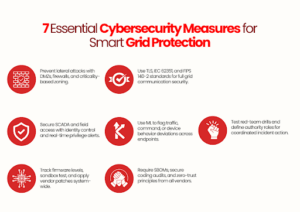
    1. Network Segmentation

    IT (corporate) and OT (operational) systems must be fully segregated. If one segment gets hacked, others remain functional.

    • Control centers must not have open network paths in common with smart meters or field sensors.
    • Implement DMZs (Demilitarized Zones) and internal firewalls to block lateral movement.
    • Zone according to system criticality, not ease of access.

    2. Encryption Protocols

    Grid data needs encryption both in transit and at rest.

    • For legacy protocols (like Modbus/DNP3), wrap them with TLS tunnels or replace them with secure variants (e.g., IEC 62351).
    • Secure all remote telemetry, command, and firmware update channels.
    • Apply FIPS 140-2 validated algorithms for compliance and reliability.

    3. Multi-Factor Authentication & Identity Control

    Weak or default credentials are still a leading breach point.

    • Apply role-based access control (RBAC) for all users.
    • Enforce MFA for operators, field technicians, and vendors accessing SCADA or substation devices.
    • Monitor for unauthorized privilege escalations in real time.

    This is especially vital when remote maintenance or diagnostics is allowed through public networks.

    4. AI-Based Intrusion Detection

    Static rule-based firewalls are no longer enough.

    Deploy machine learning models trained to detect anomalies in:

    • Grid traffic patterns
    • Operator command sequences
    • Device behavior baselines

    AI can identify subtle irregularities that humans and static logs may miss, especially across distributed networks with thousands of endpoints.

    5. Regular Patching and Firmware Updates

    Firmware without patches in smart meters, routers, or remote terminal units (RTUs) can become silent attack points.

    Continue patching on a strict timeline:

    • Take inventory of all field and control equipment, including firmware levels.
    • Test patches in sandboxed testing before grid-wide deployment.
    • Establish automated patch policies where feasible, particularly for third-party IoT subcomponents.

    6. Third-Party Risk Management

    Your network is only as strong as its weakest vendor.

    • Audit the secure coding and code-signing practices of supplier development.
    • Enforce SBOMs (Software Bills of Materials) to monitor embedded dependencies.
    • Confirm vendors implement zero-trust principles into device and firmware design.

    7. Incident Response Planning

    Detection alone won’t protect you without a tested response plan.

    At a minimum:

    • Define escalation protocols for cyber events that affect load, control, or customer systems.
    • Run red-team or tabletop exercises quarterly.
    • Appoint a cross-functional team (cybersecurity, ops, legal, comms) with clear authority to act during live incidents.

    These measures only work when applied consistently across hardware, software, and people. For cities and utilities moving toward digitalized infrastructure, building security in from the beginning is no longer a choice; it’s a requirement.

    What Urban Energy Planners Should Consider Before Grid Digitization

    Smart grid digitization is a strategic transformation that alters the way energy is provided, monitored, and protected. Urban planners, utility boards, and policymakers need to think beyond infrastructure and pose this question: Is the system prepared to mitigate new digital threats from day one?

    This is what needs to be on the table prior to mass rollout:

    • Risk Assessment First: Perform a complete inventory of current OT and IT systems. Determine what legacy components are unable to support contemporary encryption, remote access control, or patch automation.
    • Vendor Accountability: Make each vendor or integrator involved in grid modernization possess demonstrated security protocols, patch policies, and zero-trust infrastructure by design.
    • Interoperability Standards: Don’t digitize in isolation. Make sure new digital components (like smart meters or grid-edge devices) can securely communicate with central SCADA systems using standardized protocols.
    • Legal and Regulatory Alignment: Local, state, or national compliance frameworks (like NCIIPC, CERT-In, or IEC 62443) must be factored into system design from day one.

    Conclusion

    Cyberattacks on smart grids are already testing vulnerabilities in aging infrastructure in cities. And protecting these grids isn’t a matter of plugging things in. It takes highly integrated systems and custom cybersecurity solutions that can grow with the threat environment. That’s where SCS Tech comes in. We assist energy vendors, system integrators, and city tech groups with AI-infused development services tailored to critical infrastructure. If you’re building the next phase of digital grid operations, start with security.

    That’s where SCS Tech comes in.

    We assist energy vendors, system integrators, and city tech groups with AI-infused development services tailored to critical infrastructure.

    If you’re building the next phase of digital grid operations, start with security.

    FAQs 

    1. How do I assess if my current grid infrastructure is ready for smart cybersecurity upgrades?

    Begin with a gap analysis through your OT (Operational Technology) and IT layers. See what legacy elements are missing encryption, patching, and segmentation. From there, walk through your third-party dependencies and access points; those tend to be the weakest links.

    2. We already have firewalls and VPNs. Why isn’t that enough for securing a smart grid?

    Firewalls and VPNs are fundamental perimeter protections. Smart grids require stronger controls, such as segmentation in real time, anomaly detection, authentication at the device level, secure firmware pipelines that are secure, and so on. Most grid attacks originate within the network or from trusted vendors.

    3. How can we test if our grid’s cybersecurity plan will actually work during an attack?

    Conduct red-team or tabletop training simulations with technical and non-technical teams participating. These simulations reveal escalation, detection, or decision-making breakdowns far better found in practice runs than in actual incidents.

  • AI-Powered Public Health Surveillance Systems with AI/ML Service

    AI-Powered Public Health Surveillance Systems with AI/ML Service

    Public health surveillance has always depended on delayed reporting, fragmented systems, and reactive measures. AI/ML service changes that structure entirely. Today, machine learning models can detect abnormal patterns in clinical data, media signals, and mobility trends, often before traditional systems register a threat. But building such systems means understanding how AI handles fragmented inputs, scales across regions, and turns signals into decisions.

    This article maps out what that architecture looks like and how it’s already being used in real-world health systems.

    What Is an AI-Powered Public Health Surveillance System?

    An AI-powered public health surveillance system continuously monitors, detects, and analyzes signals of disease-related events in real-time, before these events contaminate the overall population.

    It does this by combining large amounts of data from multiple sources, including hospital records, laboratory results, emergency department visits, prescription trends, media articles, travel logs, and even social media content. AI/ML service models trained to identify patterns and anomalies scan these inputs constantly to flag signs of unusual health activity.

    How AI Tracks Public Health Risks Before They Escalate

    AI surveillance doesn’t just collect data; it actively interprets, compares, and predicts. Here’s how these systems identify early health threats before they’re officially recognized.

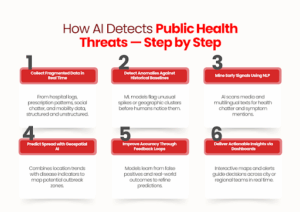
    1. It starts with signals from fragmented data

    AI surveillance pulls in structured and unstructured inputs from numerous real-time sources: 

    • Syndromic surveillance reports (i.e., fever, cough, and respiratory symptoms)
    • Hospitalizations, electronic health records, and lab test trends
    • News articles, press wires, and social media mentions
    • Prescription spikes for specific medications
    • Mobility data (to track potential spread patterns)

    These are often weak signals, but AI picks up subtle shifts that human analysts might miss.

    2. Pattern recognition models flag anomalies early

    AI systems compare incoming data to historical baselines.

    Once the system detects unusual increases or deviations (e.g., a sudden surge in flu-like symptoms in a given location), it creates an internal alert for the performance monitoring system.

    For example, BlueDot flagged the COVID-19 cluster in Wuhan by observing abnormal cases of pneumonia in local news articles before any warnings emerged from other global sources.

    3. Natural Language Processing (NLP) mines early outbreak chatter

    AI reads through open-source texts in multiple languages to identify keywords, symptom mentions, and health incidents, even in informal or localized formats.

    4. Geospatial AI models predict where a disease may move next

    By combining infection trends with travel data and population movement, AI can forecast which regions are at risk days before cases appear.

    How it helps: Public health teams can pre-position resources and activate responses in advance.

    5. Machine learning models improve with feedback

    Each time an outbreak is confirmed or ruled out, the system learns.

    • False positives are reduced
    • High-risk variables are weighted better
    • Local context gets added into future predictions

    This self-learning loop keeps the system sharp, even in rapidly changing conditions.

    6. Dashboards convert data into early warning signals

    The end result is a structured insight for decision-makers.

    Dashboards visualize risk zones, suggest intervention priorities, and allow for live monitoring across regions.

    Key Components Behind a Public Health AI System

    AI-powered surveillance relies on a coordinated system of tools and frameworks, not just one algorithm or platform. Every element has a distinct function in converting unprocessed data into early detection.

    1. Machine Learning + Anomaly Detection

    Tracks abnormal trends across millions of real-time data points (clinical, demographic, syndromic).

    • Used in: India’s National Public Health Monitoring System
    • Speed: Flagged unusual patterns 54× faster than traditional frameworks

    2. Hybrid AI Interfaces

    Designed for lab and frontline health workers to enhance data quality and reduce diagnostic errors.

    • Example: Antibiogo, an AI tool that helps technicians interpret antibiotic resistance results
    • Connected to: Global platforms like WHONET

    3. Epidemiological Modeling

    Estimates the spread, intensity, or incidence of diseases over time using historical data.

    • Use case: France used ML to estimate annual diabetes rates from administrative health records
    • Value: Allows for non-communicable disease surveillance, not only outbreak detection

    Together, these elements create a surveillance system able to record, interpret, and respond to real-time health threats, quickly and more correctly than ever before by manual means.

    How Cities and Health Bodies Are Using AI Surveillance in the Real World

    AI-powered public health surveillance is already being applied in focused contexts, by cities, health departments, and evidence-based programs to identify threats sooner and respond with exactness.

    The following are three real-world examples that illustrate how AI isn’t simply reviewing data; it’s optimizing frontline response.

    1. Identifying TB Earlier in Disadvantaged Populations

    In Nagpur, where TB is still a high-burden disease, mobile vans with AI-powered chest X-ray diagnostics are being deployed in slum communities and high-risk populations.

    These devices screen automatically, identifying probable TB cases for speedy follow-up, even where on-site radiologists are unavailable.

    Why it matters: Rather than waiting for patients to show up, AI is assisting cities in taking the problem to them and detecting it earlier.

    2. Screening for Heart Disease at Scale

    The state’s RHD “Roko” campaign uses AI-assisted digital stethoscopes and mobile echo devices to screen schoolchildren for early signs of rheumatic heart disease. This data is centrally collected and analyzed, helping detect asymptomatic cases that would otherwise go unnoticed.

    Why it matters: This isn’t just a diagnosis; it’s preventive surveillance at the population level, made possible by AI’s speed and consistency.

    3. Predicting COVID Hotspots with Mobility Data

    During the COVID-19 outbreak, Valencia’s regional government used anonymized mobile phone data, layered with AI models, to track likely hotspots and forecast infection surges.

    Why it matters: This lets public health teams move ahead of the curve, allocating resources and shaping containment policies based on forecasts, not lagging case numbers.

    Each example shows slightly different application diagnostics, early screening, and outbreak modeling, but all point to one outcome: AI gives health systems the speed and visibility they need to act before things spiral.

    Conclusion

    AI/ML service systems are already proving their role in early disease detection and real-time public health monitoring. But making them work at scale, across fragmented data streams, legacy infrastructure, and local constraints requires more than just models.

    It takes development teams who understand how to translate epidemiological goals into robust, adaptable AI platforms.

    That’s where SCS Tech fits in. We work with organizations building next-gen surveillance systems, supporting them with AI architecture, data engineering, and deployment-ready development. If you’re building in this space, we help you make it operational. Let’s talk!

    FAQs

    1. Can AI systems work reliably with incomplete or inconsistent health data?

    Yes, as long as your architecture accounts for it. Most AI surveillance platforms today are designed with missing-data tolerance and can flag uncertainty levels in predictions. But to make them actionable, you’ll need a robust pre-processing pipeline and integration logic built around your local data reality.

    2. How do you handle privacy when pulling data from public and health systems?

    You don’t need to compromise on privacy to gain insight. AI platforms can operate on anonymized, aggregated datasets. With proper data governance and edge processing where needed, you can maintain compliance while still generating high-value surveillance outputs.

    3. What’s the minimum infrastructure needed to start building an AI public health system?

    You don’t need a national network to begin. A regional deployment with access to structured clinical data and basic NLP pipelines is enough to pilot. Once your model starts showing signal reliability, you can scale modularly, both horizontally and vertically.

  • IoT-Based Environmental Monitoring for Urban Planning and Oil and Gas Industry Consulting

    IoT-Based Environmental Monitoring for Urban Planning and Oil and Gas Industry Consulting

    Cities don’t need more data. They need the appropriate data, at the appropriate time, in the appropriate place. Enter IoT-based environmental monitoring. From tracking air quality at street level to predicting floods before they hit, cities are using sensor networks to make urban planning more precise, more responsive, and evidence based. This approach is also applied in oil and gas industry consulting to optimize operations and mitigate risks.

    In this section, we talk about how to design this situation, where it already is, and how planning teams and solution providers can begin designing a smarter system from the ground up.

    IoT-Based Environmental Monitoring: What Is It?

    IoT-based environmental monitoring, utilizing networked sensors, is utilized to measure environmental phenomena in real time. While originally scoped to focus on larger urban systems such as urban economic development, construction, noise, or traffic, it can also document the condition of the urban environment (e.g., tracking temperature, noise, water, and air quality) simultaneously across a city. Similar sensor-driven approaches are increasingly valuable in oil and gas industry consulting to enhance safety, efficiency, and predictive maintenance.

    These sensors can be attached to steeples or buildings, visibility from vehicles, or new towers built specifically for dispersion of data collection, and their data continues to be collected continuously through the wireless networks to monitor real-time changes, such as pollution increases, temperature spikes, moisture increases, etc. They populate database(s) amassed in collected patterns, cleaned, processed, and available via dashboards from either a cloud service or edge processing resource.

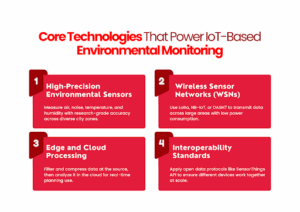
    Key IoT Technologies Behind Smart Environmental Monitoring


    Smart environmental monitoring is predicated on a highly integrated stack of hardware, connectivity, and processing technologies that have all been optimized to read and act on environmental data in real-time.

    1. High-Precision Environmental Sensors

    Sensors calibrated for urban deployments measure variables like PM2.5, NO₂, CO₂, temperature, humidity, and noise levels. Many are low-cost yet capable of research-grade accuracy when deployed and maintained correctly. They are compact, power-efficient, and suitable for long-term operation in varied weather conditions.

    2. Wireless Sensor Networks (WSNs)

    Data from these sensors travels via low-power, wide-area networks such as LoRa, DASH7, or NB-IoT. These protocols enable dense, city-wide coverage with minimal energy use, even in areas with weak connectivity infrastructure.

    3. Edge and Cloud Processing

    Edge devices conduct initial filtering and compression of data close to the point of origin to minimize loads for transmission. Data is processed and forwarded to cloud platforms for more thorough analysis, storage, and incorporation into planning teams’ or emergency response units’ dashboards.

    4. Interoperability Standards

    To manage data from multi-vendor sensors, standards such as OGC SensorThings API make various sensor types communicate in a common language. This enables scalable integration into larger urban data environments.

    These core technologies work together to deliver continuous, reliable environmental insights, making them foundational tools for modern urban planning.

    Real-World Use Cases: How Cities Are Using IoT to Monitor Environments

    Cities from around India and indeed the world are already employing IoT-based solutions to address actual planning issues. What’s remarkable, however, is not the technology in itself, it’s how cities are leveraging it to measure better, react more quickly, and plan more cleverly.

    The following are three areas where the effect is already evident:

    1. Air Quality Mapping at Street Level

    In Hyderabad, low-cost air quality sensors were installed in a network of 49 stations to continuously monitor PM2.5 and PM10 for months, including during seasonal peaks and festival seasons.

    What made this deployment successful wasn’t so much the size, but the capacity to see hyperlocal pollution data that the traditional stations fail to capture. This enabled urban planning teams to detect street-level hotspots, inform zoning decisions, and tell public health messaging with facts, not guesses.

    2. Flood Response Through Real-Time Water Monitoring

    Gorakhpur installed more than 100 automated water-level sensors linked to an emergency control center. The IoT sensors assist urban teams in monitoring the levels of drainage, initiating pump operations, and acting on flood dangers within hours rather than days.

    The payoff? 60% less pump downtime and a quantifiable reduction in water wastage response time. This data-driven infrastructure is now incorporated into the city’s larger flood preparedness plan, providing this time planners with real-time insight into areas of risk.

    3. Urban Heat and Climate Insights for Planning 

    In Lucknow, IIIT has broadened its sensor-based observatory to cover environmental data other than temperature, including humidity, air pollution, and wind behavior. The objective is to construct early warning models, heat mapping, and sustainable land-use planning decisions.

    For urban planning authorities, this type of layered environmental intelligence feeds into everything from tree-planting areas to heat-resilient infrastructure planning, particularly urgent as Indian cities continue to urbanize and heat up.

    These examples demonstrate that IoT-based monitoring is not only generating raw data but also actionable knowledge. And, incorporating that knowledge into the planning process changes reactive management of our cities to proactive, evidence-based actions.

    Benefits of IoT Environmental Monitoring for City Planning Teams

    Environmental information only looks good on paper. For urban planning departments and the service providers who assist them, IoT-based monitoring systems provide more than sensor readings; they unlock clarity, efficiency, and control.

    This is what that means in everyday decision-making:

    • Catch problems early – Receive real-time notifications on pollution surges, water-level fluctuations, or noise areas, and teams can respond, not merely react.
    • Plan with hyperlocal accuracy – Utilize hyperlocal data to plan infrastructure where it really matters, such as green buffers, noise barriers, or drainage improvement.
    • Evidence-based, not assumption-based zoning and policy – Use measurable trends in the environment to support land-use decisions, not assumptions. 
    • Strengthen disaster preparedness – Feed real private sector and municipal data in real time to heat wave, flood, and air-quality alert systems to allow for early action. 
    • Improve collaboration between departments – Build a shared dashboard or live map for multiple civic teams, including garbage, roads, and transportation departments.

    Getting Started with IoT in Urban Environmental Monitoring

    Getting started does not mean executing an entire city system on day one. It is about having clarity about what and where to measure, and how to make that information useful quickly. Here is how to start from concept to reality.

    1. Start with a clear problem

    Before choosing sensors or platforms, identify what your city or client needs to monitor first:

    • Is it the air quality near traffic hubs?
    • Waterlogging in low-lying zones?
    • Noise levels near commercial areas?

    The more specific the problem, the sharper the system design.

    2. Use low-cost, research-grade sensors for pilot zones

    Don’t wait for a budget that covers 300 locations. Start with 10. Deploy compact, solar-powered, or low-energy sensors in targeted spots where monitoring gaps exist. Prioritize places with:

    • Frequent citizen complaints
    • Poor historical data
    • Known high-risk zones

    This gives you proof-of-use before scaling.

    3. Connect through reliable, low-power networks

    LoRa, NB-IoT, or DASH7 — choose the protocol based on:

    • Signal coverage
    • Data volume
    • Energy constraints

    What matters is stable, uninterrupted data flow, not theoretical bandwidth.

    4. Don’t ignore the dashboard

    A real-time sensor is only useful if someone can see what it’s telling them.
    Build or adopt a dashboard that:

    • Flags threshold breaches automatically
    • Let’s teams filter by location, variable, or trend
    • Can be shared across departments without tech training

    If it needs a manual report to explain, it’s not useful enough.

    5. Work toward standards from the beginning

    You might start small, but plan for scale. Use data formats (like SensorThings API) that will integrate easily into larger city platforms later, without rewriting everything from scratch.

    6. Involve planners

    A planning team should know how to use the data before the system goes live. Hold working sessions between tech vendors and municipal engineers. Discuss what insights matter most and build your system around them, not the other way around.

    Conclusion

    Environmental challenges in cities aren’t getting simpler, but how we respond to them is. With IoT-based monitoring, urban planners and solution providers can shift from reactive cleanups to proactive decisions backed by real-time data. But technology alone doesn’t drive that shift. It takes tailored systems that fit local conditions, integrate with existing platforms, and evolve with the city’s needs. The role of artificial intelligence in agriculture shows a similar pattern, where data-driven insights and adaptive systems help address complex environmental and operational challenges.

    SCS Tech partners with companies building these solutions, offering development support for smart monitoring platforms that are scalable, adaptive, and built for real-world environments.

    If you’re exploring IoT for environmental planning, our team can help you get it right from day one.

  • Blockchain Applications in Supply Chain Transparency with IT Consultancy

    Blockchain Applications in Supply Chain Transparency with IT Consultancy

    The majority of supply chains use siloed infrastructures, unverifiable paper records, and multi-party coordination to keep things moving operationally. But as regulatory requirements become more stringent and source traceability is no longer optional, such traditional infrastructure is not enough without the right IT consultancy support.

    Blockchain fills this void by creating a common, tamper-evident layer of data that crosses suppliers, logistics providers, and regulatory authorities, yet does not replace current systems.

    This piece examines how blockchain technology is being used in actual supply chain settings to enhance transparency where traditional systems lack.

    Why Transparency in Supply Chains Is Now a Business Imperative

    Governments are making it mandatory. Investors are requiring it. And operational risks are putting into the spotlight firms that lack it. A digital transformation consultant can help organizations navigate these pressures, as supply chain transparency has shifted from a long-term aspiration to an instant priority.

    Here’s what’s pushing the change:

    • Regulations worldwide are getting stricter quickly. The Corporate Sustainability Due Diligence Directive (CSDDD) from the European Union will require large companies to monitor and report on. Environmental and Human Rights harm within their supply chains. If a company is found to be in contravention of the legislation, the fine could be up to 5% of global turnover.
    • Uncertainty about supply chains carries significant financial and reputational exposure.
    • Today’s consumers want assurance. Consumers increasingly want proof of sourcing, whether it be “organic,” “conflict-free,” or “fair trade.” Greenwashing or broad assurances will no longer suffice.

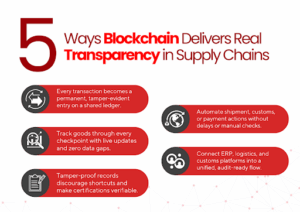
    Blockchain’s Role in Transparency of Supply Chains

    Blockchain is designed to address a key weakness of modern supply chains, however. The reality of fragmented systems, vendors, and borders is a lack of end-to-end visibility. 

    Here’s how it delivers that transparency in practice:

    1. Immutable Records at Every Step

    Each transaction, whether it’s raw material sourcing, shipping, or quality checks is logged as a permanent, timestamped entry.

    No overwriting. No backdating. No selective visibility. Every party sees a shared version of the truth.

    2. Real-Time Traceability

    Blockchain lets you track goods as they move through each checkpoint, automatically updating status, location, and condition. This prevents data gaps between systems and reduces time spent chasing updates from vendors.

    3. Supplier Accountability

    When records are tamper-proof and accessible, suppliers are less likely to cut corners.

    It’s no longer enough to claim ethical sourcing; blockchain makes it verifiable, down to the certificate or batch.

    4. Smart Contracts for Rule Enforcement

    Smart contracts automate enforcement:

    • Was the shipment delivered on time?
    • Did all customs documents clear?

    If not, actions can trigger instantly, with no manual approvals or bottlenecks.

    5. Interoperability Across Systems

    Blockchain doesn’t replace your ERP or logistics software. Instead, it bridges them, connecting siloed systems into a single, auditable record that flows across the supply chain.

    From tracking perishable foods to verifying diamond origins, blockchain has already proven its role in cleaning up opaque supply chains with results that traditional systems couldn’t match.

    Real-World Applications of Blockchain in Supply Chain Tracking

    Blockchain’s value in supply chains is being applied in industries where source verification, process integrity, and document traceability are non-negotiable. Below are real examples where blockchain has improved visibility at specific supply chain points.

    1. Food Traceability — Walmart & IBM Food Trust

    Challenge: Tracing food origins during safety recalls used to take Walmart 6–7 days, leaving a high contamination risk.

    Application: By using IBM’s blockchain platform, Walmart reduced trace time to 2.2 seconds.

    Outcome: This gives its food safety team near-instant visibility into the supply path, lot number, supplier, location, and temperature history, allowing faster recalls with less waste.

    2. Ethical Sourcing — De Beers with Tracr

    Challenge: Tracing diamonds back to ensure they are conflict-free has long relied on easily forged paper documents.

    Application: De Beers applied Tracr, a blockchain network that follows each diamond’s journey from mine to consumer.

    Outcome: Over 1.5 million diamonds are now digitally certified, with independently authenticated information for extraction, processing, and sale. This eliminates reliance on unverifiable supplier assurances.

    3. Logistics Documentation — Maersk’s TradeLens

    Challenge: Ocean freight involves multiple handoffs, ports, customs, and shippers, each using siloed paper-based documents, leading to fraud and delays.

    Application: Maersk and IBM launched TradeLens, a blockchain platform connecting over 150 participants, including customs authorities and ports.

    Outcome: Shipping paperwork is now in alignment among stakeholders near real-time, reducing delays and administrative charges in world trade.

    All of these uses revolve around a specific point of supply chain breakdown, whether that’s trace time, trust in supplier data, or document synchronisation. Blockchain does not solve supply chains in general. It solves traceability when systems, as they exist, do not.

    Business Benefits of Using Blockchain for Supply Chain Visibility

    For teams responsible for procurement, logistics, compliance, and supplier management, blockchain doesn’t just offer transparency; it simplifies decision-making and reduces operational friction.

    Here’s how:

    • Speedier vendor verification: Bringing on a new supplier no longer requires weeks of documentation review. With blockchain, you have access to pre-validated certifications, transaction history, and sourcing paths, already logged and transferred.
    • Live tracking in all tiers: No more waiting for updates from suppliers. You can follow product movement and status changes in real-time, from raw material to end delivery through every tier in your supply chain.
    • Less paper documentation: Smart contracts eliminate unnecessary paper documentation on shipment, customs clearance, and vendor pay. Less time reconciling data between systems, fewer errors, and no conflicts.
    • Better readiness for audits: When an audit comes or a regulation changes, you are not panicking. Your sourcing and shipping information is already time-stamped and locked in place, ready to be reviewed without cleanup.
    • Lower dispute rates with suppliers: Blockchain prevents “who said what” situations. When every shipment, quality check, and approval is on-chain, accountability is the default.
    • More consumer-facing claims: If sustainability is the core of your business, ethical sourcing, or authenticity of products, blockchain allows you to validate it. Instead of saying it, you show the data to support it.

    Conclusion 

    Blockchain evolved from a buzzword to an underlying force for supply chain transparency. And yet to introduce it into actual production systems, where vendors, ports, and regulators still have disconnected workflows, is not a plug-and-play endeavor—this is where expert IT consultancy becomes essential.

    That’s where SCS Tech comes in.

    We support forward-thinking teams, SaaS providers, and integrators with custom-built blockchain modules that slot into existing logistics stacks, from traceability tools to permissioned ledgers that align with your partners’ tech environments.

    FAQs 

    1. If blockchain data is public, how do companies protect sensitive supply chain details?

    Most supply chain platforms use permissioned blockchains, where only authorized participants can access specific data layers. You control what’s visible to whom, while the integrity of the full ledger stays intact.

    2. Can blockchain integrate with existing ERP or logistics software?

    Yes. Blockchain doesn’t replace your systems; it connects them. Through APIs or middleware, it links ERP, WMS, or customs tools so they share verified records without duplicating infrastructure.

    3. Is blockchain only useful for high-value or global supply chains?

    Not at all. Even regional or mid-scale supply chains benefit, especially where supplier verification, product authentication, or audit readiness are essential. Blockchain works best where transparency gaps exist, not just where scale is massive.

  • AI-Driven Smart Sanitation Systems in Urban Areas

    AI-Driven Smart Sanitation Systems in Urban Areas

    Urban sanitation management at scale needs something more than labor and fixed protocols. It calls for systems that can dynamically respond to real-time conditions, bin status, public cleanliness, route efficiency, and service accountability.

    That’s where AI-based sanitation enters the picture. Designed on sensor information, predictive models, and automation, these systems are already deployed in Indian cities to minimize waste overflow, optimize collection, and enhance public health results.

    This article delves into how these systems function, the underlying technologies that make them work, and why they’re becoming critical infrastructure for urban service providers and solution makers.

    What Is an AI-Driven Sanitation System?

    An AI sanitation system uses artificial intelligence to improve monitoring, management, and collection of urban waste. In contrast to traditional buildings that rely on pre-programmed schedules and visual checking, this system works by gathering real-time data from the ground and making more informed decisions based on it.

    Smart sensors installed in waste bins or street toilets detect fill levels, foul odours, or cleaning needs. This is transmitted to a central platform, where machine learning techniques scan patterns, e.g., how fast waste fills up in specific zones or where overflows are most likely to occur. From this, the system can automate alarms, streamline waste collection routes, and assist city staff in taking action sooner.

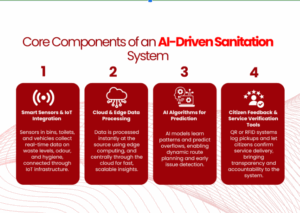
    Core Technologies That Power Smart Sanitation in Cities

    The development of a smart sanitation system begins with the knowledge of how various technologies converge to monitor, analyze, and react to conditions of waste in real time. Such systems are not isolated; they exist as an ecosystem.

    This is how the main pieces fit together:

    1. Smart Sensors and IoT Integration

    Sanitation systems depend on ultrasonic sensors, smell sensors, and environmental sensors placed in bins, toilets, and trucks. They monitor fill levels, gas release (such as ammonia or hydrogen sulfide), temperature, and humidity. Placed throughout a city once installed, they become the sensory layer, sensing the changes way before human inspections would.

    Each sensor is linked using Internet of Things (IoT) infrastructure, which permits the data to run continuously to a processing platform. Such sensors have been installed in more than 350 public toilets by cities like Indore to track hygiene in real-time.

    2. Cloud and Edge Data Processing

    Data must be acted upon as soon as it is captured. This is done with cloud-based analytics coupled with edge computing, which processes data close to the source. These layers enable data to be cleansed, structured, and organized in order to be understandably presented to AI. 

    This blend is capable of taking even high-volume, dispersed data from thousands of bins or collection vehicles and aggregating it with little latency and maximum availability.

    3. AI Algorithms for Prediction and Optimization

    This is the layer of intelligence. We develop machine learning models based on both historical and real-time data to understand at what times bins are likely to overflow, what areas will generate waste above the anticipated threshold, and how to reduce time and fuel in collection routes.

    In a recent research, the cities that adopted AI-driven route planning experienced over 28% decrease in collection time and over 13% reduction in costs against manual scheduling models.

    4. Citizen Feedback and Service Verification Tools

    Several systems also comprise QR code or RFID-based monitoring equipment that records every pickup and connects it to a particular home or stop. Residents can check if their bins were collected or report if they were not. Service accountability is enhanced, and governments have an instant service quality dashboard.

    Door-to-door waste collection in Ranchi, for instance, is now being tracked online, and contractors risk penalties for missed collections.

    These technologies operate optimally when combined, but as part of an integrated, AI-facilitated infrastructure. That’s what makes a sanitation setup a clever, dynamic city service.

    How Cities Are Already Using AI for Sanitation

    Many Indian cities are past pilot projects and, in effect, use it to rectify real, operational inefficiencies. 

    These examples indicate how AI is not simply a bag of data, but the data is being utilized for decision-making, problem-solving, and enhancing effectiveness on the ground.

    1. Real-Time Hygiene Monitoring

    Indore, one of India’s top-ranking cities under Swachh Bharat, has installed smart sensors in over 350 public toilets. These sensors monitor odour levels, air quality, water availability, and cleaning frequency.

    What is salient is not the sensors, but how the city is utilizing that data. Staff cleaning units, for example, get automated alerts when conditions fall below the city’s set thresholds (e.g., hours of rain), and instead of acting on expected days of service, they are doing services on need-derived data; used less water and improved experience.

    This is where AI plays its role, learning usage patterns over time and helping optimize cleaning cycles, even before complaints arise.

    2. Transparent Waste Collection

    Jharkhand has implemented QR-code and RFID-based tracking systems for doorstep waste collection. Every household pickup is electronically recorded, giving rise to a verifiable chain of service history.

    But AI kicks in when patterns start to set in. If specific routes have regularly skipped pickups, or if the frequency of collection falls below desired levels, the system can highlight irregularities and impose penalties on contractors.

    This type of transparency enables improved contract enforcement, resource planning, and public accountability, key issues in traditional sanitation systems.

    3. Fleet Optimization and Air Quality Goals

    In Lucknow, the municipal corporation introduced over 1,250 electric collection vehicles and AI-assisted route planning to reduce delays and emissions.

    While the shift to electric vehicles is visible, the invisible layer is where the real efficiency comes in. AI helps plan which routes need what types of vehicles, how to avoid congestion zones, and where to deploy sweepers more frequently based on dust levels and complaint data.

    The result? Cleaner streets, reduced PM pollution, and better air quality scores, all tracked and reported in near real-time.

    From public toilets to collection fleets, cities across India are using AI to respond faster, act smarter, and serve better, without adding manual burden to already stretched civic teams.

    Top Benefits of AI-Enabled Sanitation Systems for Urban Governments

    When sanitation systems start responding to real-time data, governments don’t just clean cities more efficiently; they run them more intelligently. AI brings visibility, speed, and structure to what has traditionally been a reactive and resource-heavy process.

    Here’s what that looks like in practice:

    • Faster issue detection and resolution – Know the problem before a citizen reports it, whether it’s an overflowing bin or an unclean public toilet.
    • Cost savings over manual operations – Reduce unnecessary trips, fuel use, and overstaffing through route and task optimization.
    • Improved public hygiene outcomes – Act on conditions before they create health risks, especially in dense or underserved areas.
    • Better air quality through cleaner operations – Combine electric fleets with optimized routing to reduce emissions in high-footfall zones.
    • Stronger Swachh Survekshan and ESG scores – Gain national recognition and attract infrastructure incentives by proving smart sanitation delivery.

    Conclusion

    Artificial intelligence is already revolutionizing the way urban sanitation is designed, delivered, and scaled. But for organizations developing these solutions, speed and flexibility are just as important as intelligence.

    Whether you are creating sanitation technology for city bodies or incorporating AI into your current civic services, SCSTech assists you in creating more intelligent systems that function in the field, in tune with municipal requirements, and deployable immediately. Reach out to us to see how we can assist with your next endeavor.

    FAQs

    1. How is AI different from traditional automation in sanitation systems?

    AI doesn’t just automate fixed tasks; it uses real-time data to learn patterns and predict needs. Unlike rule-based automation, AI can adapt to changing conditions, forecast bin overflows, and optimize operations dynamically, without needing manual reprogramming each time.

    2. Can small to mid-size city projects afford to have AI in sanitation?

    Yes. With scalable architecture and modular integration, AI-based sanitation solutions can be tailored to suit various project sizes. Most smart city vendors today use phased methods, beginning with the essential monitoring capabilities and adding full-fledged AI as budgets permit.

    3. What kind of data is needed to make an AI sanitation system work effectively?

    The system relies on real-time data from sensors, such as bin fill levels, odour detection, and GPS tracking of collection vehicles. Over time, this data helps the AI model identify usage patterns, optimize routes, and predict maintenance needs more accurately.

  • How to Audit Your Existing Tech Stack Before Starting a Digital Transformation Project

    How to Audit Your Existing Tech Stack Before Starting a Digital Transformation Project

    Before you begin any digital transformations, you need to see what you’ve got. Most teams are using dozens of tools throughout their departments, and for the most part, they are underutilized, do not connect with one another, or are not in alignment with the current objectives. 

    The tech stack audit is what helps you identify your tools, how they fit together, and where you have gaps or threats. If you haven’t done this process, even the best digital plans can wilt due to slowdowns, increased expenses, or breaches of security.

    This guide guides you step-by-step in how to do an audit of your stack properly, so your digital transformation starts from a good foundation, not with new software.

    What Is a Tech Stack Audit?

    A tech stack audit reviews all the software, platforms, and integrations being used in your business. It checks how well these components integrate, how well they execute, and how they align with your digital transformation goals.

    A fragmented or outdated stack can slow progress and increase risk. According to Struto, outdated or incompatible tools “can hinder performance, compromise security, and impede the ability to scale.”

    Poor data, redundant tools, and technical debt are common issues. Poor team morale and inefficiencies ensue, according to Brightdials, as stacks become unstructured or unmaintained.

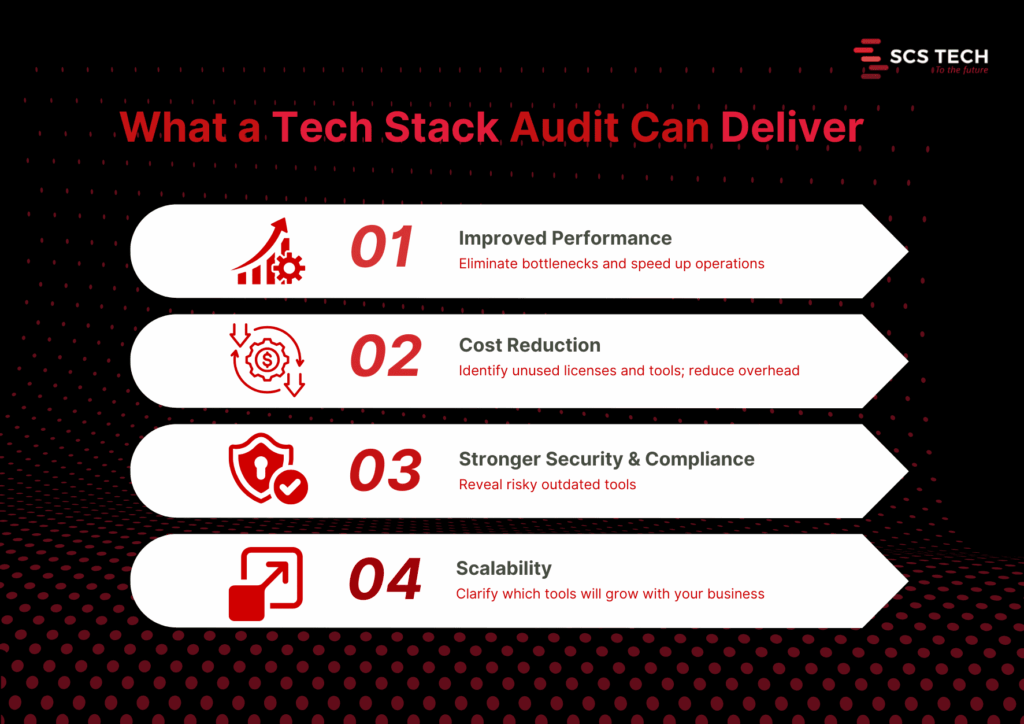
    Core benefits of a thorough audit

    1. Improved performance. Audits reveal system slowdowns and bottlenecks. Fixing them can lead to faster response times and higher user satisfaction. Streamlining outdated systems through tech digital solutions can unlock performance gains that weren’t previously possible.
    2. Cost reduction. You may discover unneeded licenses, redundant software, or shadow IT. One firm saved $20,000 annually after it discovered a few unused tools.
    3. Improved security and compliance. Auditing reveals stale or exposed pieces. It avoids compliance mistakes and reduces the attack surface.
    4. Better scalability and future-proofing. An audit shows what tools will be scalable with growth or need to be replaced before new needs drive them beyond their usefulness.

    Step-by-Step Process to Conduct a Tech Stack Audit

    It is only logical to understand what you already have and how well it is working before you begin any digital transformation program. The majority of organizations go in for new tools and platforms without checking their current systems properly. That leads to problems later on.

    A systematic tech stack review makes sense. It will inform you about what to keep, what to phase out, and what to upgrade. More importantly, it ensures your transformation isn’t based on outdated, replicated, or fragmented systems.

    The following is the step-by-step approach we suggest, in the way that we assist teams in getting ready for effective, low-risk digital transformation.

    Step 1: Create a Complete Inventory of Your Tech Stack

    Start by listing every tool, platform, and integration your organization currently uses. This includes everything from your core infrastructure (servers, databases, CRMs, ERPs) to communication tools, collaboration apps, third-party integrations, and internal utilities developed in-house.

    And it needs to be complete, not skimpy.

    Go by department or function. So:

    • Marketing may be employing an email automation tool, a customer data platform, social scheduling apps, and analytics dashboards.
    • Sales can have CRM, proposal tools, contract administration, and billing integration.
    • Operations can have inventory platforms, scheduling tools, and reporting tools.
    • IT will deal with infrastructure, security, endpoint management, identity access, and monitoring tools.

    Also account for:

    • Licensing details: Is the tool actively paid for or in trial phase?
    • Usage level: Is the team using it daily, occasionally, or not at all?
    • Ownership: Who’s responsible for managing the tool internally?
    • Integration points: Does this tool connect with other systems or stand alone?

    Be careful to include tools that are rarely talked about, like those used by one specific team, or tools procured by individual managers outside of central IT (also known as shadow IT).

    A good inventory gives you visibility. Without it, you will probably go about attempting to modernize against tools that you didn’t know were still running or lose the opportunity to consolidate where it makes sense.

    We recommend keeping this inventory in a shared spreadsheet or software auditing tool. Keep it up to date with all stakeholders before progressing to the next stage of the audit. This is often where a digital transformation consultancy can provide a clear-eyed perspective and structured direction.

    Step 2: Evaluate Usage, Cost, and ROI of Each Tool

    Having now made a list of all tools, the next thing is to evaluate if each one is worth retaining. This involves evaluating three things: how much it is being used, its cost, and what real value it provides.

    Start with usage. Talk to the teams who are using each one. Is it part of their regular workflow? Do they use one specific feature or the whole thing? If adoption is low or spotty, it’s a flag to go deeper. Teams tend to stick with a tool just because they know it, more than because it’s the best option.

    Then consider the price. That is the direct cost, such as subscription, license, and renewal. But don’t leave it at that. Add concealed costs: support, training, and the time wasted on troubleshooting. Two resources might have equal initial costs, but the resource that delays or requires constant aid has a higher cost.

    Last but not least, emphasize ROI. This is usually the neglected section. A tool might be used extensively and cheaply, yet it does not automatically mean it performs well. Ask:

    • Does it help your team accomplish objectives faster?
    • Has efficiency or manual labor improved?
    • Has an impact been made that can be measured, e.g., faster onboarding, better customer response time, or cleaner data?

    You don’t need complex math for this—just simple answers. If a tool is costing more than it returns or if a better alternative exists, it must be tagged for replacement, consolidation, or elimination.

    A digital transformation consultant can help you assess ROI with fresh objectivity and prevent emotional attachment from skewing decisions. This ensures that your transformation starts with tools that make progress and not just occupy budget space.

    Step 3: Map Data Flow and System Integrations

    Start by charting how data moves through your systems. How does it begin? Where does it go next? What devices send or receive data, and in what format? This is to pull out the form behind your operations, customer journey, reporting, collaboration, automation, etc.

    Break it up by function:

    • Is your CRM feeding back to your email system?
    • Is your ERP pumping data into inventory or logistics software?
    • How is data from customer support synced with billing or account teams?

    Map these flows visually or in a shared document. List each tool, the data it shares, where it goes, and how (manual export, API, middleware, webhook, etc.).

    While doing this, ask the following:

    • Are there any manual handoffs that slow things down or increase errors?
    • Do any of your tools depend on redundant data entry?
    • Are there any places where data needs to flow but does not?
    • Are your APIs solid, or are they perpetually patch-pending to keep working?

    This step tends to reveal some underlying problems. For instance, a tool might seem valuable when viewed in a vacuum but fails to integrate properly with the remainder of your stack, slowing teams down or building data silos.

    You’ll also likely find tools doing similar jobs in parallel, but not communicating. In those cases, either consolidate them or build better integration paths.

    The point here isn’t merely to view your tech stack; it’s to view how integrated it is. Uncluttered, reliable data flows are one of the best indications that your company is transformation-ready.

    Step 4: Identify Redundancies, Risks, and Outdated Systems

    With your tools and data flow mapped out, look at what is stopping you.

    • Start with redundancies. Do you have more than one tool to fix the same problem? If two systems are processing customer data or reporting, check to see if both are needed or if it is just a relic of an old process.
    • Scan for threats second. Tools that are outdated or tools that are no longer supported by their vendors can leave vulnerabilities. So can systems that use manual operations to function. When a tool fails and there is no defined failover, it’s a threat.
    • Then, assess for outdated systems. These are platforms that don’t integrate well, slow down teams, or can’t scale with your growth plans. Sometimes, you’ll find legacy tools still in use just because they haven’t been replaced, yet they cost more time and money to maintain.

    All of these duplicative, risky, or outdated, demands a decision: sunset it, replace it, or redefine its use. It is done now to avoid complexity in future transformation.

    Step 5: Prioritize Tools to Keep, Replace, or Retire

    With your results from the audit in front of you, sort each tool into three boxes:

    • Keep: In current use, fits well, aids current and future goals.
    • Misaligned, too narrow in scope, or outrun by better alternatives.
    • Retire: Redundant, unused, or imposes unnecessary cost or risk.

    Make decisions based on usage, ROI, integration, and team input. The simplicity of this method will allow you to build a lean, focused stack to power digital transformation without bringing legacy baggage into the future. Choosing the right tech digital solutions ensures your modernization plan aligns with both technical capability and long-term growth.

    Step 6: Build an Action Plan for Tech Stack Modernization

    Use your audit findings to give clear direction. Enumerate what must be implemented, replaced, or phased out with responsibility, timeline, and cost.

    Split it into short- and long-term considerations.

    • Short-term: purge unused tools, eliminate security vulnerabilities, and build useful integrations.
    • Long-term: timeline for new platforms, large migrations, or re-architected markets.

    This is often the phase where a digital transformation consultant can clarify priorities and keep execution grounded in ROI.

    Make sure all stakeholders are aligned by sharing the plan, assigning the work, and tracking progress. This step will turn your audit into a real upgrade roadmap ready to drive your digital transformation.

    Step 7: Set Up a Recurring Tech Stack Audit Process

    An initial audit is useful, but it’s not enough. Your tools will change. Your needs will too.

    Creating a recurring schedule to examine your stack every 6 or 12 months is suitable for most teams. Use the same checklist: usage, cost, integration, performance, and alignment with business goals.

    Make someone in charge of it. Whether it is IT, operations, or a cross-functional lead, consistency is the key.

    This allows you to catch issues sooner, and waste less, while always being prepared for future change, even if it’s not the change you’re currently designing for.

    Conclusion

    A digital transformation project can’t succeed if it’s built on top of disconnected, outdated, or unnecessary systems. That’s why a tech stack audit isn’t a nice-to-have; it’s the starting point. It helps you see what’s working, what’s getting in the way, and what needs to change before you move forward.

    Many companies turn to digital transformation consultancy at this stage to validate their findings and guide the next steps.

    By following a structured audit process, inventorying tools, evaluating usage, mapping data flows, and identifying gaps, you give your team a clear foundation for smarter decisions and smoother execution.

    If you need help assessing your current stack, a digital transformation consultant from SCSTech can guide you through a modernization plan. We work with companies to align technology with real business needs, so tools don’t just sit in your stack; they deliver measurable value. With SCSTech’s expertise in tech digital solutions, your systems evolve into assets that drive efficiency, not just cost.

  • Choosing Between MDR vs. EDR: What Fits Your Security Maturity Level?

    Choosing Between MDR vs. EDR: What Fits Your Security Maturity Level?

    If you’re weighing MDR versus EDR, you probably know what each provides, but deciding between the two isn’t always easy. The actual challenge is determining which one suits your security maturity, internal capabilities, and response readiness. 

    Some organizations already have analysts, 24×7 coverage, and SIEM tools, so EDR could play well there. Others are spread thin, suffering from alert fatigue or gaps in threat response; that’s where MDR is more appropriate.

    This guide takes you through that decision step by step, so you can match the correct solution with how your team actually functions today.

    Core Differences Between MDR and EDR

    Both MDR and EDR enhance your cybersecurity stance, but they address different requirements based on the maturity and resources of your organization. They represent two levels of cybersecurity services, offering either internal control or outsourced expertise, depending on your organization’s readiness.

    EDR offers endpoints for continuous monitoring, alerting on suspicious behavior. It gives your team access to rich forensic data, but your security staff must triage alerts and take action.

    MDR includes all EDR functions and adds a managed service layer. A dedicated security team handles alert monitoring, threat hunting, and incident response around the clock.

    Here’s a clear comparison:

    Feature  EDR  MDR 
    Core Offering Endpoint monitoring & telemetry EDR platform + SOC-led threat detection & response
    Internal Skill Needed High analysts, triage, and response Low–Moderate oversight, not 24×7 operational burden
    Coverage Endpoint devices Endpoints and often network/cloud visibility
    Alert Handling Internal triage and escalation Provider triages and escalates confirmed threats
    Response Execution Manual or semi-automated Guided or remote hands-on response by experts
    Cost Approach Licensing + staffing Subscription service with bundled expertise


    Security Maturity and Internal Capabilities

    Before choosing EDR or MDR, assess your organization’s security maturity, your team’s resources, expertise, and operational readiness.

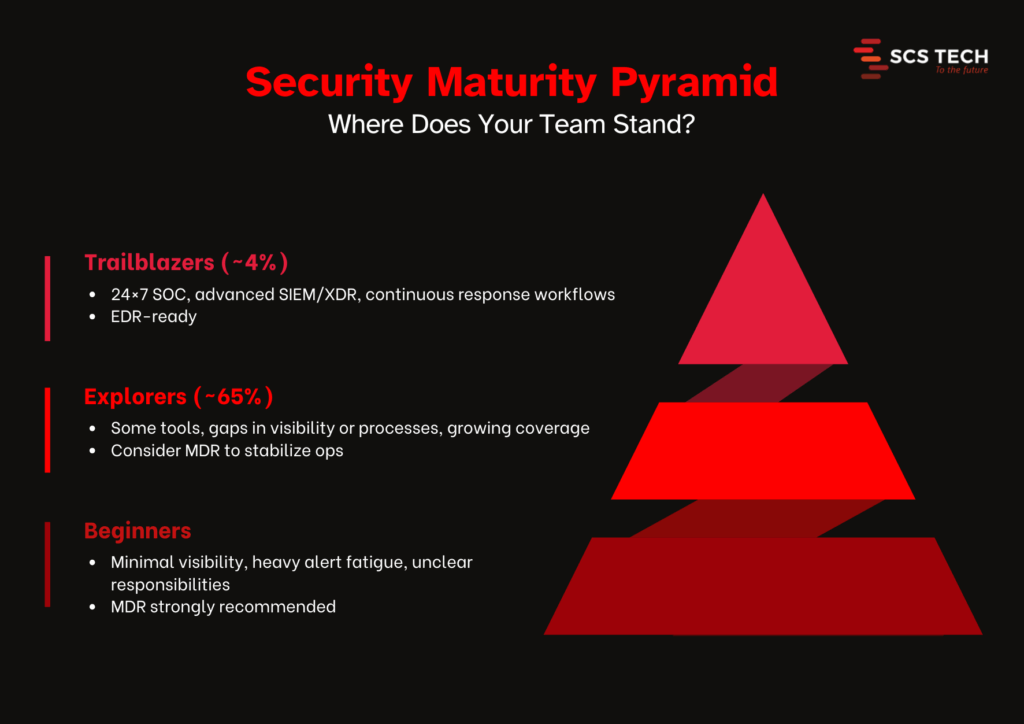
    Security Maturity Pyramid

    How Mature Is Your Security Program?

    A recent Kroll study reveals that 91% of companies overestimate their detection-and-response maturity, but only 4% are genuinely “Trailblazers” in capability. Most fall into the “Explorer” category, awareness exists, but full implementation lags behind.  

    That’s where cybersecurity consulting adds value, bridging the gap between awareness and execution through tailored assessments and roadmaps.

    Organizations with high maturity (“Trailblazers”) experience 30% fewer major security incidents, compared to lower-tier peers, highlighting the pay-off of well-executed cyber defenses

    When EDR Is a Better Fit

    EDR suits organizations that already have a capable internal security team and tools and can manage alerts and responses themselves:

    According to Trellix, 84% of critical infrastructure organizations have adopted EDR or XDR, but only 35% have fully deployed capabilities, leaving room for internal teams to enhance operations

    EDR is appropriate when you have a scalable IT security service in place that supports endpoint monitoring and incident resolution internally. 

    • 24×7 analyst coverage or strong on-call SOC support
    • SIEM/XDR systems and internal threat handling processes
    • The capacity to investigate and respond to alerts continuously

    An experienced SOC analyst put it this way:

    “It kills me when… low‑risk computers don’t have EDR … those blindspots let ransomware spread.”

    EDR delivers strong endpoint visibility, but its value depends on skilled staff to translate alerts into action.

    When MDR Is a Better Fit

    MDR is recommended when internal security capabilities are limited or stretched:

    • Integrity360 reports a global cybersecurity skills shortage of 3.1 million, with 60% of organizations struggling to hire or retain talent.
    • A WatchGuard survey found that only 27% of organizations have the resources, processes, and technology to handle 24×7 security operations on their own.
    • MDR adoption is rising fast: Gartner forecasts that 50% of enterprises will be using MDR by 2025.

    As demand for managed cybersecurity services increases, MDR is becoming essential for teams looking to scale quickly without increasing internal overhead.

    MDR makes sense if:

    • You lack overnight coverage or experienced analysts
    • You face frequent alert fatigue or overwhelming logs
    • You want SOC-grade threat hunting and guided incident response
    • You need expert support to accelerate maturity

    Choose EDR if you have capable in-house staff, SIEM/XDR tools, and the ability to manage alerts end-to-end. Choose MDR if your internal team lacks 24×7 support and specialist skills, or if you want expert-driven threat handling to boost maturity.

    MDR vs. EDR by Organization Type

    Not every business faces the same security challenges or has the same capacity to deal with them. What works for a fast-growing startup may not suit a regulated financial firm. That’s why choosing between EDR and MDR isn’t just about product features; it depends on your size, structure, and the way you run security today.

    Here’s how different types of organizations typically align with these two approaches.

    1. Small Businesses & Startups

    • EDR fit? Often challenging. Many small teams lack 24×7 security staff and deep threat analysis capabilities. Managing alerts can overwhelm internal resources.
    • MDR fit? Far better match. According to Integrity360, 60% of organizations struggle to retain cybersecurity talent, something small businesses feel intensely. MDR offers affordable access to SOC-grade expertise without overwhelming internal teams.

    2. Mid-Sized Organizations

    • EDR fit? Viable for those with a small IT/Security team (1–3 analysts). Many mid-size firms use SIEM and EDR to build internal detection capabilities. More maturity here means lower reliance on external services.
    • MDR fit? Still valuable. Gartner projects that 50% of enterprises will use MDR by 2025, indicating that even mature mid-size companies rely on it to strengthen SOC coverage and reduce alert fatigue.

    Many also use cybersecurity consulting services during transition phases to audit gaps before fully investing in internal tools or MDR contracts.

    3. Large Enterprises & Regulated Industries

    • EDR fit? Solid choice. Enterprises with in-house SOC, SIEM, and XDR solutions benefit from direct control over endpoints. They can respond to threats internally and integrate EDR into broader defense strategies.
    • MDR fit? Often used as a complementary service. External threat hunting and 24×7 monitoring help bridge coverage gaps without replacing internal teams.

    4. High-Risk Sectors (Healthcare, Finance, Manufacturing)

    • EDR fit? Offered compliance and detection coverage, but institutions report resource and skill constraints, and 84% of critical infrastructure organizations report partial or incomplete adoption.
    • MDR fit? Ideal for the following reasons:
      • Compliance: MDR providers usually provide support for standards such as HIPAA, PCI-DSS, and SOX.
      • Threat intelligence: Service providers consolidate knowledge from various sectors.
      • 24×7 coverage: Constant monitoring is very important for industries with high-value or sensitive information.

    In these sectors, having a layered IT security service becomes non-negotiable to meet compliance, visibility, and response needs effectively.

    Final Take: MDR vs. EDR

    Choosing between EDR and MDR should be made based on how ready your organization is to detect and respond to threats using internal resources.

    • EDR works if you have an expert security team that can address alerts and investigations in-house.
    • MDR is more appropriate if your team requires assistance with monitoring, analysis, and response to incidents.

    SCS Tech provides both advanced IT security service offerings and strategic guidance to align your cybersecurity technology with real-time operational capability. If you have the skills and coverage within your team, we offer sophisticated EDR technology that can be integrated into your current processes. If you require extra assistance, our MDR solution unites software and managed response to minimize risk without creating operational overhead.

    Whether your team needs endpoint tools or full-service cybersecurity services, the decision should align with your real-time capabilities, not assumptions. If you’re not sure where to go, SCS Tech is there to evaluate your existing configuration and suggest a solution suitable for your security maturity and resource levels. 

  • What an IT Consultant Actually Does During a Major Systems Migration

    What an IT Consultant Actually Does During a Major Systems Migration

    System migrations don’t fail because the tools were wrong. They fail when planning gaps go unnoticed, and operational details get overlooked. That’s where most of the risk lies, not in execution, but in the lack of structure leading up to it.

    If you’re working on a major system migration, you already know what’s at stake: missed deadlines, broken integrations, user downtime, and unexpected costs. What’s often unclear is what an IT consultant actually does to prevent those outcomes.

    This article breaks that down. It shows you what a skilled consultant handles before, during, and after migration, not just the technical steps, but how the entire process is scoped, sequenced, and stabilized. An experienced IT consulting firm brings that orchestration by offering more than technical support; it provides migration governance end-to-end.

    What a Systems Migration Actually Involves

    System migration is not simply relocating data from a source environment to a target environment. It is a multi-layered process with implications on infrastructure, applications, workflows, and in most scenarios, how entire teams function once migrated.

    System migration is fundamentally a process of replacing or upgrading the infrastructure of an organization’s digital environment. It may be migrating from legacy to contemporary systems, relocating workloads to the cloud, or combining several environments into one. Whatever the size, however, the process is not usually simple.

    Why? Because errors at this stage are expensive.

    • According to Bloor Research, 80% of ERP projects run into data migration issues.
    • Planning gaps often lead to overruns. Projects can exceed budgets by up to 30% and delay timelines by up to 41%.
    • In more severe cases, downtime during migration costs range from $137 to $9,000 per minute, depending on company size and system scale.

    That’s why companies do not merely require a service provider. They need an experienced IT consultancy that can translate technical migration into strategic, business-aligned decisions from the outset.

    A complete system migration will involve:

    “6 Key Phases of a System Migration”

    Key Phases of a System Migration

    • System audit and discovery — Determining what is being used, what is redundant, and what requires an upgrade.
    • Data mapping and validation — Satisfying that key data already exists, needs to be cleaned up, and is ready to be transferred without loss or corruption.
    • Infrastructure planning — Aligning the new systems against business objectives, user load, regulatory requirements, and performance requirements.
    • Application and integration alignment — Ensuring that current tools and processes are accommodated or modified for the new configuration.
    • Testing and rollback strategies — Minimizing service interruption by testing everything within controlled environments.
    • Cutover and support — Handling go-live transitions, reducing downtime, and having post-migration support available.

    Each of these stages carries its own risks. Without clarity, preparation, and skilled handling, even minor errors in the early phase can multiply into budget overruns, user disruption, or worse, permanent data loss.

    The Critical Role of an IT Consultant: Step by Step

    When system migration is on the cards, technical configuration isn’t everything. How the project is framed, monitored, and managed is what typically determines success.

    At SCS Tech, we own up to making that framework explicit from the beginning. We’re not just executioners. We remain clear through planning, coordination, testing, and transition, so the migration can proceed with reduced risk and improved decisions.

    Here, we’ve outlined how we work on large migrations, what we do, and why it’s important at every stage.

    Pre-Migration Assessment

    Prior to making any decisions, we first figure out what the world is like today. This is not a technical exercise. How systems are presently configured, where data resides, and how it transfers between tools, all of this has a direct impact on how a migration needs to be planned.

    We treat the pre-migration assessment as a diagnostic step. The goal is to uncover potential risks early, so we don’t run into them later during cutover or integration. We also use this stage to help our clients get internal clarity. That means identifying what’s critical, what’s outdated, and where the most dependency or downtime sensitivity exists.

    Here’s how we run this assessment in real projects:

    • First, we conduct a technical inventory. We list all current systems, how they’re connected, who owns them, and how they support your business processes. This step prevents surprises later. 
    • Next, we evaluate data readiness. We profile and validate sample datasets to check for accuracy, redundancy, and structure. Without clean data, downstream processes break. Industry research shows projects regularly go 30–41% over time or budget, partly due to poor data handling, and downtime can cost $137 to $9,000 per minute, depending on scale.
    • We also engage stakeholders early: IT, finance, and operations. Their insights help us identify critical systems and pain points that standard tools might miss. A capable IT consulting firm ensures these operational nuances are captured early, avoiding assumptions that often derail the migration later.

    By handling these details up front, we significantly reduce the risk of migration failure and build a clear roadmap for what comes next.

    Migration Planning

    Once the assessment is done, we shift focus to planning how the migration will actually happen. This is where strategy takes shape, not just in terms of timelines and tools, but in how we reduce risk while moving forward with confidence.

    1. Mapping Technical and Operational Dependencies

    Before we move anything, we need to know how systems interact, not just technically, but operationally. A database may connect cleanly to an application on paper, but in practice, it may serve multiple departments with different workflows. We review integration points, batch jobs, user schedules, and interlinked APIs to avoid breakage during cutover.

    Skipping this step is where most silent failures begin. Even if the migration seems successful, missing a hidden dependency can cause failures days or weeks later.

    2. Defining Clear Rollback Paths

    Every migration plan we create includes defined rollback procedures. This means if something doesn’t work as expected, we can restore the original state without creating downtime or data loss. The rollback approach depends on the architecture; sometimes it’s snapshot-based, and sometimes it involves temporary parallel systems.

    We also validate rollback logic during test runs, not after failure. This way, we’re not improvising under pressure.

    3. Choosing the Right Migration Method

    There are typically two approaches here:

    • Big bang: Moving everything at once. This works best when dependencies are minimal and downtime can be tightly controlled.
    • Phased: Moving parts of the system over time. This is better for complex setups where continuity is critical.

    We don’t make this decision in isolation. Our specialized IT consultancy team helps navigate these trade-offs more effectively by aligning the migration model with your operational exposure and tolerance for risk.

    Toolchain & Architecture Decisions

    Choosing the right tools and architecture shapes how smoothly the migration proceeds. We focus on precise, proven decisions, aligned with your systems and business needs.

    We assess your environment and recommend tools that reduce manual effort and risk. For server and VM migrations, options like Azure Migrate, AWS Migration Hub, or Carbonite Migrate are top choices. According to Cloudficient, using structured tools like these can cut manual work by around 40%. For database migrations, services like AWS DMS or Google Database Migration Service automate schema conversion and ensure consistency.

    We examine if your workloads integrate with cloud-native services, such as Azure Functions, AWS Lambda, RDS, or serverless platforms. Efficiency gain makes a difference in the post-migration phase, not just during the move itself.

    Unlike a generic vendor, a focused IT consulting firm selects tools based on system dynamics, not just brand familiarity or platform loyalty.

    Risk Mitigation & Failover Planning

    Every migration has risks. It’s our job at SCS Tech to reduce them from the start and embed safeguards upfront.

    • We begin by listing possible failure points, data corruption, system outages, and performance issues, and rate them by impact and likelihood. This structured risk identification is a core part of any mature information technology consulting engagement, ensuring real-world problems are anticipated, not theorized.
    • We set up backups, snapshots, or parallel environments based on business needs. Blusonic recommends pre-migration backups as essential for safe transitions. SCSTech configures failover systems for critical applications so we can restore service rapidly in case of errors.

    Team Coordination & Knowledge Transfer

    Teams across IT, operations, finance, and end users must stay aligned. 

    • We set a coordinated communication plan that covers status updates, cutover scheduling, and incident escalation.
    • We develop clear runbooks that define who does what during migration day. This removes ambiguity and stops “who’s responsible?” questions in the critical hours.
    • We set up shadow sessions so your team can observe cutover tasks firsthand, whether it’s data validation, DNS handoff, or system restart. This builds confidence and skills, avoiding post-migration dependency on external consultants.
    • After cutover, we schedule workshops covering:
    • System architecture changes
    • New platform controls and best practices
    • Troubleshooting guides and escalation paths

    These post-cutover workshops are one of the ways information technology consulting ensures your internal teams aren’t left with knowledge gaps after going live. By documenting these with your IT teams, we ensure knowledge is embedded before we step back.

    Testing & Post-Migration Stabilization

    A migration isn’t complete when systems go live. Stabilizing and validating the environment ensures everything functions as intended.

    • We test system performance under real-world conditions. Simulated workloads reveal bottlenecks that weren’t visible during planning.
    • We activate monitoring tools like Azure Monitor or AWS CloudWatch to track critical metrics, CPU, I/O, latency, and error rates. Initial stabilization typically takes 1–2 weeks, during which we calibrate thresholds and tune alerts.

    After stabilization, we conduct a review session. We check whether objectives, such as performance benchmarks, uptime goals, and cost limits, were met. We also recommend small-scale optimizations.

    Conclusion

    A successful migration of the system relies less on the tools and more on the way the process is designed upfront. Bad planning, lost dependencies, and poorly defined handoffs are what lead to overruns, downtime, and long-term disruption.

    It’s for this reason that the work of an IT consultant extends beyond execution. It entails converting technical complexity into simple decisions, unifying teams, and constructing the mitigations that ensure the migration remains stable at each point.

    This is what we do at SCS Tech. Our proactive IT consultancy doesn’t just react to migration problems; it preempts them with structured processes, stakeholder clarity, and tested fail-safes.

    We assist organizations through each stage from evaluation and design to testing and after-migration stabilization, without unnecessary overhead. Our process is based on system-level thinking and field-proven procedures that minimize risk, enhance clarity, and maintain operations while changes occur unobtrusively in the background.

    SCS Tech offers expert information technology consulting to scope the best approach, depending on your systems, timelines, and operational priorities.

  • LiDAR vs Photogrammetry: Which One Is Right for Your GIS Deployment?

    LiDAR vs Photogrammetry: Which One Is Right for Your GIS Deployment?

    Both LiDAR and photogrammetry offer the accuracy of spatial data, yet that doesn’t simplify the choice. They fulfill the same function in GIS implementations but do so with drastically different technologies, expenses, and conditions in the field. LiDAR provides laser accuracy, as well as canopy penetration; photogrammetry provides high-resolution visuals, as well as velocity. However, selecting one without knowing where it will succeed or fail means the investment is wasted or the data is compromised.

    Choosing the right technology also directly impacts the success of your GIS services, especially when projects are sensitive to terrain, cost, or delivery timelines.

    This article compares them head-to-head across real-world factors: mapping accuracy, terrain adaptability, processing time, deployment requirements, and cost. You’ll see where one outperforms the other and where a hybrid approach might be smarter.

    LiDAR vs Photogrammetry: Key Differences

    LiDAR and photogrammetry are two of GIS’s most popular techniques for gathering spatial data. Both are intended to record real-world environments but do so in dramatically different manners.

    LiDAR (Light Detection and Ranging) employs laser pulses to estimate distances between a sensor and targets on the terrain. These pulses bounce back towards the sensor to form accurate 3D point clouds. It is functional in many light environments and can even scan through vegetation to map the ground.

    Photogrammetry, however, utilizes overlapping photographs taken from cameras, usually placed on drones or airplanes. These photos are then computer-processed to construct the shape and location of objects in 3D space. It is greatly dependent on favorable lighting and open visibility to produce good results.

    Both methods are supportive of GIS mapping, although one might be more beneficial than the other based on project needs. Here’s where they vary in terms of principal differences:

    • Accuracy in GIS Mapping
    • Terrain Suitability & Environmental Conditions
    • Data Processing & Workflow Integration
    • Hardware & Field Deployment
    • Cost Implications

    Accuracy in GIS Mapping

    When your GIS implementation is contingent upon accurate elevation and surface information, applications such as flood modeling, slope analysis, or infrastructure planning, the quality of your data collection means the project makes it or breaks it.

    LiDAR delivers strong vertical accuracy thanks to laser pulse measurements. Typical airborne LiDAR surveys achieve vertical RMSE (Root Mean Square Error) between 5–15 cm, and in many cases under 10 cm, across various terrain types. Urban or infrastructure-focused LiDAR (like mobile mapping) can even get vertical RMSE down to around 1.5 cm.

    Photogrammetry, on the other hand, provides less accurate vertical accuracy. Generally, most good-quality drone photogrammetry is able to produce around 10–50 cm RMSE in height, although horizontal accuracy is usually 1–3 cm. Tighter vertical accuracy is more difficult to achieve and requires more ground control points, improved image overlap, and good lighting, all require more money and time.

    For instance, an infrastructure corridor that must be accurately elevated to plan drainage may be compromised by photogrammetry alone. A LiDAR survey would be sure to collect the small gradients required for good water flow or grading design, however.

    • Use LiDAR when vertical accuracy is critical, for elevation modeling, flood risk areas, or engineering requirements.
    • Use photogrammetry for horizontal mapping or visual base layers where small elevation errors are acceptable and the cost is a constraint.

    These distinctions are particularly relevant when planning GIS in India, where both urban infrastructure and rural landscapes present diverse elevation and surface data challenges.

    Terrain Suitability & Environmental Conditions

    Choosing between LiDAR and photogrammetry often comes down to the terrain and environmental conditions where you’re collecting data. Each method responds differently based on vegetation, land type, and lighting.

    LiDAR performs well in vegetated and complex situations. Its laser pulses penetrate the thick canopy and produce reliable ground models even with heavy cover. For instance, LiDAR has been found to be trustworthy where there are forest canopies of 30 meters, and it keeps its vertical accuracy within 10–15 cm as opposed to photogrammetry, which usually cannot trace the ground surface under heavy vegetation.

    Photogrammetry excels in flat, open, and well-illuminated conditions. It relies on unobstructed lines of sight and substantial lighting. In open spaces such as fields or urban areas devoid of tree cover, it produces high-resolution images and good horizontal positioning, usually 1–3 cm horizontal accuracy, although vertical accuracy deteriorates to 10–20 cm in uneven terrain or light. 

    Environmental resilience also varies:

    • Lighting and weather: LiDAR is largely unaffected by lighting conditions and can operate at night or under overcast skies. In contrast, photogrammetry requires daylight and consistent lighting to avoid shadows and glare affecting model quality.
    • Terrain complexity: Rugged terrain featuring slopes, cliffs, or mixed surfaces can unduly impact photogrammetry, which relies on visual triangulation. LiDAR’s active sensing covers complex landforms more reliably.

    “LiDAR is particularly strong in dense forest or hilly terrain, like cliffs or steep slopes”.

    Choosing Based on Terrain

    • Heavy vegetation/forests – LiDAR is the obvious choice for accurate ground modeling.
    • Flat, open land with excellent lighting – Photogrammetry is cheap and reliable.
    • Mixed terrain (e.g., farmland with woodland margins) – A hybrid strategy or LiDAR is the safer option.

    In regions like the Western Ghats or Himalayan foothills, GIS services frequently rely on LiDAR to penetrate thick forest cover and ensure accurate ground elevation data.

    Data Processing & Workflow Integration

    LiDAR creates point clouds that require heavy processing. Raw LiDAR data can be hundreds of millions of points per flight. Processing includes noise filtering out, classifying ground vs non-ground returns, and developing surface models such as DEMs and DSMs.

    This usually needs to be done using dedicated software such as LAStools or TerraScan and trained operators. High-volume projects may take weeks to days to process completely, particularly if classification is done manually. With current LiDAR processors that have AI-based classification, processing time can be minimized by up to 50% without a reduction in quality.

    Photogrammetry pipelines revolve around merging overlapping images into 3D models. Tools such as Pix4D or Agisoft Metashape automatically align hundreds of images to create dense point clouds and meshes. Automation is an attractive benefit for companies offering GIS services, allowing them to scale operations without compromising data quality.

    The processing stream is heavy, but very automated. However, image quality is a function of image resolution and overlap. A medium-sized survey might be processed within a few hours on an advanced workstation, compared to a few days with LiDAR. Yet for large sites, photogrammetry can involve more manual cleanup, particularly around shaded or homogeneous surfaces.

    • Choose LiDAR when your team can handle heavy processing demands and needs fully classified ground surfaces for advanced GIS analysis.
    • Choose photogrammetry if you value faster setup, quicker processing, and your project can tolerate some manual data cleanup or has strong GCP support.

    Hardware & Field Deployment

    Field deployment brings different demands. The right hardware ensures smooth and reliable data capture. Here’s how LiDAR and photogrammetry compare on that front.

    LiDAR Deployment

    LiDAR requires both high-capacity drones and specialized sensors. For example, the DJI Zenmuse L2, used with the Matrice 300 RTK or 350 RTK drones, weighs about 1.2 kg and delivers ±4 cm vertical accuracy, scanning up to 240k points per second and penetrating dense canopy effectively. Other sensors, like the Teledyne EchoOne, offer 1.5 cm vertical accuracy from around 120 m altitude on mid-size UAVs.

    These LiDAR-capable drones often weigh over 6 kg without payloads (e.g., Matrice 350 RTK) and can fly for 30–55 minutes, depending on payload weight.

    So, LiDAR deployment requires investment in heavier UAVs, larger batteries, and payload-ready platforms. Setup demands trained crews to calibrate IMUs, GNSS/RTK systems, and sensor mounts. Teams offering GIS consulting often help clients assess which hardware platform suits their project goals, especially when balancing drone specs with terrain complexity.

    Photogrammetry Deployment

    Photogrammetry favors lighter drones and high-resolution cameras. Systems like the DJI Matrice 300 equipped with a 45 MP Zenmuse P1 can achieve 3 cm horizontal and 5 cm vertical accuracy, and map 3 km² in one flight (~55 minutes).

    Success with camera-based systems relies on:

    • Mechanical shutters to avoid image distortion
    • Proper overlaps (80–90%) and stable flight paths 
    • Ground control points (1 per 5–10 acres) using RTK GNSS for centimeter-level geo accuracy

    Most medium-sized surveys run on 32–64 GB RAM workstations with qualified GPUs.

    Deployment Comparison at a Glance


    Aspect  LiDAR Photogrammetry 
    Drone requirements ≥6 kg payload, long battery life 3–6 kg, standard mapping drones
    Sensor setup Laser scanner, IMU/GNSS, calibration needed High-resolution camera, mechanical shutter, GCPs/RTK
    Flight time impact Payload reduces endurance ~20–30% Similar reduction; camera weight less critical
    Crew expertise required High—sensor alignment, real-time monitoring Moderate — flight planning, image quality checks
    Processing infrastructure High-end PC, parallel LiDAR tools 32–128 GB RAM, GPU-enabled for photogrammetry


    LiDAR demands stronger UAV platforms, complex sensor calibration, and heavier payloads, but delivers highly accurate ground models even under foliage.

    Photogrammetry is more accessible, using standard mapping drones and high-resolution cameras. However, it requires careful flight planning, GCP setup, and capable processing hardware.

    Cost Implications

    LiDAR requires a greater initial investment. A full LiDAR system, which comprises a laser scanner, an IMU, a GNSS, and a compatible UAV aircraft, can range from $90,000 to $350,000. Advanced models such as the DJI Zenmuse L2, combined with a Matrice 300 or 350 RTK aircraft, are common in survey-grade undertakings.

    If you’re not buying in bulk, LiDAR data collection services typically begin at about $300 an hour and go higher than $1,000 based on the type of terrain and resolution needed.

    Photogrammetry tools are considerably more affordable. An example is a $2,000 to $20,000 high-resolution drone with a mechanical shutter camera. In most business applications, photogrammetry services are charged at $150-$500 per hour, which makes it a viable alternative for repeat or cost-conscious mapping projects.

    In short, LiDAR costs more to deploy but may save time and manual effort downstream. Photogrammetry is cheaper upfront but demands more fieldwork and careful processing. Your choice depends on the long-term cost of error versus the up-front budget you’re working with.

    A well-executed GIS consulting engagement often clarifies these trade-offs early, helping stakeholders avoid costly over-investment or underperformance.

    Final Take: LiDAR vs Photogrammetry for GIS

    A decision between LiDAR and photogrammetry isn’t so much about specs. It’s about understanding which one fits with your site conditions, data requirements, and the results your project relies on.

    Both are strong suits. LiDAR provides you with improved results on uneven ground, heavy vegetation, and high-precision operations. Photogrammetry provides lean operation when you require rapid, broad sweeps in open spaces. But the true potential lies in combining them, with one complementing the other where it is needed.

    If you’re unsure which direction to take, a focused GIS consulting session with SCSTech can save weeks of rework and ensure your spatial data acquisition is aligned with project outcomes. Whether you’re working on smart city development or agricultural mapping, selecting the right remote sensing method is crucial for scalable GIS projects in India.

    We don’t just provide LiDAR or photogrammetry; our GIS services are tailored to deliver the right solution for your project’s scale and complexity.

    Consult with SCSTech to get a clear, technical answer on what fits your project, before you invest more time or budget in the wrong direction.